ICD-10 Code S82.242H: Displaced spiral tibial shaft fracture, delayed healing
ICD-10 Code S82.242H: Definition and code details ICD-10 Code S82.242H designate...

Last Updated: Oct 15, 2026
Billable Code Specific Code
V49.29XS is the billable ICD-10-CM code for unspecified car occupant injured in collision with other motor vehicles in nontraffic accident, sequela.
The S suffix applies only when the visit treats the late effect, once the original injury has resolved. Using S in place of D, the subsequent-encounter character, is a common denial trigger on motor vehicle accident claims. This page covers the 7th character rules, code hierarchy, documentation requirements, and claim submission for FY2026.
Let Pabau's smart automation suggest the right codes, reduce claim denials, and keep your practice compliant—effortlessly.
Automate repetitive tasks and focus on what matters most—your patients.
Reduce coding errors and ensure compliance with the latest regulations.
Clean claims, fewer denials, and faster reimbursements.
Powerful insights and reporting to help your practice thrive.
HIPAA compliant SOC 2 certified GDPR-compliant Trusted by 4,000+ clinics worldwide

V49.29XS is a billable FY2026 ICD-10-CM external cause code for car occupant injury sequela, valid from October 1, 2025.
The 7th character S means sequela, or late effect, and D means subsequent encounter during recovery.
Choosing between S and D is the biggest denial risk on motor vehicle accident (MVA) claims.
V49.29XS is supplementary, so report it alongside a primary diagnosis naming the sequela condition.
Documentation must establish a causal link between the original MVA and the condition treated today.
ICD-10 Code V49.29XS is a billable ICD-10-CM external cause code, and the S marks a sequela. It covers an unspecified car occupant injured in a collision with other motor vehicles in a nontraffic accident.
“Unspecified” means the occupant’s role in the vehicle was not documented at the original encounter, whether driver, passenger, or other. When the record does document that role, a more specific code applies. A patient injured while boarding or alighting a car struck by another car takes V43.42XS.
The same unspecified-occupant rule runs across vehicle types, carried by the fourth character in each one. For a bus occupant, V79.60XS carries it into a traffic collision sequela, while V49.29XS stays nontraffic.
Nontraffic means the collision happened somewhere other than a public highway, such as a parking lot or a private driveway. The traffic version of the same collision is a separate entry in the tabular list, so confirm the setting before you pick the code.
Because this is an external cause code, it cannot stand alone on a claim. The code documents the mechanism of injury, meaning the collision and the sequela encounter. A separate principal diagnosis code has to identify the sequela condition being treated, such as chronic neck pain or post-traumatic headache.
The 7th character extension is the most consequential coding decision in the V49.29X family. Using S instead of D during ongoing treatment triggers claim denials and audit flags. Rejections of this kind arrive with a remark code, and the common denial codes tell you which rule the payer applied.
Per the CMS ICD-10-CM Official Guidelines, sequela coding with S requires that the original injury is considered resolved. The current visit addresses only the late-effect condition.
If the patient is still in active recovery from the MVA, the S suffix is wrong and D applies instead. Payers check claim timelines against treatment history, so that choice surfaces in review.
V49.29XS sits in a specific branch of the ICD-10-CM tabular list for external causes of morbidity. Its position in that branch shows which related codes sit nearby. It also confirms that V49.29XS is the most specific code available for the scenario.
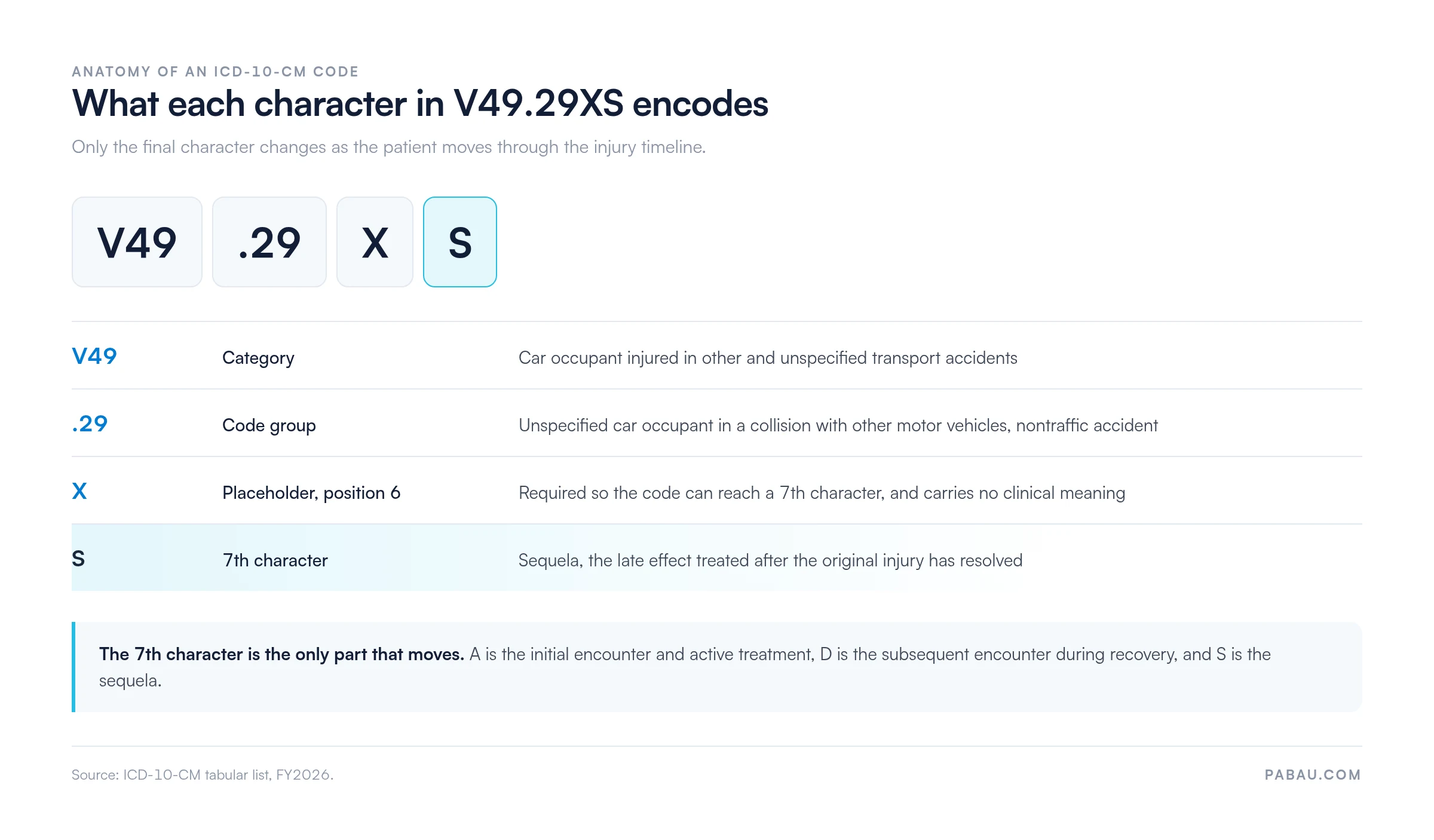
The “X” placeholder in position 6 is required by ICD-10-CM structure so the code can carry a 7th character. It has no clinical meaning of its own. The block V40-V49 covers car occupant transport injuries, separating them from the motorcycle, pedestrian, and heavy-vehicle accidents coded elsewhere in V00-V99.
Heavy transport vehicle occupants sit in V60-V69, a separate block from the car occupant codes in V40-V49. V69.9XXA covers a traffic accident of undocumented type at the initial encounter, while V49.29XS is nontraffic and sequela.
Pick-up truck and van occupants sit in V50-V59 instead. V53.3XXS is the sequela code there for an unspecified occupant in a nontraffic collision, matching V49.29XS for a car.
Read left to right, each segment of the code carries one fact about the accident.
The sequela suffix covers a narrow set of clinical situations. In each of the scenarios below, V49.29XS is the correct external cause code, paired with a primary diagnosis for the late-effect condition.
Per ICD-10-CM Official Guidelines Section I.B.10, sequela coding turns on the medical record. It has to establish a clear causal relationship between the original injury and the present condition. Payers increasingly audit S-suffix claims for this documentation, particularly on auto-insurance and personal injury protection (PIP) files.
Review your billing timeline before submitting with the S suffix. If your practice billed V49.29XD (subsequent encounter) in the past 90 days for the same patient and site, the S-suffix claim looks inconsistent. A payer may flag it for review. Document that the treatment phase has shifted from recovery to sequela management, and put that language in the clinical note.
V49.29XS belongs to a family of codes sharing the V49.29X stem. Coders treating the same patient across the injury lifecycle will use all three 7th character variants. The table below also shows neighboring V49 subcategory codes for driver and passenger injuries, where occupant role is specified.
For a searchable view of the full V49 subcategory, the AAPC Codify ICD-10-CM lookup lists code descriptions alongside documentation guidance for each 7th character variant.
External cause codes in chapter V00-Y99 capture the circumstances of an injury rather than the injury itself. Per WHO’s ICD-10 classification framework and the ICD-10-CM Official Guidelines Section I.C.20, these codes are always supplementary. They sit on the claim next to a primary diagnosis that names the condition, such as a pain code or a musculoskeletal disorder.
Billing an MVA sequela claim takes more paperwork than a standard injury encounter. The payer has to verify that the original accident is on file and that the sequela relationship is clinically supported.
Submitting V49.29XS on a claim takes more than picking the right 7th character. Reviewers also look for a specific sequencing pattern on MVA sequela encounters.
Practices that run code validation before submission cut their rejection rate on MVA sequela claims. Practice management software like Pabau integrates with the Claim.MD clearinghouse, which validates ICD-10-CM codes, builds 837P claims, and handles electronic remittance advice.
It reaches more than 4,000 US payers, including the auto-insurance and workers’ compensation carriers behind most V49.29XS claims.
Practices with a high volume of personal injury cases should review their external cause code rejections monthly. A pattern in the remark codes usually points back to one missing line in the clinical note. Compliance requirements for sequela claims are strictest on that causal-link documentation.
Code lookup tools explain what V49.29XS means. The claim still fails further down the line, at documentation and submission. Three failure points in that chain account for most denials on MVA sequela claims.
Missing causal-link documentation. The S suffix requires an explicit provider statement tying the current condition to the past MVA. Practices without structured note templates leave coders to infer that link from narrative text.
Pabau’s claims management software connects to the clinical note, so the causal-link statement can be a required field on MVA sequela encounters.
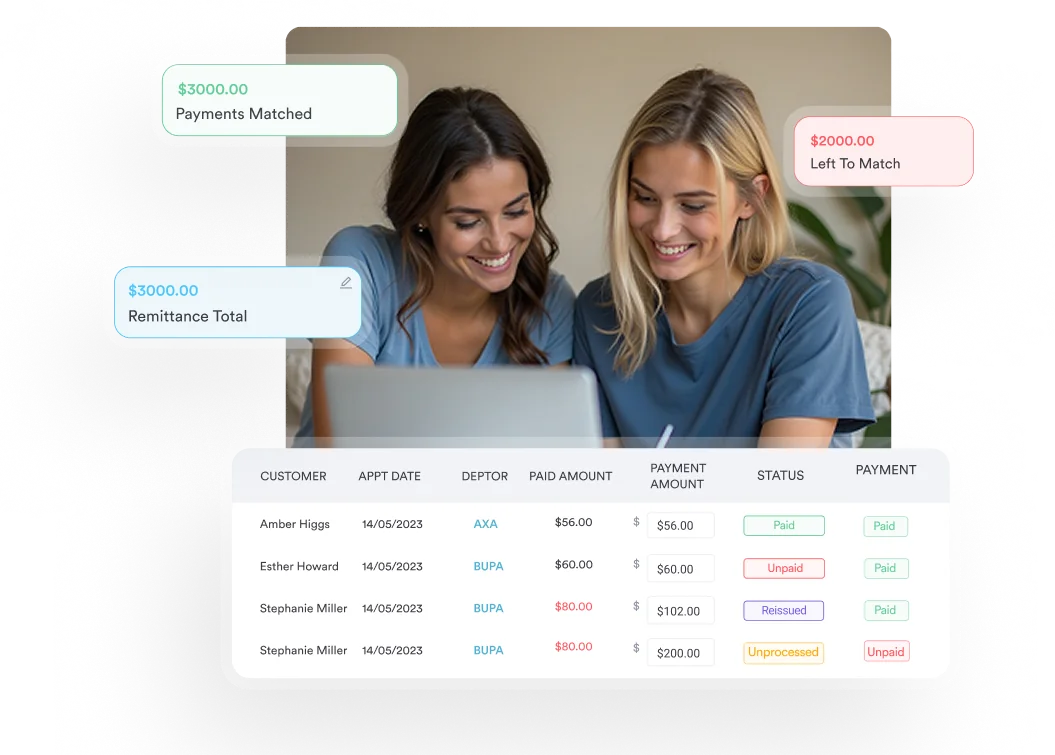
7th character selection errors. A patient with a long treatment history moves through initial, subsequent, and sequela encounters. Coders pick the wrong suffix when that timeline is not visible in the billing screen. An integrated system puts the treatment phase in front of the coder at the moment of selection.
Clearinghouse rejection before payer review. V49.29XS submitted without a paired primary diagnosis rejects at clearinghouse validation, before a human reviewer sees it. Code-pair validation at submission catches that error automatically. One check removes a large share of MVA claim rejections before they turn into denials.
For practices billing auto-insurance or PIP payers, build a dedicated encounter type for MVA sequela visits in your practice management system. Tag these encounters with a checklist covering the causal statement, the original MVA date, and confirmation that active treatment is closed. A required field set beats coder memory, and it will cut your S-suffix denial rate.

Pabau validates ICD-10-CM codes, builds 837P claims, and submits them to the clearinghouse, so fewer sequela and external cause claims come back denied.

V49.29XS is a simple code with a documentation problem. The S is correct only once the original MVA injury has resolved and the visit treats the late effect. That judgment has to live in the clinical note, where a payer can find it.
So the work sits upstream of the coder. Practices that build the causal statement into the encounter template, and validate code pairs before submission, stop most of these denials before they happen.
Pabau links clinical notes, ICD-10 code selection, and remittance processing in one system, so the documentation-to-billing handoff drops fewer details. Book a demo to see how it handles MVA and external cause claim workflows.

Need to understand how MVA claims move through the billing cycle? Revenue cycle management explained covers the full workflow from ICD-10 coding through payment posting.
Seeing recurring denials on external cause code claims? Denial management in healthcare walks through systematic denial pattern analysis for practices billing complex diagnosis codes.
V49.29XS is the billable ICD-10-CM external cause code for a car occupant’s sequela after a nontraffic collision with other motor vehicles. The S suffix means the current condition is a documented late effect of a prior MVA, not an active or follow-up encounter. Report it alongside a primary diagnosis code naming the sequela condition being treated.
Yes, V49.29XS is a billable ICD-10-CM code valid for reimbursement in FY2026, effective October 1, 2025. However, it is an external cause code and cannot appear as the sole or principal diagnosis on a claim. It must be paired with a primary diagnosis code that identifies the sequela condition.
All three share the same base code for an unspecified car occupant injured in a nontraffic collision with other motor vehicles. Only the 7th character differs. V49.29XA is used during active treatment, at the initial encounter and all definitive care visits. V49.29XD applies during the healing and recovery phase, at routine follow-up after definitive treatment. V49.29XS applies only once the original injury has resolved and the current visit treats a condition caused by the past accident.
Use V49.29XS once the original MVA injury is healed or resolved. The current condition must be a distinct late effect of that accident. Use V49.29XD when the patient is still in the healing or recovery phase of the same injury. Applying S during active recovery is a common denial trigger and may raise audit concerns.
The medical record needs three elements. First, an explicit provider statement linking the current condition to the original injury. Second, a reference to the injury event and its approximate date. Third, confirmation that the original injury has resolved. Per ICD-10-CM Official Guidelines Section I.B.10, the causal relationship must be documented, and proximity in time is not enough.
Several primary diagnosis codes pair with V49.29XS. M54.2 (cervicalgia) covers chronic neck pain, and G44.309 (post-traumatic headache, unspecified) covers headache sequela. M79.3 (panniculitis) covers soft tissue complications, and F43.10 (PTSD, unspecified) covers psychological sequela. The pairing code names the condition being treated, while V49.29XS documents the MVA as the external cause.