

ICD-10 code S61.201A: Open wound of left index finger without nail damage
ICD-10 code S61.201A covers a left index finger wound of unstated type ICD-10 co...

Last Updated: Oct 16, 2026
Billable Code Specific Code
V79.88XD is the billable ICD-10-CM code for bus occupant (driver) (passenger) injured in other specified transport accidents, subsequent encounter.
It applies once active treatment is complete and the patient receives routine care during healing or recovery. The code sits in category V79 and is always reported after the injury code, never as the first-listed diagnosis.
Let Pabau's smart automation suggest the right codes, reduce claim denials, and keep your practice compliant—effortlessly.
Automate repetitive tasks and focus on what matters most—your patients.
Reduce coding errors and ensure compliance with the latest regulations.
Clean claims, fewer denials, and faster reimbursements.
Powerful insights and reporting to help your practice thrive.
HIPAA compliant SOC 2 certified GDPR-compliant Trusted by 4,000+ clinics worldwide

V79.88XD covers bus drivers and passengers injured in specified transport accidents that fit no other V70-V79 code.
The 7th character D applies once active treatment is complete and the patient receives routine care during healing or recovery.
V79.88XD is never the first-listed diagnosis, so sequence the injury code (S-code) first and V79.88XD after it.
Pabau, the practice management platform we build, submits claims through Claim.MD and tracks their status, while your coders apply the sequencing rules.
ICD-10 code V79.88XD is a billable ICD-10-CM diagnosis code for a bus occupant injured in an other specified transport accident. The occupant may be the driver or a passenger. It applies to subsequent encounters, when the patient receives routine care during healing or recovery. According to the CMS ICD-10-CM code set, the code has been valid since ICD-10-CM took effect and remains in the current tabular list.
The code sits in category V79 (Bus occupant injured in other and unspecified transport accidents), within the External causes of morbidity chapter (V00-Y99). Bus collisions with pedestrians, animals, specific vehicle types and fixed objects, plus noncollision accidents, have their own categories in V70-V78. V79 holds collisions with other and unspecified motor vehicles, unspecified accidents and the V79.8x codes. V79.88 captures specified transport accidents that fit none of the other V70-V79 codes.
Every character in V79.88XD carries a distinct meaning. Misreading one position produces an invalid code that fails at the clearinghouse before a reviewer sees it. The placeholder X in position 6 is the usual culprit.
The placeholder X at position 6 is non-negotiable. ICD-10-CM requires codes to reach the 7th character when a 7th character is defined. Because V79.88 is only five characters, the X fills position 6 so D can occupy position 7. Submitting V79.88D (omitting the X) produces an invalid code structure that most clearinghouses reject outright.
The three 7th character options for V79.88XD represent distinct phases of care, not distinct injuries. Selecting the wrong one is a frequent reason these claims are denied or queried on audit.
The A-to-D transition: The 7th character A applies to every encounter where the patient receives active treatment for the injury. That includes evaluation and continuing treatment by a new physician. D applies once active treatment is complete and the patient receives routine care during the healing or recovery phase. A bus passenger with a fractured rib moves to D for visits that check healing or adjust medication, even if pain continues. A subsequent encounter does not mean the patient has recovered.
The D-to-S transition: Sequela applies when care shifts from the original injury to a new condition that the injury caused. If the same patient develops post-traumatic intercostal neuralgia that is now the reason for the visit, the external cause code switches to V79.88XS. Use the CDC/NCHS ICD-10-CM web tool to verify current descriptor language and episode-of-care guidance by code year.
V79.88XD applies only when three checks all point to it:
The diagram below runs those checks in order and shows where every other answer leads.
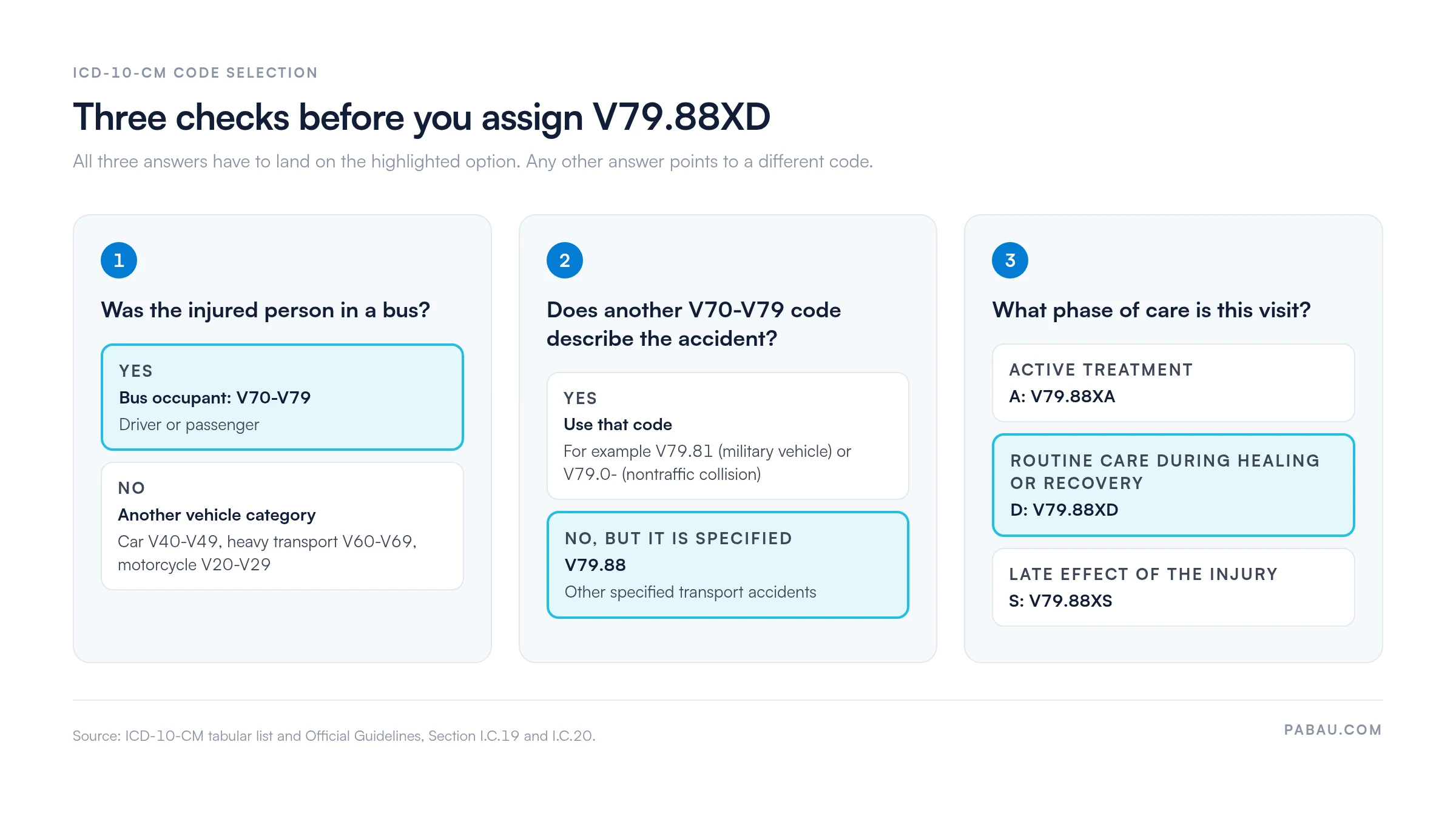
Encounters that correctly use V79.88XD include:
The “other specified” qualifier means the record documents the accident type, but no named V70-V79 code matches it. Before defaulting to V79.88XD, confirm in the AAPC ICD-10-CM code lookup that no more specific code applies.
Several codes share enough structural similarity with V79.88XD to create routine selection errors. The table below shows the most frequent confusion points and the rule that distinguishes each.
Check the vehicle type first. The V-category depends on the vehicle. A bus is V70-V79, a car V40-V49, a heavy transport vehicle V60-V69, and a motorcycle V20-V29. Confirming the vehicle before confirming the accident type prevents the most common category-level coding error.
V79.88XD is an external cause code. Per ICD-10-CM Official Guidelines Section I.C.20.a, external cause codes are never sequenced as the principal or first-listed diagnosis. The injury code leads; V79.88XD follows as a secondary code that explains how the injury occurred.
For a subsequent encounter bus accident claim, the order is:
Place of occurrence (Y92), activity (Y93) and external cause status (Y99) codes do not belong on this claim. The ICD-10-CM Official Guidelines (Section I.C.20) report each of them only once, at the initial encounter for treatment.
A claim that lists V79.88XD first will be rejected by most payers. ICD-10-CM allows no exceptions to this rule, which makes it one of the easiest denials to prevent. Pabau submits claims electronically through its Claim.MD clearinghouse integration and tracks their status. It does not check or assign codes, so your coders apply the sequencing rule before submission.
V79.88XD cannot stand alone on a claim. It documents the external cause of injury, so a separate code must document the injury itself. The table shows which companion codes belong on a subsequent encounter claim.
Watch for one mismatch in particular. If V79.88XD carries the D character, every companion injury S-code must carry D as well. Pairing S22.39XA (initial encounter) with V79.88XD (subsequent encounter) creates a character mismatch that payers may flag for review. Keeping the episode of care consistent across the claim is a core principle of submitting a clean claim.
External cause codes like V79.88XD are treated inconsistently across payer types. Coders working across multiple payer mixes need to know the variance before submission.
On a mixed payer panel, keep a one-page reference of each payer’s external cause requirements. Update it whenever a MAC, a state Medicaid program or a workers’ comp carrier changes its billing guidance.
V79.88XD denials cluster around five preventable errors. Each one comes back on the remittance with one of the standard claim denial codes, which points to the cause. Recognizing the pattern behind each error cuts down on repeated correction and resubmission.
Strong denial management in healthcare starts with finding which of these five errors drives the denial pattern in your practice. They rarely occur in equal proportion, so fix the highest-volume error first.
The medical record must support every element of V79.88XD before the code reaches the claim. Four documentation fields create the evidentiary foundation.
Consistent documentation also supports medical billing compliance during payer audits, especially on accident-related claims. Recheck the V79.88XD descriptor and its validity before each October 1 code set update.
Accident follow-up claims pass through several hands before submission. The provider documents the phase of care, and a coder then puts the S-code and V79.88XD in the right order.
In Pabau, the appointment, the treatment note and the invoice live in one patient record. The coder works from the same documentation the provider wrote. Pabau’s streamlined claims management then submits the claim electronically through Claim.MD and tracks its status.
Pabau does not select codes or check their order, so your coders still apply the sequencing rules. What changes is the follow-up. Your team tracks each claim’s status from inside Pabau, next to the visit it bills.

Pabau submits claims electronically through Claim.MD and tracks their status, so your team can follow each V79.88XD claim from submission to payment.

The quickest win on V79.88XD is a pre-submission check against the visit note. Confirm the X placeholder, a D on every injury code, and the injury code in first position.
The harder call is the phase of care. If the note leaves open whether active treatment has ended, query the provider first. Whichever 7th character you pick, the record has to support it.
Once coding is settled, Pabau submits the claim through Claim.MD and tracks it to payment, so your team spends less time chasing status. Book a demo to see how Pabau handles accident follow-up claims.

Need to understand clearinghouse submission for injury claims? Our Claim.MD clearinghouse guide explains how electronic claim validation works before claims reach the payer.
Dealing with frequent claim rejections on accident-related codes? Denial codes in medical billing maps the most common rejection reasons to their root causes.
Want to understand how electronic remittance works after submission? Electronic remittance advice covers how ERA files communicate payer decisions back to your billing system.
ICD-10 code V79.88XD identifies a bus occupant, either the driver or a passenger, injured in an other specified transport accident. It applies to subsequent encounters, when active treatment is complete and the patient receives routine care during healing or recovery.
Yes, V79.88XD is a valid, billable ICD-10-CM code in the current fiscal year. It can never be the first-listed diagnosis, so it always follows the injury code (S-code) it explains.
V79.88XA applies while the patient receives active treatment for injuries from the bus accident. V79.88XD applies once active treatment is complete and the patient receives routine care during healing or recovery. The phase of care decides the character, not the number of visits.
The 7th character switches from D to S when the visit is for a new condition caused by the original injury. For example, a patient may develop chronic neuropathic pain as a late effect of bus accident injuries. If that condition is the reason for the visit, S is correct.
No. Per ICD-10-CM Official Guidelines Section I.C.20.a, external cause codes are never sequenced as the principal or first-listed diagnosis. The injury code (S-code) must always lead, with V79.88XD appearing as a secondary code to document how the injury occurred.
Requirements vary by payer type. Medicare Part B generally treats external cause codes as optional on professional claims, though some MACs encourage them. Medicaid requirements differ by state, and several states mandate external cause codes on trauma claims. Workers’ compensation requirements vary by jurisdiction, so verify the payer’s submission rules. In every case, the external cause code is never first-listed.



