ICD-10 Code S42.444P: Medial epicondyle fracture, right humerus
ICD-10 Code S42.444P: full descriptor and code validity ICD-10 Code S42.444P car...

Last Updated: Oct 13, 2026
Billable Code Specific Code
V79.60XS is the billable ICD-10-CM code for unspecified bus occupant injured in collision with unspecified motor vehicles in traffic accident, sequela.
The 7th character S marks a sequela encounter. The patient is being treated for a residual condition that the earlier bus collision caused directly. A sequela encounter looks almost identical to a subsequent encounter, and choosing the wrong one is the top denial trigger for V79.60XS claims.
Let Pabau's smart automation suggest the right codes, reduce claim denials, and keep your practice compliant—effortlessly.
Automate repetitive tasks and focus on what matters most—your patients.
Reduce coding errors and ensure compliance with the latest regulations.
Clean claims, fewer denials, and faster reimbursements.
Powerful insights and reporting to help your practice thrive.
HIPAA compliant SOC 2 certified GDPR-compliant Trusted by 4,000+ clinics worldwide

V79.60XS is valid and billable for fiscal year 2026 as an external cause code for bus occupant collision sequela
Use the 7th character S only when treating a residual condition caused by the earlier bus accident, never for a fracture still healing
V79.60XS is always an additional code, so it can never be the principal or primary diagnosis
A sequela encounter requires two codes: the residual condition code first, then V79.60XS as the external cause
ICD-10 Code V79.60XS has one official descriptor in the CMS ICD-10-CM tabular list. It reads: Unspecified bus occupant injured in collision with unspecified motor vehicles in traffic accident, sequela.
The code is billable and valid for the 2026 fiscal year. Report it as a secondary external cause code whenever the condition being treated traces back to a qualifying bus accident.
The 7th character S in ICD-10 Code V79.60XS designates a sequela encounter. The visit treats a condition that the earlier bus collision caused directly, and the active injury phase is over.
Under the ICD-10-CM Official Guidelines for Coding and Reporting, Section I.B.10, sequela coding applies once the original injury has resolved but a residual condition remains.
Typical examples include post-traumatic cervical radiculopathy developing months after a bus rear-end collision, or chronic knee instability persisting after ligament damage from the original crash.
A sequela is the residual condition left behind, so ongoing treatment of an unhealed fracture never qualifies. That distinction sits at the core of the A/D/S decision, and coders get it wrong more often than any other part of this code family.
Document the causal link explicitly. The medical record must state that the current residual condition is a direct consequence of the prior bus accident. Without that linkage statement, payers treat the claim as a new injury and reject V79.60XS. They may also deny the primary residual condition code as unsupported.
The difference between V79.60XS and its siblings V79.60XA and V79.60XD comes down to whether the original injury is still being actively treated. A patient returning six months after a bus crash with persistent neck pain and radiculopathy uses S.
A patient returning three weeks post-crash for a follow-up X-ray on an unhealed rib fracture uses D instead. The word “subsequent” describes the status of the injury rather than the calendar. It applies for as long as the crash injury itself is the condition being managed.
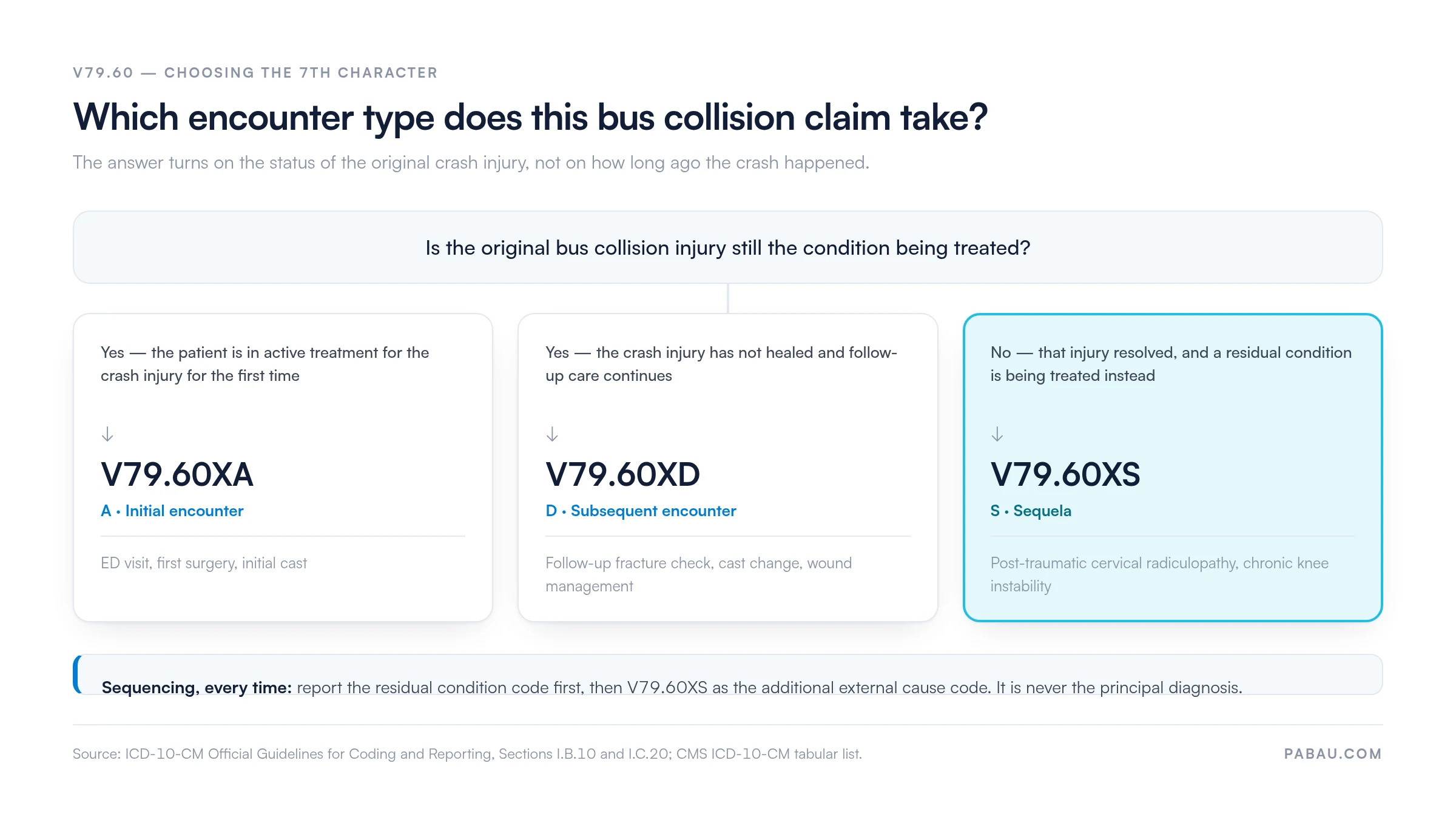
One practical test settles most cases. Ask whether the physician documented a new residual diagnosis, such as cervical spondylosis or nerve damage, alongside the external cause code.
If yes, that is a sequela encounter (S). If the physician is still treating the fractured rib or soft-tissue injury from the crash, the encounter is subsequent (D), however many months have passed.
That same split runs through every transport category. A railway train occupant still under treatment after a nontraffic collision with a motor vehicle takes V81.0XXD.
An unspecified bus occupant is any person aboard the bus whose specific role cannot be determined from the medical record. ICD-10-CM offers more specific V79 subcodes for drivers and passengers. V79.60XS applies only when the documentation does not clearly identify the occupant type.
Emergency department notes, police reports referenced in the record, and patient-reported history can all support a more specific occupant designation. Query the treating provider before defaulting to the unspecified code when that information is available in the chart.
V79.60XS is classified within the external causes of morbidity chapter of ICD-10-CM, confirmed by the CDC/NCHS ICD-10-CM web tool. Understanding the hierarchy helps coders navigate the tabular list and select the correct level of specificity.
The same breakdown appears on every page in our library of ICD-10-CM codes, which helps when comparing V79.60XS against a neighboring subcategory.
Several sibling codes within the V79 category are frequently selected in error. The most common confusion points involve the occupant-type distinctions and the encounter-type suffix.
One lookalike sits outside the V79 category entirely. When a bus driver is hurt in a noncollision accident off the public road, the sequela code is ICD-10 code V78.0XXS.
V79.60XS is an external cause code and must never be sequenced as the principal or primary diagnosis. This is an absolute rule in the ICD-10-CM Official Guidelines, Section I.C.20. Claims that list V79.60XS as the first-listed diagnosis will be rejected by payers, however strong the documentation.
A sequela encounter always requires two codes in sequence:
Never submit V79.60XS alone. Without the residual condition code in first position, the claim has no billable diagnosis and will be denied. The residual condition code must use its own sequela or appropriate encounter-type 7th character where applicable.
Every V79.60XS claim requires documentation that supports both the sequela 7th character and the unspecified occupant designation. A missing element turns the submission into rework. The wider clean claim submission checklist covers the rest of what a payer looks for.
Coders cannot add a causal linkage the provider did not document. If the chart shows a post-crash condition but the physician has not connected it to the original accident, query the provider before assigning V79.60XS. Submitting the sequela external cause code without a documented causal link is a compliance risk.
V79.60XS denial patterns cluster around four errors, and a pre-submission check catches all four. The table below pairs each denial with its root cause and the correction that clears it.
External cause codes including V79.60XS are accepted by Medicare, Medicaid, and most commercial payers as secondary codes, though acceptance policies vary. Bus collision cases frequently involve auto liability insurance or workers’ compensation as the primary payer, ahead of health insurance. That coverage order decides which payer receives the claim first.
When a bus accident claim involves auto liability insurance as the primary payer, document the coverage coordination on the claim. Health insurers billing secondary for sequela treatment need the primary payer’s remittance or denial letter to process the claim correctly. Missing coordination of benefits documentation is a separate denial trigger from the coding errors listed above.
Sequencing errors on external cause codes usually surface after the denial arrives. A biller enters the residual condition code and V79.60XS, the clearinghouse passes the claim through, and the rejection lands weeks later. The encounter is closed by then, so the fix becomes rework.
Practice management software like Pabau checks the claim while the encounter is still open. Pabau’s claims management software validates diagnosis order before submission, so an external cause code in first position gets flagged at the point of coding.
That changes what the billing team spends its week on. Denials that used to arrive in a monthly batch get resolved at the desk instead. The documentation query reaches the provider while the visit is still fresh.
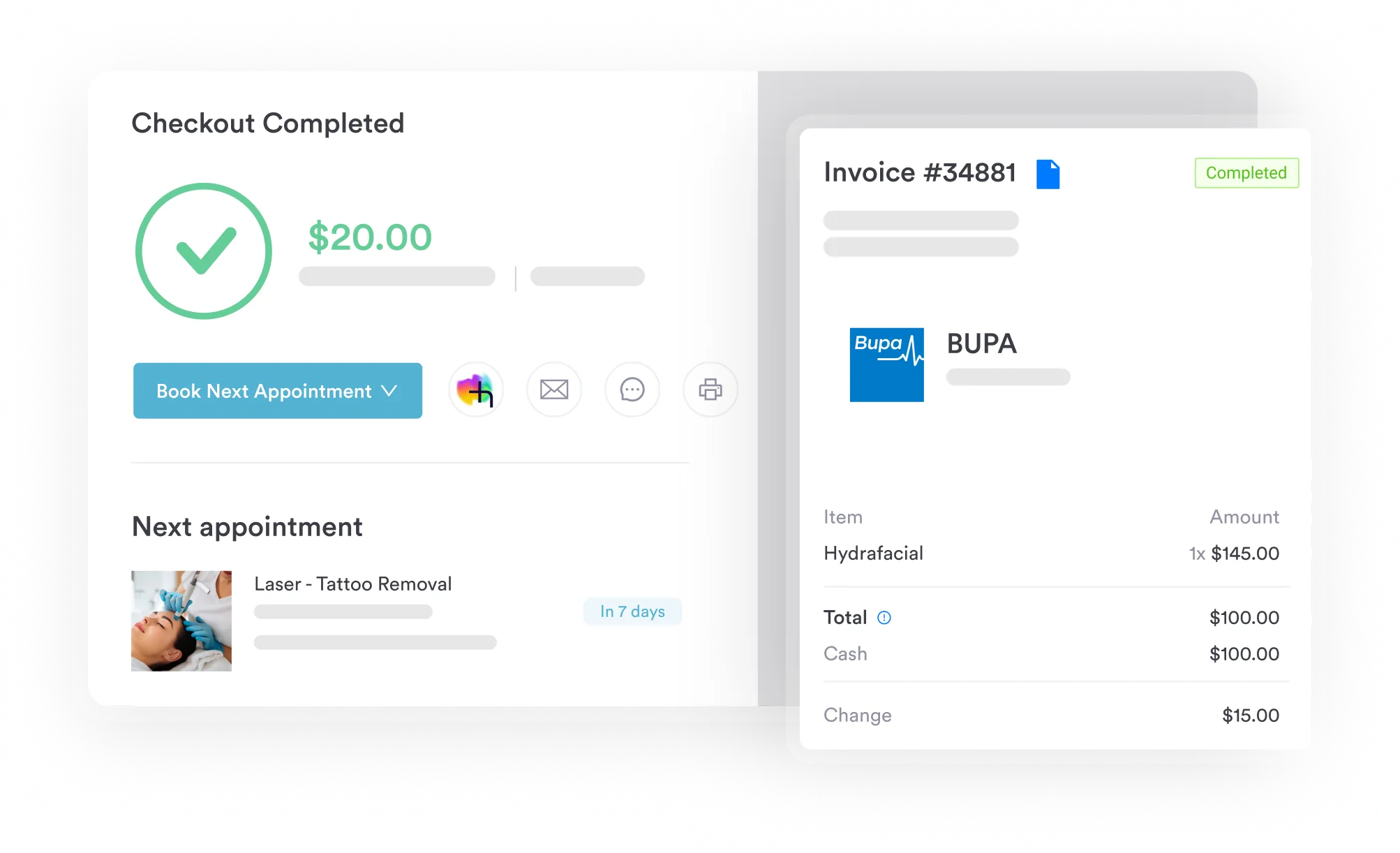

Pabau’s claims management tools validate code sequencing and flag external cause code placement before submission, so these denials get prevented rather than reworked.

V79.60XS rarely fails on the code selection. It fails on the encounter-type judgment behind it, and that judgment depends on documentation the coder cannot write alone. Building the provider query into the coding step, rather than into the appeal, is what keeps these claims out of the denial queue.
Treat the sequela decision as a documentation question first and a coding question second. Practices that do rarely see V79.60XS come back from the payer. Book a demo to see how Pabau validates external cause code sequencing before a claim is submitted.

Need a reference for denial code meanings? Denial codes in medical billing covers the CARC and RARC codes most frequently paired with external cause code rejections.
Working denials after they land? Denial management in healthcare sets out the workflow for tracking, appealing and preventing repeat rejections.
Want to understand the billing compliance framework? Medical billing compliance covers the documentation and sequencing standards that underpin external cause code acceptance across payers.
ICD-10 Code V79.60XS is the billable ICD-10-CM code for unspecified bus occupant injured in collision with unspecified motor vehicles in traffic accident, sequela. The S suffix means the visit treats a residual condition caused by the earlier bus collision, rather than the crash injury itself.
V79.60XA is for the initial encounter, when the bus collision injury is being actively treated for the first time. V79.60XS is for a sequela encounter, when a residual condition from a past, resolved bus collision injury is now being treated. The occupant and vehicle descriptors are identical, and only the encounter type differs.
Yes. V79.60XS is a valid, billable ICD-10-CM code for fiscal year 2026. It must always be reported as an additional code alongside a primary residual condition diagnosis, never as a standalone or first-listed code.
A subsequent encounter (7th character D) is a follow-up visit while the original injury is still healing or being actively treated. A sequela encounter (7th character S) is a visit for a new residual condition that developed after the original injury resolved. If the fracture is still healing, use D. If it has healed but nerve damage remains, use S.
The residual condition code goes first. Common pairings include codes for post-traumatic cervical radiculopathy (M54.12), chronic pain (G89.29), post-traumatic headache (G44.309), and anxiety disorders following trauma. The specific residual condition code drives medical necessity, and V79.60XS supplies the external cause context.
Four errors account for most denials. Coders use the wrong 7th character, A or D instead of S. They sequence V79.60XS as the primary diagnosis. They submit it without a companion residual condition code. Or the chart carries no physician-documented link between the current condition and the crash.