ICD-10 code V43.42XS: Car boarding injury, sequela
ICD-10 code V43.42XS covers the late effects of a car boarding injury ICD-10 cod...

Last Updated: Oct 7, 2026
Billable Code Specific Code
ICD-10 code V43.54XD is the billable code for a car driver hurt in a traffic collision with a van, at a follow-up visit. Coders use it once active treatment has ended. It records how the injury happened, so payers and auto insurers can see the cause behind the claim.
The code never stands alone, because it always follows the injury code. Three details decide whether it pays: the X placeholder, the D for follow-up care, and a van as the other vehicle. Getting those right starts with the patient's chart.
Let Pabau's smart automation suggest the right codes, reduce claim denials, and keep your practice compliant—effortlessly.
Automate repetitive tasks and focus on what matters most—your patients.
Reduce coding errors and ensure compliance with the latest regulations.
Clean claims, fewer denials, and faster reimbursements.
Powerful insights and reporting to help your practice thrive.
HIPAA compliant SOC 2 certified GDPR-compliant Trusted by 4,000+ clinics worldwide

V43.54XD codes a car driver hurt in a collision with a van in traffic, at a follow-up visit after active treatment.
The X placeholder in the 6th position is mandatory, so V43.54D without it is an invalid code.
V43.54XD is always a secondary code, listed after the injury code that describes what was hurt.
The other vehicle sets the 5th character: 1 for an SUV, 2 for another car, 3 for a pick-up truck and 4 for a van.
Place of occurrence, activity and status codes belong on the initial encounter, so they stay off V43.54XD follow-ups.
ICD-10 code V43.54XD describes a car driver injured in a collision with a van in traffic, at a subsequent encounter.
The official CMS descriptor reads “Car driver injured in collision with van in traffic accident, subsequent encounter.” It is a billable ICD-10-CM code from Chapter 20. It records how the injury happened, not what the injury is.
Because the code records a cause, it never stands alone on a claim. The guidelines in the CMS ICD-10-CM coding resources place external cause codes after the injury diagnosis. Payers, auto insurers and injury researchers read V43.54XD as context on the crash.
For the wider code set around it, see our ICD-10-CM code guide.
The hierarchy narrows from the chapter down to the visit type. Each level adds one fact about the crash.
Two characters do most of the work. The 4th character sets the occupant’s position and whether the crash was in traffic. That is why V43.4 means a person boarding or alighting, not a vehicle type.
The 5th character then names the other vehicle. Under V43.5-, V43.51 is an SUV, V43.52 another car, V43.53 a pick-up truck and V43.54 a van. The breakdown below shows each character and what replaces it.
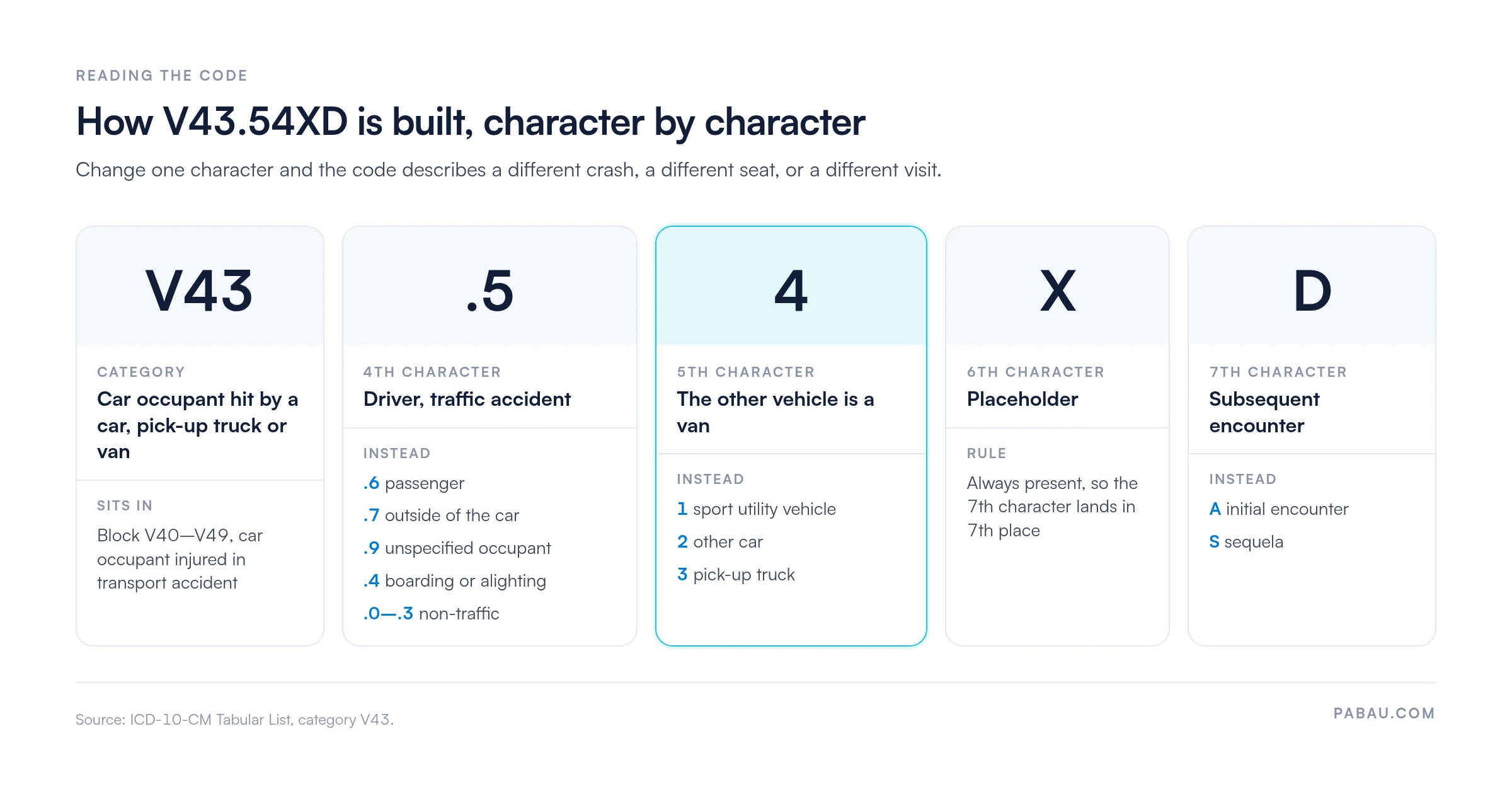
Before you code, check the full V43 tabular list in the CDC/NCHS ICD-10-CM web tool.
The 7th character tells the payer which phase of care the visit belongs to. It is a frequent audit finding on crash-related claims.
The choice turns on the phase of care, not the number of visits. A driver still in active treatment gets V43.54XA, even on a third ED visit. Once care shifts to routine healing checks, each visit takes V43.54XD.
Sequela works differently. When a healed injury leaves a late effect, such as post-traumatic arthritis, the visit takes V43.54XS. A quick test helps here. Is the clinician still managing an unresolved injury, or a consequence of a healed one?
One more rule keeps claims consistent. The guidelines say the external cause code’s 7th character should match the injury code’s 7th character for that encounter.
Document the phase of care plainly in the encounter note. Phrases like ‘routine follow-up for fracture healing’ or ‘physical therapy for post-MVA cervical strain’ let coders assign the 7th character without guessing.
Inclusion and exclusion notes sit at several levels of the V43 hierarchy. These are the scenarios that send coders to the wrong code.
Most mix-ups happen in three places. Coders confuse the occupant’s seat, the other vehicle or the phase of care.
When the record is unclear on any of these points, query the provider before you settle on an unspecified code.
Four details must appear in the record before V43.54XD fits. If one is missing, the coder drops to a less specific code, or the claim is exposed at audit.
V43.54XD never leads a claim. The injury code that describes what was hurt comes first, and V43.54XD follows it. Good medical billing documentation keeps that order on every claim line.
Take a typical follow-up as an example. A driver returns three weeks after a van hit her car, for physical therapy on a neck sprain.
Steps 2 and 3 are where sequencing errors start. When a claim comes back, check those two first.
Many external cause codes appear on the POA (present on admission) exempt list. That list sits in Appendix I of the ICD-10-CM Official Guidelines. Check the current year’s list before you leave the POA field blank for V43.54XD.
External cause reporting rules vary by payer too. There is no national requirement to report external cause codes, and many payers accept claims without them.
Still, some state Medicaid programs and auto-liability carriers do require them. Check each payer’s policy before you leave V43.54XD off a claim. Then record the rule where your billing team can find it.
Most denials tied to ICD-10 code V43.54XD trace back to five errors. Each one can be caught before the claim leaves the practice.
Review the clean claim requirements before you send crash-related claims. A denial management workflow that tags V-code denials by reason also shows repeat errors early.
Run a monthly audit of claims containing V43.54XD. Pull any claim where it sits in the first diagnosis position. Each hit is a coding error to fix before the next billing cycle.
Follow-up crash claims often stall on small errors, like a dropped placeholder or a missing membership number. Teams that check claims by hand tend to find these late, after a rejection.
Pabau, the practice management platform we build, pre-fills each claim from the patient record. Its faster claims management tools include ICD-10-CM and CPT lookup libraries, so coders search V43.54XD instead of typing it. Required fields are checked before the claim can be sent.
In the US, claims go out through the Claim.MD clearinghouse. Real-time eligibility checks confirm coverage before the follow-up visit is billed.
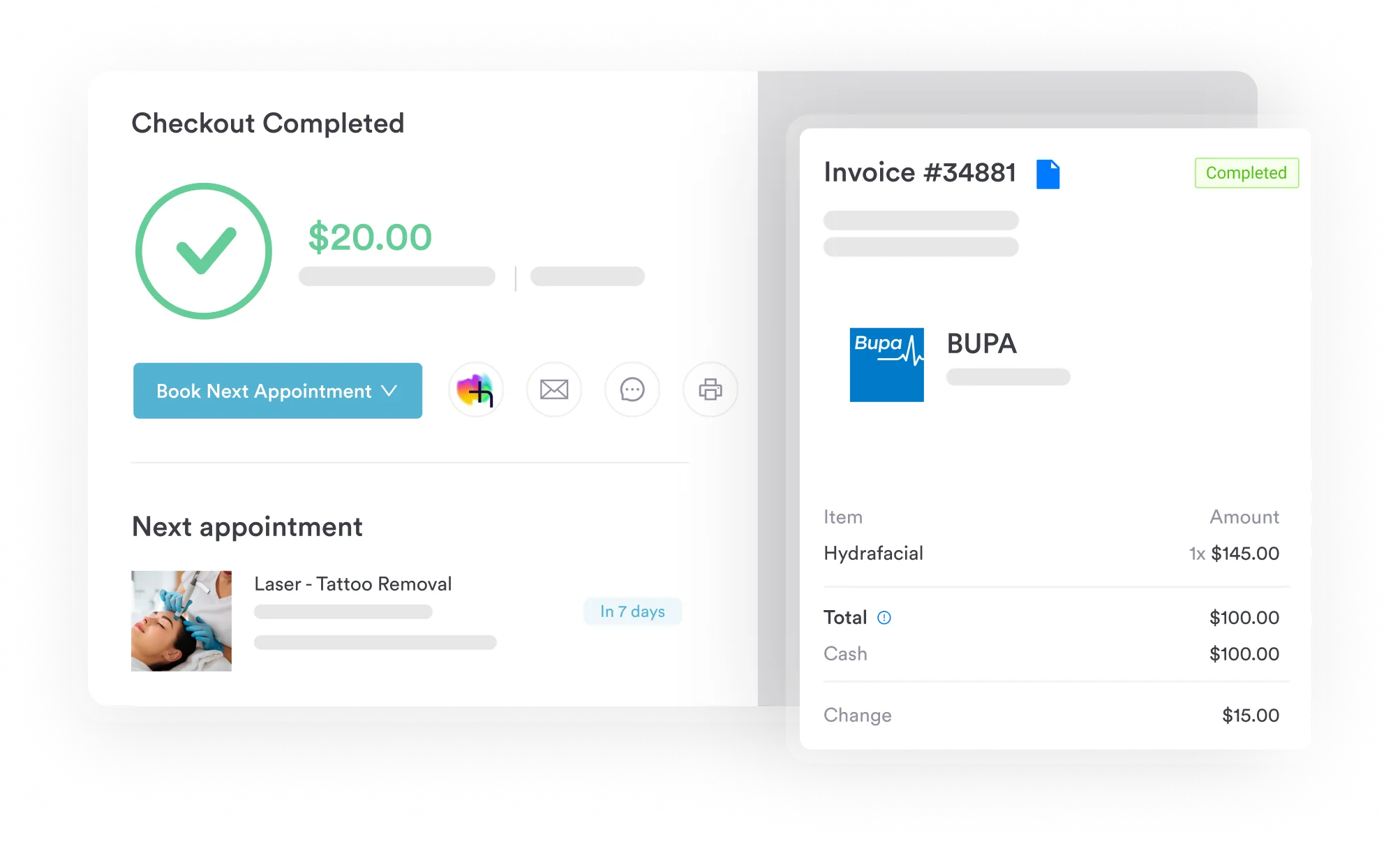

Pabau pre-fills claims from the patient record, adds ICD-10 and CPT code lookup, and checks required fields. Claims then go out through Claim.MD with eligibility checks.

V43.54XD pays when three facts line up in the note: the driver, the van and a follow-up visit. Get those into the record, and the code almost assigns itself.
The trade-off is a minute at the point of care against a resubmission later. Build the checklist above into your follow-up workflow, and audit first-position errors every month.
For practices that bill crash follow-ups often, revenue cycle management works best when coding checks happen before the claim is sent. Book a demo to see how Pabau helps your team send cleaner injury claims from the first follow-up.

Need a process for claims that come back denied? Denial management in healthcare covers how to identify, appeal and prevent payer denials on injury claims.
Submitting crash follow-up claims electronically? How the Claim.MD clearinghouse works explains 837P submission, real-time eligibility checks and remittance handling.
Want to see where diagnosis codes sit in a claim file? 837 file format guide breaks down the transaction set and how ICD-10 codes map to claim segments.
Not sure what a clearinghouse checks before the payer? Medical claims clearinghouse explained walks through the scrubbing and routing steps between your practice and the payer.
Checking coverage before a follow-up visit? Insurance eligibility verification shows what to confirm before the visit so the claim is payable.
It codes a car driver injured in a collision with a van in a traffic accident, at a subsequent encounter. The patient is in routine follow-up care after active treatment. Because it records the cause, it is never the principal diagnosis.
Yes. ICD-10-CM guidelines say the external cause code’s 7th character should match the injury code for that encounter. A follow-up for S13.4XXD therefore pairs with V43.54XD, not V43.54XA.
No. Place of occurrence (Y92), activity (Y93) and external cause status (Y99) codes are reported once, at the initial encounter. Leave them off V43.54XD follow-up claims.
There is no national requirement to report external cause codes. Some state mandates and payer policies do require them, though. Report V43.54XD whenever it applies, unless the payer says otherwise.
Report as many as you need to describe the event. If the claim format limits the count, keep the code most related to the principal diagnosis.
V43.54XA covers the initial encounter, while the driver is in active treatment. V43.54XD covers later visits in the healing phase, such as therapy or fracture checks. The phase of care decides it, not the visit count.