ICD-10 code T32.0: Corrosions under 10% of body surface area
What ICD-10 code T32.0 covers: Chemical corrosions under 10% T32.0 reports chemi...

Last Updated: Nov 26, 2026
Billable Code Specific Code
V86.73XS is the billable ICD-10-CM code for person on outside of dune buggy injured in nontraffic accident, sequela. It records how an earlier injury happened. The patient was riding on the outside of a dune buggy, away from any public road. Today's visit treats a late effect of that injury.
It is an external cause code, so it never goes first on the claim. The residual condition leads, the injury code with S follows, and V86.73XS comes last. A rider in a seat is a passenger and takes V86.63XS, while a crash on a public road moves the code to V86.23XS.
Let Pabau's smart automation suggest the right codes, reduce claim denials, and keep your practice compliant—effortlessly.
Automate repetitive tasks and focus on what matters most—your patients.
Reduce coding errors and ensure compliance with the latest regulations.
Clean claims, fewer denials, and faster reimbursements.
Powerful insights and reporting to help your practice thrive.
HIPAA compliant SOC 2 certified GDPR-compliant Trusted by 4,000+ clinics worldwide

ICD-10 code V86.73XS is the billable external cause code for a person on the outside of a dune buggy injured in a nontraffic accident, sequela.
The 4th character 7 means person on outside in a nontraffic accident, and the 5th character 3 means dune buggy. A rider in a seat is a passenger and takes V86.63XS.
ICD-10-CM treats an accident involving only off-road vehicles as nontraffic unless the record says otherwise. A documented public-road crash moves the code to V86.23XS.
The 7th character S marks a late effect after the acute phase is over. Use V86.73XA during active treatment and V86.73XD for routine care while the injury heals.
V86.73XS is never first-listed. The sequela condition goes first and the injury code with S follows, per Official Guidelines Sections I.B.10, I.C.19.a and I.C.20.
ICD-10 code V86.73XS is the billable code for a person on the outside of a dune buggy injured in a nontraffic accident, sequela. You report it when that injury has healed and the visit treats a condition it left behind. The 2027 ICD-10-CM code files from CMS list V86.73XS as a valid code under that exact descriptor.
V86.73XS is an external cause code from Chapter 20, External causes of morbidity (V00-Y99). It records how an injury happened, while the injury itself takes its own code from Chapter 19. Our ICD-10-CM code guide explains how the wider code set is organized.
Each character narrows the code. Change one and you describe a different rider, a different vehicle or a different kind of visit.
The subcategory code V86.73 has five characters. Category V86 requires a 7th character on every code, and that character has to sit in the seventh position. The letter X fills the empty sixth position so that S lands where it belongs.
Both invalid forms describe codes that do not exist in ICD-10-CM. A claim scrubber or a payer front-end edit rejects them before anyone reviews the claim.
ICD-10-CM defines a person on the outside of a vehicle as someone being transported by it without occupying the driver or passenger space. The cargo space is excluded too. The definition, in the Chapter 20 notes of the Tabular List, names riders on the bodywork, bumper, fender, roof, running board or step.
It also covers anyone hanging on to the outside of the vehicle. On a dune buggy, that means a rider on a side step, a fender or the rear bodywork, or one clinging to the frame. The Alphabetic Index calls this rider a hanger-on and sends a nontraffic case to V86.73.
Query the provider before falling back on V86.93XS. A note that says “thrown from the back of a dune buggy” can mean a rear seat or the rear deck. Those two readings lead to different codes.
In category V86, the 4th character carries two facts at once: the rider’s role and the accident setting. ICD-10-CM defines a traffic accident as one on a public highway, or one that starts, ends or partly happens on it. A nontraffic accident happens entirely somewhere else.
Off-road vehicles get their own default. Most vehicle accidents are assumed to happen on a public highway unless another place is specified. An accident involving only off-road motor vehicles is classified as nontraffic unless the record states otherwise.
A dune buggy crash on dunes, a beach, a trail or private land is therefore nontraffic. When the note gives no location, the crash still counts as nontraffic and V86.73XS applies. Only a documented public-road accident moves an outside rider to V86.23XS.
V86 has no 4th character 8, and no V86 code separates collision from noncollision accidents. Whether the dune buggy rolled, hit a dune or struck another vehicle, the code depends only on role, setting, vehicle and encounter. For a dune buggy, the grid below turns role and setting into the full set of sequela codes.
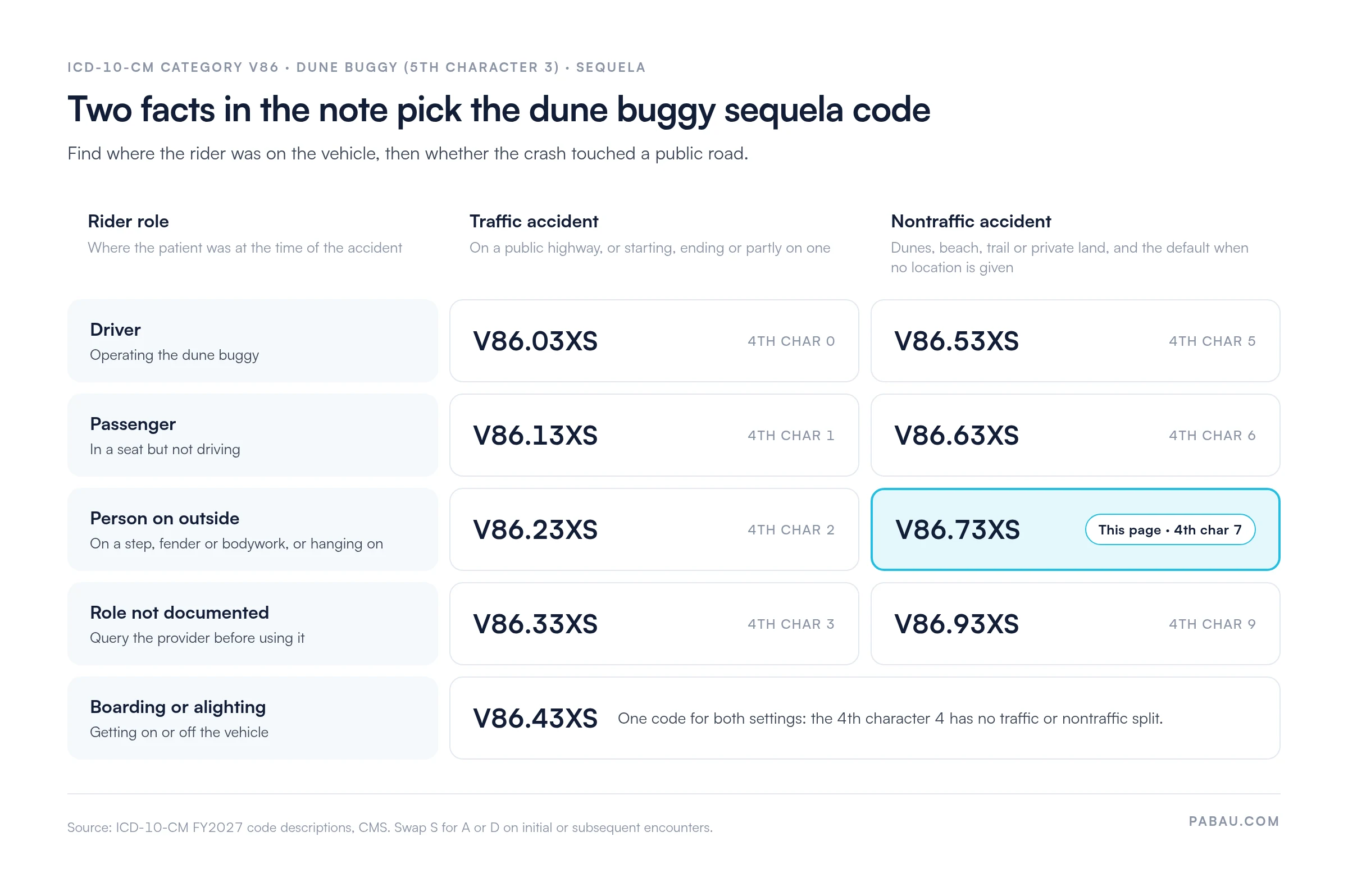
ICD-10-CM defines a special all-terrain vehicle as a motor vehicle built to cross rough or soft terrain, snow or sand. The definition names snowmobiles, all-terrain vehicles (ATVs) and dune buggies, and leaves out sport utility vehicles. Category V86 gives each common type its own 5th character.
An ATV is not a dune buggy, even when both run on sand. Match the 5th character to the vehicle the note names. When the note says only “off-road vehicle”, query the provider before choosing.
The Excludes1 note on V86 sends three situations to other categories:
Vehicles built mainly for industrial, farm or construction work have their own categories, V83, V84 and V85.
The 7th character S marks a sequela, a condition that arises as a direct result of an injury once its acute phase is over. Official Guidelines Section I.C.19.a gives scar formation after a burn as the example. Section I.B.10 adds that there is no time limit on when a sequela code can be used.
For V86.73XS, the patient was hurt riding on the outside of a dune buggy, away from public roads. That injury has healed, and today’s visit treats something it left behind, such as a stiff knee or a thickened scar.
Section I.C.20.a.2 ties the external cause 7th character to the injury code’s. If the injury code ends in S, the V86.73 code ends in S too. Section I.C.20.i adds two limits. A sequela external cause code never sits beside a related current injury code. It is also not used for follow-up care when no late effect is documented.
Sequela coding generally takes two codes in a fixed order, per Official Guidelines Section I.B.10. The external cause code then follows them. When building a clean claim for this visit, list the codes in this order:
Leave out place of occurrence (Y92), activity (Y93) and external cause status (Y99) codes. Section I.C.20 assigns each of them once, at the initial encounter for treatment, so a sequela visit does not repeat them.
Reporting external cause codes is not a national requirement. The guidelines leave it to state-based mandates and individual payers, and encourage voluntary reporting everywhere else. Practices that send claims through the Claim.MD clearinghouse still need the order right. A clearinghouse or payer edit can reject an external cause code in the first position.
Fourteen months ago, a patient riding on the rear bodywork of a dune buggy on a private sand track was thrown off. The displaced bicondylar fracture of the right tibia has healed. The patient now sees an orthopedic practice for post-traumatic osteoarthritis of the right knee.
Code M17.31 (unilateral post-traumatic osteoarthritis, right knee) first. S82.141S (displaced bicondylar fracture of right tibia, sequela) comes second, and V86.73XS comes last.
A patient held on to the side frame of a moving dune buggy on a beach, fell and cut the right forearm. The laceration closed months ago, but a thick, raised scar has formed. A plastic surgeon now sees the patient for scar revision.
Code L91.0 (hypertrophic scar) first, then S51.811S (laceration without foreign body of right forearm, sequela), then V86.73XS. A beach is not a public highway, so the nontraffic code fits.
Picture the scenario 1 patient six weeks after surgery, back for a routine follow-up X-ray. The fracture is still healing, and no late effect is documented. Code S82.141D and V86.73XD, and hold the S codes until a residual condition is treated.
A rider belted into the passenger seat of the same dune buggy has the same healed injury. That patient is a passenger, so V86.63XS replaces V86.73XS. If the outside rider had crashed on a public road, V86.23XS would apply instead.
Sequela claims rest on details recorded months earlier. Understanding medical billing fundamentals starts with what the record must hold before the code is assigned. For V86.73XS, the note should establish:
Following billing compliance requirements means this detail is visible and retrievable for every sequela claim. Post-payment reviews look for the causal-link statement, and a missing one can lead to a recoupment request.
Before you assign V86.73XS, check four details in the note. Confirm the rider position, the vehicle, the accident setting and the residual condition being treated. If one is missing, query the provider before the claim goes out.
There is no national requirement to report external cause codes. Some states mandate them, and some payers require them on injury claims. Where neither applies, the guidelines still encourage reporting V86.73XS as a secondary code.
Dune buggy accidents often involve liability or other accident coverage. Payers may use the external cause code to decide whether a claim belongs with health insurance or another carrier. Claims management software that supports coordination of benefits cuts the manual follow-up for billing staff.
Key payer considerations for V86.73XS claims include:
V86.73XS claims fail in predictable ways. Effective denial management workflows start with catching these before submission, not after the remittance arrives.
Most V86 coding errors come from three characters: the 4th (role and setting), the 5th (vehicle) and the 7th (encounter). Check all three against the record before you assign the code.
Use the CDC/NCHS ICD-10-CM browser tool to confirm each descriptor before you submit. The AAPC Codify ICD-10-CM lookup adds cross-references to Excludes notes and inclusion terms for vehicle edge cases.
A sequela claim needs three codes in a fixed order, and the right V86 code depends on where the patient was riding. In many practices, a biller pieces that together from a note written months earlier. That is where a seated passenger turns into an outside rider, or the S drops off the injury code.
Pabau, a practice management platform with built-in insurance billing, keeps the clinical note, the invoice and the claim in one system. The biller codes from the provider’s own documentation rather than a retyped summary. In the US, claims go out through Claim.MD as 837P claims, and remittances come back the same way.
Fewer claims then leave the practice with a code the note does not support. The payer still decides each claim, but every one of them starts from the record.

Pabau keeps the clinical note, the invoice and the insurance claim in one system. Billers code external cause details straight from the provider’s documentation before the claim reaches the clearinghouse.

V86.73XS fits a narrow set of facts. The patient rode on the outside of a dune buggy, the accident happened away from public roads, and the visit treats a late effect. Change any one of those and a sibling code takes over, such as V86.63XS, V86.23XS or V86.73XD.
The safest habit is to code from the residual condition outward. Name it, code the injury behind it with S, then confirm rider position, vehicle and setting before V86.73XS goes last on the claim. When the note cannot answer one of those questions, a provider query costs far less than an appeal.
Pabau keeps the note and the claim in one system, so billers code from what the provider recorded. Book a demo to see how Pabau handles external cause coding on injury claims.

Need to understand how clearinghouse validation catches coding errors? Pabau’s Claim.MD clearinghouse integration explains how real-time claim edits work before submission, including external cause code sequencing checks.
Confused about denial reason codes on remittances for sequela claims? Denial codes in medical billing covers the most common CARC and RARC codes that appear on rejected external cause code claims.
Looking for the 837 transaction format requirements for external cause codes? The 837 file guide explains how external cause codes map to the 837P claim transaction for professional claims.
ICD-10 code V86.73XS is the billable ICD-10-CM code for a person on the outside of a dune buggy injured in a nontraffic accident, sequela. It is an external cause code for a visit that treats a late effect of that injury. On the claim, it always follows the sequela condition and the injury code.
Yes. V86.73XS is a billable, valid code in the FY2027 ICD-10-CM code set. It has been part of ICD-10-CM since the first US release on October 1, 2015. It is reported as a secondary code and is never first-listed.
ICD-10-CM defines a person on the outside as someone transported by the vehicle without occupying the driver, passenger or cargo space. That includes riders on the bodywork, bumper, fender, roof, running board or step, and anyone hanging on. A rider in a seat is a passenger and takes V86.63XS.
The 4th character 7 means a person on the outside injured in a nontraffic accident, one that happens entirely off a public highway. ICD-10-CM classifies accidents involving only off-road vehicles as nontraffic unless the record states otherwise. A documented public-road crash takes V86.23XS instead.
V86.73XA is for encounters where the patient receives active treatment for the injury, such as emergency care or surgery. V86.73XS is for a later visit that treats a residual condition after the acute phase. Only the 7th character differs, but the two describe different encounters.
Use 7th character S when the visit treats a condition caused by an injury after its acute phase is over. A scar after a burn is the classic example. Do not use it during active treatment (A) or routine healing-phase care (D). The sequela condition is always coded first.
No. V86.73XS is an external cause code from Chapter 20 (V00-Y99). Official Guidelines Section I.C.20.a.6 bars external cause codes from the principal or first-listed position. List the sequela condition first, then the injury code with S, then V86.73XS.
The record should show where the patient was on the vehicle, that the vehicle was a dune buggy, and where the accident happened. It should also name the original injury and the residual condition being treated. A provider statement must link today’s condition to that accident.