ICD-10 Code S82.242H: Displaced spiral tibial shaft fracture, delayed healing
ICD-10 Code S82.242H: Definition and code details ICD-10 Code S82.242H designate...

Last Updated: Oct 15, 2026
Billable Code Specific Code
V37.2XXA is the billable ICD-10-CM code for person on outside of three-wheeled motor vehicle injured in collision with fixed or stationary object in nontraffic accident, initial encounter.
The FY2026 edition of ICD-10-CM V37.2XXA became effective October 1, 2025, under the CMS ICD-10-CM annual code update. The code sits in Chapter V (external cause codes V00-Y99) and is maintained jointly by CMS and the National Center for Health Statistics (NCHS).
Let Pabau's smart automation suggest the right codes, reduce claim denials, and keep your practice compliant—effortlessly.
Automate repetitive tasks and focus on what matters most—your patients.
Reduce coding errors and ensure compliance with the latest regulations.
Clean claims, fewer denials, and faster reimbursements.
Powerful insights and reporting to help your practice thrive.
HIPAA compliant SOC 2 certified GDPR-compliant Trusted by 4,000+ clinics worldwide

V37.2XXA is the billable ICD-10-CM code for a person riding on the outside of a three-wheeled motor vehicle. The vehicle hit a fixed object off a public road, and the visit is the initial encounter.
The parent code V37.2 is non-billable. Submit V37.2XXA, V37.2XXD, or V37.2XXS instead, depending on the encounter type.
The 7th character A covers active treatment, D covers follow-up visits, and S covers residual effects of the injury.
The traffic version of the same occupant position is V37.7XXA, so the accident location decides which of the two you submit.
Practice management software like Pabau keeps the insurer, the invoice, and the coded diagnosis on one record, so nothing is re-keyed at submission.
V37.2XXA is a billable, specific ICD-10-CM diagnosis code valid for reimbursement in FY2026, which runs from October 1, 2025 through September 30, 2026. The full official description is: Person on outside of three-wheeled motor vehicle injured in collision with fixed or stationary object in nontraffic accident, initial encounter.
The CDC/NCHS ICD-10-CM web tool confirms V37.2XXA as a specific, reportable code. Coders must always submit the full seven characters. V37.2 on its own is a header code, and payers reject it as non-billable.
Each element of the V37.2XXA description carries clinical and coding weight. Misreading any one of them leads to the wrong code.
Several documentation phrasings map to V37.2XXA. Watch for “person on outside of 3-wheeled motor vehicle injured in nontraffic accident” and “three-wheeled vehicle collision with wall, nontraffic.” A note describing a tricycle-type vehicle’s exterior rider hitting a stationary object points here too. Any of them should trigger this code at chart review.
The 7th character is the most common source of coding errors on V37.2 claims. All three child codes share the same base scenario, and only the encounter type changes.
Under CMS guidelines, the 7th character A is not limited to a single visit. A patient can see a hospitalist, an orthopedist, and a general surgeon while under active treatment for the same injury. Each of those claims correctly carries V37.2XXA.
Switch to D once care becomes routine monitoring of a healing injury. Use S when you document a complication or late effect that traces back to the original accident.
Reading the hierarchy from the top down is how coders avoid stopping at a non-billable header code. The same four-step logic applies across the whole V00-Y99 chapter.
The “XX” placeholder characters between the subcategory digits and the 7th character are required by ICD-10-CM structure. They hold the place of the 5th and 6th characters, which this code does not use. Drop them and you produce an invalid code that payers reject. The breakdown below shows what each segment of the code is telling the payer.
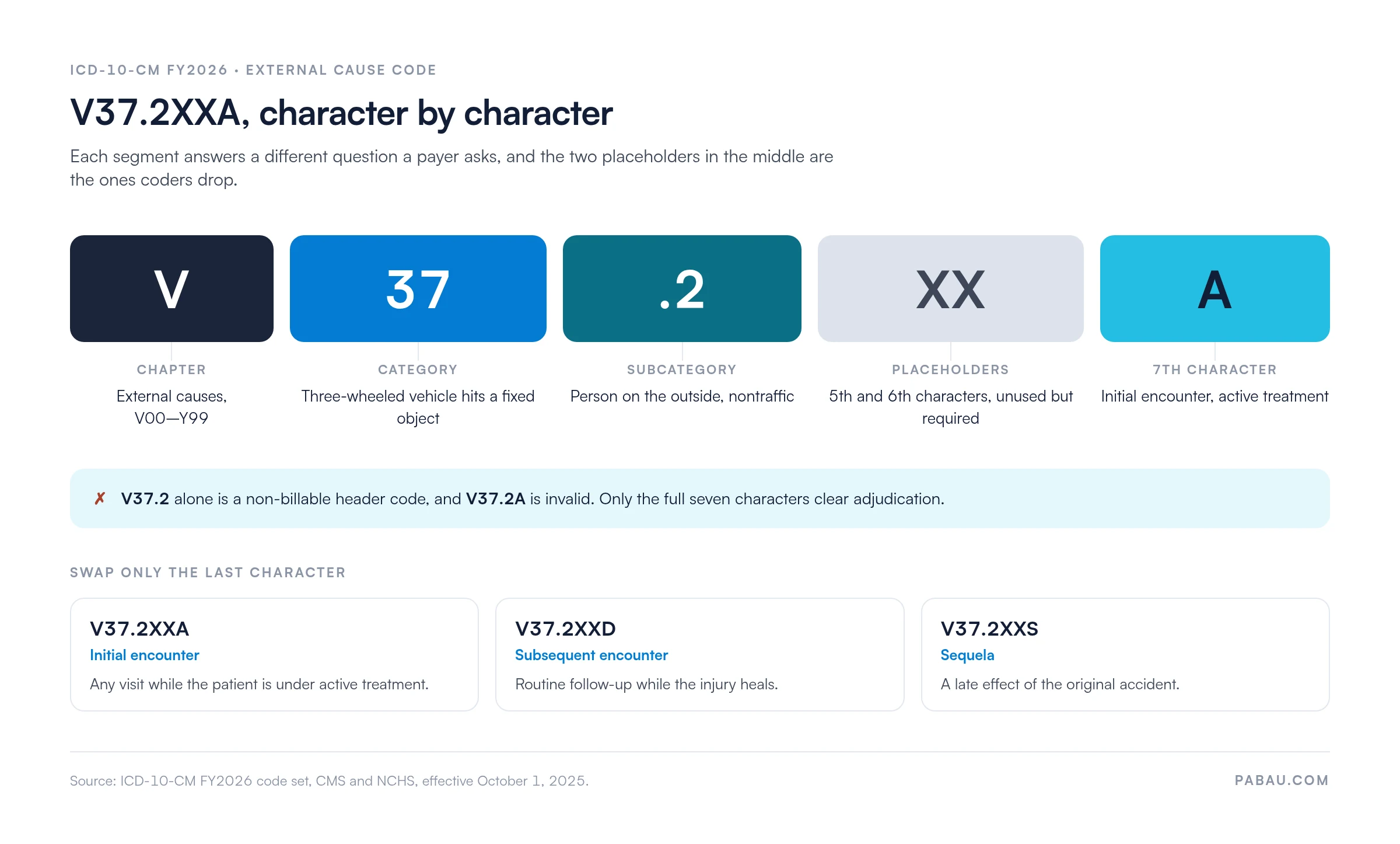
Accident location sets the traffic-versus-nontraffic split under official ICD-10-CM definitions. Road speed and vehicle type have no bearing on it. A collision on a private driveway at 5 mph is a nontraffic accident. A collision in a parking lot open to public use may count as a traffic accident, depending on jurisdiction and documentation.
V37.4XXA sits outside this pairing. It covers a person boarding or alighting from a three-wheeled motor vehicle. Reach for it only when the record describes getting on or off the vehicle.
The collision partner sets the category, so a moving vehicle takes the claim outside V37. If a heavy transport vehicle or bus struck the three-wheeler while the patient was getting on or off, code V34.4XXA instead. If a two- or three-wheeler hit the vehicle off a public road, a passenger’s follow-up visit codes to V32.1XXD.
If the record does not say whether the accident happened on a public road, default to the unspecified occupant codes, V37.3 or V37.9. Better still, query the treating provider before you submit. Guessing at traffic versus nontraffic without documentation is a compliance risk.
Query the physician if chart documentation does not specify where the accident occurred, on a public road or on private property. Submitting a nontraffic code like V37.2XXA when the record is ambiguous exposes the claim to audit. A brief addendum confirming accident location takes seconds and protects reimbursement.
External cause codes like V37.2XXA are supplementary codes under the CMS ICD-10-CM Official Guidelines for Coding and Reporting. Holding to medical billing compliance on these rules is what keeps injury claims out of the denial and audit queues.
Most code references stop at the description and the billable flag. The physician’s note has to establish five things explicitly before V37.2XXA is defensible, and each one maps to a segment of the code.
Capturing those five details at the first visit is what makes the claim easy to bill weeks later. Claims management software keeps the insurer, the invoice, and the coded diagnosis on one patient record, so nothing has to be re-keyed at submission.
Most V37.2XXA claim failures trace to one of five avoidable mistakes. The medical billing denial codes returned on ICD-10-CM errors usually flag an invalid or non-specific code. All five mistakes below trigger one of those flags.
A patient injured in the scenario V37.2XXA describes usually presents with soft-tissue injuries, fractures, or head trauma. The CPT codes below appear frequently on claims that carry V37.2XXA as the external cause code. Treat the pairings as illustrative, since procedure code selection depends on the encounter and payer policies vary.
Consult the AAPC ICD-10-CM code reference for expanded crosswalk guidance and medical necessity documentation tips by specialty.
Record audits and historical billing comparisons sometimes require mapping V37.2XXA back to ICD-9-CM. That mapping is approximate, because the two code sets are built differently and do not translate one to one. The closest family is E821, which covers nontraffic accidents involving off-road motor vehicles.
For precise bidirectional mapping, use the Check ICD-10 crosswalk database, which mirrors the official CMS and NCHS mapping files. ICD-9 identified the injured person with a fourth digit, but it had no code for a three-wheeled motor vehicle. No exact ICD-9 equivalent of V37.2XXA exists.
Typically the accident details sit in a clinical note, while the billing team works from an invoice in another system. The coder reads the note, picks V37.2XXA, and types it somewhere else. Every hand-off is a chance to drop the placeholders or carry the wrong 7th character forward.
Pabau, our all-in-one practice management system, holds the insurer and policy on the patient record itself. Invoices route to the correct third party automatically, so the coded diagnosis travels with the claim instead of being re-entered at billing.
Validation checks then run in the background each time you go to send. Where a required detail such as a membership number is missing, the Send button stays disabled until someone fixes it. In the US, claims go out electronically through our Claim.MD integration, with real-time eligibility checks and ERA remittances in the same dashboard.
Every claim then moves through the same visible stages, from pending to paid or error. A rejected external cause code shows up the day it bounces, not at month end when the aging report is built.

Pabau keeps the insurer, the invoice, and the coded diagnosis on one patient record, and runs validation checks before a claim can be sent. You see every claim’s status in one dashboard, so rejections surface the day they happen.

V37.2XXA rarely fails on clinical judgment. It fails on mechanics. The parent code goes out without its 7th character, or the placeholders get dropped between the note and the claim form.
Fix it at the documentation end rather than the billing end. If the note names the vehicle, the patient’s position, the object struck, and the location, the code follows from the record and survives an audit. If it does not, no amount of care at submission will rescue the claim.
The trade-off worth remembering is that a query to the provider costs minutes, while a denied trauma claim costs a rework cycle. Book a demo to see how Pabau keeps coded injury claims and their documentation on one record.

Need guidance on denial management for external cause codes? Denial management in healthcare covers the most common reasons injury claims are rejected and how to build a recovery workflow.
Want to know what a payer-ready claim looks like? Clean claim requirements explains the checks a claim has to pass and where external cause codes fit into them.
Checking coverage before you submit an injury claim? Insurance eligibility verification outlines how to confirm patient coverage for trauma-related services before billing.
Yes, V37.2XXA is a billable and specific ICD-10-CM code, valid for reimbursement in FY2026. The parent code V37.2 is non-billable, so always submit the full seven characters with the XX placeholders and the right 7th character extension.
All three codes describe the same accident but apply to different phases of care. V37.2XXA is used during active treatment of the initial injury. V37.2XXD is used for follow-up visits while the injury heals. V37.2XXS is used when treating a late effect of the original accident.
V37.2XXA codes a nontraffic accident, meaning the collision happened off a public roadway, on private property, a farm, a construction site, or a similar location. The equivalent traffic accident code for the same occupant position is V37.7XXA.
The 7th character A designates an initial encounter under ICD-10-CM guidelines, meaning the patient is receiving active treatment for the injury. It does not mean only the first visit. Any visit during active treatment, including an ED visit, surgery, or a specialist consultation, correctly uses A.
V37.2XXA applies to motorized three-wheeled vehicles, including motorcycle-sidecar combinations, three-wheeled ATVs, and similar tricycle-type motor vehicles. Standard two-wheeled motorcycles and four-wheeled passenger cars are coded elsewhere in the V00-V99 transport accident chapter.
No exact ICD-9-CM equivalent exists, because ICD-9 had no three-wheeled motor vehicle category. The closest family is E821, nontraffic accidents involving off-road motor vehicles, with E821.8 for an other specified person. Use a crosswalk tool built on official CMS mapping files for historical claims research.
Not always, but it helps. A Y92 place of occurrence code, a Y93 activity code, or a Y99 external cause status code adds detail where the record supports it. None of them replaces V37.2XXA, which stays the code for the transport mechanism itself.