ICD-10 Code S82.242H: Displaced spiral tibial shaft fracture, delayed healing
ICD-10 Code S82.242H: Definition and code details ICD-10 Code S82.242H designate...

Last Updated: Oct 15, 2026
Billable Code Specific Code
V34.4XXA is the billable ICD-10-CM code for an injury while boarding or alighting a three-wheeled motor vehicle that collides with a truck or bus. The A marks the initial encounter, while the patient is in active treatment. It's an external cause code, so it explains how the injury happened and always follows the injury code on the claim.
Claims stall when the details slip. The record must name the three-wheeler, the act of getting on or off, and the truck or bus. The sections below show how to confirm each fact, sequence the code and head off the four denials that hit it most.
Let Pabau's smart automation suggest the right codes, reduce claim denials, and keep your practice compliant—effortlessly.
Automate repetitive tasks and focus on what matters most—your patients.
Reduce coding errors and ensure compliance with the latest regulations.
Clean claims, fewer denials, and faster reimbursements.
Powerful insights and reporting to help your practice thrive.
HIPAA compliant SOC 2 certified GDPR-compliant Trusted by 4,000+ clinics worldwide

V34.4XXA is a billable, specific ICD-10-CM code, but its parent V34.4 can’t be billed without the 7th character.
Use the 7th character A only during active treatment, then switch to D once the patient moves into routine recovery care.
V34.4XXA is an external cause code, so it always follows the injury code and never takes the first position.
Claim software can pre-fill fields and flag missing data, but sequencing V34.4XXA stays the coder’s decision.
ICD-10 code V34.4XXA is a billable, specific code for an injury while boarding or alighting a three-wheeled motor vehicle. The other vehicle in the collision is a heavy transport vehicle or bus. The final A marks the initial encounter, while the patient is still in active treatment.
The code sits in Chapter 20 of ICD-10-CM, External causes of morbidity (V00-Y99). Its category is V34, Occupant of three-wheeled motor vehicle injured in collision with heavy transport vehicle or bus.
The full official descriptor is: Person boarding or alighting a three-wheeled motor vehicle injured in collision with heavy transport vehicle or bus, initial encounter.
The record has to confirm all three of these before you assign the code:
Change any one of them and a different V34 subcode, or a different category, takes over.
ICD-10-CM defines a three-wheeled motor vehicle as a motorized tricycle built mainly for road use. That includes motor-driven tricycles, motorized rickshaws and three-wheeled motor cars.
A motorcycle with a sidecar is excluded and codes to V20-V29 instead. All-terrain and other off-road vehicles go to V86. If the note just says “motorcycle” or “scooter,” query the provider rather than guess.
Boarding or alighting covers the act of getting on or off the vehicle at the moment of injury. It’s a narrow window. A patient already riding in or on the three-wheeler takes a different V34 subcategory. That’s V34.0-V34.3 for non-traffic accidents, or V34.5-V34.7 and V34.9 for traffic accidents.
And if the patient fell while getting off with no collision at all, the injury moves to V38.4, the noncollision category.
Heavy transport vehicles include trucks, tractor-trailers and similar large goods vehicles. Buses sit in the same category. A collision with a car, pickup truck or van routes to category V33 instead. A boarding injury in that kind of crash codes to V33.4-, and V33.4XXD covers the follow-up visits.
A person outside a vehicle in the same crash is coded as a pedestrian, not an occupant. A skateboarder struck by the truck or bus, seen for follow-up care with traffic status undetermined, takes V04.92XD.
Check the accident report or ED notes for the other vehicle’s type before you finalize the code. The decision path below runs all three checks in order.
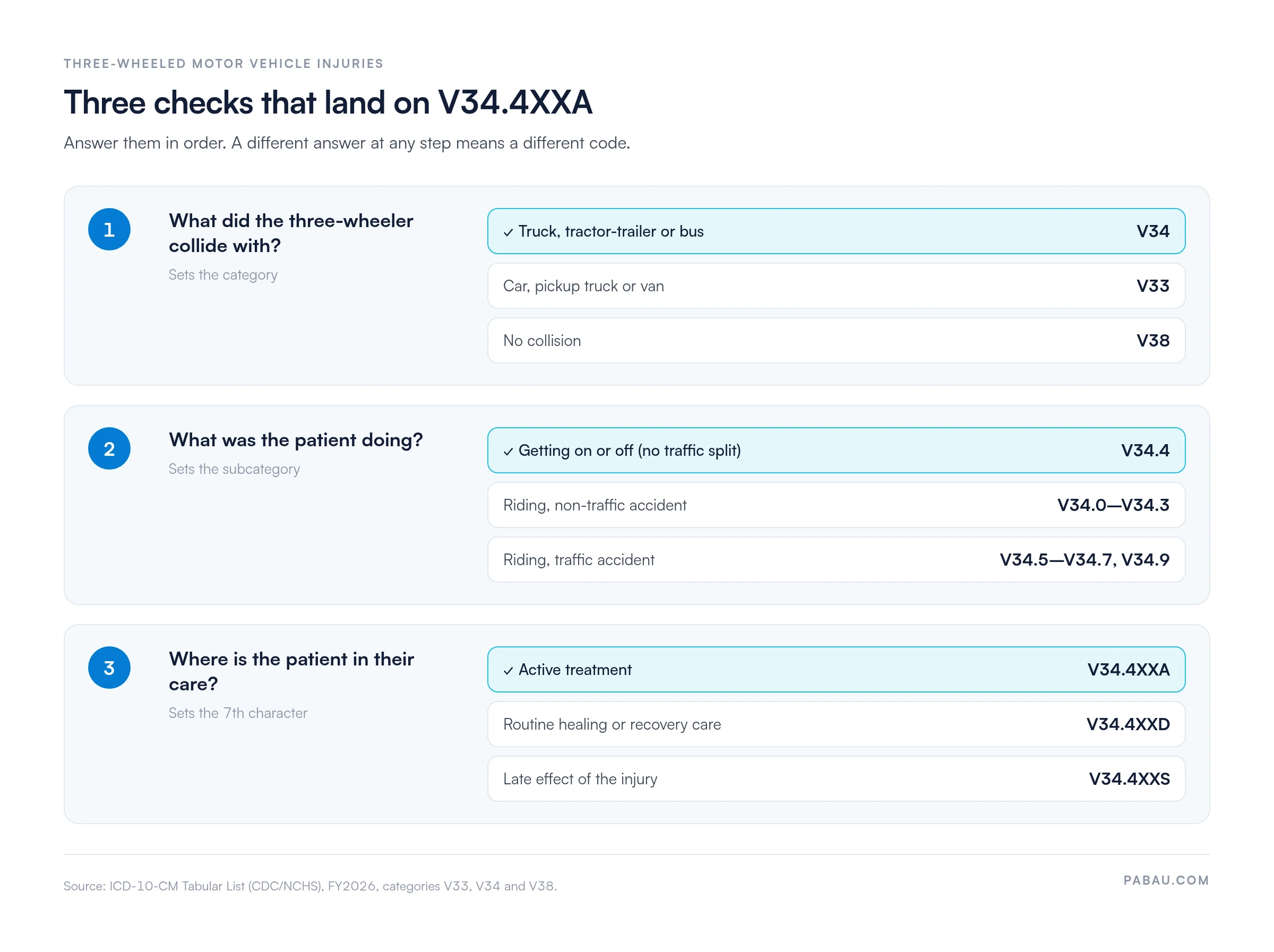
V34.4 offers three 7th characters, one for each episode of care. Picking the wrong one is a common error on transport accident codes, and payers do deny claims for it.
The usual slip is keeping A on follow-up visits. Once the provider moves the patient into healing or maintenance care, those visits take D as the 7th character. Leaving A on every claim draws payer scrutiny, and later claims can be denied.
Category V34 splits into nine subcategories by the patient’s role and whether the accident happened in traffic. Picking the wrong one is a specificity error. Use the table to confirm V34.4 fits before you add the 7th character.
V34.4 is the one subcategory with no traffic or non-traffic split. Boarding and alighting injuries are classified by the act itself, wherever the accident took place.
V34.4XXA is an external cause code. Under the ICD-10-CM Official Guidelines, Section I.C.20, an external cause code can never be the principal or first-listed diagnosis.
Put it first and the payer will reject the claim. If your team is new to the revenue cycle, how medical billing works shows where diagnosis codes fit on a claim.
Here’s the order that holds up:
CMS publishes the code set and its guidelines on its ICD-10 coding resources page. External cause codes are generally not required for payment. Even so, many payers request them for coordination of benefits and liability decisions. Report V34.4XXA whenever it applies, even though payment doesn’t depend on it.
Check the injury code before you add V34.4XXA. When both codes carry a 7th character, they should reflect the same episode of care. An injury coded D next to V34.4XXA is a mismatch that invites payer review.
Every V34.4XXA claim rests on four documented facts. If the record can’t support one of them, the claim won’t survive an audit, even if the payer pays it at first.
Building those four prompts into the provider’s note template saves a round of queries later. It also fits the wider medical billing compliance rules your practice already follows.
External cause codes are rarely required for payment. Still, payers often ask for them to settle coordination of benefits, subrogation and liability. After a motor vehicle accident, the code helps decide whether auto insurance, workers’ compensation or the health plan pays first.
Medicare and Medicaid accept V34.4XXA as a secondary code. Commercial payers vary. Some require external cause codes before they process an accident claim, while others treat them as informational. Check each payer’s claim edit policy before you treat the code as optional.
Here’s how a typical claim moves. The coder sequences the injury code and V34.4XXA, then the claim goes to a clearinghouse for format checks. From there it reaches the payer, which may hold it for a coordination-of-benefits review. Clearinghouses such as Claim.MD also run real-time eligibility checks against health plans before you submit.
A clean claim pairs the right injury code, a correctly sequenced V34.4XXA and any documented place or activity codes in one submission. Leave one of them out and the claim comes back for rework.
Most rejections on V34.4XXA claims trace back to one of four patterns. Each one has a specific fix.
A structured denial management workflow catches these patterns before they repeat. Track each denial by root cause across your external cause claims. The pattern shows whether the fix belongs in coder training, provider documentation or billing system setup.
To decide which corrections to tackle first, compare your remittance notes against the common denial codes payers use.
Once a month, compare denied V34.4XXA claims against accepted ones. If denials cluster around certain providers or visit types, fix the documentation template before you retrain the coders.
Run this quick check on every V34.4XXA claim before it leaves the practice:
Coding a transport injury often means copying details from ED notes into a claim by hand. That’s where fields go missing and claims bounce back.
Pabau, the practice management platform we build, offers claims management that pre-fills each claim from the patient record. Its ICD-10-CM and CPT lookup libraries help coders find V34.4XXA and the injury code without leaving the claim.
Before a claim goes out, Pabau checks that the required fields are complete. In the US, claims are then submitted through Claim.MD. Sequencing and code choice stay with your coder, but fewer claims come back for missing data.
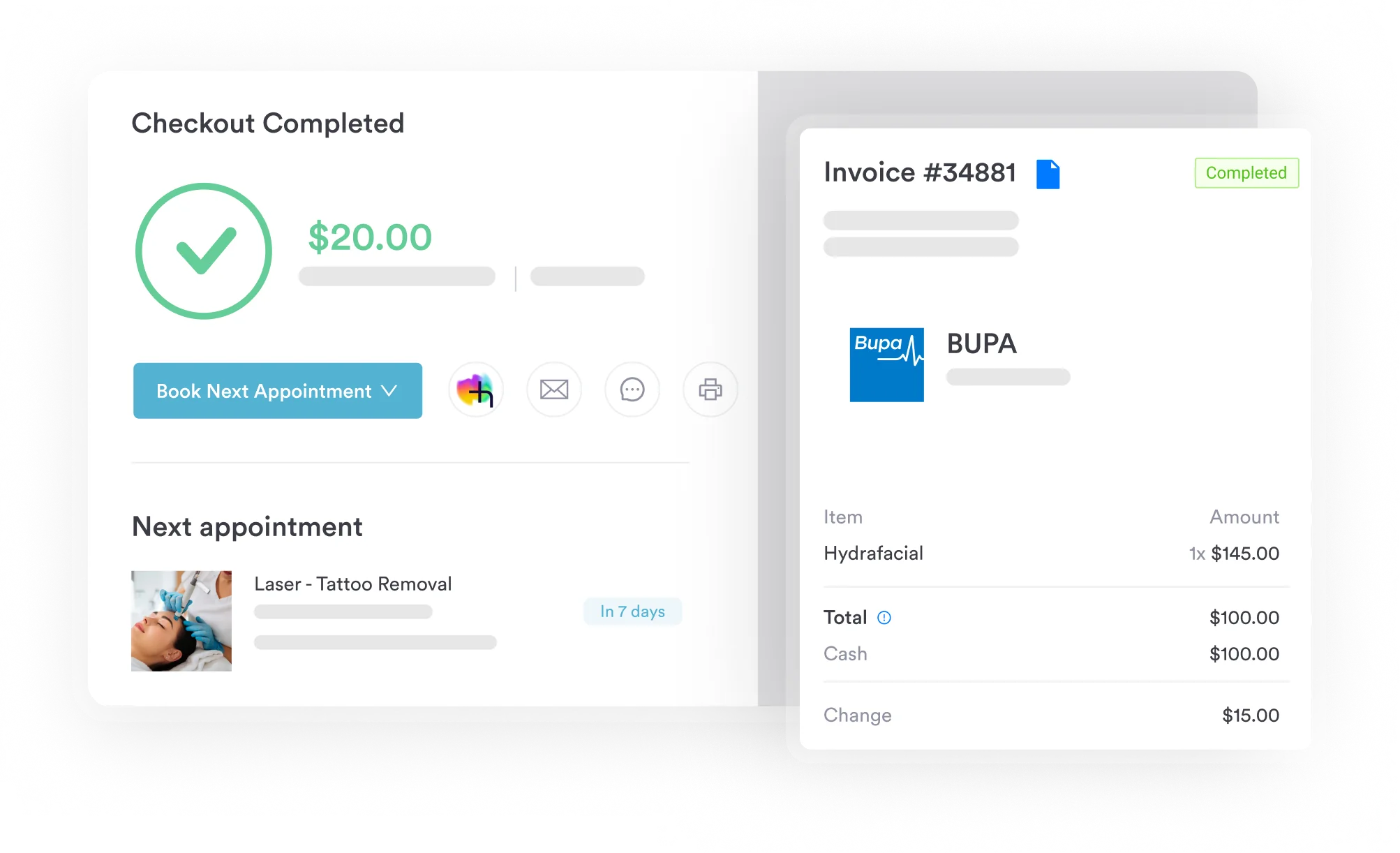

Pabau pre-fills claims from the patient record, checks required fields before sending and submits US claims through Claim.MD. Your coders spend less time fixing returned claims.

V34.4XXA rarely fails on clinical grounds. It fails on paperwork: the code in the wrong slot, an A that should be a D, or a note that never names the bus.
So put the effort upstream. Get the four facts into the note at the point of care, and the code almost picks itself. The trade-off is a slightly longer note template, which costs far less than a rework queue.
Book a demo to see how Pabau pre-fills injury claims from the patient record and checks required fields before they go out.

New to the revenue cycle? How medical billing works for injury claims covers the full cycle from documentation through remittance.
Getting denials on external cause codes? Denial management in healthcare explains how to track root causes before they repeat.
Want fewer claims sent back? What makes a clean claim outlines the pairing and sequencing rules that prevent rejections.
Was the other vehicle a car? ICD-10 code V33.3XXA covers an unspecified three-wheeler occupant in a non-traffic collision with a car, pickup truck or van.
Did the three-wheeler hit a fixed object? ICD-10 code V37.2XXA covers a person on the outside of the vehicle in a non-traffic collision with a fixed or stationary object.
Use category V38, which covers noncollision accidents for three-wheeled motor vehicle occupants. A fall while getting on or off codes to V38.4, plus the 7th character for the visit. A tuk-tuk counts as a motorized rickshaw.
Yes. Report the external cause code for each encounter where the injury is treated. Change the 7th character to match the visit: A during active treatment, D for routine recovery care and S for late effects.
Not nationally. ICD-10-CM sets no national mandate for external cause codes. You must report them if your state has a reporting mandate or a payer requires them. Many practices report them anyway, because payers use them to settle liability.
Only once, at the initial encounter. Place of occurrence (Y92) and activity (Y93) codes aren’t repeated on follow-up visits. Add them only when the record documents the place or activity.
It depends on where the crash happened. A passenger in a traffic accident codes to V34.6, and a non-traffic accident codes to V34.1. Each needs a 7th character, such as V34.6XXA for the first visit.