ICD-10 Code T31.77: Burns involving 70-79% of body surface
ICD-10 code T31.77: Quick reference and code details ICD-10 code T31.77 is the b...

Last Updated: Nov 5, 2026
Billable Code Specific Code
V35.0XXA is the billable code for driver of three-wheeled motor vehicle injured in collision with railway train or railway vehicle in nontraffic accident, initial encounter. Nontraffic means the crash happened entirely off a public highway.
It belongs to ICD-10-CM Chapter 20 (External Causes of Morbidity, V00-Y99) and is always coded as a secondary, supplemental code alongside the primary injury diagnosis. Most denials on this code trace to three errors. They are missing placeholder X characters, a wrong 7th character, or the code sequenced ahead of the injury diagnosis.
Let Pabau's smart automation suggest the right codes, reduce claim denials, and keep your practice compliant—effortlessly.
Automate repetitive tasks and focus on what matters most—your patients.
Reduce coding errors and ensure compliance with the latest regulations.
Clean claims, fewer denials, and faster reimbursements.
Powerful insights and reporting to help your practice thrive.
HIPAA compliant SOC 2 certified GDPR-compliant Trusted by 4,000+ clinics worldwide

V35.0XXA is a billable ICD-10-CM external cause code for a three-wheeled vehicle driver hit by a train off a public highway.
It is always a secondary code, sequenced after the injury diagnosis and never listed as the principal diagnosis.
Two placeholder X characters in positions 5 and 6 are required, and omitting either one makes the code invalid.
The 7th character A means initial encounter (active treatment). Switch to D for subsequent encounters and S for sequelae.
A collision on a public highway takes V35.5XXA instead, so the accident setting matters as much as the occupant role.
Pabau’s claims management software helps validate external cause code sequences before submission to reduce denials.
ICD-10 code V35.0XXA is the billable code for a three-wheeled motor vehicle (3WMV) driver hit by a railway train in a nontraffic accident. The A in the 7th position marks the initial encounter, while the patient is still under active treatment.
Nontraffic means the crash happened entirely off a public highway, such as at a private crossing or inside a rail yard. The code is valid for the current ICD-10-CM fiscal year and is listed as billable on the CMS ICD-10 codes page.
V35.0XXA is seven characters long, and each position carries a specific meaning. The two X characters in positions 5 and 6 are required placeholders, not optional filler.
They push the 7th character into the 7th position, as the CDC/NCHS ICD-10-CM Official Guidelines require. Omitting either X produces an invalid code string that payers reject outright.
The placeholder rule applies to any V35.0 variant. Coding V35.0A (five characters) instead of V35.0XXA (seven characters) is one of the most common submission errors on this code set.
The 7th character specifies when in the care episode the encounter occurs. A wrong one is an audit risk as well as a denial risk. Payers flag an A coded at a routine follow-up visit during medical record reviews.
A common coder question: Can the same injury produce multiple A encounters? Yes. The ICD-10-CM guidelines permit multiple initial-encounter visits when the patient is still under active treatment, even across different facilities or providers.
Category V35 applies only to occupants of three-wheeled motor vehicles hit by a railway train or railway vehicle. Misidentifying the vehicle type sends the claim to the wrong category, and auditors notice. A collision with an unspecified motor vehicle off a public road belongs in V39, and a passenger’s sequela visit there takes code V39.10XS.
The “railway train or railway vehicle” element covers any device built to run on railway track, with or without cars coupled to it. That includes freight, commuter, subway and elevated trains. A streetcar or tram is excluded from the railway definition, so a trike hit by a tram belongs in a different category.
The V35 category and its neighbors look similar in the tabular list, and choosing the wrong code is a specificity error. Two questions settle most cases. What was the patient’s role, and did the crash happen on a public highway? The grid below maps both answers to a code.
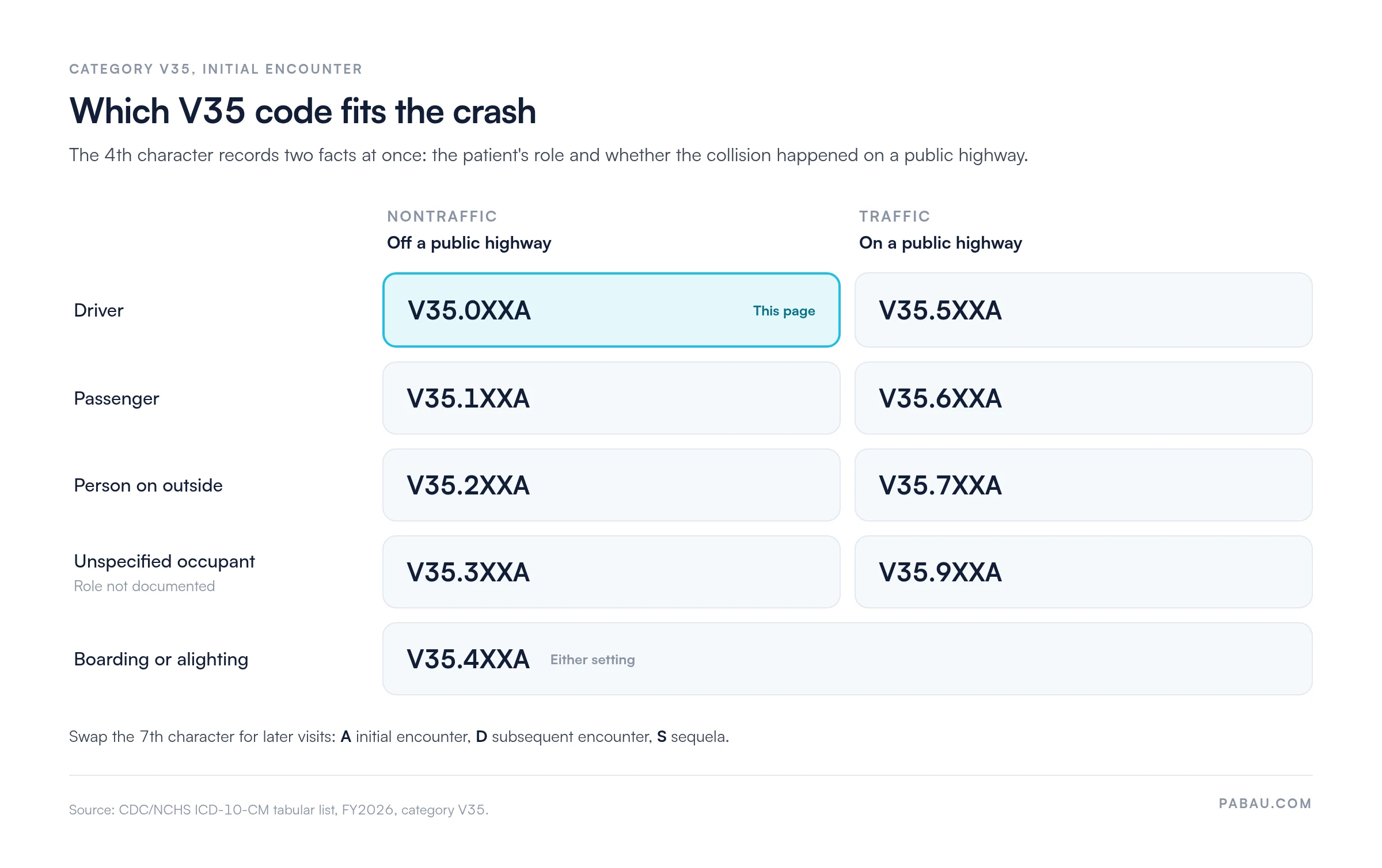
The table covers the codes coders confuse most often with V35.0XXA.
If the injured person was aboard the train rather than the trike, the occupant category changes to V81, as on V81.0XXD.
When the clinical note is unclear about the occupant’s role or the crash location, query the provider before coding. A wrong 4th character (driver, passenger or person on the outside) is a specificity error that payers can spot in police reports or liability filings.
Payers evaluating external cause code claims cross-reference them against the clinical narrative. For V35.0XXA, six documentation elements must be present and consistent.
Per the AAPC ICD-10-CM code reference, an external cause code always needs a matching injury or condition code on the same claim. The external cause code explains how and where the injury happened. The injury code explains what happened.
External cause codes in Chapter 20 are supplemental codes. They are never sequenced as the principal or first-listed diagnosis. The ICD-10-CM Official Guidelines state this as an absolute rule, and every major payer enforces it. Submitting V35.0XXA without a primary injury code will result in claim rejection.
There is no national requirement to report external cause codes. The official guidelines make them mandatory only under a state reporting mandate or a payer’s own policy.
Even so, CMS and commercial payers use accident details to decide whether auto insurance pays first. The external cause code is what flags the accident to them.
Payers that ask for external cause codes often want the place, activity and status codes too, such as Y99.8 for a leisure ride.
Third-party liability situations (where auto insurance is primary) typically require:
Denials on V35.0XXA cluster around five root causes. Knowing which one triggered a rejection tells you whether to fix the code, the note or the sequence.
Tracking external cause code rejections by root cause shows whether a problem is systemic or a one-off. A repeat placeholder error, for example, usually points to a training need. Pabau’s claims management software surfaces denial patterns by code, so teams fix repeat errors at the source.
For practices working through external cause code denials, the structured approach in denial management in healthcare applies directly to this code category.
Knowing where V35.0XXA sits in the Chapter 20 hierarchy helps coders navigate to related codes quickly and understand why external cause codes are always supplemental.
Chapter 20 codes exist purely to explain the external cause of an injury or condition documented elsewhere in the claim. To compare neighboring categories by vehicle type and collision partner, browse our library of ICD-10-CM codes.
Most V35.0XXA rejections start at the coding desk. A biller keys the injury and external cause codes by hand. The remittance then reveals that an X went missing or the sequence flipped.
Pabau checks the claim before it leaves the practice. Through its Claim.MD clearinghouse integration, your team validates ICD-10-CM code combinations, checks insurance eligibility and submits claims electronically to thousands of US payers. That supports the clean claim process, because structural errors surface while the encounter note is still open.
The outcome is fewer rework cycles on injury claims. A sequencing error gets corrected in minutes, instead of being rebuilt after a denial weeks later.

Pabau’s claims management workflows validate ICD-10-CM code sequences and flag sequencing errors before submission. See how it fits your injury billing workflow.

Treat V35.0XXA as a two-question code. Was the patient driving, and did the crash happen off a public highway? If the note can’t answer both, query the provider before the claim goes anywhere.
The structural rules never change, so the errors on this code are preventable rather than judgment calls. Build the placeholder, 7th character and sequencing checks into your medical billing workflow once, and injury claims stop bouncing back.
Book a demo to see how Pabau catches external cause code errors before your injury claims reach the payer.

Recording injury visits on paper first? Free encounter form template gives you ICD-10 and CPT fields to capture the diagnosis and external cause codes at the visit.
Comparing billing platforms for injury claims? Best medical practice billing software reviews seven platforms on how much of the visit-to-payment path they automate.
ICD-10 code V35.0XXA is the billable code for a three-wheeled motor vehicle driver hit by a railway train in a nontraffic accident, initial encounter. It is a Chapter 20 external cause code, so it is always a supplemental code alongside the primary injury diagnosis. It is never a standalone or principal diagnosis.
Yes, V35.0XXA is a valid billable ICD-10-CM code, but it is billable only as a secondary external cause code. It cannot be submitted as a primary or principal diagnosis. Every claim using V35.0XXA must also include the primary injury diagnosis code (fracture, laceration, concussion, etc.) sequenced first.
The 7th character A indicates an initial encounter, meaning the patient is receiving active treatment for the injury. Use A for emergency department visits, first surgical interventions, and initial fracture management. Switch to D (subsequent encounter) for follow-up visits and routine healing care, and S (sequela) when treating late effects after the original injury has healed.
Positions 5 and 6 in V35.0XXA are placeholder X characters with no clinical meaning. They are structurally required by the ICD-10-CM coding rules to ensure the 7th character occupies the mandated 7th position in the code string. Submitting V35.0A or V35.0XA instead of the full V35.0XXA produces an invalid code that payers will reject without adjudicating.
The key differentiators are the occupant role, the accident setting, the collision partner and the encounter type. The 4th character sets the role and setting (0 = driver, 1 = passenger, 2 = person on outside of the vehicle, 5 = driver in a traffic accident). The category sets the collision partner (V35 = railway vehicle, V34 = heavy transport vehicle, V32 = two- or three-wheeled motor vehicle). The 7th character sets the encounter (A = initial, D = subsequent, S = sequela). Confirm the vehicle type, the patient’s role and the crash location in the clinical documentation before choosing.
The four most common reasons are a code under seven characters and a 7th character that doesn’t match the visit type. The other two are V35.0XXA sequenced before the injury code, and notes that don’t confirm the vehicle type or occupant role. Each is a correctable coding error rather than a coverage issue.