ICD-10 Code S42.444P: Medial epicondyle fracture, right humerus
ICD-10 Code S42.444P: full descriptor and code validity ICD-10 Code S42.444P car...

Last Updated: Oct 13, 2026
Billable Code Specific Code
V81.0XXD is the billable ICD-10-CM code for occupant of railway train or railway vehicle injured in collision with motor vehicle in nontraffic accident, subsequent encounter.
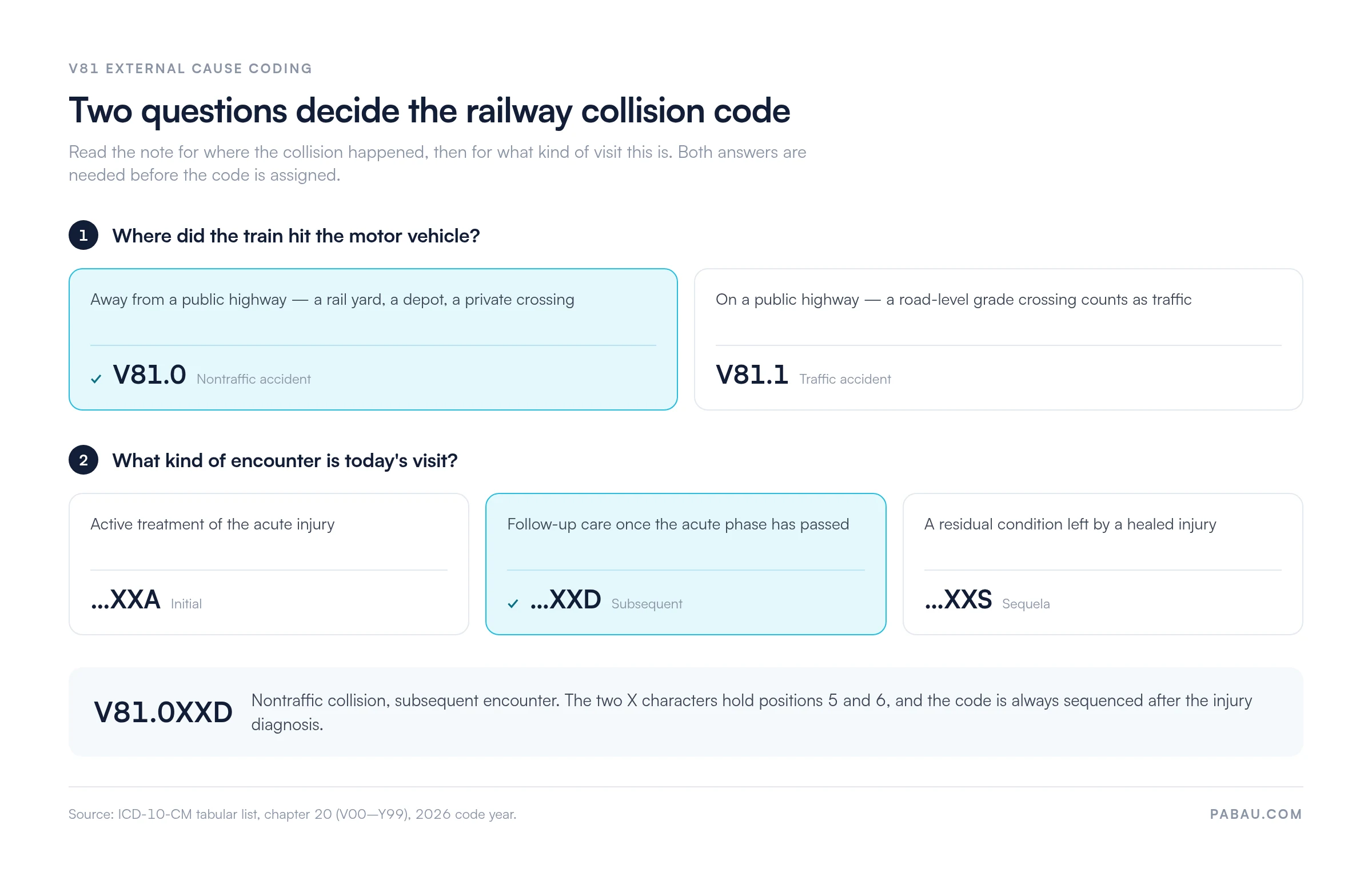
Nontraffic means the collision happened away from a public highway, inside a rail yard or on a private crossing. A collision on a public road takes V81.1 instead. The D suffix marks a follow-up visit, once active treatment of the injury has finished. The code sits in chapter 20 and is valid for the 2025 and 2026 code years. It is always reported after the injury diagnosis, never first.
Let Pabau's smart automation suggest the right codes, reduce claim denials, and keep your practice compliant—effortlessly.
Automate repetitive tasks and focus on what matters most—your patients.
Reduce coding errors and ensure compliance with the latest regulations.
Clean claims, fewer denials, and faster reimbursements.
Powerful insights and reporting to help your practice thrive.
HIPAA compliant SOC 2 certified GDPR-compliant Trusted by 4,000+ clinics worldwide

V81.0XXD covers a railway vehicle occupant injured when the train hit a motor vehicle away from a public highway, at a follow-up visit.
A collision on a public highway, including a road-level grade crossing, is a traffic accident and takes V81.1 instead.
The D suffix marks a subsequent encounter. Use V81.0XXA for the initial visit and V81.0XXS for sequela care.
V81.0XXD is always a secondary code, because ICD-10-CM chapter 20 prohibits external cause codes as the principal diagnosis.
Practice management software like Pabau flags denials by code and payer, so a repeating external cause edit surfaces early.
ICD-10 Code V81.0XXD is a fully specified, billable external cause code. The table below summarizes its attributes before we get into the code structure and the clinical application rules.
Verify current-year validity against the CMS ICD-10 codes page, which publishes the official tabular list and addenda each fiscal year. The CDC/NCHS ICD-10-CM web tool also lets you search by code number and confirm the descriptor wording.
Every character position in V81.0XXD carries a specific meaning under the ICD-10-CM coding system. Misreading any one of them, especially the placeholder Xs, is a common root cause of the formatting errors that trigger claim edits.
The two X characters in positions 5 and 6 are placeholders only. They carry no clinical meaning. Their sole purpose is to push the encounter character into the mandatory 7th position.
Billing systems that strip X characters, or that expect only meaningful digits, will reject V81.0XXD outright. The AAPC’s ICD-10-CM lookup confirms the seven-character format.
V81.0XXD applies when three things are true at once. The patient was riding on a train or other railway vehicle. That vehicle collided with a motor vehicle somewhere other than a public highway. And the current encounter is a follow-up visit rather than the original acute treatment.
This is the distinction most V81 write-ups skip, and it decides the 4th character before the 7th one is even considered. ICD-10-CM treats a vehicle accident as a traffic accident when it happens on the public highway. A nontraffic accident is one that occurs entirely somewhere else.
So V81.0 is the rail yard, the depot apron, the private crossing on farm or industrial land. A train striking a car at a road-level grade crossing is a traffic accident, and that belongs to V81.1. Coders who read V81.0 as “train hit a car” and stop there pick the wrong subcategory roughly every time a public road is involved.
Consider these scenarios, where V81.0XXD is the right external cause code:
In each case, the initial acute-care visit used V81.0XXA. The moment the patient returns for any follow-up, the coder switches to V81.0XXD. Nothing about the mechanism changes between the two visits, so only the 7th character moves.
The 7th character is the most commonly misapplied element in V81.0 coding. All three variants share the same mechanism. Only the encounter type and the clinical phase differ.
Sequela (S) is the one most often confused with subsequent encounter (D). Here is the working rule. If the original injury is still healing or being actively treated, the D suffix applies. If it has resolved and the patient presents with a residual complication that developed from it, use the S suffix instead. The ICD-10-CM Official Guidelines for Coding and Reporting define both encounter types in chapter 20.
When a patient transfers from an acute hospital to rehab after a railway accident, the rehab facility’s first encounter still uses the D suffix. The A suffix belongs to the visit where active, acute treatment began, wherever that happened.
V81.0XXD is one of many codes in the V81 category, which covers transport accidents involving railway or train vehicle occupants. Knowing the full group prevents miscoding when the collision partner, the victim type, or the setting differs from the nontraffic motor vehicle scenario.
One more confusion point worth flagging: V81.0XXD is written from the train occupant’s perspective. If the injured party was the car driver struck by a train, the correct code comes from the V40-V49 motor vehicle occupant block instead. The V81 codes are reserved for people riding on or in the railway vehicle.
Pick-up truck and van occupants code from the V50-V59 block. A person injured while boarding or alighting one of those vehicles in a train collision takes V55.4XXD at follow-up. Heavy transport vehicle occupants fall under V60-V69, where an unspecified traffic accident takes V69.9XXA at the initial visit.
External cause codes are only as defensible as the documentation behind them. For ICD-10 Code V81.0XXD, the medical record must support four specific elements.
ICD-10-CM chapter 20 guidelines, section C.20, make clear that external cause codes are supplementary. They document circumstances, not conditions. The injury diagnosis code, whether that is the patient’s fracture, contusion, or laceration, must always be sequenced first.
External cause code requirements vary by payer type. Knowing those differences prevents administrative denials that have nothing to do with the code’s clinical validity.
Practices that bill workers comp and auto liability alongside standard insurance carry three sets of rules at once. A clearinghouse that handles multi-payer submission logic is what keeps those rules from being applied by memory at the point of coding.
Most V81.0XXD denials trace back to a small set of repeating errors, and each one is preventable with a pre-submission coding check. The denial codes payers return map predictably onto these external-cause failure modes.
Tracking which of these edits repeats in your own claim data is the fastest route to stopping the pattern. One practice keeps tripping the sequencing edit; another keeps tripping the subcategory. The fix is different in each case.
Reporting V81.0XXD correctly means following a consistent five-step workflow. Deviating from the sequence, particularly at steps 1 and 2, is where most coding errors originate.
Check your billing system’s character count on every V81 code before submission. Some older clearinghouse interfaces treat the decimal point as a separator rather than a character. That can shift the placeholder Xs and send a malformed string where V81.0XXD’s seven characters belong.
In most practices, the sequencing rule and the traffic or nontraffic rule live in someone’s head. The coder remembers that V81.0XXD goes second. A locum covering the same practice does not. The claim goes out with the external cause code in position 1, and the edit comes back two weeks later.
Practice management software like Pabau keeps the whole claim in one place instead. Diagnosis codes are attached to the encounter as the visit closes. The invoice is raised against the payer at checkout, and the claim goes out through an integrated clearinghouse. Our claims management software then groups returned denials by code and by payer.
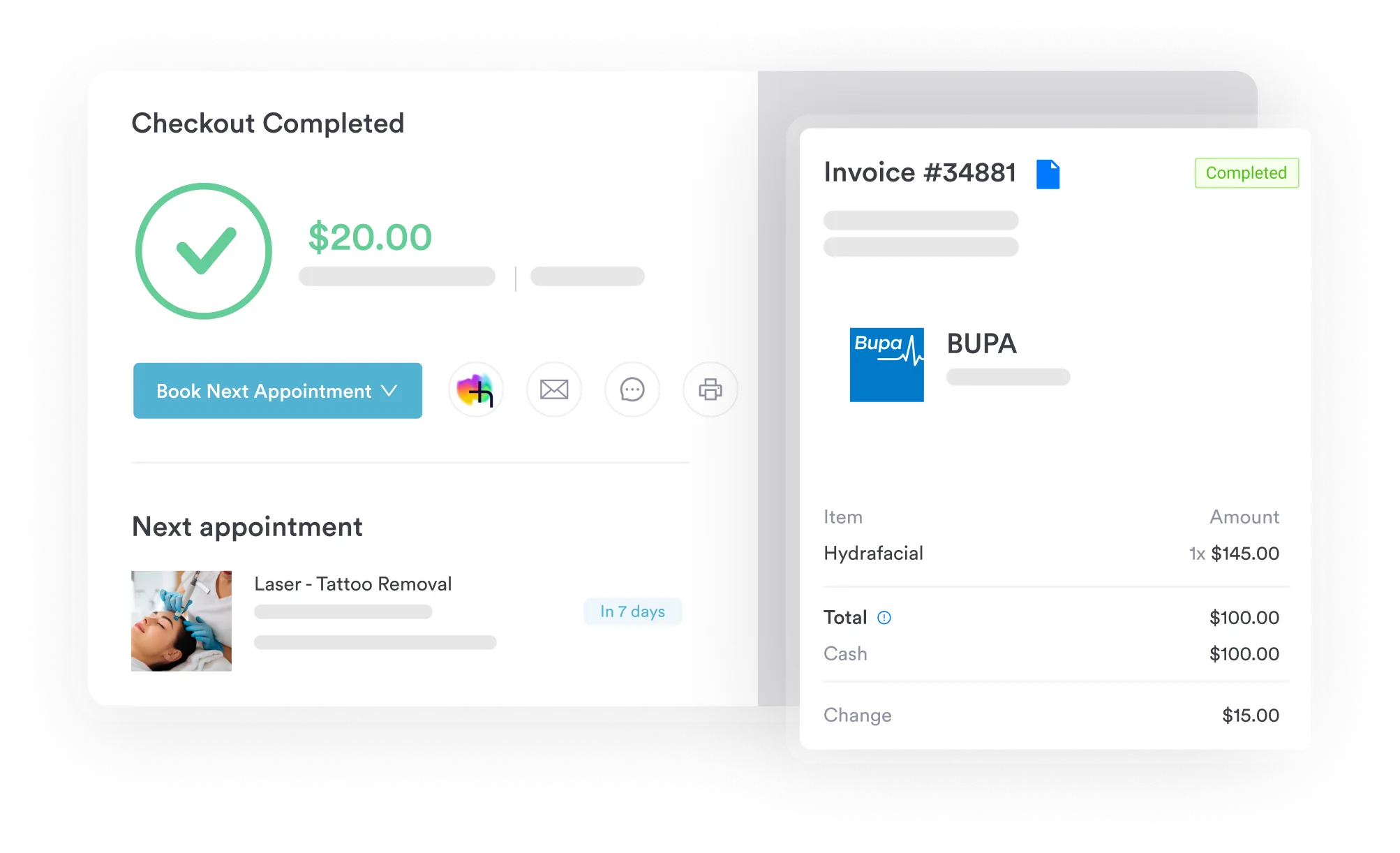
That grouping is what turns a pile of rejections into a fixable pattern. If eleven of your V81 claims came back on the same sequencing edit, that shows up in one view. You fix the workflow once, instead of reworking eleven claims one at a time.

Pabau handles multi-payer claim submission, denial tracking, and remittance reconciliation for practices treating workers comp and auto liability patients. Denials are grouped by code and payer, so a repeating edit is easy to spot.

V81.0XXD rewards a coder who reads two lines of the note carefully. Where did the collision happen, and is this the first visit or a later one? Get those two answers and the code assembles itself. Guess at either, and the claim comes back.
The trade-off worth remembering is that neither answer is clinical. Both are administrative details a treating provider has little reason to spell out unprompted. If your V81 claims are being rejected, the place to look is the intake question, not the coder. Book a demo to see how Pabau keeps injury coding, invoicing, and denial tracking in one record.

Want to see how clean claim submission is structured? Clean claim requirements covers what a payer-ready claim looks like before it reaches a clearinghouse.
Handling prior authorization for injury-related services? Insurance eligibility verification walks through the pre-submission checks that reduce denials on injury claims.
ICD-10 Code V81.0XXD is the diagnosis code for a railway train or railway vehicle occupant injured in a collision with a motor vehicle. The accident is a nontraffic one, and the encounter is subsequent. It is used for follow-up visits after the initial acute treatment has already been provided.
No. A road-level grade crossing is a public highway, so that collision is a traffic accident and takes V81.1 rather than V81.0. V81.0 is reserved for collisions that happen entirely off the public highway. Think of a rail yard, a depot apron, or a private industrial crossing.
Yes, V81.0XXD is a billable, valid ICD-10-CM code for the 2025 and 2026 code years. It can be submitted on claims but must always be sequenced as a secondary diagnosis, never as the first-listed or principal diagnosis code.
The two X characters in positions 5 and 6 of V81.0XXD are mandatory placeholder characters with no clinical meaning. They exist only to push the encounter character (D) into the required 7th position. Omitting them produces an invalid code format that billing systems will reject.
Subsequent encounter (D) applies when the original injury is still healing and the patient is receiving active follow-up care. Sequela (S) applies when the injury has healed but has left a residual condition that is now the focus of treatment. Chronic pain and scarring are typical examples. Use D while the injury is being managed, and switch to S once only its late effects remain.
Medicare fee-for-service does not universally mandate external cause codes, but it does encourage their use for injury encounters. Many Medicare Advantage plans impose their own requirements, and workers compensation and auto liability payers frequently require them. Verify the specific payer policy before submitting.
No. ICD-10-CM chapter 20 guidelines explicitly prohibit any external cause code from being sequenced as the principal or first-listed diagnosis. V81.0XXD must always follow an injury diagnosis code such as a fracture, sprain, or laceration code that appears in position 1.