ICD-10 Code R34: Anuria and oliguria
ICD-10 Code R34 is the billable ICD-10-CM diagnosis code for anuria and oliguria...

Last Updated: Oct 6, 2026
Billable Code Specific Code
V00.892S is the billable ICD-10-CM code for pedestrian on other pedestrian conveyance colliding with stationary object, sequela. It records the cause behind a late effect, such as chronic pain or scarring, after the rider of an unlisted conveyance struck a fixed object.
It is always listed after the late-effect condition and the injury code ending in S, never as the first-listed diagnosis. Coders often confuse it with V00.898S, other accident on other pedestrian conveyance, and with V00.892A and V00.892D, which cover earlier stages of care.
Let Pabau's smart automation suggest the right codes, reduce claim denials, and keep your practice compliant—effortlessly.
Automate repetitive tasks and focus on what matters most—your patients.
Reduce coding errors and ensure compliance with the latest regulations.
Clean claims, fewer denials, and faster reimbursements.
Powerful insights and reporting to help your practice thrive.
HIPAA compliant SOC 2 certified GDPR-compliant Trusted by 4,000+ clinics worldwide

V00.892S is a billable ICD-10-CM external cause code for a sequela of a collision with a stationary object while riding an other pedestrian conveyance.
It is valid in the FY2027 code set, effective October 1, 2026, and the FY2027 addenda made no change to category V00.
V00.892S is not V00.898S. A fall from the conveyance is V00.891S, and any other accident on it is V00.898S.
Use it only when the conveyance has no code of its own. Strollers, wheelchairs, mobility scooters, e-scooters, skates, sleds, skis and boards all do.
Sequence the late-effect condition first, then the injury code with an S, then V00.892S. An external cause code is never the principal diagnosis.
Pabau’s billing software validates each claim for missing details before it sends, so sequela claims leave complete.
ICD-10 Code V00.892S means “Pedestrian on other pedestrian conveyance colliding with stationary object, sequela.” It is a billable external cause code for encounters that treat a late effect of that collision. The external cause code never stands alone in the medical billing process, so read the descriptor before you build the claim.
The code reads in three parts. V00 is the pedestrian conveyance accident category. The .892 places the event as a collision with a stationary object while riding an other pedestrian conveyance. The S marks a sequela encounter.
Each part must be right before the claim goes out. Change the sixth character from 2 to 8 and you have V00.898S, a different accident. Change the seventh and you report a different stage of care.
V00.892S covers the late effects of one mechanism: a person riding a pedestrian conveyance collides with a stationary object. The conveyance must be one that ICD-10-CM does not classify anywhere else. In the CDC/NCHS ICD-10-CM External Cause Index, it is the path Accident, transport, pedestrian, conveyance, specified type NEC, collision, stationary object.
The rider strikes something fixed, such as a wall, curb, post, bollard, bench or doorframe. The injury, and the late effect that follows it, comes from that impact.
Two neighboring mechanisms use different codes. A fall from the conveyance with no collision is V00.891S. Any other accident on the conveyance, such as a collision with another person on a conveyance, is V00.898S.
Most pedestrian conveyances have their own codes, and most of those have a collision code of their own. Check this list before reaching for V00.892S:
V00.892S is left for a conveyance the record names but none of these entries describe. It is also not a default for “type not documented.” Query the provider if the chart does not say what the patient was riding.
Collisions with vehicles: V00 covers accidents involving only the pedestrian conveyance. If the rider collided with a car, bicycle or other land transport vehicle, code from V01-V09 instead.
The 7th character S marks an encounter for a condition that arose as a direct result of the original injury. Per the CDC/NCHS ICD-10-CM Official Guidelines for Coding and Reporting, Section I.B.10, a sequela is the residual effect after the acute phase has ended.
The same guidelines set no time limit on a sequela. Section I.C.20.i says external cause sequelae are reported with the 7th character S, for any late effect of a previous injury.
Common sequela conditions after a collision with a fixed object include chronic pain, post-traumatic arthritis, scar contracture and residual stiffness. None of these is the original fracture or laceration. Each one is what persists afterward.
The test is simple. Ask whether the provider is treating the original injury or a downstream consequence of it. If the visit is for the consequence, the encounter is a sequela and S is correct.
One limit matters for therapy practices. Section I.C.20.i.3 says not to use a sequela external cause code for routine follow-up or rehabilitation when no late effect is documented.
V00.892A, V00.892D and V00.892S describe the same event, a collision with a stationary object while riding an other pedestrian conveyance. They represent three different encounters. Section I.C.20.a.2 says the external cause 7th character should match the 7th character of the injury code for that encounter.
The most common error runs one direction. Coders apply D when S is correct, because any visit after the acute phase feels like a subsequent encounter. Once the injury has healed and the patient returns for a residual condition, the encounter is a sequela.
The three V00.89 sequela codes share a conveyance and a 7th character. They split on what happened, so the accident description in the chart decides which one applies.
V00.892S sits at the bottom of this path: block V00-V09, category V00, subcategory V00.8, parent V00.89, code V00.892, then the billable V00.892S. It inherits every note above it in the tabular list.
The block note for V00-V09 repeats three of these: W03, W00.- and W51. The ice and snow exclusion sends a slip on foot to W00. It has no link to V00.0, which covers a pedestrian on foot hit by someone riding a conveyance.
The practical rule is to work down the tree, as the path below shows. Rule out a vehicle collision, then each named conveyance, then the rolling, gliding and flat-bottomed residual codes. Only then does V00.892S apply.
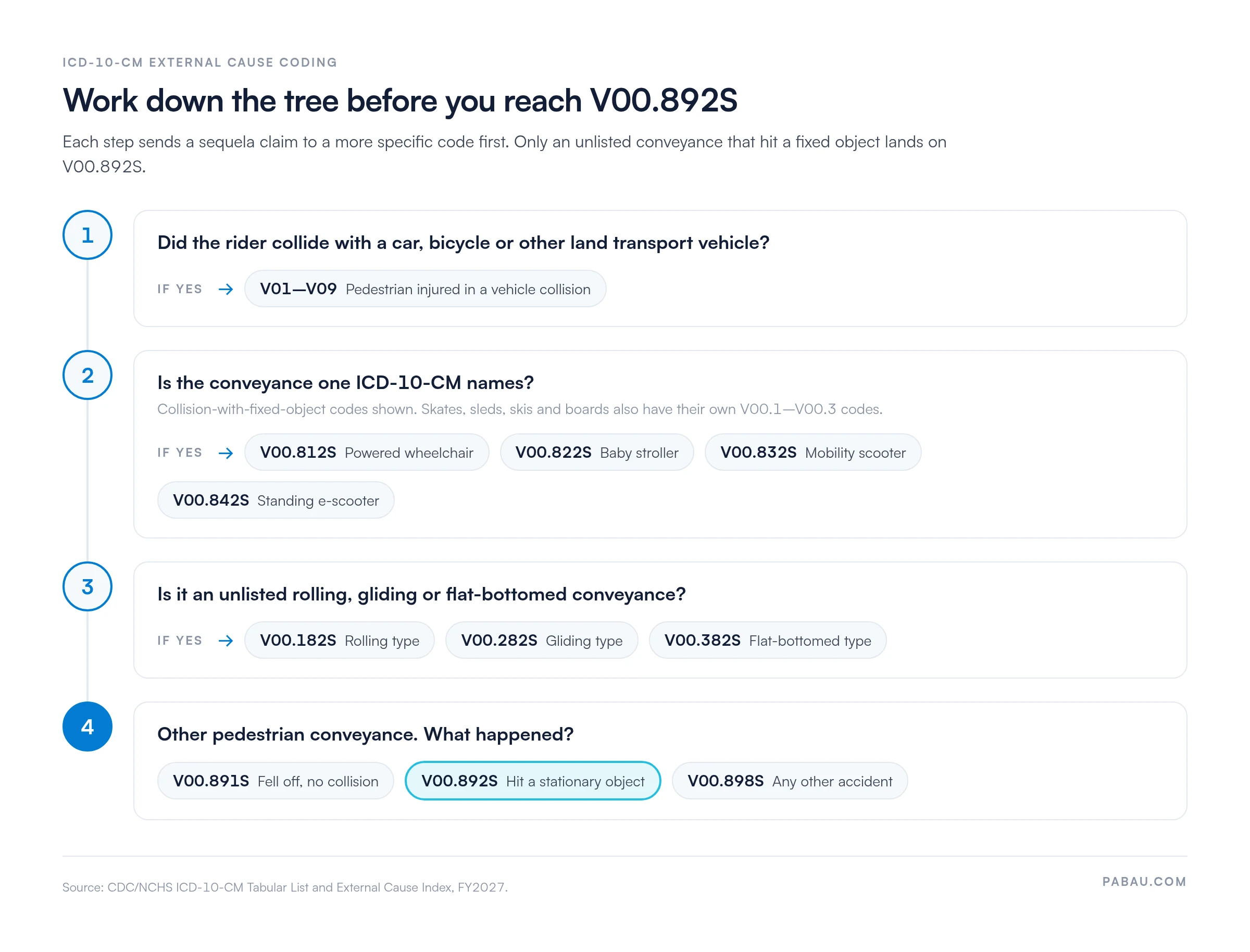
V00.892S is never reported alone. Guideline I.B.10 puts the sequela condition first. Guideline I.C.19.a adds the injury code with an S, and the external cause code follows both.
Practices submitting through the Claim.MD clearinghouse can review the code order before submission. These codes often appear with V00.892S, in this order:
The S goes only on the injury code, never on the condition code. M79.622, G54.2 and G89.21 take no 7th character at all, so “M79.622S” or “G54.2S” is an invalid code.
Physical therapy and rehabilitation practices code many sequela encounters. Patients often return months or years later for stiffness, chronic pain or functional rehabilitation.
Build every sequela claim in three layers: the late-effect condition, the injury code ending in S, then V00.892S. If V00.892S appears in position 1 on any claim, fix it before submission. An external cause code can never be the principal diagnosis.
The medical record must connect the current condition to the earlier collision for V00.892S to survive audit. Meeting clean claim standards takes documentation that answers four questions.
Auditors look for the causal statement first. Without it, a sequela visit looks like any musculoskeletal or pain management visit with no accident behind it.
Payer policies on external cause codes vary by state and by insurer. Meeting billing compliance requirements for V00.892S means checking each payer’s stance before you submit.
National rule: the official guidelines say there is no national requirement to report external cause codes. Reporting is required only under a state mandate or a payer’s own policy. Otherwise, providers are encouraged to report them voluntarily.
Medicaid and state mandates: some states require external cause codes for injury encounters, while others do not. Check the state Medicaid billing manual and any state reporting rule before assuming they are optional.
Commercial payers: some commercial insurers require external cause codes on accident-related claims, especially where a third party may be liable. An accident code on a sequela claim may prompt a coordination of benefits (COB) inquiry about who pays.
Claims management software that validates claims before submission cuts the rework these inquiries create.
Five predictable errors sit behind the V00.892S denials a practice can prevent. Denial management workflows that flag these patterns before submission stop many of them.
If a claim comes back anyway, the payer’s denial reason codes show which of these errors to fix first.
Run a monthly audit of every claim carrying V00.892S. Pull any claim where the code sits in position 1, or where no S-coded injury code precedes it. Then check that each chart names the conveyance and the fixed object struck.
Sequela claims fail on order and evidence. The condition, the injury code and V00.892S must appear in sequence, and the chart must support each one. Many practices check this by hand, claim by claim, after the visit is closed.
In Pabau, the practice management platform we build, the clinical note, the diagnosis codes and the claim sit in one patient record. Coders see the accident history next to the codes, so they can check the mechanism and the 7th character against the chart.
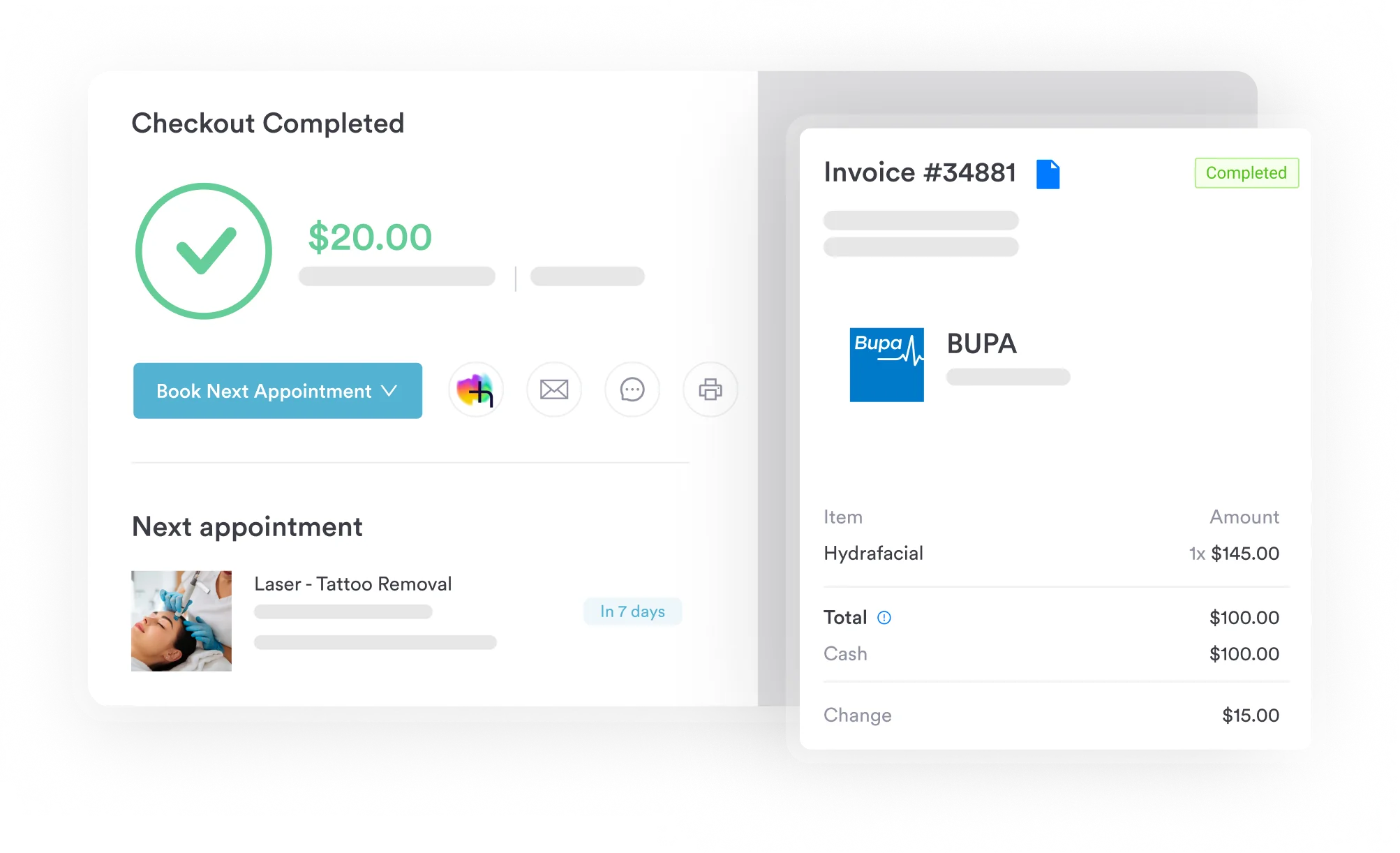
Pabau runs validation checks each time you send a claim, and the Send button stays disabled until required details are complete. US practices submit through Claim.MD, then track claim status and post electronic remittance advice (ERA) without leaving Pabau.

Pabau validates each claim before it goes out and tracks its status after, so sequela claims reach payers complete.

V00.892S is narrow by design. It fits one mechanism, one family of unlisted conveyances and one stage of care. Most charts that seem to need it belong to a named conveyance code, to V00.891S or to V00.898S.
Make the chart name the conveyance and the fixed object before you code. That one habit settles the mechanism, the conveyance and the 7th character, and it is what an auditor checks first.
Sequela claims that go out in the right order, with the evidence attached, rarely need a second pass. Book a demo to see how Pabau helps you submit complete sequela claims and track claim status.

Need to understand clearinghouse claim validation? Claim.MD clearinghouse overview explains how electronic claim validation catches coding errors before payer adjudication.
Want to see where external cause codes fit in billing? Revenue cycle management fundamentals covers how external cause codes fit into the broader billing lifecycle.
Want to reduce claim rework across your practice? Superbill documentation guide walks through how to structure encounter records so code selection is defensible at audit.
ICD-10 Code V00.892S means “Pedestrian on other pedestrian conveyance colliding with stationary object, sequela.” It is a billable external cause code for treating a late effect, such as chronic pain or post-traumatic arthritis. The original injury came from riding a conveyance with no code of its own into a fixed object, such as a wall or curb.
All three describe the same collision with a stationary object. V00.892A is for encounters where the injury is under active treatment. V00.892D is for routine care while it heals. V00.892S is for treating a late effect after the injury has healed. Match the external cause 7th character to the injury code’s 7th character.
Yes, V00.892S is a billable ICD-10-CM code and needs no further characters. It cannot be the principal or first-listed diagnosis. List the sequela condition first and the injury code with an S second, then V00.892S.
No. Guideline I.C.20.a.6 says an external cause code can never be the principal or first-listed diagnosis. The sequela condition, such as G89.21 chronic pain due to trauma, is listed first. The injury code with an “S” follows, then V00.892S.
There is no national requirement to report external cause codes, according to the ICD-10-CM Official Guidelines. They are required only where a state mandate or a payer’s own policy calls for them. Some commercial payers require them on accident-related claims, so check each payer’s billing manual.
Yes. V00.892S is valid in the FY2027 ICD-10-CM code set, effective October 1, 2026, and the FY2027 addenda made no change to category V00. Check the CMS and CDC/NCHS update files each October, because codes and descriptors can change.