ICD-10 code S61.201A: Open wound of left index finger without nail damage
ICD-10 code S61.201A covers a left index finger wound of unstated type ICD-10 co...

Last Updated: Oct 16, 2026
Billable Code Specific Code
V00.01XD is the billable ICD-10-CM code for pedestrian on foot injured in collision with roller-skater, subsequent encounter.
Two details trip billing teams up on this code. The first is the seventh character, because the non-billable parent V00.01 or the wrong encounter letter triggers a denial. The second is the neighboring code V00.02, which covers skateboarders rather than roller-skaters.
Let Pabau's smart automation suggest the right codes, reduce claim denials, and keep your practice compliant—effortlessly.
Automate repetitive tasks and focus on what matters most—your patients.
Reduce coding errors and ensure compliance with the latest regulations.
Clean claims, fewer denials, and faster reimbursements.
Powerful insights and reporting to help your practice thrive.
HIPAA compliant SOC 2 certified GDPR-compliant Trusted by 4,000+ clinics worldwide

V00.01XD is a billable ICD-10-CM code for a pedestrian struck by a roller-skater, used only at subsequent (follow-up) encounters, not initial treatment.
V00.02 is a different code entirely. It covers a collision with a skateboarder, so check the conveyance in the note before you pick between the two.
The parent code V00.01 is non-billable. Append XA (initial), XD (subsequent), or XS (sequela) to create a valid submission.
V00.01XD is exempt from Present on Admission (POA) reporting, as are all external cause codes under CMS policy.
Pabau’s claims management integration with Claim.MD supports accurate ICD-10 code submission and real-time eligibility checks for US practices.
V00.01XD is a specific, billable ICD-10-CM code. The table below captures the key reference data coders and billing teams need before submitting a claim.
The CDC/NCHS ICD-10-CM web tool provides the official tabular list for FY2026. Use it to confirm V00.01XD’s billable status and its place in the V00 hierarchy.
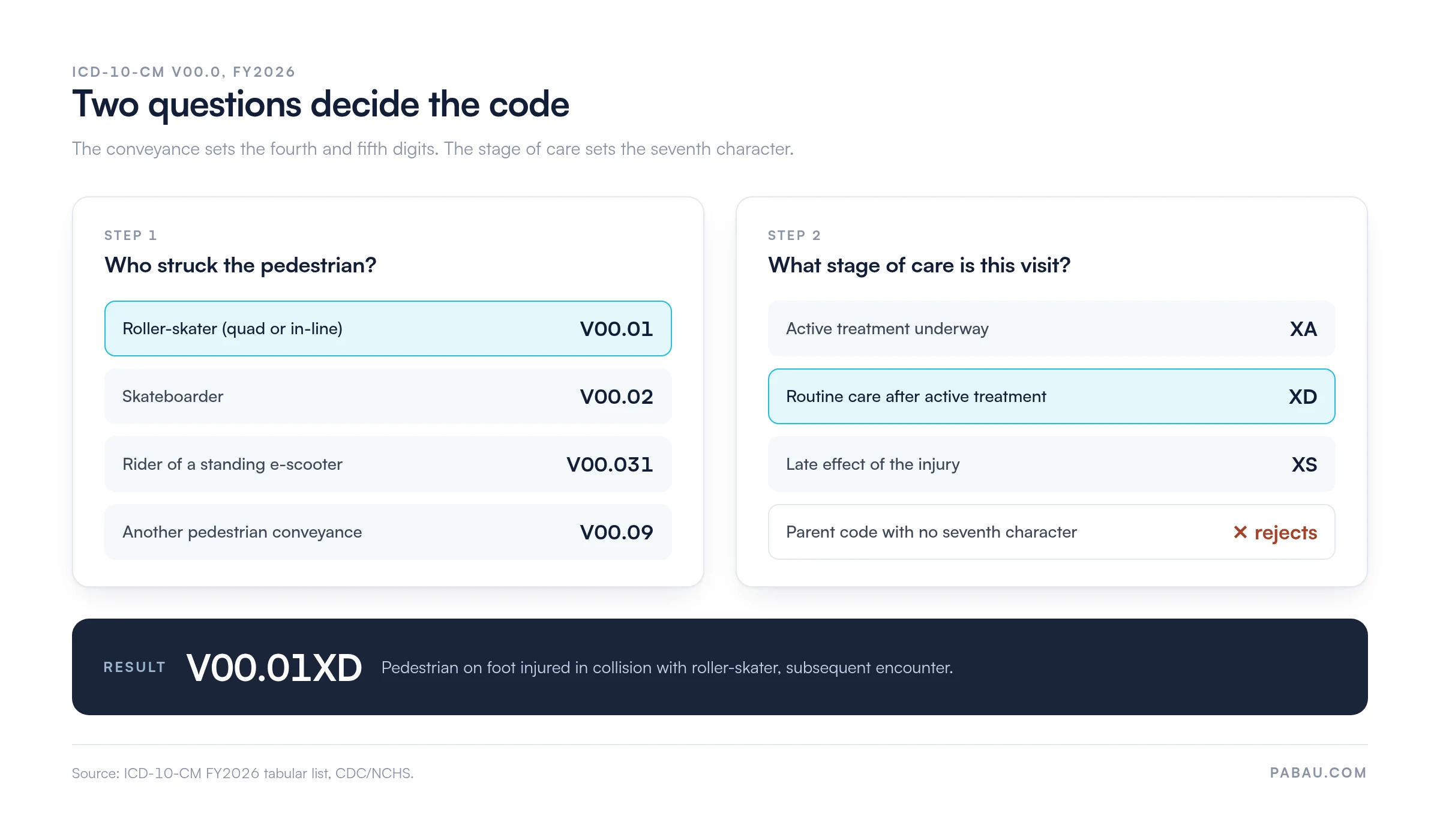
Use V00.01XD when the person who struck the pedestrian was on roller-skates, and V00.02XD when that person was on a skateboard. The two codes sit side by side under V00.0 and share an identical seventh character structure. Only the conveyance differs.
That single digit is the most common source of error on this code family. Both descriptors read “pedestrian on foot injured in collision with,” so a coder scanning the tabular list quickly can land one row off. Published code references and third-party summaries get the pairing wrong too. Check the tabular list rather than a search result.
If the note only says “struck by a skater” with no further detail, query the clinician before assigning either code. A guess between V00.01 and V00.02 is not defensible in an audit, and the correction costs more than the query did.
The conveyance can also move the claim out of the V00 category. When a motorcycle, moped or motor scooter struck the pedestrian off a public highway, the initial encounter is V02.00XA.
The seventh character in ICD-10-CM external cause codes designates the type of encounter: A for initial, D for subsequent, and S for sequela. Each character signals something different to the payer about where the patient is in their care episode.
Character D (subsequent encounter) applies once active treatment has concluded. The patient returns for wound checks, physical therapy, cast or splint changes, or other routine recovery management. The injury itself does not need to be fully resolved. The distinguishing factor is that the provider is no longer delivering acute intervention.
Character S (sequela) is not interchangeable with D. Sequela applies when the visit is for a late effect of the original roller-skate collision. Chronic joint instability appearing months later is a typical example. That distinction matters for billing accuracy and for payer audits.
The placeholder X in the fifth and sixth positions is not optional. V00.01D is an invalid code, and a claim carrying it will reject at the clearinghouse before it reaches the payer.
All three billable child codes under V00.01 describe the same mechanism: A pedestrian on foot struck by a roller-skater. The only variable is the care stage. A common denial trigger is selecting V00.01XA for every visit by default, including follow-up appointments where D is correct.
The CMS ICD-10-CM coding page publishes annual guidelines that confirm this A/D/S framework. ICD-10-CM Official Guidelines for Coding and Reporting are maintained by NCHS and CMS. They define subsequent encounter as the healing and recovery phase, whether or not healing is complete. Read alongside the conveyance rule above, those two choices narrow the V00.0 subcategory to a single code.
V00.01XD applies in any situation where a pedestrian previously injured by a roller-skater returns for follow-up care after active treatment concluded. The visit purpose drives the character selection, not the date or the number of visits.
In each scenario, the visit is routine and recovery-oriented rather than acutely therapeutic. If the provider is administering a new procedure or surgical intervention for the same injury, reconsider whether V00.01XA applies again for that specific encounter.
Tracking follow-up encounters accurately is where practice management software like Pabau earns its place. Its patient records let clinicians record the encounter type and the care stage inside the clinical note. That supports accurate seventh character selection at the point of care.
Document the care stage explicitly in the encounter note. Write something like ‘patient is in recovery phase; initial fracture management completed at [facility] on [date]’. That line lets the coding team assign character D confidently, and it defends the selection in a payer audit.
External cause codes like V00.01XD require supporting clinical documentation. The medical record must establish two points clearly enough for a coder to assign the code without inference. Those are the mechanism of injury, meaning a collision with a roller-skater, and the stage of care.
The AAPC ICD-10-CM code reference highlights that external cause codes are supplemental and must accompany the primary diagnosis code, not replace it. For practices managing medical billing compliance, documentation templates that capture encounter type, mechanism, and primary diagnosis in a structured format reduce coder ambiguity.
V00.01XD is exempt from Present on Admission (POA) reporting. POA exemption means hospital coders are not required to report whether this external cause code was present at the time of admission.
CMS policy exempts all external cause of morbidity codes (the V00-Y99 range) from POA requirements. V00.01XD describes the cause of the injury rather than a clinical condition. It cannot be “present on admission” the way a comorbid disease can. This simplifies inpatient coding for facilities using the code alongside principal diagnosis codes on hospital claims.
For outpatient claims, POA reporting does not apply at all, so the exemption is relevant only in the inpatient hospital setting. Physician office and outpatient facility coders can disregard the POA field for V00.01XD entirely.
These are the most frequent mistakes coders make with ICD-10 code V00.01XD and the V00.0 code family.
Understanding denial codes helps coding teams identify which error triggered a rejection, so the right correction happens before resubmission. A claim denied for an invalid code or a missing seventh character can often be resubmitted the same day, once the root cause is clear.
V00.01XD sits within the V00.0 subcategory, which covers pedestrians on foot injured by nonmotorized pedestrian conveyances. The table below maps the parent codes, the two sibling seventh-character variants, and the neighboring conveyance codes coders reach for most often.
Note that V00.1 covers a different situation again. Those codes describe an injury to the person riding the roller-skates, not the pedestrian. Check who was on wheels before moving between V00.0 and V00.1.
That check also points to codes outside V00.0 and V00.1. When the injured patient was riding a conveyance with no code of its own and struck a stationary object, the sequela is V00.892S.
The broader V00-V09 range covers all pedestrian transport accident external cause codes. The WHO ICD-10 browser provides the international hierarchy. The CDC/NCHS tool gives the US clinical modification (CM) version used for American billing.
Inside that V00-V09 range, V06 handles a pedestrian hit by a nonmotor vehicle instead of by another person on a conveyance. V06.90XA is the initial-encounter code there, used for an animal-drawn vehicle or a ridden animal.
NCHS and CMS jointly publish the ICD-10-CM Official Guidelines for Coding and Reporting. Those guidelines define subsequent encounter as the period of “routine care during the healing or recovery phase.” Key guidance points for FY2026 include:
The same D rules apply across the rest of the transport accident codes. A follow-up visit after a golf cart boarding injury takes V86.49XD, built from the same placeholder X and D character.
Guidelines only pay off if they survive the trip from the note into a submitted claim. Pabau’s Claim.MD integration ships with ICD-10-CM and CPT catalogs that validate codes before transmission. That lowers rejection rates on external cause code submissions.
Seventh-character errors usually start in the clinical note. Coders work from what the clinician recorded, so when the encounter type and the conveyance are missing from the note, the wrong code follows.
Pabau ties the diagnosis coding step to the billing workflow, so practices get claims management without rework. Clinicians document the encounter type in structured notes. That information flows into the billing queue without manual re-entry.
Pabau’s integration with Claim.MD supports over 4,000 US payers via CMS-1500 and 837P formats. It adds real-time eligibility verification and electronic remittance advice (835). Through the same integration, practices handle secondary claims, corrected claims, and CARC denial reason tracking in one system.
For injury follow-up visits where ICD-10 code V00.01XD or a related subsequent encounter code applies, the workflow runs end to end. The attending clinician’s note captures the encounter stage, and the coder reviews it in the same system. The claim is then validated against ICD-10-CM catalogs before submission.
That closed loop catches most seventh-character errors before a payer sees them. How often a claim comes back for rework depends on the documentation habits built into the workflow.
Run a quarterly audit of claims submitted with external cause codes. Filter by seventh character and look for V00.01XA appearing on visits that are clearly follow-up encounters. Then filter by code and check whether any V00.02 claims describe a roller-skater rather than a skateboarder. Those two checks catch the errors this code family is most prone to.

Pabau integrates with Claim.MD to validate ICD-10 codes, check eligibility in real time, and submit clean claims for US practices. See how Pabau reduces coding errors and denial rates.

ICD-10 code V00.01XD is the specific, billable external cause code for follow-up care after a pedestrian was struck by a roller-skater. Two details decide whether the claim clears. The fourth and fifth digits must say 01 for a roller-skater, not 02 for a skateboarder. The seventh character must say D once active treatment is complete.
Both choices are only as defensible as the note behind them. A record that names the conveyance and states the care stage takes the guesswork out of the assignment. It also holds up when a payer asks.
Pabau’s billing workflow connects to Claim.MD for electronic claim submission and remittance advice processing. US practices submit ICD-10 coded claims cleanly the first time. To see how Pabau handles diagnosis coding, encounter documentation, and claims management, book a demo with our team.

Need to understand how claims move through the billing cycle? What is medical billing walks through the end-to-end process from encounter to payment posting.
Coding a clean claim starts before submission? Clean claim fundamentals covers the fields and code combinations that clear payer edits on first pass.
Wondering how denial management fits into your revenue cycle? Denial management in healthcare explains how to identify, track, and appeal claim denials systematically.
ICD-10 code V00.01XD is the billable ICD-10-CM diagnosis code for “pedestrian on foot injured in collision with roller-skater, subsequent encounter.” It is an external cause code valid for FY2026. Use it when a patient returns for routine follow-up care after active treatment for the collision injury has finished.
V00.01XD covers a pedestrian on foot injured in collision with a roller-skater. V00.02XD covers a pedestrian on foot injured in collision with a skateboarder. Both are subsequent encounter codes with identical structure, so the only difference is the conveyance the other party was riding. If the clinical note does not name the conveyance, query the clinician rather than guessing.
Use V00.01XA (initial encounter) when the patient is receiving active treatment for the injury. Use V00.01XD (subsequent encounter) once active treatment is complete. That covers routine recovery care such as wound checks, splint changes, or physical therapy. Continuing to use XA for follow-up visits is a common coding error that payers flag.
Subsequent encounter (seventh character D) applies when the patient is still healing from the original injury and receiving routine care. Sequela (seventh character S) applies when the visit is for a late effect of the original injury. Chronic instability or scarring that appears after healing is a typical example. The two are not interchangeable. Sequela requires a separate code for the late-effect condition, sequenced before the external cause code.
Yes, V00.01XD is a billable, specific ICD-10-CM code valid for claim submission in FY2026. The parent code V00.01 is not billable. You must use one of the three child codes (V00.01XA, V00.01XD, or V00.01XS) to submit a valid claim. The placeholder X is required, so V00.01D will reject as an invalid code.
Yes, V00.01XD is exempt from POA reporting. CMS policy exempts all external cause of morbidity codes (the V00-Y99 range) from POA requirements. For outpatient claims, POA reporting does not apply at all, so the exemption is relevant only in the inpatient hospital setting.
The sibling codes under V00.01 are V00.01XA (initial encounter) and V00.01XS (sequela). The V00.0 subcategory also holds V00.02XD for a skateboarder collision and V00.031D for a standing electric scooter rider. V00.09XD covers any other pedestrian conveyance. All share the same A/D/S seventh character structure.