

ICD-10 Code S42.444P: Medial epicondyle fracture, right humerus
ICD-10 Code S42.444P: full descriptor and code validity ICD-10 Code S42.444P car...

Last Updated: Oct 13, 2026
Billable Code Specific Code
V86.49XD is the billable ICD-10-CM code for a person injured while boarding or alighting from another special all-terrain or off-road motor vehicle, subsequent encounter. Its inclusion terms are go-carts and golf carts, which makes it the residual option for vehicles the tabular list does not name separately.
Three errors derail these claims. Coders submit V86.49XD as a standalone principal diagnosis, which it can never be. They drop the placeholder X and send the invalid string V86.49D. Or they reach for V86.49XD after an ATV or snowmobile injury, when V86.45XD and V86.42XD are correct.
Let Pabau's smart automation suggest the right codes, reduce claim denials, and keep your practice compliant—effortlessly.
Automate repetitive tasks and focus on what matters most—your patients.
Reduce coding errors and ensure compliance with the latest regulations.
Clean claims, fewer denials, and faster reimbursements.
Powerful insights and reporting to help your practice thrive.
HIPAA compliant SOC 2 certified GDPR-compliant Trusted by 4,000+ clinics worldwide

V86.49XD is the billable ICD-10-CM external cause code for a subsequent-encounter visit after a golf cart or go-cart boarding injury.
The fifth character 9 means “other vehicle”, not “unspecified occupant”. An ATV boarding injury is V86.45XD and a snowmobile one is V86.42XD.
It is always a secondary code. A principal injury diagnosis, such as an S-code fracture or sprain, must appear first on every claim.
The placeholder X between V86.49 and the 7th character D is mandatory. V86.49D is an invalid string and is rejected at the clearinghouse.
Pabau’s claims management software supports ICD-10 external cause code entry and connects to Claim.MD for US claim submission and eligibility checks.
ICD-10 Code V86.49XD is the external cause of morbidity code for a golf cart or go-cart boarding injury at a subsequent encounter. It covers any other off-road vehicle the tabular list does not name separately. Go-cart and golf cart are the two inclusion terms printed under V86.49.
The 7th character D marks a subsequent encounter. Active treatment has already been delivered, and this visit covers routine healing care, wound checks, or rehabilitation.
The code sits in ICD-10-CM Chapter 20 (External causes of morbidity, V00-Y99). Its parent block is V80-V89, other land transport accidents. The immediate parent category is V86, occupant of special all-terrain or other off-road motor vehicle, injured in transport accident. The full parent-to-leaf hierarchy is shown below.
One point in that hierarchy causes more mis-coding than the rest of the code combined. In the V86.4 subcategory the fifth character identifies the vehicle, not the occupant’s role. In V86.49, “other” means a vehicle this subcategory does not list.
It never means that the record fails to say whether the patient was the driver or a passenger. Occupant role is carried by the fourth character elsewhere in V86, and it plays no part in a boarding or alighting code.
V86.49XD is the residual option in its subcategory. Reach for it only after checking that the documented vehicle is not one of the six types the tabular list names on its own. The table below maps each V86.4 fifth character to its vehicle and its subsequent-encounter code.
The practical reading is short. A golf cart or a go-cart goes to V86.49XD. Any other off-road vehicle goes there too, but only once the coder has ruled out the six named types above. An ATV never does, and neither does a snowmobile.
The code also depends on the mechanism. V86.49XD applies while the person is boarding (mounting, climbing in) or alighting (dismounting, stepping off). An occupant already seated and riding is coded elsewhere in V86. Verify both the vehicle and the mechanism against the current CMS ICD-10-CM annual tabular list for the fiscal year of the encounter.
Category V86 carries Excludes1 notes, and an Excludes1 note means the two codes can never appear together on the same claim for the same encounter. Three exclusions do most of the work.
Motorcycles and mopeds sit in V20-V29 and passenger cars in V40-V49, so neither can be coded to V86.49XD. Watercraft and aircraft fall outside V86 altogether.
The 7th character extension is what separates V86.49XA, V86.49XD, and V86.49XS. Choosing the wrong one is the single most common audit trigger on these claims.
“Subsequent encounter” does not simply mean any visit after the first. Per ICD-10-CM Official Guidelines Section I.C.19, the patient must still be receiving active treatment or routine healing care for the injury.
Once the injury resolves and the patient returns for a late effect, switch to V86.49XS. Pair it with the appropriate sequela condition code. Chronic wrist pain two years after a healed fracture is the textbook example.
The placeholder X rule: V86.49 has only five characters. ICD-10-CM requires the 7th character extension, but the code cannot carry it at position six without a filler. The letter X occupies that position, making the valid string V86.49XD rather than V86.49D.
The truncated version fails format validation at the clearinghouse before the claim reaches the payer. It comes back as an immediate rejection rather than a denial with a CARC reason code.
Five code-selection errors account for most V86.49XD denials. The table below maps each mix-up to the correct alternative and explains the distinction.
The riding-versus-boarding distinction matters most on workers’ compensation and liability claims. A groundskeeper who falls stepping off a golf cart is coded V86.49XD. The same worker thrown from the cart mid-drive is coded to the relevant V86.09 or V86.59 group. Document the mechanism explicitly, because it can decide which insurer carries the claim.
V86.49XD is an external cause code, so the medical record must justify it independently of the principal injury diagnosis. Payers running post-payment audits look for four documentation elements before they accept the assignment.
External cause codes have supplemental status under the UHDDS definition of principal diagnosis. They document the circumstances of the injury rather than the injury itself, which is why the S-code always leads. Practices that build the check into their charge-capture template catch a missing S-code before the claim is created.
Sequencing follows ICD-10-CM Official Guidelines Section I.C.20, which governs every external cause code assignment.
Take a worked example. A patient catches a foot stepping down from a golf cart at a resort and falls onto an outstretched right hand. Six weeks later the patient returns for a cast check on a healing radial shaft fracture. That follow-up claim is sequenced like this.
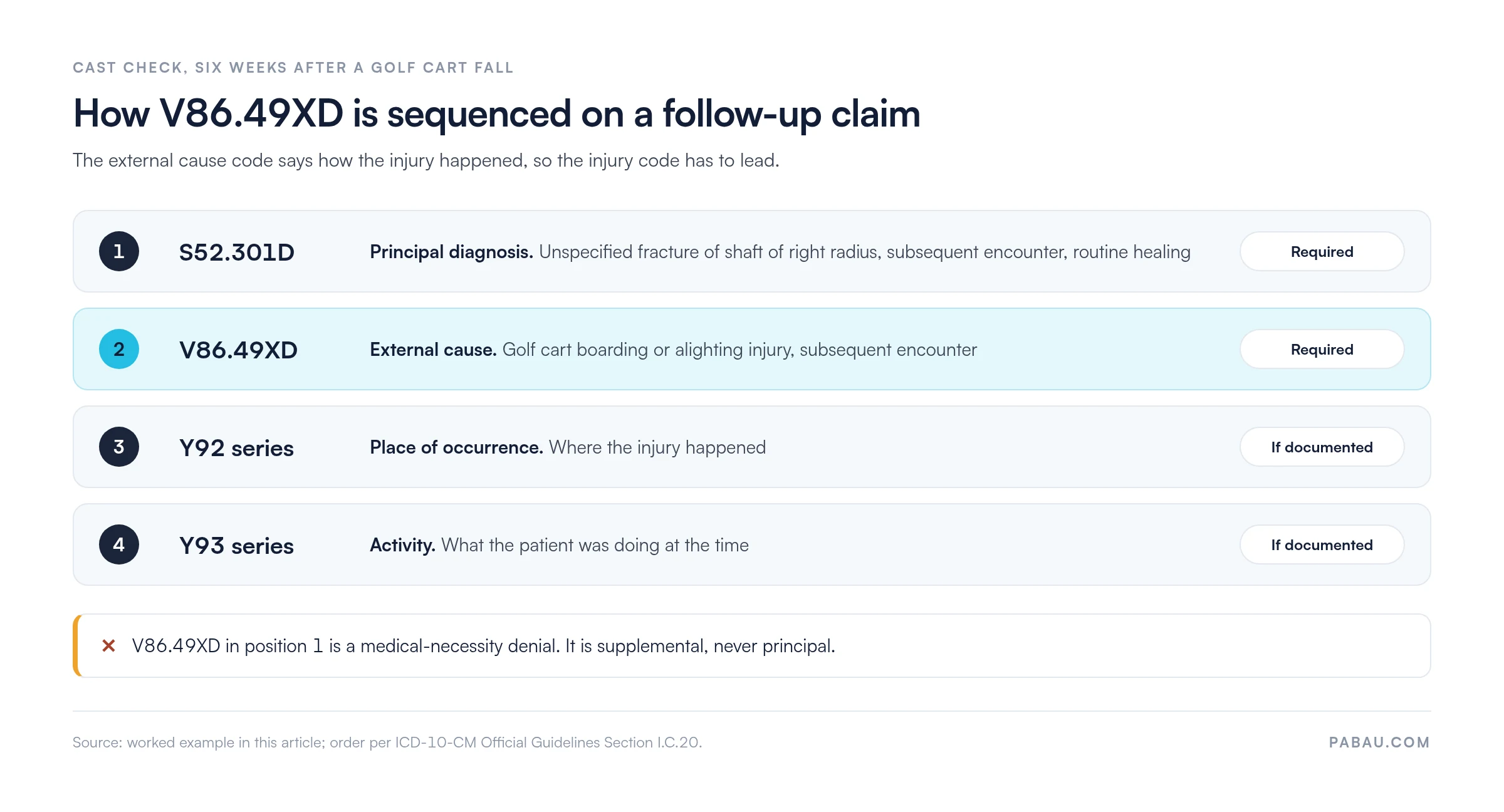
Submitting V86.49XD as a standalone first-listed diagnosis produces a medical-necessity denial. The code carries no clinical meaning on its own, so the payer cannot tell what was treated or why.
Pabau’s claims management software flags an external cause code entered without a principal injury code. The claim is held before it leaves the practice, so the sequencing error is caught in the workflow rather than after a denial.
Practices submitting ICD-10 coded claims to US payers can route them through the Claim.MD clearinghouse integration built into Pabau. That connection reaches thousands of US payers and supports eligibility verification alongside 837P electronic claim submission.
A clean claim submission needs the external cause code correctly sequenced, the placeholder X in place, and the 7th character matching the encounter documentation.
The official CDC/NCHS ICD-10-CM web tool is the most reliable reference for confirming code validity and descriptor accuracy each fiscal year.
Add one line to your pre-submission edit check for V86.49XD. Reject the claim if the encounter note names an ATV, snowmobile, dune buggy, dirt bike, military vehicle, ambulance or fire engine. Each of those has its own fifth character. Then check that an S-code principal diagnosis is present and that the placeholder X sits in the code string. Three of the five denial patterns on this code never reach the payer.
Knowing why these claims are denied tells a billing team which edit checks to build. The five patterns below account for most rejections and reconsiderations on golf cart and go-cart boarding injuries at subsequent encounters.
The denial codes in medical billing reference covers the CARC codes payers attach to these rejections. Looking up the CARC is the fastest way to identify which pattern triggered a denial. Pair that lookup with the root-cause categories above, so the billing team resolves the right issue the first time.
Payer policy also varies more than coders expect. Workers’ compensation and auto liability payers often require complete external cause coding for subrogation. Several state Medicaid programs make external cause codes a condition of clean claim status.
Medicare Fee-for-Service treats them as supplemental, though many Medicare Administrative Contractors encourage their inclusion. Check individual payer policies before treating these codes as optional on any injury claim.
V86.49XD is valid in the FY2026 ICD-10-CM code set. Confirm it against the FY2027 tabular list, effective October 1, 2026, before coding encounters on or after that date. The AAPC ICD-10-CM code lookup carries the current descriptor.
The same Section I.C.20 rules apply across Chapter 20, so the supplemental-only requirement and the 7th character logic hold well beyond this one code.
These checks usually live in one coder’s head. That coder remembers that V86.49XD needs an S-code in front of it. The same coder remembers the placeholder X and checks the vehicle before picking the fifth character. When that coder is on leave, the claims still go out, and the denials arrive three weeks later.
Practice management software like Pabau moves those checks into the claim itself. Diagnosis codes are entered against the encounter note, so the vehicle and mechanism a clinician documented sit beside the code a biller selects.
Sequencing validation flags an external cause code with no principal injury code before submission. Claims then route to US payers through the Claim.MD clearinghouse, with eligibility verification and ERA retrieval built in.
The outcome is fewer avoidable rebills on injury claims, and a shorter path from the follow-up visit to the payment. Every Pabau subscription includes the full billing workflow, so a single-site practice runs the same edit checks as a multi-location group.

Pabau integrates with Claim.MD to submit ICD-10 coded claims directly to US payers, verify eligibility in real time, and manage denial workflows. Your billing team spends less time correcting code errors and more time getting paid.

V86.49XD carries three hard rules. It describes a golf cart, a go-cart, or another off-road vehicle the tabular list does not name, never an ATV or a snowmobile. It is always secondary to an injury S-code. The placeholder X is non-negotiable. Check those three before submission and the most common rejection patterns on this code disappear.
Pabau’s claims management software supports ICD-10 external cause code entry with built-in sequencing validation. It connects to US payers via the Claim.MD clearinghouse for 837P submission, eligibility checks, and ERA retrieval. To see how the billing workflow handles V86.49XD and other external cause codes, book a demo with the Pabau team.

Want to understand the full claim lifecycle from submission to payment? What is revenue cycle management covers how external cause codes feed into the broader billing and reimbursement process.
Looking for a reference on clean claim requirements before submission? Superbill documentation guide explains the fields and code sequencing requirements that support a clean claim for injury encounters.
ICD-10 Code V86.49XD is the billable ICD-10-CM external cause code for a subsequent-encounter visit. It covers a person injured while boarding or alighting from another special all-terrain or off-road motor vehicle. Its inclusion terms are go-carts and golf carts. It sits in Chapter 20 of ICD-10-CM and is always assigned as a secondary code alongside a principal injury diagnosis.
No. An ATV boarding or alighting injury at a subsequent encounter is V86.45XD, because 3- and 4-wheeled all-terrain vehicles have their own fifth character. V86.49XD is the residual code for off-road vehicles the subcategory does not name, and its listed inclusion terms are go-carts and golf carts. Snowmobiles are V86.42XD, dune buggies V86.43XD, and dirt bikes V86.46XD.
Yes, V86.49XD is a billable ICD-10-CM code in the FY2026 code set. It cannot be submitted alone as a principal diagnosis. A principal injury code, such as an S-code for the fracture, sprain, or soft tissue injury, must precede it on every claim.
The three codes differ only in the 7th character. A is the initial encounter, used at the first active-treatment visit. D is the subsequent encounter, used during the healing phase at follow-up visits. S is sequela, used when the patient presents with a late effect after the original injury has resolved. Using XA at a follow-up visit, or XD at a first visit, are both coding errors that trigger payer audits.
Five causes account for most denials. The first is submitting V86.49XD as a standalone principal diagnosis. The second is omitting the placeholder X, which sends the invalid string V86.49D. The third is naming a vehicle with its own fifth character, such as an ATV or a snowmobile. The fourth is a 7th character that does not match the documented encounter type. The fifth is a mechanism mismatch, where the record describes a riding injury rather than boarding or alighting.
Category V86 covers ambulances and fire engines, snowmobiles, dune buggies, and military vehicles. It also covers 3- and 4-wheeled ATVs, dirt bikes, and other off-road vehicles such as go-carts and golf carts. Excluded are sport-utility vehicles (V50-V59), three-wheeled vehicles designed for on-road use (V30-V39), and special all-terrain vehicles in stationary use or maintenance (W31). Motorcycles, passenger cars, watercraft, and aircraft also sit outside V86.
No. V86.49XD is an external cause code governed by ICD-10-CM Official Guidelines Section I.C.20, which classifies external cause codes as supplemental. They describe the circumstances of an injury rather than the injury itself, so they are never assigned as the principal diagnosis. A payer that receives V86.49XD as the first-listed code will deny the claim for a missing principal diagnosis.




