ICD code T87.52 – Necrosis of left upper extremity amputation stump
Billable Code•Specific Code
Code Definition
ICD-10 code T87.52 is the billable diagnosis for necrosis of amputation stump, left upper extremity. It reports dead tissue on a residual left arm, after an amputation at the hand, wrist, forearm, elbow, upper arm or shoulder.
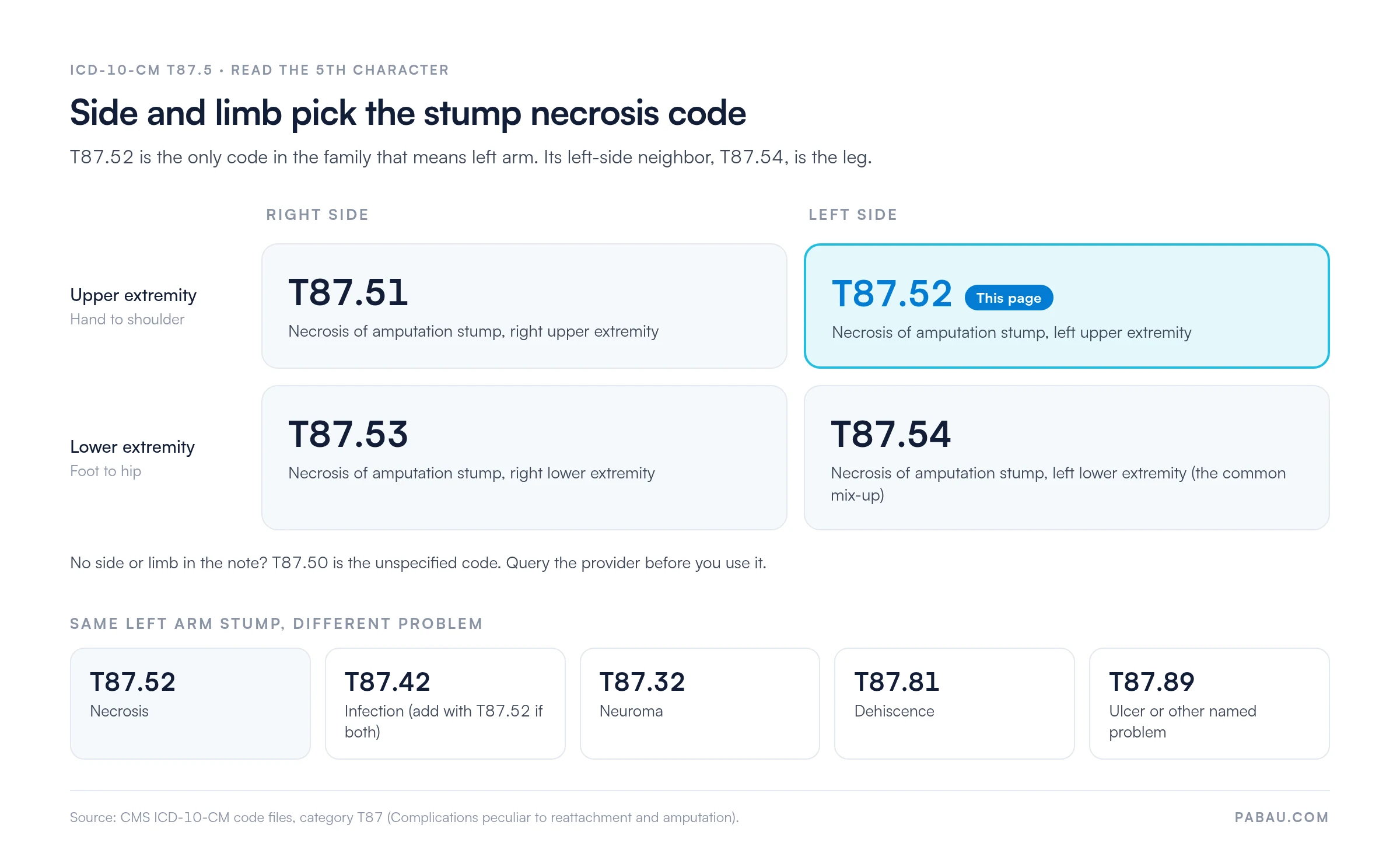
The code is easy to confuse with its leg siblings. Its 5th character, 2, means left and upper. The left leg is T87.54, and an infected left arm stump takes T87.42. Pick the code from the side and limb in the note, then match the CPT code to the stump level.
Related Information
Chapter
S00-T88 Injury, poisoning and certain other consequences of external causes
Category
T87 Complications peculiar to reattachment and amputation
Group
T87.5 Necrosis of amputation stump
Billable
Yes
Code also known as
stump necrosis, left arm stump necrosis, left upper limb residual limb necrosis
Save time. Improve accuracy. Get paid faster.
Automate coding with Pabau
Let Pabau's smart automation suggest the right codes, reduce claim denials, and keep your practice compliant—effortlessly.
T87.52Necrosis of left upper extremity amputation stump
ICD Code Suggestion
AI
Suggested code
T87.52Necrosis of left upper extremity amputation stumpHigh match
Confidence score
98%
Why this code?
Matches patient diagnosis
Supported by clinical notes
Commonly used for this condition
Why practices choose Pabau
Save hours every week
Automate repetitive tasks and focus on what matters most—your patients.
Improve accuracy
Reduce coding errors and ensure compliance with the latest regulations.
Get paid faster
Clean claims, fewer denials, and faster reimbursements.
Grow with confidence
Powerful insights and reporting to help your practice thrive.
HIPAA compliant•SOC 2 certified•GDPR-compliant•Trusted by 4,000+ clinics worldwide
Key takeaways
ICD-10 code T87.52 is billable and means necrosis of an amputation stump on the left upper extremity, not the left leg.
The 5th character carries side and limb. T87.51 is right arm, T87.53 right leg, and T87.54 left leg.
Infection of the same stump takes T87.42, and a neuroma takes T87.32. Ulcers and other named stump problems go to T87.8-, not T87.5-.
Upper-limb revision uses arm, forearm, wrist or shoulder CPT codes, such as 25907 or 24925, never lower-limb codes.
List T87.52 first in item 21 of the CMS-1500 and point each debridement or revision line to it in 24E.
ICD-10 code T87.52 at a glance: Left arm, not left leg
ICD-10 code T87.52 is the billable code for necrosis of an amputation stump on the left upper extremity. It applies at any level from the hand to the shoulder, and the left leg takes a different code.
Field
Value
Code
T87.52
Official descriptor
Necrosis of amputation stump, left upper extremity
Billable
Yes
Code system
ICD-10-CM (US clinical modification)
Chapter
Chapter 19: Injury, poisoning and certain other consequences of external causes (S00-T88)
Block
T80-T88: Complications of surgical and medical care, not elsewhere classified
Parent code
T87.5 Necrosis of amputation stump (not billable)
Laterality and limb
Carried by the 5th character, 2 = left upper extremity
7th character
None. The code is complete at five characters
What T87.52 covers: Dead tissue on a left arm stump
T87.52 describes necrosis at the residual limb after an amputation anywhere on the left upper extremity. That includes a partial hand, a wrist disarticulation, a forearm, an elbow, an upper arm or a shoulder-level amputation.
Upper-limb amputations most often follow trauma, such as crush, blast or machinery injuries. Necrosis tends to show up at the flap edge when blood supply to the skin is poor. A tight closure, swelling, infection or damaged tissue left from the original injury can all start it.
On exam, the note usually describes black, grey or brown tissue, eschar, slough or wound breakdown at the stump. The provider has to call it necrosis, or use a term that means tissue death, for T87.52 to apply.
Left upper extremity only: Any level from the hand to the shoulder on the left side.
Necrosis, not infection: An infected stump takes T87.42. When the note documents both, report both.
Not an ulcer or a neuroma: Stump ulcers and other named problems go to T87.8-, usually T87.89. A neuroma takes T87.3-, which is T87.32 on the left arm.
Tied to a past amputation: The record must show that the patient has a left arm amputation.
Where T87.52 sits in the T87.5 family
The T87.5 subcategory has five billable codes. The 5th character tells the payer the side and the limb, so each code means one stump. The CMS ICD-10 code files list the same five.
Code
Descriptor
Billable
T87
Complications peculiar to reattachment and amputation
No (category)
T87.5
Necrosis of amputation stump
No (subcategory)
T87.50
Necrosis of amputation stump, unspecified extremity
Yes
T87.51
Necrosis of amputation stump, right upper extremity
Yes
T87.52
Necrosis of amputation stump, left upper extremity
Yes
T87.53
Necrosis of amputation stump, right lower extremity
Yes
T87.54
Necrosis of amputation stump, left lower extremity
Yes
Read the 5th character as a pair of facts. Odd numbers 1 and 3 are right, while 2 and 4 are left. The 1 and 2 cover the arms, and 3 and 4 cover the legs. So T87.52 is left and upper, while T87.54 is left and lower.
The grid below sets all four side by side, with the codes for other problems on the same stump.
One wrong 5th character moves a left arm claim to the left leg, so read side and limb before the problem. Codes from the CMS ICD-10-CM files.
Pro Tip
Say the code back as words before you submit it. If “T87.52” and “left leg” are in the same sentence, the code is wrong. The left leg is T87.54.
The coding notes T87.52 inherits
T87.52 has no notes of its own. It picks up the notes set higher in Chapter 19 and in the T80-T88 block, and these apply to every T87.5 code.
Excludes2: Birth trauma (P10-P15) and obstetric trauma (O70-O71). Excludes2 means they are not part of T87.52, so a patient with both can carry both codes.
Use additional code for a retained foreign body: Add a Z18.- code when a fragment is left in the stump.
Use additional code for the resulting condition: Code the specific condition the complication caused, when the note names one.
Devices and circumstances: Codes Y62-Y82 can identify devices involved and the circumstances, when relevant.
External cause codes: There is no national mandate to report them. Some practices add Y83.5 to show that an amputation led to the later complication.
Other stump complications: Dehiscence takes T87.81. An ulcer or other named problem takes T87.89, not a T87.5 code.
Staying on top of these inherited notes is part of medical billing compliance. Auditors read them when they review a stump claim.
T87.52 vs related codes: Side, limb and problem decide
Three questions pick the code. Which side is it, which limb, and is the tissue dead or infected? The table shows where each neighbor differs from T87.52.
Code
Descriptor
How it differs from T87.52
T87.50
Necrosis of amputation stump, unspecified extremity
No limb or side on record. Query the provider before you use it.
T87.51
Necrosis of amputation stump, right upper extremity
Same limb, other side.
T87.53
Necrosis of amputation stump, right lower extremity
Other side and other limb.
T87.54
Necrosis of amputation stump, left lower extremity
Same side, but the leg. This is the most common mix-up.
T87.40
Infection of amputation stump, unspecified extremity
Infection with no limb on record.
T87.41
Infection of amputation stump, right upper extremity
Infection of the right arm stump.
T87.42
Infection of amputation stump, left upper extremity
Infection of the same stump. Report with T87.52 when both are documented.
T87.43
Infection of amputation stump, right lower extremity
Infection of the right leg stump.
T87.44
Infection of amputation stump, left lower extremity
Infection of the left leg stump.
T87.32
Neuroma of amputation stump, left upper extremity
A nerve-end neuroma on the same stump, with no necrosis documented.
T87.81
Dehiscence of amputation stump
The wound has opened, with no necrosis documented.
T87.89
Other complications of amputation stump
Ulcers and other named stump problems, such as hematoma or edema. A neuroma has its own codes, T87.3-.
T87.9
Unspecified complication of amputation stump
Only when the type of complication is unknown.
The T87.4 codes carry their own note to use an additional code for the infection. So a necrotic, infected left arm stump can carry T87.52, T87.42 and an organism code.
Worked example: A left forearm stump that won’t heal
A 44-year-old patient had a left transradial amputation after a crush injury at work. Five weeks later, the surgeon sees a 3 cm by 2 cm patch of black eschar at the distal flap.
She performs sharp selective debridement of 6 sq cm of devitalized tissue. The depth stays within the dermis, and she sees no signs of infection. Her note reads “necrosis of left transradial amputation stump.”
Diagnosis: T87.52, listed first.
Procedure: 97597, since the debridement was selective and stayed above subcutaneous tissue.
What changes the codes: If she had cut into subcutaneous tissue, 11042 would replace 97597. If a culture had come back positive, T87.42 would join T87.52.
Documentation: What the note has to say
Auditors look for five things in the note. If one is missing, the claim is open to a denial or a recoupment later.
Side: The word “left” must appear. “Stump wound” on its own does not support T87.52.
Limb and level: Name the upper limb and the level, such as transradial, transhumeral or wrist disarticulation.
Necrosis: Use terms like necrosis, necrotic tissue, devitalized tissue or eschar. “Slow healing” does not count.
Size and depth: Record length, width and the deepest tissue removed. Debridement codes depend on both.
History: Show the original amputation in the problem list, surgical history or consult note.
Common CPT codes billed with T87.52
T87.52 usually supports debridement or a stump revision. Revision codes for the upper limb depend on the level of the original amputation, so match the CPT code to the stump.
CPT code
Descriptor
When it fits T87.52
97597
Debridement, open wound, selective; first 20 sq cm or less
Selective removal of necrotic tissue down to the dermis
97598
Debridement, open wound, selective; each additional 20 sq cm
Add-on when the debrided area passes 20 sq cm
11042
Debridement, subcutaneous tissue; first 20 sq cm or less
Necrosis that reaches subcutaneous tissue
11043
Debridement, muscle and/or fascia; first 20 sq cm or less
Deeper necrosis that reaches muscle or fascia
97602
Removal of devitalized tissue from wound(s), non-selective debridement, without anesthesia, per session
Non-selective debridement. Medicare status B (bundled). Not reported with 97597, 97598 or 11042 for the same wound.
25907
Amputation, forearm, through radius and ulna; secondary closure or scar revision
Revising a necrotic transradial stump
25909
Amputation, forearm, through radius and ulna; re-amputation
Re-amputating a forearm stump when tissue won’t recover
24925
Amputation, arm through humerus; secondary closure or scar revision
Revising a necrotic transhumeral stump
24930
Amputation, arm through humerus; re-amputation
Re-amputating an upper arm stump
25922
Disarticulation through wrist; secondary closure or scar revision
Revising a wrist disarticulation stump
23921
Disarticulation of shoulder; secondary closure or scar revision
Revising a shoulder disarticulation stump
99213 / 99214
Office or outpatient visit, established patient (low or moderate medical decision making)
Follow-up visits for the stump without a same-day procedure
Selective debridement codes 97597 and 97598 are not reported with 11042-11047 for the same wound. Code the deepest tissue removed instead. Check the Medicare LCD for wound care and current NCCI edits before you bill, since both change during the year.
How to put T87.52 on the CMS-1500
The diagnosis and the procedure have to line up on the form. Here is the order most billing teams follow.
Enter the ICD indicator 0 in item 21 to show ICD-10-CM codes.
List T87.52 first, in slot A, when stump necrosis is the reason for the visit.
Add any second diagnosis, such as T87.42, in slot B.
Enter each CPT code in item 24D, such as 97597 or 25907.
In 24E, point each line to the letter of the diagnosis it treats, with A first.
A debridement line pointing only to slot B, the infection code, can look unsupported for necrosis. Point it to A, or to both A and B.
ICD-9 crosswalk: One approximate match
Older records and audits sometimes need the ICD-9-CM code that came before T87.52. The General Equivalence Mappings (GEMs) published by CMS give one approximate match.
ICD-10-CM
ICD-9-CM
ICD-9 descriptor
GEMs note
T87.52
997.69
Other late amputation stump complication
Approximate. ICD-9 had no side, limb or necrosis detail.
T87.9
997.60
Late amputation stump complication, unspecified
Shown for contrast. 997.60 maps to T87.9, not to T87.52.
Mapping always loses detail going backward. An ICD-9 claim for 997.69 could have been any stump problem on any limb, so read the old note before you convert it.
Common mistakes that get T87.52 claims denied
Coding the left leg as T87.52: The left leg is T87.54. It is the easiest slip in this family.
Sending the parent code: T87.5 is not billable. Payers reject it at the front end.
No side in the note: The code says left, but the note doesn’t. An audit can reverse the payment.
Lower-limb CPT codes: Leg revision codes paired with an arm diagnosis fail payer edits.
Stacking debridement codes: 97602 with 97597 or 11042 for the same wound gets denied.
Calling an ulcer necrosis: A stump ulcer belongs in T87.89, so T87.52 won’t hold up.
Track your denials by root cause, as denial management in healthcare explains. Then fix the note or the code before the next claim. The remittance will carry a CARC code, and this guide to common denial codes explains what each one means.
Before you submit a T87.52 claim, run this checklist
The note says “left” and names an upper-limb level.
The provider used the word necrosis, or a clear synonym.
Infection is coded separately with T87.42 if it’s documented.
The CPT code matches the stump level and the deepest tissue removed.
No 97602 sits on the same wound as 97597, 97598 or 11042.
T87.52 is in slot A of item 21, and every procedure line points to it in 24E.
Prior authorization is on file for a planned revision or re-amputation.
Each pass through this list moves you closer to a clean claim on the first try.
How Pabau keeps T87.52 claims moving
Most T87.52 problems start before charge entry, in a note that never named the side or the limb. They show up weeks later as a denial on the remittance.
Pabau, the practice management platform we build, ties each claim to the visit record. Its claims management software generates the claim from the invoice, so nobody re-keys the charge. It also flags denied claims for rework.
Pabau raises the invoice against the patient’s insurer at checkout, so the stump debridement charge and its claim start from one record.
In the US, Pabau sends electronic claims through Claim.MD. Eligibility checks run in real time from the patient record, and ERA remittances are matched to the claims they settle. Your billing team sees each claim’s status, so a pattern on stump claims is easy to spot and fix at the note.
Send cleaner amputation stump claims
Pabau generates claims from the invoice, checks eligibility from the patient record, and posts ERA remittances back. Your team spends less time reworking stump necrosis claims.
Check side and limb first on a T87.52 claim, before the tissue finding or the CPT code. A wrong 5th character sends the claim to the left leg, and no CPT pairing can rescue that.
When the note is vague, query the provider before you bill. A one-line addendum naming a left transradial stump costs minutes, while a recoupment after an audit costs the whole payment.
Book a demo to see how Pabau helps practices send stump necrosis claims that match the visit record.
Continue your research
Coding the left leg instead?ICD-10 code T87.54 covers necrosis of a left lower extremity amputation stump.
No side or limb in the note?ICD-10 code T87.50 explains when the unspecified extremity code applies and when to query.
Coding a stump ulcer or other named stump problem?ICD-10 code T87.89 covers other complications of amputation stump that aren’t necrosis, infection or neuroma.
Want to understand clearinghouse claim routing?Medical claims clearinghouse explains how electronic claims travel from your practice to the payer.
Reading denials on your remittance?Electronic remittance advice shows how to read 835 files and spot repeat denial patterns.
Frequently asked questions
What does ICD-10 code T87.52 mean?
T87.52 means necrosis of amputation stump, left upper extremity. It reports dead tissue on the residual limb after a left hand, wrist, forearm, arm or shoulder amputation.
Is T87.52 for the left leg?
No. T87.52 is the left arm. Necrosis of a left leg stump is T87.54, and a right leg stump is T87.53.
Is T87.52 billable, and does it need a 7th character?
T87.52 is billable and complete at five characters. It takes no 7th character and no placeholder X. Its parent, T87.5, is not billable.
Can T87.52 and T87.42 be reported together?
Yes. When the note documents both necrosis and infection of the left arm stump, report T87.52 and T87.42. Add a code for the organism if it’s known.
What is the ICD-9 equivalent of T87.52?
The CMS GEMs map T87.52 to 997.69, other late amputation stump complication, as an approximate match. ICD-9 had no side, limb or necrosis detail.
Which CPT codes go with T87.52?
T87.52 pairs with debridement codes such as 97597 or 11042, and with upper-limb revision codes such as 25907, 25909, 24925 or 24930. Pick the revision code that matches the stump level.