ICD-10 Code V91.84XS: Other burn due to burning watercraft
ICD-10 Code V91.84XS: overview and key facts ICD-10 Code V91.84XS identifies the...

Last Updated: Oct 30, 2026
Billable Code Specific Code
T86.91 is the billable ICD-10-CM code for unspecified transplanted organ and tissue rejection.
The physician documents rejection, but the record does not name the transplanted organ. T86.91 is a last resort, used only when chart review and a provider query cannot identify the graft. Once the chart names it, the organ's own rejection code applies instead, such as T86.11 for a kidney.
Let Pabau's smart automation suggest the right codes, reduce claim denials, and keep your practice compliant—effortlessly.
Automate repetitive tasks and focus on what matters most—your patients.
Reduce coding errors and ensure compliance with the latest regulations.
Clean claims, fewer denials, and faster reimbursements.
Powerful insights and reporting to help your practice thrive.
HIPAA compliant SOC 2 certified GDPR-compliant Trusted by 4,000+ clinics worldwide

T86.91 is the billable ICD-10-CM code for unspecified transplanted organ and tissue rejection, valid for claims in the current fiscal year (FY2027).
Rejection is the documented part and the organ is the unspecified part, so T86.91 is a last resort when no record names the graft.
Once the organ is known, its own rejection code replaces T86.91, such as T86.11 for a kidney or T86.41 for a liver.
Leave Z94.- status codes off the claim: category Z94 excludes transplant complications, and T86.91 already tells the payer a transplant exists.
Pabau, the practice management platform we build, flags missing documentation before submission and tracks denials on complex T86 claims.
ICD-10 Code T86.91 is the billable code for “Unspecified transplanted organ and tissue rejection,” its full official descriptor.
It applies when the physician documents rejection but the record never names the transplanted organ. The code sits in Chapter 19 of ICD-10-CM, which covers injury, poisoning and certain other consequences of external causes. It needs no further subdivision, so it can go straight on a claim.
T86.91 belongs to subcategory T86.9, which holds the complication codes for a transplanted organ or tissue the record does not identify. The table below summarizes the reference data coders need before submitting a claim.
T86.91 is for a patient whose physician documents transplant rejection without naming which graft is being rejected. The complication type is specific. The organ is the unspecified part, which makes the code narrow rather than a catch-all.
The ICD-10-CM Official Guidelines (Section I.C.19.g.3.a) use category T86 for both complications and rejection of transplanted organs. A transplant complication code is only assigned when the problem affects the function of the transplanted organ.
Fitting scenarios are few. Examples include a consult note that records “transplant rejection” with no organ, or a referral that arrives before the transplant history does. In both cases, a provider query comes before T86.91.
According to the CMS ICD-10-CM guidelines, “unspecified” codes are for cases where the record lacks the detail for a more specific code. Query the provider first wherever that is possible. The decision path below shows where T86.91 sits among the other T86 codes.
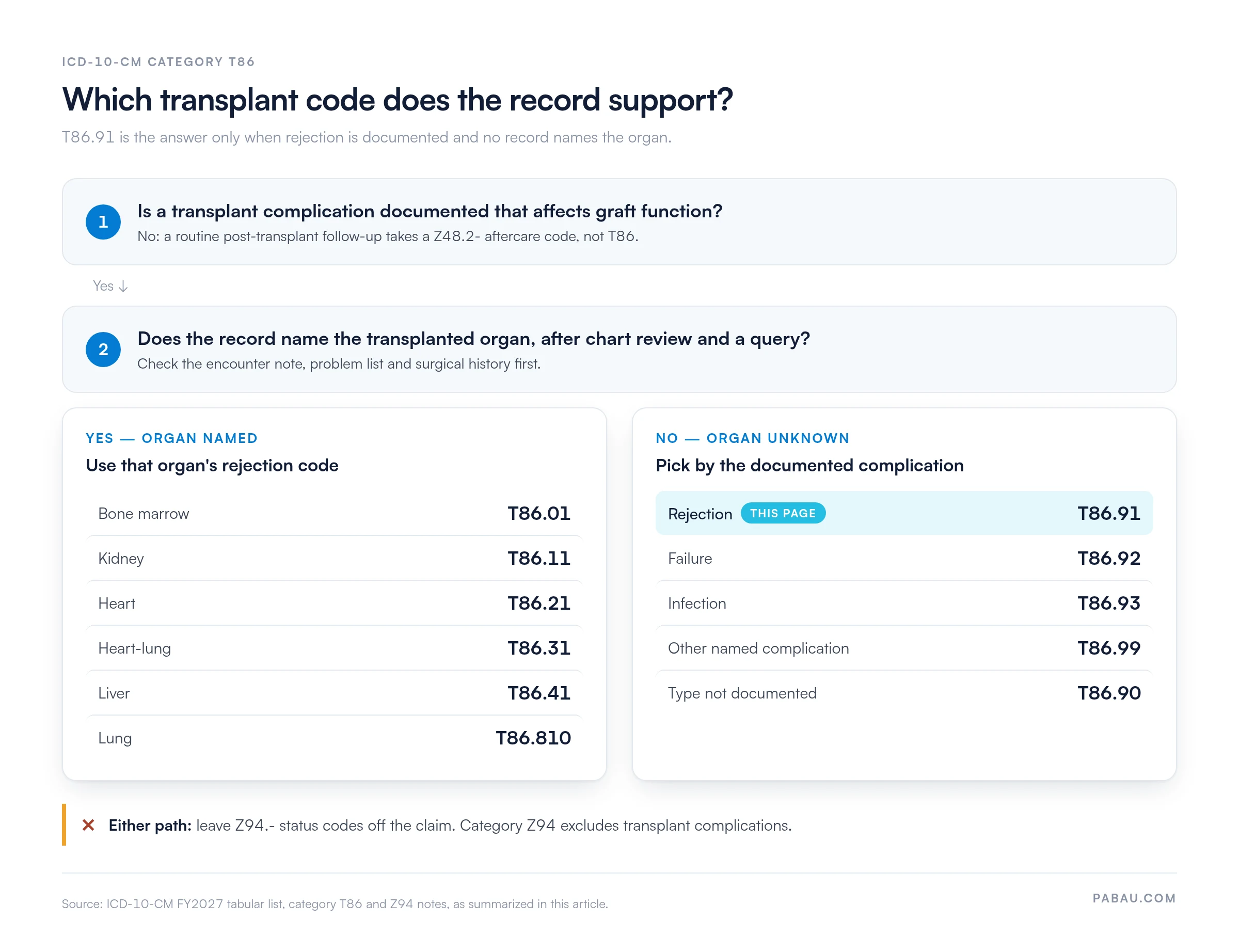
T86.91 has four siblings in subcategory T86.9. Each one names a different complication type for a transplanted organ or tissue the record does not identify. The closest sibling is T86.90, used when the note confirms a complication but names neither its type nor the organ.
Once the organ is known, coding moves out of T86.9 and into that organ’s own range, so a kidney rejection becomes T86.11. From T86.0 to T86.4, the fifth character follows one pattern: 0 unspecified, 1 rejection, 2 failure, 3 infection and 9 other.
Lung, skin, bone, cornea, intestine and other tissue sit under T86.8 and use a sixth character instead. There, 0 is rejection, 1 failure, 2 infection, 8 other and 9 unspecified. Corneal codes add a seventh character for laterality.
T86.81 is a frequent mix-up because it looks like an “other organ” twin of T86.91. It is the non-billable subcategory for complications of lung transplant, and lung rejection is T86.810. A heart-lung graft uses T86.3- instead, per the Excludes1 note at T86.81.
The practical decision rule: Check the encounter note, problem list and surgical history for the organ first. If the organ appears anywhere in the record, use its specific rejection code. T86.91 is only defensible when the organ cannot be established after chart review and a query.
Neither T86.91 nor its parents, T86.9 and T86, carry an Excludes1 or Excludes2 note. The instructions that do apply come from category T86 and the T80-T88 block above it in the FY2027 tabular list.
The Z94 note matters most in practice. Category Z94, Transplanted organ and tissue status, carries an Excludes1 note for complications of transplanted organs. The Official Guidelines (Section I.C.21.c.3) add that a status code adds nothing when the diagnosis code already shows the transplant.
Verify the current notes in the CDC/NCHS ICD-10-CM tool for the current fiscal year, as tabular notes can change in annual releases.
Before submitting, check that no other T86 code on the claim describes the same rejection. If a second T86 code names the organ, T86.91 comes off the claim and the organ-specific code stays.
Sequencing T86.91 correctly depends on the care setting and what brought the patient to the encounter. The ICD-10-CM Official Guidelines and UHDDS rules apply differently in inpatient and outpatient contexts.
T86.91 may serve as the principal diagnosis when transplant rejection is the condition established after study to be chiefly responsible for the admission. That is the UHDDS definition of principal diagnosis.
In outpatient settings, the “first-listed diagnosis” is the condition chiefly responsible for the visit, coded to the highest degree of certainty. If the physician confirms rejection and it is the reason for the visit, T86.91 is the first-listed code. A routine post-transplant follow-up with no documented complication takes an aftercare code from Z48.2- instead.
Payers, including Medicare and Medicaid, expect more than a transplant history before they accept a rejection code with no organ named. These elements should be in the chart before the claim goes out.
With claims software for billers, a practice can build pre-submission checklists into its billing workflow. Those checklists flag a T86.91 claim that has no organ query or transplant history entry before it leaves the practice. Pairing them with medical billing compliance protocols stops the same documentation errors from repeating across a transplant caseload.
Medicare, Medicaid and most commercial payers do not require prior authorization for the use of T86.91 itself. The code is a diagnosis, not a procedure, so prior authorization applies to the procedures or services billed on the same claim.
What payers do require is medical necessity documentation that supports the diagnosis. A claim pairing T86.91 with an evaluation and management code must show the rejection made the visit necessary. A transplant history alone does not.
T86.91 tells a payer that rejection is documented but the organ is not, so reviewers look for the reason. The table below identifies common denial patterns and the corrective actions that resolve them.
A structured denial management workflow captures the claim adjustment reason codes (CARCs) from each ERA response. That shows which of these patterns affects a transplant caseload. Our reference on denial codes for billers explains what each CARC means. Routing T86-category denials to a dedicated queue, rather than the general denial pool, makes the patterns easier to spot.
Pabau also connects to the Claim.MD clearinghouse for electronic US claim submission. The integration runs real-time eligibility checks and tracks ERA-based denial reasons, which cuts the manual effort of chasing T86.91 denials. The medical claims clearinghouse process also validates claims against payer-specific edits before transmission.
T86.91 rarely stands alone on a claim. The guidelines expect a second code that identifies the complication, and the tabular list names a few specific pairings.
Confirm companion-code pairings against the current-year tabular list in the CDC/NCHS ICD-10-CM tool before reporting any additional code with T86.91.
Build a T86 coding template in your practice management system that prompts for an organ query whenever T86.91 is selected. The same prompt can stop a Z94.- status code from being added to the claim.
Most T86.91 problems start before the claim exists. Think of an organ missing from the note, a habitual status code, or sequencing set by guesswork. Each one is cheaper to catch at coding than at appeal.
In Pabau, the encounter note, transplant history and claim sit in one record. Pre-submission checks flag an incomplete T86.91 claim, and ERA-based denial tracking shows which fixes work.
The result is fewer resubmissions on transplant claims and a billing team that spends its time on coding, not chasing payers.

Pabau helps transplant-care teams build documentation checklists, flag incomplete records before submission, and track T86-category claim outcomes across the full revenue cycle.

T86.91 is a narrow code: rejection is documented, but the record never names the transplanted organ. Using it when the organ appears elsewhere in the record is an easy audit target, and so is pairing it with a Z94.- status code. Get the organ query, the companion codes and the sequencing right, and the claim carries what a reviewer needs.
Practices that handle a significant volume of transplant-related claims benefit from building coding checkpoints directly into their submission workflow. Pabau supports pre-submission validation, ERA-based denial tracking and integration with the Claim.MD clearinghouse. To see how it fits a transplant-care billing workflow, book a demo.

Need to understand how electronic claims move through the clearinghouse? How the Claim.MD clearinghouse works explains the end-to-end submission and ERA return process for US practices.
Want to reduce denial rates across your T86 caseload? Denial management in healthcare covers how to build a systematic denial tracking and appeal workflow.
Looking for a clean claim checklist before submission? Clean claim requirements outlines the fields payers require to accept a claim without initial rejection.
Is the rejected graft a lung? T86.810 covers lung transplant rejection, the code that replaces T86.91 once the record names a lung graft.
Is the rejected graft a liver? T86.41 is the liver transplant rejection code to use once the chart names the organ.
ICD-10 Code T86.91 is the billable diagnosis code for unspecified transplanted organ and tissue rejection. The complication is known, but the organ is not. That makes it a last resort when the record cannot name the rejecting graft.
Yes, T86.91 is a billable, valid ICD-10-CM code in FY2027, which took effect on October 1, 2026. It can go directly on a claim without further subdivision. Verify validity in the current fiscal year release using the CDC/NCHS ICD-10-CM tool.
T86.81 is not a billable code. It is the subcategory for complications of lung transplant, and lung transplant rejection is coded T86.810. T86.91 applies only when rejection is documented and the record does not identify the organ.
No. T86.91 is complete as a five-character code and needs no encounter-type extension. Confirm against the current-year tabular list, as annual updates can change code structure.
Typical causes are an organ named elsewhere in the record or a complication that is not rejection. A Z94.- status code reported despite its Excludes1 note is another. Sequencing T86.91 as secondary when rejection drove the encounter also triggers denials.
Yes, in the right circumstances. In an inpatient setting, T86.91 may be the principal diagnosis when transplant rejection is, after study, chiefly responsible for the admission. In outpatient settings, it is first-listed when confirmed rejection is the reason for the visit.