ICD-10 Code Y76.0: Diagnostic obstetric and gynecological devices
ICD-10 Code Y76.0: Definition and billable status ICD-10 Code Y76.0 is a valid, ...

Last Updated: Oct 23, 2026
Billable Code Specific Code
T86.90 is the billable ICD-10-CM code for unspecified complication of unspecified transplanted organ and tissue.
Coders reach for it when the documentation names neither the organ transplanted nor the nature of the complication. That double layer of unspecificity separates T86.90 from every other code in the T86 category. It also makes the code a frequent target for CDI queries and payer scrutiny.
Let Pabau's smart automation suggest the right codes, reduce claim denials, and keep your practice compliant—effortlessly.
Automate repetitive tasks and focus on what matters most—your patients.
Reduce coding errors and ensure compliance with the latest regulations.
Clean claims, fewer denials, and faster reimbursements.
Powerful insights and reporting to help your practice thrive.
HIPAA compliant SOC 2 certified GDPR-compliant Trusted by 4,000+ clinics worldwide

ICD-10 code T86.90 is a billable FY2026 code for unspecified complication of unspecified transplanted organ and tissue, effective October 1, 2025.
Use T86.90 only when the record names neither the transplanted organ nor the complication type. Look for a more specific T86.x code first.
T86.90 is not on the CMS POA-exempt list. Inpatient claims must carry an actively assigned POA indicator of Y, N, W, or U.
Never report a Z94.x transplant status code with a T86 complication code for the same organ. An Excludes1 note at Z94 blocks that pair.
The category’s use additional code note calls for D89.81-, C80.2, or D47.Z1 whenever one of those conditions is documented.
ICD-10 code T86.90 is the billable diagnosis code for a complication in a transplant recipient. It applies when the record names neither the organ nor the type of complication. Both elements are unspecified, which places the code at the broadest level of the T86 category.
Billable means the code is complete as written and can stand as a diagnosis on a submitted claim. It does not mean the code is a good choice. T86.90 passes a format edit and still invites a documentation request from the payer.
T86.90 descends from chapter 19 through the T80-T88 block, which covers complications of surgical and medical care not classified elsewhere. The T86 category then splits by organ, and the T86.9 subcategory holds the codes used when the organ is unknown.
The T86.9 subcategory contains five billable codes. Four of them name a complication type, and only T86.90 leaves the complication unstated.
T86.90 is appropriate when two facts are missing from the clinical record at the same time. Those two facts are the organ transplanted and the nature of the complication. Meeting only one of those conditions calls for a different code, as the grid below sets out.
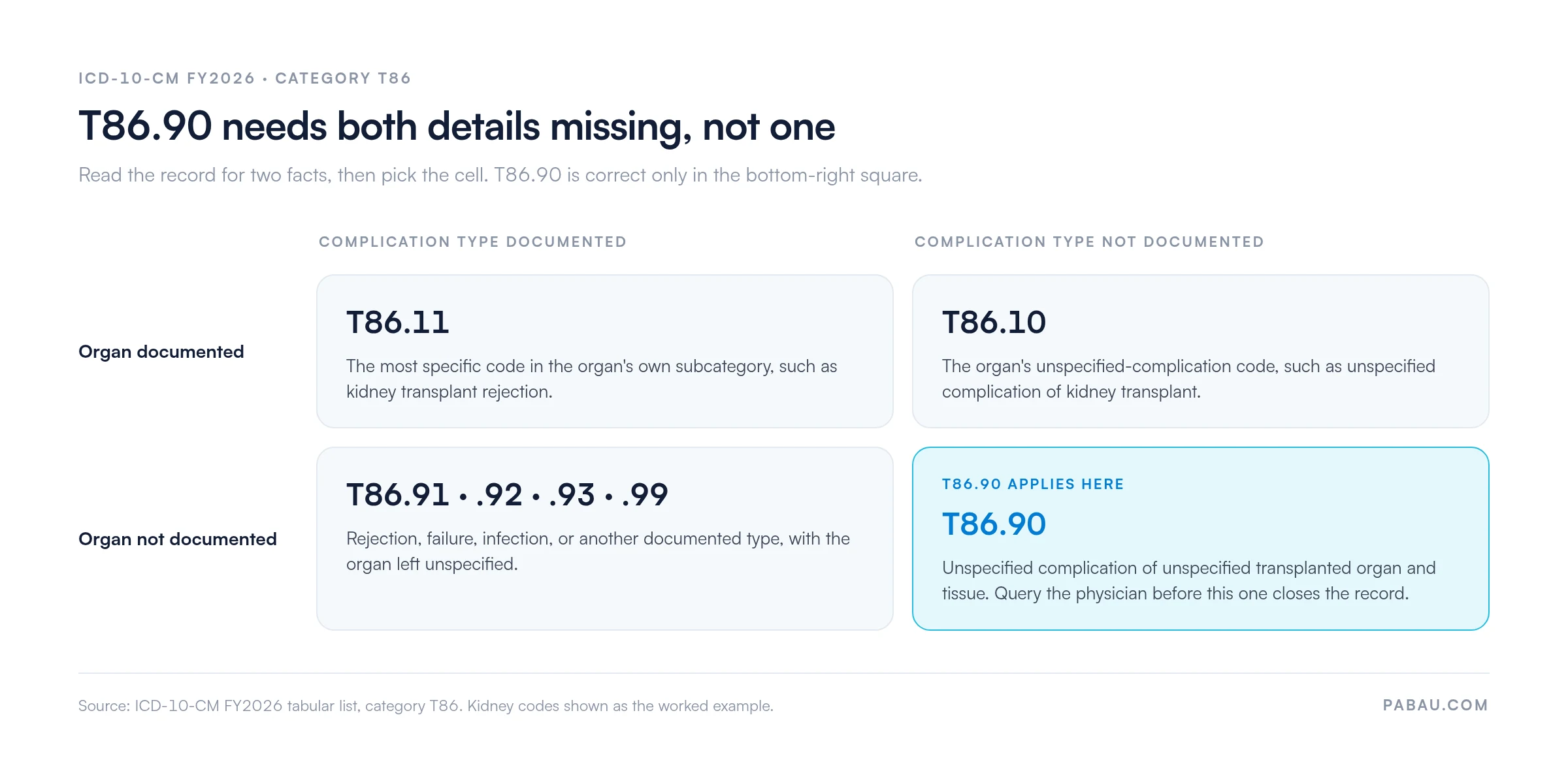
In practice, T86.90 should work as a temporary placeholder pending a physician query, not a routine assignment. The CMS ICD-10-CM coding resources reinforce that coders must assign the highest level of specificity the documentation supports. Using T86.90 on a final coded record without a query attempt signals a missed CDI opportunity.
T86.90 is not POA exempt, so an inpatient claim carrying it still needs an actively assigned present-on-admission indicator. Facilities that assume otherwise leave the field blank and collect clearinghouse edits.
The T86 category contains organ-specific and complication-specific codes at every level. The table below maps T86.90 against the siblings coders confuse it with most often.
Documentation that names the organ moves the claim out of T86.9 altogether. A heart-lung graft with a complication outside rejection, failure, or infection takes T86.39. A lung graft on its own, with the complication type left unstated, codes to T86.819 rather than T86.90.
The distinction between T86.90 and T86.99 trips up many coders. Under ICD-10-CM conventions, “.90” means both dimensions are unspecified. “.99” means the complication type is known while the organ remains unspecified.
Assigning T86.99 when only the organ is documented would be equally incorrect. The CDC/NCHS ICD-10-CM tool exposes the full T86 hierarchy for verification, and our ICD-10-CM code index collects the neighboring transplant entries.
Infection has its own code in the same subcategory. When the record documents infection but not the graft site, T86.93 is the code to assign.
Documentation rarely uses the code’s official wording. The phrases below all map to T86.90 when neither the organ nor the complication type appears anywhere in the record.
Treat each of these as a query trigger rather than a coding answer. If the chart names the graft anywhere, the organ-specific code replaces T86.90.
Z94.x transplant status codes are not companion codes for T86.90. The tabular list places an Excludes1 note at Z94 reading “complications of transplanted organ or tissue – see Alphabetical Index”. An Excludes1 note means the two codes are never reported together for the same organ.
The logic behind the note is straightforward. A Z94 code reports a functioning graft with no complication. A T86 code reports a graft that has developed one. The same organ cannot be both at the same encounter.
Section I.C.21.c.3 of the ICD-10-CM Official Guidelines makes the same point from the other direction. A status code is not assigned when another code on the claim already carries the information it would supply. Once T86.90 establishes that the patient has a transplanted organ, the status code adds nothing.
For T86.90 the rule bites harder still. Assigning a Z94 code means you know which organ was transplanted. Once the organ is known, the organ-specific T86.1x through T86.8x entry replaces T86.90.
The Z94 codes below are the status codes coders most often reach for. Use them when a functioning graft is documented and no complication of that graft is present at the encounter.
Two exceptions survive the note. It applies organ by organ, so a patient may carry a status code for one organ and a complication code for another. Guideline I.C.14.a.2 also directs coders to report Z94.0 with the appropriate N18 code when chronic kidney disease persists after a kidney transplant.
The T86 category carries a “use additional code” instruction, and that note is where a second code on the claim comes from. It directs coders to identify other transplant complications present at the encounter, naming three in particular.
Guideline I.C.19.g.3 explains the structure. T86 codes are combination codes that carry the transplant complication itself, so the second code identifies the specific condition rather than the transplant history. Where a malignancy is coded with C80.2, an additional code for the specific malignancy is also reported.
If none of these conditions is documented, T86.90 stands alone. Nothing in the tabular list requires a second code for a complication that has not been described.
The FY2026 ICD-10-CM Official Guidelines for Coding and Reporting govern the whole T86 category. Four conventions matter most when T86.90 is on the record.
Practices submitting claims electronically should confirm that T86.90 clears their clearinghouse edits before final submission. A claim passes cleanly when the code is valid, sequenced correctly, and carrying a POA indicator where the setting requires one.
The AAPC ICD-10-CM code reference works as a secondary check on billable status and guideline notes alongside the official tabular list.
Run a 30-day audit of T86.90 assignments in your facility. Flag two patterns: any claim that carries a Z94.x status code alongside it, and any record with no documented physician query. The first is an Excludes1 violation that a payer edit will catch. The second is audit exposure you can still close before the billing cycle ends.
On inpatient claims, T86.90 runs through the CMS IPPS grouper like any other diagnosis. The DRG that results depends on the principal diagnosis and on the complications documented during the same stay.
Under MS-DRG v43.0, T86.90 groups to DRG 919, DRG 920, and DRG 921. Those are complications of treatment with MCC, with CC, and without CC or MCC. All three sit in MDC 21, injuries, poisonings and toxic effects of drugs.
Relative weights move every year with the IPPS final rule, so read the FY2026 figure from the current CMS MS-DRG Definitions Manual. Check Appendix C of that manual for the code’s CC or MCC designation as a secondary diagnosis, along with its exclusion list.
T86.90 does not appear on the CMS POA exempt code list. The exempt list has not carried any T86 code across FY2023 through FY2026, and no addition, deletion, or revision file has changed that.
POA reporting is therefore required on every inpatient claim that carries T86.90. The coder assigns one of four values based on what the record shows.
The blank or “1” value reserved for exempt codes is not available here. A transplant recipient admitted with a complication usually warrants Y, but the timing has to come from the record rather than from the diagnosis.
Practices running legacy systems, or comparing pre-2015 claims against current data, need the approximate ICD-9-CM equivalent. The mapping is not exact, because ICD-10-CM encodes more detail than ICD-9-CM could hold.
ICD-10-CM replaced ICD-9-CM for US payers on October 1, 2015. No ICD-9-CM code has been billable on a primary claim since that date, so the crosswalk serves trend analysis rather than submission.
T86.90 signals incomplete documentation. CDI specialists should treat its presence on a working record as a query trigger, not a final answer. The query should happen before the record is coded and closed, not after a denial arrives.
That sequencing changes what the claim is worth. A query submitted before claim submission can change the code assignment, improve the inpatient DRG, and prevent a denial. A query submitted after a denial requires a corrected claim, appeals processing, and a payment delay measured in weeks.
Consider a physician query when any of the following appears in the clinical record alongside a transplant complication note.
Per AHIMA and AAPC query practice standards, queries must be compliant. They should not lead the physician, must offer multiple response options including “clinically unable to determine”, and must be documented in the medical record.
A compliant query that produces a specific diagnosis, such as kidney transplant rejection, lets the coder move from T86.90 to T86.11. That is a materially different code for reimbursement and quality reporting.
Several patterns of misuse appear consistently in transplant complication audits. Recognizing them reduces denials and improves specificity before the billing cycle closes.
Facilities with high volumes of T86.90 on final coded records should examine whether their query workflows are working as intended. A compliance program that flags the code automatically for CDI review catches most of them before submission.
Unspecified diagnosis codes rank among the top denial triggers for transplant-related encounters, so denial management work pays off fastest here.
Accurate transplant complication coding depends on capturing the right clinical detail at the point of care, not retrospectively.
Pabau, practice management software for healthcare practices, puts ICD-10 code selection inside the clinical encounter. The coder then works from the detail the physician has just recorded, using our claims management software.
For US practices, the clearinghouse connection validates ICD-10 codes against payer edits before the claim leaves the building. An unspecified assignment such as T86.90 surfaces while the encounter is still fresh. The coder can then chase the missing organ or complication detail from the physician who wrote the note.
Remittance data flows back into the same record, so denial patterns tied to unspecified codes stay visible. A billing lead can see where T86.90 keeps appearing and fix the documentation upstream, rather than reworking one claim at a time.

Pabau’s claims management software supports accurate ICD-10 code selection and documentation workflows. See how Pabau helps coders move from unspecified codes to specific diagnoses before claim submission.

ICD-10 code T86.90 is valid and billable for FY2026, but it should rarely survive to a final coded record. Its correct use is narrow, because both the transplanted organ and the complication type must be genuinely undocumented.
When either element is available, a more specific T86.x code applies. When neither is, a compliant physician query belongs in the record before it closes.
Two details decide whether the claim holds up. T86.90 is not POA exempt, so the inpatient indicator has to be assigned from the documentation. A Z94 transplant status code is not its companion, and pairing the two for the same organ breaks an Excludes1 rule. To see how Pabau supports this workflow across your practice, book a demo with our team.

Wondering which clearinghouse edits catch unspecified codes? Claim.MD clearinghouse overview explains how electronic claim submission works for complex diagnosis codes.
Dealing with unspecified code denials? Denial codes in medical billing covers the most common denial reason codes and how to respond.
Building a CDI review workflow? Medical billing compliance sets out the audit standards a T86.90 assignment has to survive.
Want fewer corrected claims? Clean claim submission walks through what a payer checks before it accepts a claim.
ICD-10 code T86.90 is the diagnosis code for unspecified complication of unspecified transplanted organ and tissue. It is assigned when a transplant recipient presents with a complication and the record identifies neither the organ nor the complication type. It is a billable FY2026 code, valid for HIPAA-covered claim submission.
Yes. T86.90 is a billable, specific ICD-10-CM code valid for FY2026, effective October 1, 2025. It is accepted in all HIPAA-covered transactions by Medicare, Medicaid, and commercial payers. Billable does not mean preferred, and payers often request documentation when it appears.
T86.90 applies when both the organ and the complication type are unspecified. T86.99 applies when the organ is unspecified but the complication type is documented and is not rejection, failure, or infection. Rejection, failure, and infection take T86.91, T86.92, and T86.93 respectively.
No. T86.90 is not on the CMS present-on-admission exempt code list, and no T86 code has appeared on that list for FY2023 through FY2026. Every inpatient claim carrying T86.90 needs an actively assigned POA indicator. Valid values are Y, N, W, and U, chosen from the documentation. Leaving the field blank triggers a clearinghouse edit failure, and so does reporting the value reserved for exempt codes.
No. The tabular list places an Excludes1 note at Z94 for complications of transplanted organ or tissue. That note means a Z94 status code and a T86 complication code are never reported together for the same organ. Z94.x reports a functioning graft with no complication. If you can assign the Z94 code, you know the organ, which means an organ-specific T86 code applies instead of T86.90.
The T86 category’s instructional note directs coders to identify other transplant complications with an additional code. The three named are D89.81- for graft-versus-host disease, C80.2 for malignancy associated with a transplanted organ, and D47.Z1 for post-transplant lymphoproliferative disorder. If none of those conditions is documented, T86.90 stands alone.
Under MS-DRG v43.0, T86.90 groups to DRG 919, DRG 920, and DRG 921. Those cover complications of treatment with MCC, with CC, and without CC or MCC, all within MDC 21. Relative weights change with each IPPS final rule, so read the current CMS MS-DRG Definitions Manual.
Query the physician when the record shows evidence of an organ-specific complication while the documentation stays generic. Rising creatinine, rejection labs, and graft dysfunction notes are all triggers. The query should occur before the record is coded and closed, not after a payer denial. It must follow compliant query formatting per AHIMA and AAPC standards.
The CMS General Equivalence Mappings give 996.80, complications of transplanted organ unspecified, as the approximate ICD-9-CM equivalent. The match is not exact, because ICD-9-CM did not separate the complication type from the organ. ICD-9-CM has not been billable on US primary claims since October 1, 2015.