ICD-10 code T32.0: Corrosions under 10% of body surface area
What ICD-10 code T32.0 covers: Chemical corrosions under 10% T32.0 reports chemi...

Last Updated: Nov 26, 2026
Billable Code Specific Code
T86.20 is the billable ICD-10-CM code for unspecified complication of heart transplant. It applies when the physician documents a complication of the transplanted heart without naming its type.
The T86.2 subcategory has five more specific siblings: rejection (T86.21), failure (T86.22), infection (T86.23), cardiac allograft vasculopathy (T86.290) and other named complications (T86.298). T86.20 is the right code only when none of them is documented.
Let Pabau's smart automation suggest the right codes, reduce claim denials, and keep your practice compliant—effortlessly.
Automate repetitive tasks and focus on what matters most—your patients.
Reduce coding errors and ensure compliance with the latest regulations.
Clean claims, fewer denials, and faster reimbursements.
Powerful insights and reporting to help your practice thrive.
HIPAA compliant SOC 2 certified GDPR-compliant Trusted by 4,000+ clinics worldwide

T86.20 is a billable ICD-10-CM code with no 7th character, and it is valid in the FY 2027 code set.
Use T86.20 only when the physician documents a heart transplant complication but does not name its type.
Rule out the specific sibling codes first: T86.21 to T86.23, T86.290 for cardiac allograft vasculopathy, and T86.298.
Never add Z94.1 to a T86.2 code, because the complication code already shows the patient has a heart transplant.
Pabau, a practice management platform with claims management built in, keeps the note, the results and the claim in one patient record.
ICD-10 code T86.20 is the billable ICD-10-CM code for an unspecified complication of heart transplant. It appears under that exact descriptor in CMS’s FY 2027 ICD-10-CM code files, which apply to encounters from October 1, 2026, to September 30, 2027. Use it when the physician documents a complication of the transplanted heart without naming its type.
The code sits in Chapter 19 (Injury, poisoning and certain other consequences of external causes), under category T86 for complications of transplanted organs and tissue. It is billable as a complete 5-character code. It has been valid since the ICD-10-CM transition in fiscal year 2016, per the CDC/NCHS ICD-10-CM web tool.
The key word is “unspecified.” In ICD-10-CM, an unspecified code fits when the documentation confirms a condition but does not characterize it further. An uncertain diagnosis is a different situation, with its own coding rules. Use T86.20 only when the record shows a complication and gives no type for it.
The T86.2 subcategory covers every complication of a heart transplant, and each sibling code names a distinct clinical condition. ICD-10-CM guidelines require the most specific code the physician’s documentation supports. T86.20 is the least specific code in the set. Our ICD-10-CM code library gives each sibling its own reference page.
T86.20 applies when the physician’s record confirms a complication of the transplanted heart but does not identify its type. The complication must be documented, so coding a routine post-transplant follow-up visit with T86.20 is incorrect. The official guidelines add one more condition. A T86 code is assigned only when the complication affects the function of the transplanted organ.
What T86.20 covers: Encounters where the physician notes a complication or adverse event of the transplanted heart without characterizing it. Usually the workup is still pending, or the type cannot yet be determined at the encounter.
What T86.20 does not cover: A complication the physician has named. The tabular list carries no Excludes1 note between T86.20 and its siblings. A more specific sibling code is used instead of T86.20 once the documentation supports it:
The Excludes1 note that does apply sits one level up, at T86.2. It sends complications of an artificial heart device to T82.5- and complications of a heart-lung transplant to T86.3-.
Z94.1 (heart transplant status) is never added to T86.20. The FY 2027 ICD-10-CM Official Guidelines use this exact pair as their example in Section I.C.21.c.3. The status code adds nothing, because the T86.2 complication code already shows the patient has a heart transplant.
The choice between T86.20 and its siblings rests on what the physician has documented. A coder’s suspicion of rejection or failure does not change the code. Work through the six checks below before finalizing T86.20, in the order the decision table shows.
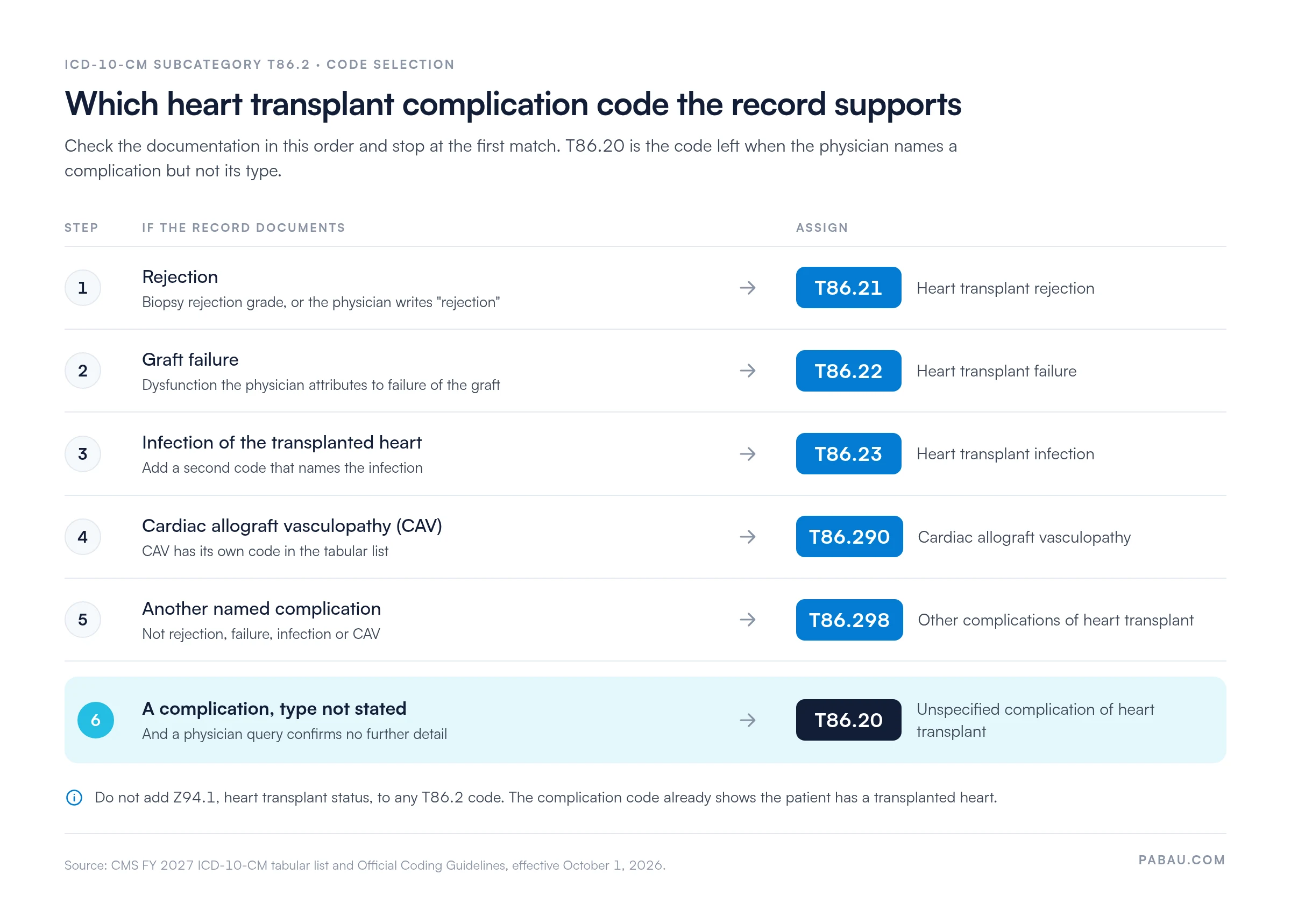
Query before defaulting to T86.20. A transplant patient may present with an adverse event while the note says only ‘complication.’ Check the same encounter’s biopsy results, echocardiogram reports and infectious workup. Any of them may support a more specific sibling code. Finalizing T86.20 without that review is a common route to a denial.
Supporting T86.20 on a claim takes more than a transplant history. The physician record must meet five core documentation standards to satisfy payer medical necessity review and billing compliance requirements.
ICD-10 code T86.20 does not take a 7th character. It is a complete, billable 5-character code. Many Chapter 19 codes for fractures and other injuries need a 7th character, so coders sometimes assume T86.20 does too. The FY 2027 ICD-10-CM tabular list defines no 7th character for category T86.
T86.20 may be sequenced as the principal diagnosis when the unspecified transplant complication is the main reason for the encounter. Inpatient readmissions for a complication event are the usual case.
The official guidelines say two codes fully describe a transplant complication: the T86 code and a secondary code that identifies the complication. With T86.20 that second code is often missing, because the complication has not been identified yet.
When a related condition is documented, such as acute kidney injury from immunosuppressive toxicity, sequencing follows the circumstances of the encounter and the guidelines. Z94.1 is not reported with T86.20 in any position.
CMS and most commercial payers impose specific requirements before accepting a claim coded with T86.20. Meeting them before submission heads off the most predictable denials.
Submitting a clean claim with complete documentation attached reduces payer touchpoints and shortens the payment cycle for transplant-related encounters.
MS-DRG assignment for an inpatient stay coded with T86.20 depends on the principal diagnosis and on the secondary codes. Those secondary codes count through their complication or comorbidity (CC) or major complication or comorbidity (MCC) status. T86.20 carries no fixed DRG weight of its own.
MS-DRG 001 (with MCC) and MS-DRG 002 (without MCC) cover a heart transplant or the implant of a heart assist system. A readmission for a post-transplant complication groups by its own principal diagnosis and secondary codes instead.
Coding T86.20 when the documentation supports a specific sibling can understate the clinical complexity of the stay. A physician query and amended documentation before the claim is final can correct that. Revenue cycle management teams can add a documentation checkpoint for T86.2 codes before submission.
Verify DRG weights against the current CMS MS-DRG Definitions Manual (version 44 for FY 2027), because weights change every year.
T86.20 denials typically fall into five categories. Each has a specific root cause and a fix that revenue cycle teams can apply before the claim goes out. Building these checks into denial management workflows for transplant encounters prevents most of them upstream.
Run a T86.2-specific edit check before claim submission. Flag any claim that carries T86.20 alongside a specific sibling code, and any claim with Z94.1 next to a T86.2 code. Flag T86.20 claims without a documented transplant history too, plus inpatient claims with no prior authorization on record.
Heart transplant encounters rarely involve a single diagnosis code. The crosswalk below covers codes billed with T86.20, instead of it, or in its sequencing. When a biopsy confirms rejection, the claim moves to T86.21. Documented vasculopathy goes to T86.290.
In most practices the diagnosis makes two trips. The physician writes “complication of heart transplant” in the note, and the biopsy or echo result lands in the chart later. Someone at the billing desk then codes from whichever version they see first. That is how T86.20 ends up on a claim the record could have supported as T86.21.
Pabau keeps the note, the results and the claim in one patient record, so the billing team codes from the latest documentation. Its claims management software submits US claims through Claim.MD, which also runs eligibility checks and returns remittances.
Prior authorization codes, dates and sessions sit on the patient’s case, with a warning when one is missing. The result is a claim that matches the chart it came from, and fewer readmission claims held up by a missing authorization.

Pabau keeps physician notes, results and claims in one patient record. Your billing team codes T86.2 encounters from the latest documentation and tracks prior authorizations on the case.

Treat T86.20 as a holding code. It is correct while the type of complication is unknown, and it stops being correct once the record names one. The habit worth building is a check of the same encounter’s biopsy, echo and infection workup before the claim is final.
That check takes a few minutes per claim. Skipping it risks a denial, or a stay grouped with less detail than the chart supports. Keep Z94.1 off every T86.2 claim as well.
Book a demo to see how Pabau keeps transplant notes, authorizations and claims in one record, so your coders work from the latest documentation.

Coding a transplanted heart that is failing? ICD-10 code T86.22 covers heart transplant failure, the code that replaces T86.20 once graft failure is documented.
Looking to understand the full claim submission lifecycle? Medical claims clearinghouse explains how claims move from EHR to payer and where coding errors typically cause delays.
Want to reduce prior authorization bottlenecks? Insurance eligibility verification covers how real-time eligibility checks flag prior auth requirements before the patient encounter.
Building a denial prevention process for your practice? Denial codes in medical billing provides a reference for CARC denial reason codes and correction workflows.
ICD-10 code T86.20 is the billable diagnosis code for an unspecified complication of heart transplant. It is used when the physician documents a complication but has not characterized it as rejection, failure, infection, cardiac allograft vasculopathy or another named condition. It sits in subcategory T86.2, in Chapter 19 of ICD-10-CM, and is valid for fiscal year 2027.
Yes. T86.20 is a complete, billable 5-character ICD-10-CM code with no 7th character requirement. It has been valid since the ICD-10-CM transition and remains valid for fiscal year 2027.
T86.20 is used when the physician’s documentation does not specify the type of heart transplant complication. T86.21 represents heart transplant rejection, used only when rejection is explicitly documented (often confirmed by endomyocardial biopsy with an ISHLT grade). T86.22 represents heart transplant failure, used when graft dysfunction is documented as failure. Once the documentation supports T86.21 or T86.22, the specific code replaces T86.20, because the complication is no longer unspecified.
Use T86.20 when the physician documents a complication but does not name or characterize it. Use T86.298 (other complications of heart transplant) for a named complication that does not fit T86.21, T86.22, T86.23 or T86.290. Cardiac allograft vasculopathy has its own code, T86.290, so it goes to neither T86.20 nor T86.298.
No. T86.20 is a 5-character code and takes no 7th character extension. The ICD-10-CM tabular list defines no 7th character for category T86. Many Chapter 19 injury codes, such as fractures, need a 7th character, but transplant complication codes in category T86 do not.
Yes. T86.20 may be sequenced as the principal diagnosis when the unspecified heart transplant complication is the main reason for the inpatient admission or outpatient encounter. Z94.1 (heart transplant status) is not reported with T86.20 at all. The official guidelines state that the T86.2 code already shows the patient has a heart transplant.