ICD-10 Code S42.444P: Medial epicondyle fracture, right humerus
ICD-10 Code S42.444P: full descriptor and code validity ICD-10 Code S42.444P car...

Last Updated: Oct 13, 2026
Billable Code Specific Code
T86.93 is the billable ICD-10-CM code for an infection of a transplanted organ or tissue. It applies when the record does not name which organ or tissue was transplanted.
The complication type is settled, because the code names infection. What stays unspecified is the transplant site. A site-specific code applies whenever the documentation names the graft. T86.13 covers a kidney transplant infection, and T86.03 covers a bone marrow transplant infection. Treating T86.93 as a general transplant complication code invites avoidable denials.
Let Pabau's smart automation suggest the right codes, reduce claim denials, and keep your practice compliant—effortlessly.
Automate repetitive tasks and focus on what matters most—your patients.
Reduce coding errors and ensure compliance with the latest regulations.
Clean claims, fewer denials, and faster reimbursements.
Powerful insights and reporting to help your practice thrive.
HIPAA compliant SOC 2 certified GDPR-compliant Trusted by 4,000+ clinics worldwide

T86.93 is the billable ICD-10-CM code for an infection of a transplanted organ or tissue when the record never names the transplant site.
The code already specifies the complication as infection, so the only unspecified element is which organ or tissue was transplanted.
Bone marrow transplant infections belong to T86.03 and stem cell transplant complications to T86.5, never to T86.93.
T86.93 carries a use additional code instruction to specify the infection, so a second code almost always belongs on the claim.
Pabau’s claims management software flags T86.93 claims that reach the payer without the transplant site or organism documented.
T86.93 sits within Chapter 19 of ICD-10-CM (Injury, poisoning and certain other consequences of external causes), under category T86 (Complications of transplanted organs and tissue). The table below covers the reference data coders need before building a claim.
According to the CMS ICD-10 codes page, T86.93 has been a valid, billable code since ICD-10-CM took effect in October 2015. Coders can confirm current-year status using the CDC/NCHS ICD-10-CM web tool.
T86.93 reports an infection involving a transplanted organ or tissue where the documentation does not identify which organ or tissue was transplanted. The complication type is settled, because the code names infection. The transplant site is the part the record leaves open.
In the T86.9 subcategory, the word “unspecified” attaches to the graft rather than to the complication. Every T86.9x code opens with an unspecified transplanted organ and tissue, then names the complication that follows. T86.93 names infection.
Because ICD-10-CM already supplies an infection code for each transplant site, T86.93 should be rare in a well-documented chart. It is the fallback the classification provides when the note records a graft infection without recording the graft.
T86.93 is not a bone marrow transplant code, and neither are T86.90, T86.91 or T86.92. Bone marrow transplant complications sit in the separate T86.0x subcategory, which the next sections cover in detail.
T86.93 carries no Excludes1 or Excludes2 note of its own. What it does carry are instructional notes at three levels of the tabular list, and each one changes what else belongs on the claim.
The Z94 rule catches a large share of transplant claims. Post-transplant charts often default to a status code such as Z94.0, and that code survives into the claim after the complication code is added. Strip it out before submission. The same notes apply differently once the graft is named, as the guide to T86.19 shows.
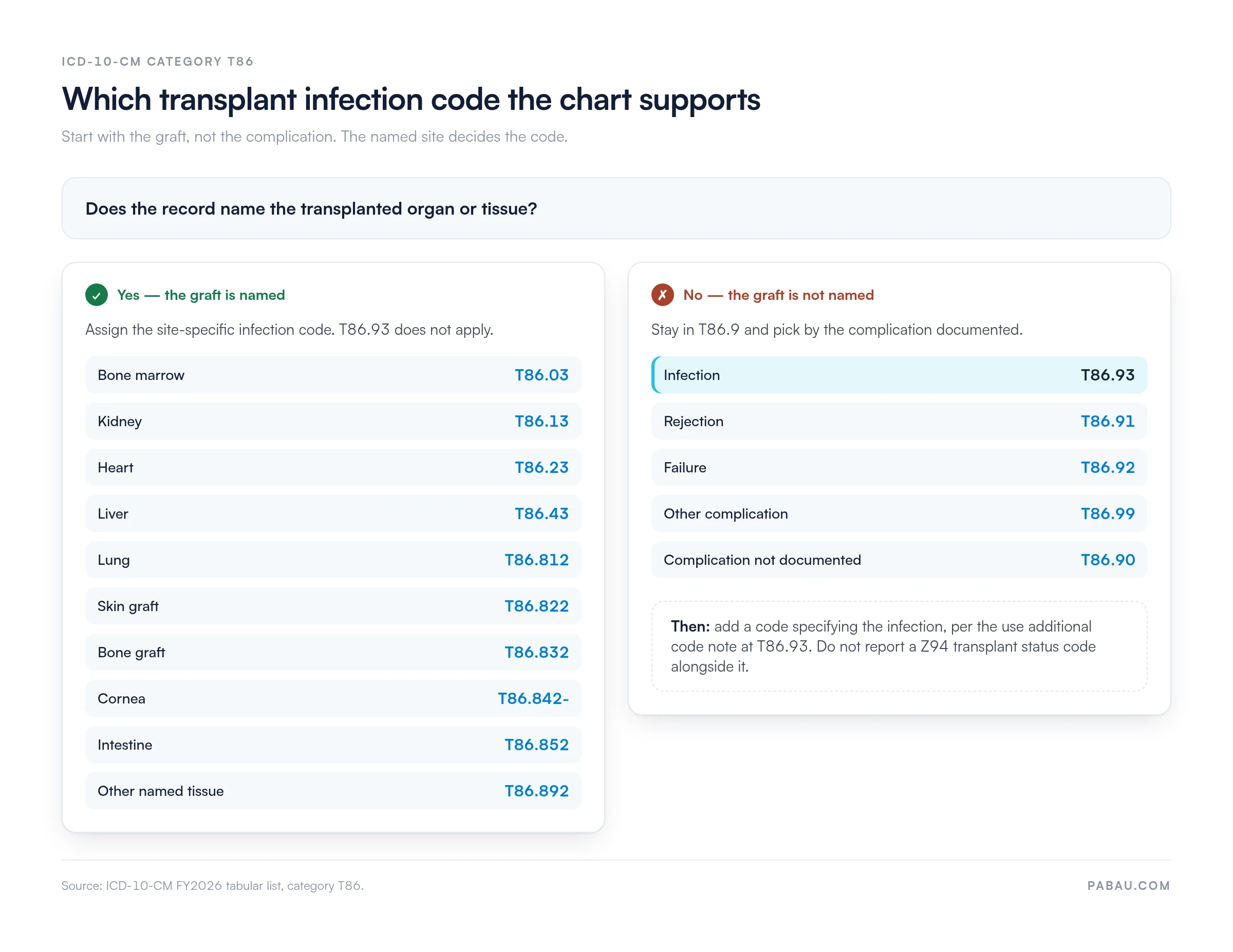
The T86.9 subcategory holds five codes. All five describe a transplanted organ or tissue that the record does not identify. What separates them is the complication reported.
The practical rule runs in two steps. First ask whether the record names the transplanted organ or tissue, because a named graft moves the claim out of T86.9 entirely. Then ask which complication the physician documented, which selects the final character.
Coders who work the second question first tend to land on T86.93 far more often than the chart supports. The chart below runs both questions in order.
Using T86.93 without adequate documentation is the fastest route to a records request on transplant claims. The physician record must support three elements before the code can be assigned.
The third element is where most T86.93 assignments fall apart. Auditors routinely find the transplant site recorded elsewhere in the same chart, which converts a valid unspecified code into an unsupported one.
Billers should also confirm that the encounter type is reflected consistently on the claim. T86.9x codes carry no 7th-character extension, so the revenue code, place of service, and supporting documentation have to do that work. Inconsistency between claim fields and the record is a common audit trigger.
A T86.93 claim clears only when the physician’s note and the claim form tell the same clinical story. A mismatch between them invites automatic denial before human review.
Add the transplant site to the problem list at the first post-transplant encounter, not just to the operative report. Coders can then reach for T86.13 or T86.43 instead of T86.93, which removes the most common reason these claims stall in payer review.
CMS and commercial payers apply extra scrutiny to transplant complication codes, because transplant care is a high-cost service category. T86.93 attracts attention for a further reason: an unspecified transplant site suggests the documentation was thin rather than the clinical picture unclear.
Transplant programs that read their MAC’s local coverage policies first set payer expectations correctly. That check takes minutes, and it heads off a records request that costs weeks.
T86.93 denials cluster around four root causes. Each has a specific coder action that resolves the underlying problem rather than simply resubmitting the same claim.
Working these four causes in order stops the same errors from recurring across the transplant program’s billing cycle. The CARC and RARC codes on a remittance map onto the root causes above, so reading denial codes tells the biller which fix applies.
The ICD-10-CM official guidelines for transplant complications require two codes to describe the event fully. The T86 code comes first, followed by a code that identifies the complication. For T86.93 that second code specifies the infection.
Under UHDDS guidelines, the principal diagnosis is the condition established after study to be chiefly responsible for the admission. T86.93 can lead when the patient is admitted to treat a graft infection and no other condition better explains the admission.
T86.93 becomes a secondary code when a different condition drove the admission. Sepsis is the common example: the sepsis code leads, and T86.93 records the transplant infection that produced it. Both codes belong on the claim in that scenario.
For outpatient encounters, ICD-10-CM directs coders to report the condition chiefly responsible for the visit. Where no condition is established, the sign or symptom is reported instead. T86.93 can lead on an outpatient claim when the visit exists to manage the graft infection.
Sequencing works the same way across the rest of Chapter 19, so the same two questions settle any T86 code. Ask what drove the encounter, then place the transplant complication code around that answer.
Almost every T86.93 assignment has a better alternative waiting in the same category. ICD-10-CM supplies an infection code for each named transplant site, and the table below lists them.
That table lists infection codes only. When the named graft has no subcategory of its own and the complication is not rejection, failure, or infection, T86.898 applies.
This is the single most consequential miscoding pattern around T86.93. Hematopoietic stem cell transplant patients are frequent users of transplant complication codes, which tempts coders toward the T86.9x block.
ICD-10-CM keeps those complications elsewhere. Bone marrow transplant complications run from T86.00 through T86.09, with T86.03 for infection. T86.5 covers complications of stem cell transplant. Neither route passes through T86.9x, which exists only for grafts the record does not name.
Graft-versus-host disease is coded from D89.81-, and the note at category T86 asks coders to add it alongside the transplant complication code. GVHD does not replace T86.93, and T86.93 does not replace GVHD. Where both are documented, both are reported.
The AAPC ICD-10-CM lookup provides a useful cross-reference for the boundaries between these code families. The CDC web tool cited above confirms whether a given code is valid for the current fiscal year.
Practices billing T86.93 usually lose revenue for a documentation reason rather than a coding one. The transplant site or the infection detail never reaches the claim, and no step in the workflow catches the omission. Practice management software like Pabau closes that loop by checking the claim against the record before submission.
High-volume post-transplant billing depends on the handoff between the clinical note and the claim. Documentation prompts and claim scrubbing in the same system remove most of those handoff errors.
Pull every T86.93 claim from the last quarter and check whether the transplant site appears anywhere else in each chart. Most programs find the site was recorded all along, which turns a coding problem into a note template problem with a much faster fix.

Pabau’s integrated claims management flags incomplete documentation on codes like T86.93 before submission, helping transplant and specialty practices reduce avoidable denials and speed up reimbursement.

T86.93 is a valid, billable code with one narrow job. It reports an infection of a transplanted organ or tissue that the record never names, and the graft site is the only missing element.
Most claims that carry it should have carried a site-specific code such as T86.03, T86.13 or T86.43 instead. Adding the code that specifies the infection, sequencing against UHDDS guidance, and dropping the Z94 status code resolve the rest.
Pabau’s integrated claims management builds those checks into the billing workflow. T86.93 claims then reach the payer with the documentation they need. To see how it works for your program, book a demo with the team.

Need the site-specific alternative? ICD-10 code T86.13: Kidney transplant infection covers the code that applies once the chart names a kidney graft.
Complication type missing as well? ICD-10 code T86.90: Unspecified transplant complication explains the weakest code in the T86.9 subcategory.
A complication other than infection? ICD-10 code T86.99: Other complications of unspecified transplanted organ sets out when the other code applies.
Graft named but with no subcategory? ICD-10 code T86.892: Other transplanted tissue infection is the code for named tissue with no block of its own.
Working through a denial backlog? Denial management in healthcare gives the process for stopping repeat denials across a billing cycle.
ICD-10 code T86.93 is the billable diagnosis code for an unspecified transplanted organ and tissue infection. It reports an infection involving a transplanted organ or tissue where the documentation does not identify which organ or tissue was transplanted. The complication is already specified as infection, so the transplant site is the only unspecified element. Where the record names the graft, a site-specific code such as T86.13 or T86.43 applies instead.
Yes, T86.93 is a valid, billable ICD-10-CM code accepted for HIPAA-covered transactions. The FY2026 edition took effect on October 1, 2025. It falls within Chapter 19 under category T86, Complications of transplanted organs and tissue, and can be reported as a principal or secondary diagnosis. As a principal diagnosis it groups to MS-DRG 919, 920 or 921.
All four codes describe a transplanted organ or tissue that the record does not identify, and they differ by the complication reported. T86.90 is an unspecified complication, T86.91 is rejection, T86.92 is failure, and T86.93 is infection. T86.99 covers other complications of an unspecified transplanted organ and tissue. Whenever the documentation names the graft, none of these five codes applies.
No. A bone marrow transplant infection is coded to T86.03, inside the T86.0x subcategory that also holds T86.00, T86.01, T86.02 and T86.09. Complications of stem cell transplant are coded to T86.5. The T86.9x codes are reserved for grafts the record does not name, so they should not be used as a general hematology transplant block.
T86.93 carries a tabular instruction to use an additional code to specify the infection, so a second code normally belongs on the claim. The note at category T86 also asks coders to add codes for other transplant complications such as D89.81- for graft-versus-host disease. No external cause code from Chapter 20 is needed, because the T86 code already includes the external cause.
Four triggers account for most denials. The transplant site is documented elsewhere in the chart, which makes the unspecified code unsupported. No code specifying the infection accompanies T86.93. A bone marrow or stem cell transplant was miscoded to T86.93 rather than T86.03 or T86.5. Or T86.93 was sequenced as principal when another condition drove the admission. Each has its own corrective action before resubmission.