ICD-10 Code Y76.0: Diagnostic obstetric and gynecological devices
ICD-10 Code Y76.0: Definition and billable status ICD-10 Code Y76.0 is a valid, ...

Last Updated: Oct 23, 2026
Billable Code Specific Code
T65.4X1S is the billable ICD-10-CM code for toxic effect of carbon disulfide, accidental (unintentional), sequela. It applies when a patient is treated for a lasting condition, such as neuropathy or heart disease. That condition was caused by an earlier accidental exposure that has since resolved.
Carbon disulfide is an industrial solvent used in rayon and cellophane production, so most cases trace back to the workplace. On the claim, the residual condition usually comes first, and T65.4X1S follows to explain the cause. The sections below show how the claim is built, where it tends to break, and what to check before you submit.
Let Pabau's smart automation suggest the right codes, reduce claim denials, and keep your practice compliant—effortlessly.
Automate repetitive tasks and focus on what matters most—your patients.
Reduce coding errors and ensure compliance with the latest regulations.
Clean claims, fewer denials, and faster reimbursements.
Powerful insights and reporting to help your practice thrive.
HIPAA compliant SOC 2 certified GDPR-compliant Trusted by 4,000+ clinics worldwide

T65.4X1S is the billable ICD-10-CM code for a sequela visit after accidental carbon disulfide exposure, once the acute poisoning has resolved.
The residual condition, such as neuropathy or heart disease, is usually listed first, and T65.4X1S follows to explain the cause.
The placeholder X in position 5 is mandatory, and a dropped X or the wrong 7th character is a common reason these claims fail.
Pabau’s claims management software offers ICD-10-CM code lookup, checks required claim fields before sending, and tracks eligibility and ERAs through Claim.MD.
ICD-10 code T65.4X1S covers a sequela visit after an accidental (unintentional) toxic exposure to carbon disulfide. In plain terms, the poisoning is over, but it left damage that still needs care. The code sits in Chapter 19 of ICD-10-CM (S00-T88), within the T51-T65 block for toxic effects of nonmedicinal substances.
Three parts of the code have to match the chart. The substance is carbon disulfide (T65.4), and the intent is accidental (6th character 1). Finally, the encounter is a sequela (7th character S). If one of them is off, you’re reporting a different code.
So what counts as a sequela visit? The patient comes in for a lasting effect of the earlier exposure, not for the exposure itself. Typical examples are peripheral neuropathy, parkinsonism, memory problems, heart disease, and vision changes. Because care now targets that lingering condition, the encounter takes the S character.
Misread one character in T65.4X1S and you get a different code, or no code at all. Here’s what each position means.
The X at position 5 is the easiest character to lose. It carries no clinical meaning and only holds the space so a 7th character can follow. Without it you get T65.411S, which doesn’t exist in the tabular list, so the claim is rejected outright.
Check every Chapter 19 code for the placeholder X before batch processing. A quick search for T65.41 (the missing-X version) catches this error before the claim leaves your system.
Knowing the clinical picture makes the documentation easier to read. Carbon disulfide is an industrial solvent used mainly in rayon fiber production, cellophane manufacturing, and soil fumigation.
Workers are exposed mostly by breathing it in, and the NIOSH Pocket Guide also lists skin absorption as a route. Long-term, low-level exposure can leave effects that outlast the original episode.
These residual conditions are the ones most often coded alongside T65.4X1S:
Each of these conditions needs its own ICD-10-CM code on the claim. First, pin down which condition the provider is treating at this visit. Then confirm the note links it to the earlier carbon disulfide exposure.
T65.4X1A, T65.4X1D, and T65.4X1S share the same substance and intent. Only the 7th character differs, and picking the wrong one is an easy way to get a claim denied.
The deciding question is whether the acute episode has resolved. If it has, every later visit for a lasting effect takes S. When in doubt, read the reason for the visit in the provider’s note. For example, peripheral neuropathy “due to prior carbon disulfide exposure” points to a sequela visit.
The diagram below puts the whole decision on one page, from the 7th character to the order of codes on the claim.
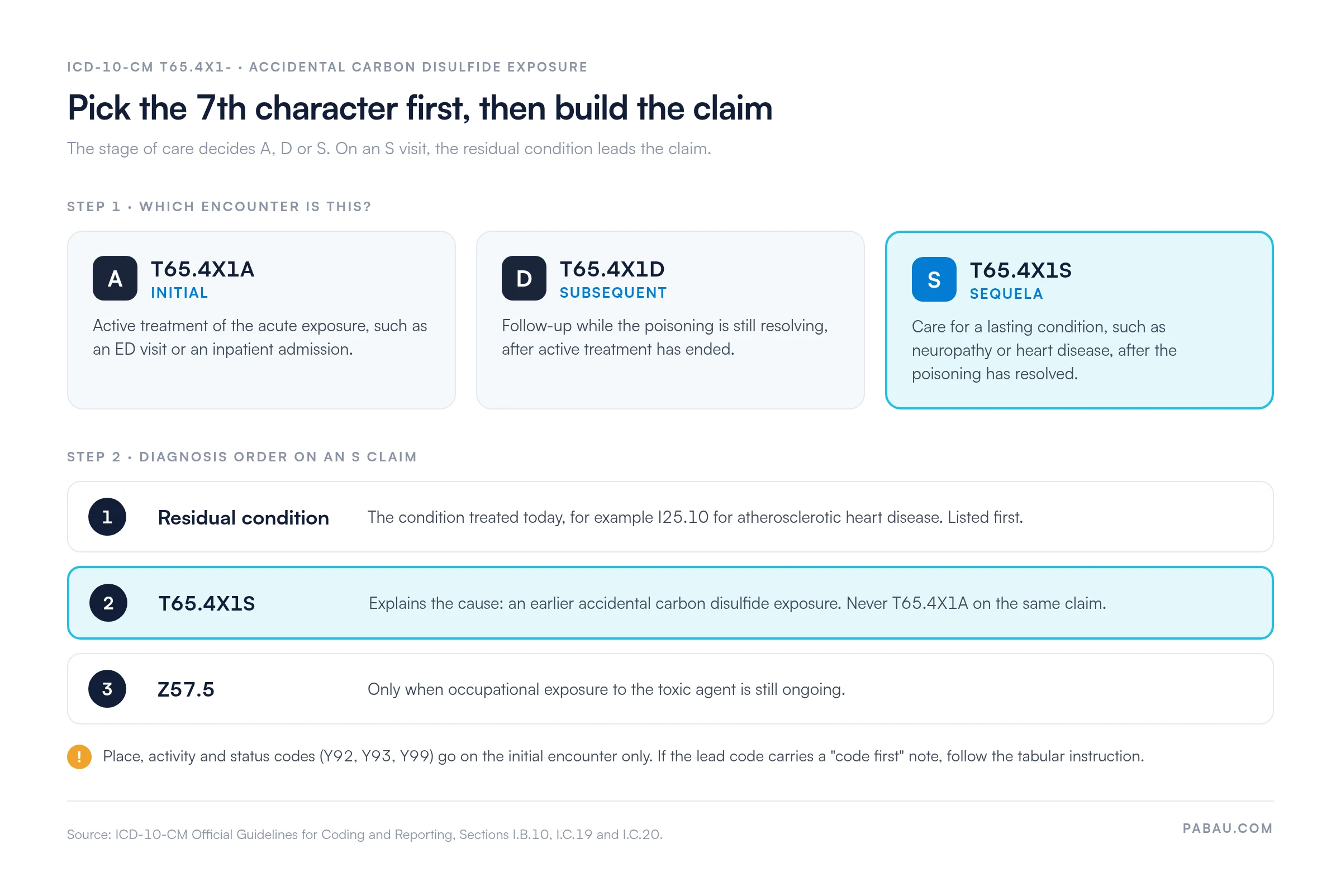
Section I.B.10 of the ICD-10-CM Official Guidelines sets the general order for sequela coding, and Section I.C.19 applies it to Chapter 19 codes. Coders who learned late effects in ICD-9-CM often get this order backwards.
For a standard sequela visit, build the claim in this order:
One exception deserves a check on every claim. Some lead codes carry a “code first” note in the tabular list. For example, G62.2 (polyneuropathy due to other toxic agents) tells you to code the toxic agent from T51-T65 first. In that case, follow the tabular instruction and list T65.4X1S ahead of G62.2.
The CMS ICD-10-CM Official Guidelines are updated every fiscal year, so check you’re on the current edition. It also helps to add a sequela review step to your medical billing workflows. That way, a second coder checks the order before the claim goes out.
T65.4X1S already carries the substance and the intent, so it needs no separate external cause code for intent. The other external cause codes follow a rule of their own. Place, activity, and status codes are reported once, at the initial encounter for treatment.
Status codes cover more than paid work. When the original exposure happened during a hobby or other leisure activity, Y99.8 records that status on the initial claim instead. Either way, the sequela claim leaves the status code out.
As a result, occupational payers may ask for context the sequela claim cannot carry in codes. Put the employer, job title, and exposure dates in the note, so a reviewer can find them fast.
Watch the placeholder X in batch environments too. Scanning tools and EHR auto-fill sometimes drop it when they parse alphanumeric codes, which produces the invalid T65.411S. A billing-system rule that flags any T65.4 code without an X at position 5 stops that denial before it starts.
Several codes sit close enough to T65.4X1S in the tabular list to cause mix-ups. These are the ones worth a second look.
T52.4X1S is the one that surprises coders. It follows the same pattern but covers ketones, not carbon disulfide. Older EHR lookup tables can return T52 codes for a search on “carbon bisulfide.” Before you assign either code, confirm the full descriptor in the CDC ICD-10-CM lookup tool.
To compare neighboring codes in the same chapter, browse the ICD-10-CM code library.
Payers reviewing a T65.4X1S claim want a clear story. It has to tie today’s condition to a confirmed past exposure. Before you assign the code, check that the record shows each point below:
One template change prevents the most common omissions. Add two required fields to your sequela follow-up note: “acute event resolved” and “residual condition treated.” That supports medical billing compliance without a provider query later.
Flag every chart with T65.4X1S for a quick documentation check before coding. Confirm the note names the residual condition, links it to carbon disulfide exposure, and says the acute poisoning has resolved.
Sequela claims fail in predictable ways, usually because the lead code is missing or a character is wrong. The table maps each denial to its cause and its fix.
Sort your rejections by claim adjustment reason code (CARC) as part of your denial management workflows. That way, you can see which of these patterns shows up most at each payer. Then fix the cause at the source, whether that is a note template, a coder check, or a lookup habit.
T65.4X1S isn’t a high-volume code on commercial plans. Instead, it shows up in occupational health, workers’ compensation, and VA or military medicine, where carbon disulfide exposure histories are more common. Each line of business reads it a little differently.
Medicare and Medicaid: CMS doesn’t publish a specific LCD or NCD for toxic effect sequela codes. Medical necessity is judged at the service level, through the procedure or E/M code paired with the residual condition. T65.4X1S explains the cause, while the residual condition code justifies the visit.
Workers’ compensation: State programs often want the original exposure date and employer details with the claim. Their rules differ from standard health insurance, so check your state’s workers’ comp billing manual before you submit.
Commercial payers: Most follow Medicare claim edit logic. The most common edit flags T65.4X1S when no residual condition code appears on the claim. Electronic remittance advice shows which edit triggered a denial, so you can correct and resubmit faster.
Sequela denials often start with manual steps, such as retyping codes, chasing missing claim fields, and checking payer portals one claim at a time. Pabau, the practice management platform we build, brings those steps into the patient record.
Its claims management software includes a full ICD-10-CM code lookup library, so coders check the tabular descriptor instead of typing from memory. Before a claim can go, Pabau also confirms that required fields, such as membership numbers and authorization codes, are complete.
US practices submit through the Claim.MD clearinghouse integration. It adds real-time eligibility checks, 835 ERA remittance posting, and claim-status tracking. As a result, a rejected sequela claim shows up while the chart is still fresh.

Pabau connects with Claim.MD to streamline ICD-10-CM claims submission, ERA matching, and denial tracking for occupational health and toxicology practices.

T65.4X1S rewards the coder who reads the note before reaching for the code. Once the chart shows a resolved exposure and a named residual condition, the rest follows a set pattern. The residual condition goes first, the X stays in place, and first-encounter codes stay off the claim.
The trade-off is a little time up front. A two-field note template and a quick pre-submission check take minutes, while a denied sequela claim takes far longer to rework. Start with whichever step your team skips today.
Pabau supports that routine with ICD-10-CM code lookup, required-field validation, CARC tracking, and ERA matching through Claim.MD. Book a demo to see how it keeps your toxic effect sequela claims moving.

Need a structured framework for managing denied claims? Denial management in healthcare covers the full workflow from CARC code interpretation to root-cause fixes and resubmission timelines.
Submitting a clean claim on the first pass? Clean claim submission outlines the data elements payers validate before adjudication, including diagnosis code sequencing and required secondary codes.
Weighing up a clearinghouse for US claims? Claim.MD clearinghouse review explains what Claim.MD does, how it works, and what it costs.
Not sure what a clearinghouse checks before a payer sees your claim? Medical claims clearinghouse walks through how claims are validated and routed to payers.
Coding another toxic effect sequela? ICD-10 code T59.3X2S applies the same sequela rules to lacrimogenic gas exposure.
No. The ICD-10-CM guidelines set no time limit on sequela codes. You can report T65.4X1S months or years after the exposure, as long as the provider is treating a condition it caused.
ICD-10-CM reserves poisoning codes (T36-T50) for drugs and biologicals. Carbon disulfide is an industrial chemical, so it falls under toxic effects of nonmedicinal substances (T51-T65). Its older name, carbon bisulfide, leads to the same T65.4 codes.
Code it as accidental. The guidelines treat unknown or unspecified intent as accidental. Save T65.4X4S, the undetermined code, for records that state the intent can’t be determined.
No. Carbon monoxide has its own category, T58, while carbon disulfide sits under T65.4. The names look alike in a quick search, so check the substance before you pick the code.