ICD-10 code S61.201A: Open wound of left index finger without nail damage
ICD-10 code S61.201A covers a left index finger wound of unstated type ICD-10 co...

Last Updated: Oct 16, 2026
Billable Code Specific Code
T59.3X2S is the billable ICD-10-CM code for toxic effect of lacrimogenic gas, intentional self-harm, sequela. It applies at follow-up visits for a lasting effect of a past, intentional exposure to tear gas or a similar agent.
The residual condition, such as chronic conjunctivitis, reactive airway disease, or a psychological effect, is coded first. T59.3X2S follows it to record the cause. Common errors include using A or D instead of S, dropping the placeholder X, and leaving out the residual condition code.
Let Pabau's smart automation suggest the right codes, reduce claim denials, and keep your practice compliant—effortlessly.
Automate repetitive tasks and focus on what matters most—your patients.
Reduce coding errors and ensure compliance with the latest regulations.
Clean claims, fewer denials, and faster reimbursements.
Powerful insights and reporting to help your practice thrive.
HIPAA compliant SOC 2 certified GDPR-compliant Trusted by 4,000+ clinics worldwide

T59.3X2S is the billable ICD-10-CM code for toxic effect of lacrimogenic gas, intentional self-harm, sequela, valid for FY2025 and FY2026.
The 7th character S marks a sequela visit, so the residual condition is coded first and T59.3X2S is listed second.
The 6th character 2 (intentional self-harm) needs explicit provider documentation and is never inferred from clinical context alone.
Place-of-occurrence codes come from Y92 and activity codes from Y93, and some payers require them on the claim.
Claims management software like Pabau flags incomplete code structures and missing residual condition codes before a claim is submitted.
ICD-10 code T59.3X2S is the specific, billable ICD-10-CM diagnosis code for toxic effect of lacrimogenic gas, intentional self-harm, sequela. It applies at a follow-up visit for a lasting effect of a past, intentional exposure to tear gas or a similar agent. The CMS ICD-10-CM annual release lists it as valid for both FY2025 and FY2026.
The code sits in Chapter 19 of ICD-10-CM. Knowing each parent level helps when a payer LCD policy, crosswalk tool, or audit query cites a category rather than the full code.
Each character in T59.3X2S carries a specific coding instruction. Misread one position and you get an invalid code or, worse, the wrong intent on the patient’s record.
The placeholder X is not optional. T59.3 has only four characters, so it needs a placeholder in position 5 to push the intent and episode characters into positions 6 and 7. Omitting X produces “T59.32S,” which is an invalid code structure and an automatic payer rejection. Verify against the CDC/NCHS ICD-10-CM web tool whenever a code structure question comes up.
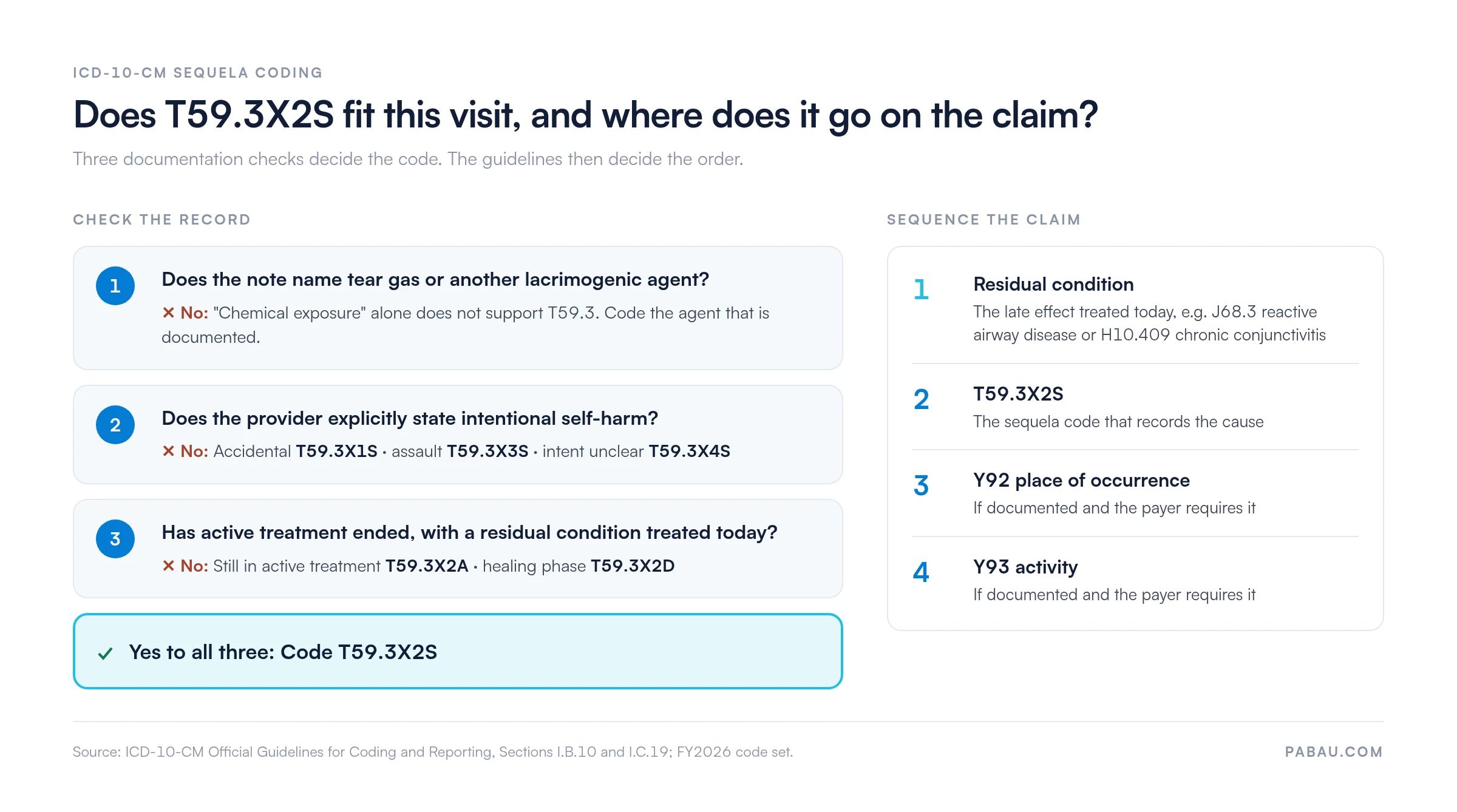
The 7th character S designates a sequela encounter. The active toxic exposure is over, and the patient is now treated for a residual or late effect that persists after healing. Per ICD-10-CM Official Guidelines Section I.B.10, sequela coding takes two codes. The residual condition is sequenced first, and T59.3X2S follows it to record the cause.
A common error is applying S before the acute treatment phase has concluded. If the patient is still being treated for the toxic exposure itself, A or D is correct. Switching to S too early breaks the ICD-10-CM Official Guidelines and misstates the record. Run the same check before you add a psychological sequela, such as situational anxiety, to the claim.
That timing test holds anywhere in the T51-T65 block. T65.4X1S sets the same bar for an accidental carbon disulfide exposure, and its residual condition is sequenced first too. T63.034S covers a taipan venom sequela where the provider could not determine intent, and the residual condition still leads the claim.
The intent character and episode character together narrow T59.3X2S to a very specific clinical scenario. Confusing either produces a different code entirely, with different legal and billing implications.
Coding as accidental (T59.3X1S) when the record explicitly documents self-harm is a classification error. It understates the clinical picture and may affect mental health follow-up coordination. It can also trigger an audit when the rest of the record tells a different story. When intent is unclear from the documentation, T59.3X4S (undetermined) is the correct choice.
Intent behaves the same way across the other toxic effect subcategories. T52.0X3D carries digit 3 for assault, applied to a petroleum product exposure at a follow-up visit.
Lacrimogenic gas is any chemical agent that causes tearing, burning, and temporary visual impairment upon mucous membrane contact. The ICD-10-CM category T59.3 groups all such agents together regardless of their specific chemical composition.
Agents coded as lacrimogenic gas include CS gas (2-chlorobenzalmalononitrile), CN gas (chloroacetophenone), oleoresin capsicum (OC) spray, and combination aerosols with several irritants. The ICD-10-CM tabular does not list chemical names, so this grouping comes from toxicology literature rather than from the code set itself.
Late effects (sequelae) that may persist after acute exposure and justify the S episode include:
Documentation should identify the agent by name where possible. “Tear gas exposure” is acceptable if the specific formulation is not documented. The provider must still note that the agent was lacrimogenic, which supports T59.3 over a more general toxic gas category.
T59.3X2S already encodes intent in its 6th character, where 2 means intentional self-harm. So it is not paired with a separate X71-X83 intent code, the way a T-code without built-in intent might be. ICD-10-CM Official Guidelines do recommend place-of-occurrence (Y92) and activity (Y93) codes, and some payers enforce them as a hard requirement.
Sequence the codes this way for a T59.3X2S sequela visit:
Payer policies on external cause codes vary, so no single code is universally required. Review each payer’s LCD and billing guidelines before you confirm the sequence. Practices that submit through a clearinghouse such as Claim.MD can check code combinations before the payer ever sees them.
Before you submit a sequela claim, confirm the residual condition code is present and listed first. T59.3X2S on its own fails medical necessity review at most payers, because it does not say what is being treated today.
Four elements must appear in the clinical record to justify T59.3X2S on a claim. Missing any one shifts the code to a less specific or incorrect alternative.
Sequela follow-ups can run for months, so capture all four elements in the note at every visit. A clean claim depends on documentation that maps directly to these ICD-10-CM requirements. The flow below turns the checks into a coding decision, then shows the order the codes go on the claim.
T59.3X2S claims get denied for a short list of predictable reasons. Each one traces back to a documentation or coding error you can catch before submission.
Appealing a denial for any of the first three triggers means sending the relevant section of the clinical note with a cover letter. The letter explains why the specific code is supported. For intent-character mismatches, quote the exact language from the provider’s note. For a missing residual condition code, send a corrected claim that lists that code first.
The guide to CARC denial codes maps each payer code to the trigger behind it. Running these checks before submission surfaces the errors before remittance, not after it.
Audit the T59.3X2 family codes billed in the last 90 days. Flag any claim with an A or D 7th character where the note shows active treatment had ended, and review it for sequela reclassification.
Without a pre-submission check, each sequela claim depends on a coder spotting every error by hand. That means the right 7th character, a residual condition code, and the correct order, every time.
Practice management software like Pabau runs those checks for you. Pabau gives practices claims software built for coders that validates ICD-10-CM code pairs before submission. It flags a sequela code sent without its residual condition, then routes clean claims through the Claim.MD clearinghouse.
Your billing team spends less time on resubmissions and appeals. Payment for sequela follow-ups arrives on the first pass more often, and the patient’s record stays accurate.

Pabau’s claims management tools validate ICD-10-CM code pairs, flag missing residual condition codes, and route clean claims through Claim.MD before they reach the payer. Book a demo to see how it works for your practice.

Treat T59.3X2S as the second line on the claim, not the first. The residual condition explains why the patient is here today, and the sequela code explains where it came from.
The riskiest character is the 6th. Code self-harm only when the provider has written it down, and fall back to T59.3X4S when the record is silent. A wrong intent misstates the patient’s history, which is harder to correct than a denied claim.
The safest setup makes these checks part of submission, so no coder has to remember them. Book a demo to see how Pabau flags sequela sequencing errors before a T59.3X2S claim leaves your practice.

Need a framework for clean ICD-10-CM claim submission? Clean claim submission outlines the documentation and code-pair standards that prevent rejections at clearinghouse level.
Want to understand how denial codes map to specific claim errors? Denial management in healthcare covers CARC code interpretation and systematic appeal workflows.
Looking for the broader revenue cycle context for diagnostic coding? Revenue cycle management explains how ICD-10-CM codes feed into payment posting and remittance reconciliation.
T59.3X2S is the billable ICD-10-CM diagnosis code for “toxic effect of lacrimogenic gas, intentional self-harm, sequela.” It covers a visit for a late effect of a past, intentional exposure to tear gas, pepper spray, or a similar agent. Active treatment for the original exposure has already concluded.
Yes. T59.3X2S is a specific, billable ICD-10-CM code valid for FY2025 and FY2026. Its parent T59.3X2 lacks the 7th character and cannot be submitted. T59.3X2S includes every required character, so payers accept it as a complete diagnosis code.
The difference is the episode of care. A is the initial encounter, for active treatment of the acute toxic exposure. D is a subsequent encounter, during healing or monitoring after active treatment. S is sequela, for late or residual effects once the acute phase has fully concluded.
Yes, and the residual condition code is listed ahead of it. Per ICD-10-CM Official Guidelines Sections I.B.10 and I.C.19.b, the residual condition is sequenced first and T59.3X2S second. Common residual codes include J68.3 for reactive airway disease, H10.409 for chronic conjunctivitis, or an appropriate F-code for psychological sequelae.
Use T59.3X4S when the clinical record does not establish whether the exposure was intentional self-harm, accidental, or assault. Intent character 4 fits when documentation is ambiguous or the provider has not recorded the intent. Never assign T59.3X2S on inference. The record must contain explicit language documenting intentional self-harm.
Yes. T59.3X2S is valid for FY2026, and it was not revised or deleted in the FY2025 or FY2026 annual updates. Check validity against the official CMS release at the start of each fiscal year, because codes in the T59 family can change.