

ICD-10 code S61.201A: Open wound of left index finger without nail damage
ICD-10 code S61.201A covers a left index finger wound of unstated type ICD-10 co...

Last Updated: Oct 16, 2026
Billable Code Specific Code
T63.123S is the billable ICD-10-CM code for toxic effect of venom of other venomous lizard, assault, sequela. It records that a patient's current condition is a late effect of a venomous lizard bite inflicted during an assault.
The code sits in T63.12, under T63.1, toxic effect of venom of other reptiles, and covers any venomous lizard except the gila monster. It is always a secondary code, sequenced after the residual condition. Gila monster venom uses T63.113S, and rattlesnake venom belongs to T63.01-.
Let Pabau's smart automation suggest the right codes, reduce claim denials, and keep your practice compliant—effortlessly.
Automate repetitive tasks and focus on what matters most—your patients.
Reduce coding errors and ensure compliance with the latest regulations.
Clean claims, fewer denials, and faster reimbursements.
Powerful insights and reporting to help your practice thrive.
HIPAA compliant SOC 2 certified GDPR-compliant Trusted by 4,000+ clinics worldwide

T63.123S covers the sequela of a toxic effect of venom of a venomous lizard other than a gila monster, inflicted by assault.
The 7th character S marks a visit for a residual condition, so that condition is coded first and T63.123S follows it.
Gila monster venom uses T63.113S, and rattlesnake venom belongs to a separate family, T63.01-, so species documentation decides the code.
The code already carries the external cause and the assault intent, so no Chapter 20 cause code is needed at a sequela visit.
ICD-10 code T63.123S is a billable code for the late effect of a venomous lizard bite inflicted during an assault. The lizard is any venomous species except the gila monster. The code is always sequenced after the residual condition treated at the visit. The table below collects the facts coders check most often.
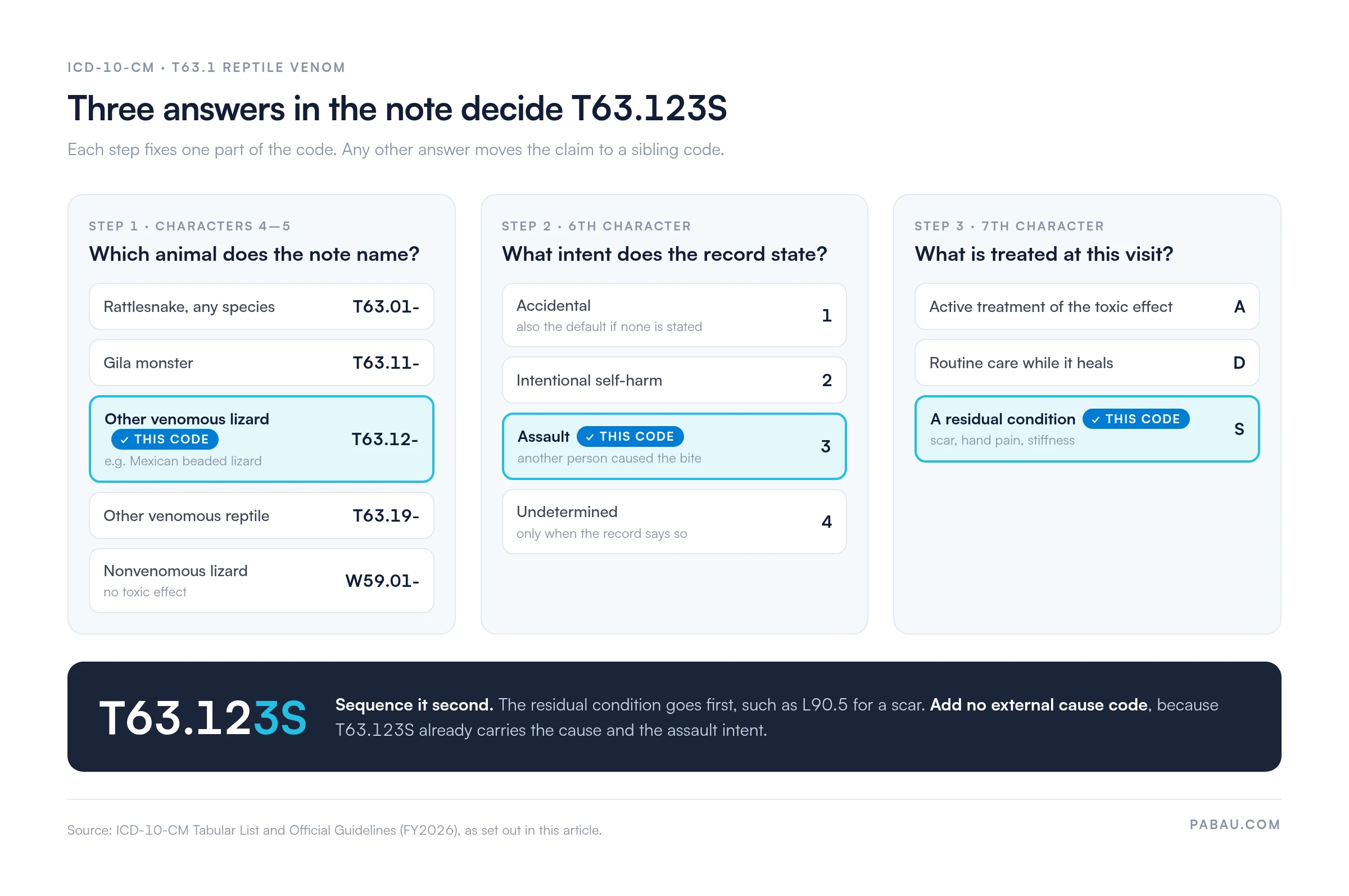
Each character in T63.123S narrows the code a step further. Misreading one of them sends the claim to the wrong animal, intent, or encounter type.
The Alphabetic Index sends “Lizard (bite) (venom)” to T63.12-, while the gila monster has its own entry at T63.11-. In practice, the Mexican beaded lizard (Heloderma horridum) is the species most often coded to T63.12-. When the note says only “lizard bite” and describes no venom effect, query the provider before choosing any T63 code.
The path below shows the three answers in the note that lead to T63.123S, and where each other answer sends the claim.
Subcategory T63.1 splits into three reptile groups, and each group carries four intents and three encounter types. The sequela codes below show where T63.123S sits among its closest neighbors.
Rattlesnake venom does not belong anywhere in this table. It is coded in T63.01-, so the assault sequela of a rattlesnake bite is T63.013S. ICD-10-CM also has no separate code for diamondback rattlesnakes, so every rattlesnake species shares the T63.01- codes.
The same intent and encounter grid runs through the other venom families in T63. Bee stings fall under T63.44-, where intentional self-harm at a subsequent encounter becomes T63.442D. Snake venom works the same way, and a taipan bite with undetermined intent at the sequela stage is coded T63.034S.
The S 7th character applies when the patient is treated for a condition that arose as a direct result of the original toxic effect. ICD-10-CM Official Guidelines Section I.C.19.a describes it with the example of scar formation after a burn.
For T63.123S, the sequela is the residual problem that remains once the acute envenomation has been treated. The table compares the three encounter types for the same assault.
The most common error is using D for a return visit about a residual condition. A patient treated for the bite months ago who now presents with hand stiffness has a sequela encounter. The guidelines also set no time limit on when a sequela code can be used.
D belongs to the earlier stage, when the toxic effect is still being treated. A petroleum product assault at that point is coded T52.0X3D, which keeps the intent and changes only the 7th character.
T63.123S never works as a standalone code, yet its companion list is short. The residual condition is the only required partner, and a claim scrubber can flag a claim that arrives without one.
Two external cause codes cause most of the confusion. W59.11XS means “Bitten by nonvenomous snake, sequela,” and category W59 excludes contact with venomous reptiles. Y04 describes assault by bodily force, such as a fight or a human bite, so it does not describe a lizard envenomation either.
Clearinghouse front-end edits check code pairs like these before the payer sees them. Adding a W59 code next to T63.123S breaks an Excludes1 note, which those edits can flag.
The Tabular List places no Excludes note on T63.1 or T63.12 themselves. The boundaries come from the T51-T65 block, category T63, and the external cause categories nearby.
T63.123S sits close to several codes that share part of its wording. This comparison shows what each one means and when it applies instead.
A T63.123S claim holds up only when the note supports every part of the code. The record needs to carry four elements.
When any element is missing, query the provider before coding rather than inferring it. That habit keeps the claim defensible in an audit.
Run a four-point check on every T63.123S claim before it goes out. Confirm the sequela linkage phrase, a lizard other than a gila monster, a documented assault, and a named residual condition. A claim missing any of the four goes back to the provider as a query.
Most T63.123S denials trace back to sequencing, species, or intent. The table lists the common patterns and the fix for each.
CARC 16 (claim lacks information or has submission errors) and CARC 11 (diagnosis inconsistent with the procedure) are the usual signals of a coding problem. The full list of denial reason codes helps you tell a coding denial from a coverage one.
Electronic remittance advice files carry these codes for every claim you submit. Sorting them by code shows a repeating pattern, and a denial management process fixes it at the source instead of one claim at a time.
Three scenarios show where T63.123S applies, where a sibling code is correct, and the most common 7th-character error.
A patient presents ten months after another person forced a pet Mexican beaded lizard to bite their right hand. The emergency department treated the envenomation at the time. The provider documents: “Scar of right hand, sequela of beaded lizard envenomation during an assault.”
Correct code sequence: L90.5 (scar conditions and fibrosis of skin) first, then T63.123S. The beaded lizard places the case in T63.12-, the assault sets the sixth character to 3, and the residual scar calls for the S character. No external cause, place, or activity code is added.
A patient returns eight months after an assault in which the attacker used a gila monster. The note reads: “Chronic right hand pain, late effect of gila monster envenomation (assault).” The billing team selects T63.123S because the chart mentions a lizard.
Correct code sequence: M79.641 (pain in right hand) first, then T63.113S. The gila monster has its own subcategory, T63.11-, so T63.123S is incorrect here. Reserve T63.12- for venomous lizards the note does not identify as a gila monster.
A patient bitten by a beaded lizard during an assault two years ago visits a new practice for stiffness in the right hand. The billing team selects T63.123A because this is the patient’s first visit to that practice.
Why this is wrong: The A character means active treatment of the toxic effect, not a first visit to a new provider. The envenomation resolved long ago, so the correct sequence is M25.641 (stiffness of right hand) first, then T63.123S.
Without a check before submission, a sequencing or species error on T63.123S usually surfaces only when the denial arrives. The claim then needs correcting, resubmitting, and chasing, weeks after the visit.
Practice management software like Pabau keeps insurer details on the patient record and sends US claims to Claim.MD without leaving the system. Your team codes the residual condition and T63.123S against the same record the provider documented.

Pabau’s claims management for billers then tracks each claim’s status in one dashboard. A rejected T63.123S claim shows up quickly, so your team can fix the code order and resubmit from the same screen.

Pabau connects the patient record to your claims workflow, so billing teams can check sequencing and the 7th character before claims reach the payer.

T63.123S is a narrow code, and it holds up when three facts in the note line up. The animal is a venomous lizard other than a gila monster, the bite came from an assault, and today’s condition is a residual effect.
When one of those facts is missing, a provider query costs minutes, while a denial costs a resubmission cycle. Check species, intent and sequence before the claim leaves, and it only has to go out once.
Book a demo to see how Pabau helps your billing team submit and track sequela claims from the patient record.

Need a framework for working denial patterns across injury codes? Denial management in healthcare covers the systematic approach to identifying, tracking, and appealing claim denials at scale.
Want to understand how clearinghouse submission affects ICD-10 claim accuracy? Medical claims clearinghouse explains how clearinghouse edits catch code-pairing errors before payer submission.
Looking for guidance on clean claim requirements for poisoning and injury codes? Clean claim requirements outlines the data elements every injury claim needs to avoid front-end rejections.
Wondering what a clearinghouse does with your claims? Claim.MD clearinghouse explains how a clearinghouse checks and routes claims on their way to the payer.
Need to read the reason codes on a denied claim? Electronic remittance advice shows how remittance files report the reason behind each payment decision.
ICD-10 code T63.123S means toxic effect of venom of other venomous lizard, assault, sequela. It applies when a patient is treated for a residual condition caused by a venomous lizard bite inflicted during an assault. The lizard is any venomous lizard other than a gila monster, such as a Mexican beaded lizard. The residual condition is coded first, and T63.123S follows it.
The four codes differ only in the documented intent behind the lizard bite. T63.121S is accidental, T63.122S is intentional self-harm, T63.123S is assault, and T63.124S is undetermined. The provider’s documentation sets the intent. When no intent is documented, the code defaults to accidental.
The 7th character S marks a sequela, a condition that arose as a direct result of an earlier injury or toxic effect. It contrasts with A for active treatment and D for routine care while the injury heals. For T63.123S, S means the envenomation has resolved and the visit treats a lasting effect, such as a scar.
No. T63.123S already includes the external cause and the assault intent, so the guidelines call for no additional Chapter 20 code. W59.11XS is wrong here, because it describes a nonvenomous snake bite. Place of occurrence, activity, and status codes are reported only at the initial encounter, not at a sequela visit.
No. T63.123S cannot stand alone on a claim. The sequela guidelines require the residual condition, such as L90.5 for a scar, to be sequenced first. T63.123S follows it to identify the toxic effect that caused the condition.
Most denials come from sequencing, species, or intent errors. Common causes include T63.123S submitted without a residual condition code first, or the wrong 7th character on a sequela visit. Others are a gila monster or rattlesnake bite coded to T63.12-, or an assault the note never documents. Adding a W59 code can also trigger an edit, because W59 excludes venomous reptiles.



