

ICD-10 code S61.201A: Open wound of left index finger without nail damage
ICD-10 code S61.201A covers a left index finger wound of unstated type ICD-10 co...

Last Updated: Oct 16, 2026
Billable Code Specific Code
T83.718S is the billable ICD-10-CM code for erosion of other implanted mesh to organ or tissue, sequela.
The seventh character matters because 'S' marks a late effect after treatment, and a wrong character can trigger a payer denial or audit query.
Let Pabau's smart automation suggest the right codes, reduce claim denials, and keep your practice compliant—effortlessly.
Automate repetitive tasks and focus on what matters most—your patients.
Reduce coding errors and ensure compliance with the latest regulations.
Clean claims, fewer denials, and faster reimbursements.
Powerful insights and reporting to help your practice thrive.
HIPAA compliant SOC 2 certified GDPR-compliant Trusted by 4,000+ clinics worldwide

T83.718S is a valid billable ICD-10-CM code for FY2026 and FY2027, classifying mesh erosion into surrounding organ or tissue as a sequela (late effect) encounter.
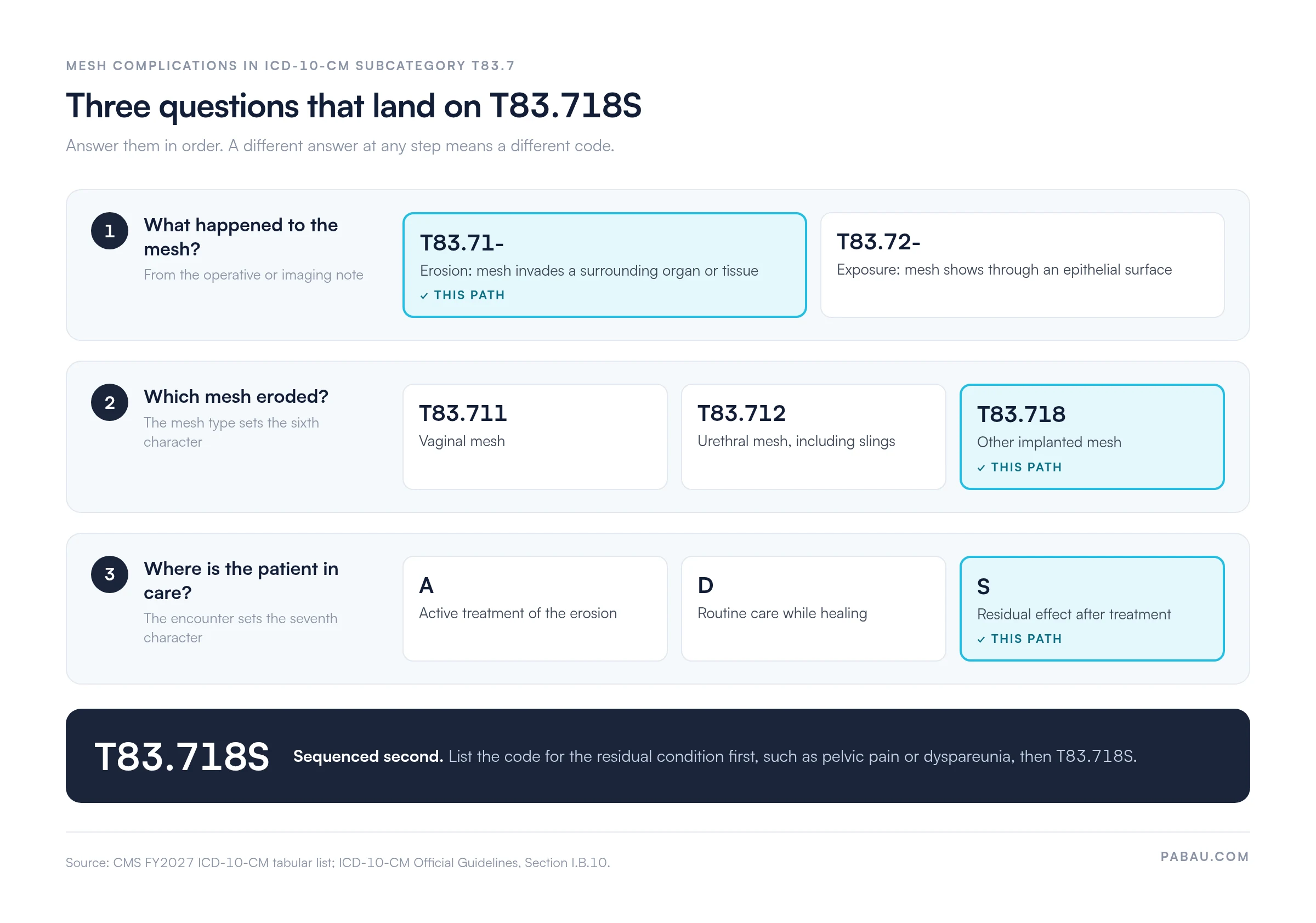
The seventh character ‘S’ applies only after the healing phase is complete and residual effects remain. It does not apply during active treatment (use ‘A’) or routine follow-up (use ‘D’).
Mesh type sets the subcategory: vaginal mesh is T83.711, urethral mesh and slings are T83.712, and other implanted mesh is T83.718.
Erosion (T83.71-) and exposure (T83.72-) are separate subcategories, and mixing them up can lead to denials on pelvic mesh and urological implant claims.
Pabau, the practice management platform we build, validates each claim before it leaves and submits CMS-1500 claims via Claim.MD to thousands of US payers.
ICD-10 code T83.718S is a billable ICD-10-CM diagnosis code describing erosion of other implanted mesh to organ or tissue, sequela. It is valid for encounters in FY2026 and FY2027. The descriptor and hierarchy are unchanged in the current tabular list, per the CMS ICD-10 codes page.
The code sits within the T80-T88 block (Complications of surgical and medical care, not elsewhere classified) of Chapter 19 (S00-T88). Its full hierarchy is shown below.
The “other” qualifier in T83.718 separates this subcategory from T83.711 (vaginal mesh) and T83.712 (urethral mesh, including slings). Verify the code against the CDC/NCHS ICD-10-CM web tool for the most current descriptor before billing. For other complication and sequela codes, start from our ICD-10-CM code library.
The seventh character ‘S’ designates a sequela encounter. The patient presents with a residual or late effect of a prior mesh erosion after the healing phase has concluded. This follows ICD-10-CM Official Guidelines Section I.B.10 (sequela/late effects).
A critical sequencing rule applies to sequela coding. The code for the nature of the sequela is listed first, and T83.718S is sequenced second, per ICD-10-CM Official Guidelines Section I.B.10. Pelvic and perineal pain, for example, is coded R10.2 and goes ahead of T83.718S on the claim. Reversing the order creates a principal-diagnosis mismatch that automated payer edits can flag.
A frequent coding error on mesh complication claims is assigning ‘D’ (subsequent) when ‘S’ (sequela) is correct. The distinction turns on whether the erosion itself is still being treated or whether only its residual effects remain.
Some notes document both ongoing erosion treatment and a residual effect in the same encounter. Assign the character that reflects the primary reason for the visit. A mixed-encounter note needs a query to the provider before coding to avoid character mismatch on audit.
Erosion (T83.71x) and exposure (T83.72x) are different clinical events with different codes. The two are easy to confuse, and payers check the distinction because the clinical pathway, procedure selection, and medical necessity documentation differ.
Use T83.718S only when the eroded mesh is neither vaginal nor urethral mesh. Vaginal mesh erosion maps to T83.711S. Urethral mesh erosion, including a male or female urethral sling, maps to T83.712S. Review the operative note and imaging reports to confirm the mesh type and the direction of migration before you assign a subcategory. The diagram below puts the three coding decisions in order.
The T83 category carries several instructional notes that affect how T83.718S can be coded. Misreading these notes can lead to combination-code denials. The key notes under T83 and its parent block include:
Verify current instructional notes in the AAPC Codify ICD-10-CM lookup or the CDC tabular before finalizing your claim. Notes can change between fiscal years even when the code itself remains active.
The T83.71x and T83.72x subcategories share a parent and look similar in the index, which creates routine confusion. The table below shows the codes most often confused with T83.718S and the distinguishing factor for each.
Search the ICD List database to cross-check code edits and DRG assignments for any of these codes before submitting a claim.
Coders cannot assign T83.718S from a note that simply mentions mesh or a prior complication. Coders should confirm four elements, based on ICD-10-CM Official Guidelines Section I.B.10 and standard documentation best practice.
If any of these elements is absent, query the provider before coding. Assigning T83.718S on an incomplete note is a documentation integrity risk regardless of what the coder infers from the chart history.
Run a monthly audit of all T83.71x and T83.72x claims using your practice management system’s coding reports. Flag any encounter where the seventh character changed between visits without a corresponding note documenting the transition from active treatment to sequela. Seventh-character mismatches across a single patient’s encounter history may trigger post-payment audits by Medicare and commercial payers on mesh complication cases.
Payers run several automated edits on mesh complication sequela claims before adjudication, so small coding slips can turn into denials. Pre-submission eligibility and claim validation checks catch many of them before the claim reaches the payer. The main denial patterns are:
For recurring denials, review the denial management workflows your billing team uses and cross-check each denial reason against your specific payer’s LCD policy. Appeal language should cite ICD-10-CM Section I.B.10 directly when the denial reason is a sequela-coding challenge.
Supporting clean claim submission practices upstream reduces the volume of T83.718S denials before they enter the appeals queue. In practice, that means accurate CPT pairing, correct modifier assignment, and electronic eligibility verification.
When billing sits in a separate tool, the coder reads the note and re-keys the diagnosis order and seventh character into a claim form. Each re-keyed line is another chance to flip the sequence or pick the wrong character.
In Pabau’s billing software, claims are raised from the patient’s invoice and scrubbed for missing or invalid details before they leave. A claim that fails comes back flagged Needs action, with a link to the field that needs fixing.
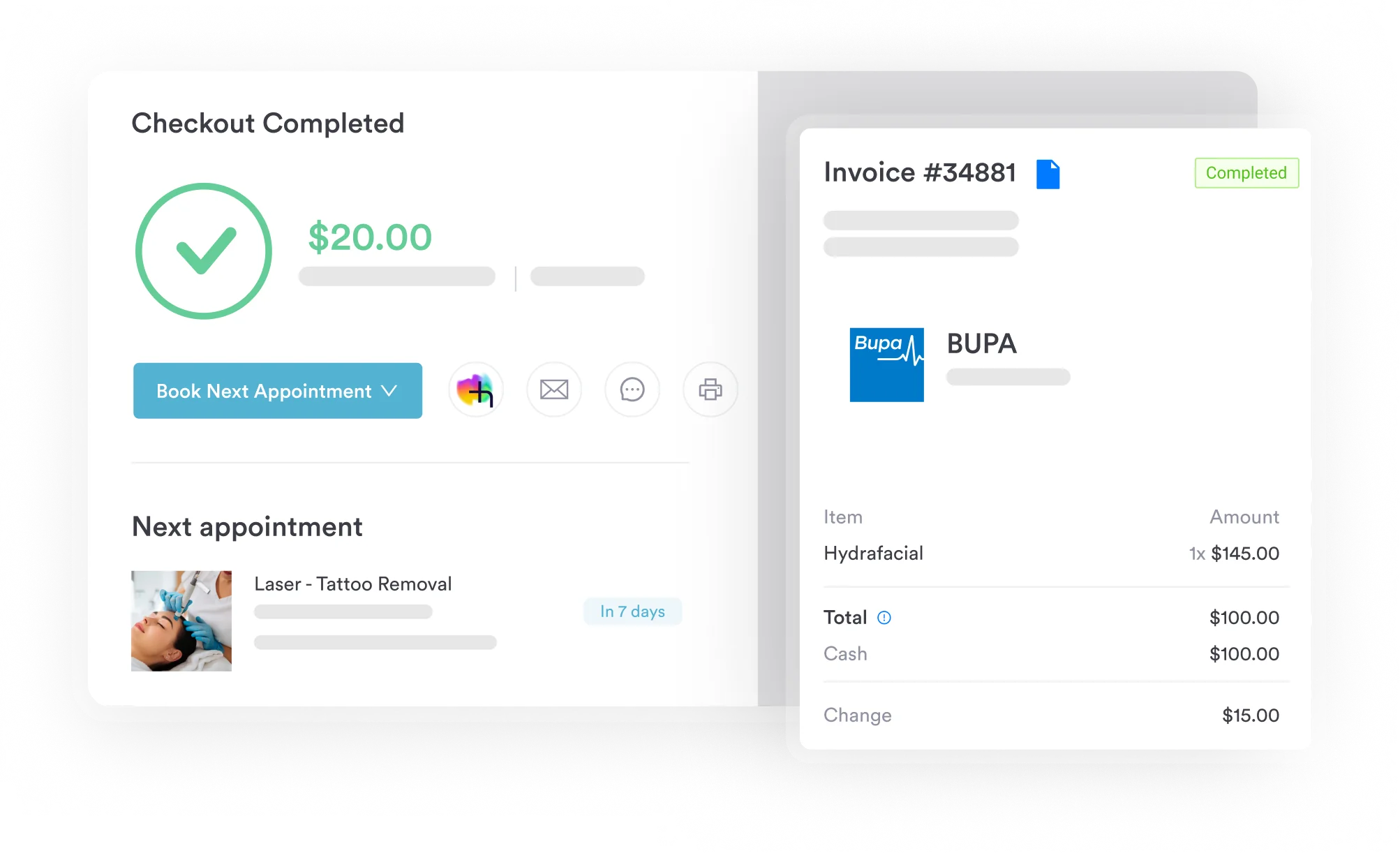
From there, Pabau’s error-checking claims management software submits each CMS-1500 claim through Claim.MD to thousands of US payers. Eligibility checks run before the visit, and electronic remittance advice files settle payments and carry the payer’s reason for any denial.
Your team can then work through the denial patterns above as a short list of fixes, before the next T83.718S claim goes out.

Pabau validates each claim before it leaves and submits CMS-1500 claims to thousands of US payers through Claim.MD. Eligibility checks and ERA tracking show which T83.718S claims need attention.

T83.718S is a narrow code. It applies only once the erosion of other implanted mesh has been treated and a residual effect remains. On the claim, it always sits behind the code for that effect.
The habit that protects these claims is a query protocol. If the note lacks the mesh type, the treated status of the erosion, or the causal link, the coder asks before coding. The cost is a short billing delay, and the payoff is fewer seventh-character and sequencing denials.
Book a demo to see how Pabau keeps mesh complication claims, eligibility checks, and remittances in one billing workflow.

Need a framework for handling claim denials across ICD-10 codes? Denial management in healthcare covers root-cause analysis and appeal strategies for common payer rejections.
Want to understand how ERA processing reduces manual reconciliation? Electronic remittance advice explains how 835 files work and how practices use them to close the claim loop.
Looking for guidance on what makes a claim clean before submission? Clean claim submission walks through the pre-billing checks that reduce rejection rates on complex diagnosis codes.
Billing the mesh implant itself? HCPCS code C1781 explains how implantable mesh is reported on outpatient claims.
Preparing for a payer audit on complication codes? Medical billing compliance sets out the documentation and coding controls auditors look for.
ICD-10 code T83.718S is the billable ICD-10-CM diagnosis code for erosion of other implanted mesh to organ or tissue, sequela. It falls under the T83 category (complications of genitourinary prosthetic devices, implants and grafts) and is valid for FY2026 and FY2027 billing.
The ‘S’ designates a sequela encounter. The patient presents with a late effect or residual condition from a prior mesh erosion, after the erosion has been treated and healing is complete. Per ICD-10-CM Official Guidelines Section I.B.10, T83.718S is sequenced after the code for the nature of the sequela, such as chronic pelvic pain or dyspareunia.
T83.718A applies during active or definitive treatment of the erosion (for example, surgical mesh removal). T83.718D applies for routine post-treatment care, such as a wound check after the active phase. T83.718S applies when the erosion is resolved but a residual condition persists. Assigning ‘D’ when ‘S’ is correct is a frequent cause of denials on these claims.
Erosion (T83.71x) means the mesh has penetrated or invaded a surrounding organ or tissue, an inward migration. Exposure (T83.72x) means the mesh protrudes through or becomes visible at an epithelial surface such as the vaginal wall, an outward migration. These are separate subcategories with different clinical pathways and different codes, so they cannot be used interchangeably.
Yes. T83.718S is a valid billable ICD-10-CM diagnosis code for FY2027, which began on October 1, 2026. Its descriptor and hierarchy are unchanged from FY2026 in the current CMS tabular list. Confirm against the CDC/NCHS ICD-10-CM web tool before billing to verify there are no late-cycle updates for the relevant encounter date.



