ICD-10 Code S62.664D: Nondisplaced ring finger fracture
ICD-10 Code S62.664D: quick reference ICD-10 Code S62.664D reports a follow-up v...

Last Updated: Oct 21, 2026
Billable Code Specific Code
T60.4X3S is the billable ICD-10-CM code for toxic effect of rodenticides, assault, sequela. It applies when the acute poisoning has resolved and the visit treats a condition it left behind, such as persistent coagulopathy.
The code sits in subcategory T60.4 (toxic effect of rodenticides) of category T60. Report the residual condition first and T60.4X3S after it. The parent T60.4 and the incomplete stem T60.4X3 are not billable.
Let Pabau's smart automation suggest the right codes, reduce claim denials, and keep your practice compliant—effortlessly.
Automate repetitive tasks and focus on what matters most—your patients.
Reduce coding errors and ensure compliance with the latest regulations.
Clean claims, fewer denials, and faster reimbursements.
Powerful insights and reporting to help your practice thrive.
HIPAA compliant SOC 2 certified GDPR-compliant Trusted by 4,000+ clinics worldwide

T60.4X3S is a billable ICD-10-CM code for the late effects of a rodenticide poisoning inflicted by another person, after the acute poisoning has resolved.
The 7th character S is required. T60.4 and T60.4X3 are not billable and cannot be submitted on a claim.
Assault must be documented by the provider. With no intent documented, code accidental, and use undetermined only when the record states intent can’t be determined.
Sequence the residual condition first and T60.4X3S after it. Assault external cause codes are optional, added only where payer or state rules ask for them.
Pabau’s claims tools keep diagnosis codes attached to the encounter note, so the record that supports T60.4X3S goes out with the claim.
ICD-10 Code T60.4X3S is a valid, billable ICD-10-CM diagnosis code for FY2026 encounters.
Its official descriptor is “Toxic effect of rodenticides, assault, sequela.” The code sits in Chapter 19 of ICD-10-CM (Injury, poisoning and certain other consequences of external causes, S00-T88). Within it, the code falls under category T60 (Toxic effect of pesticides) and subcategory T60.4 (Toxic effect of rodenticides).
Three elements make this code specific. The substance is a rodenticide, not an organophosphate or a herbicide. The intent is assault, meaning another person inflicted the harm. The encounter is a sequela: the acute poisoning has resolved, and the clinician is managing a residual condition. All three must be documented before the code applies.
T60.4X3S is a 7-character code. Each position carries a specific meaning, and changing any one character produces a different code with a different intent or encounter type. Knowing the breakdown prevents the most common error: submitting T60.4X3 without the 7th character, which is invalid.
The placeholder X at position 5 is an ICD-10-CM convention. Codes that need a 7th character but have fewer than six characters before it take X as filler. Omitting the X invalidates the code.
Subcategory T60.4 covers rodenticides in general. The anticoagulant rodenticides are the most clinically significant, because they interfere with vitamin K-dependent clotting factors. Superwarfarins cause prolonged coagulopathy that can last weeks to months after a single exposure.
Warfarin taken as a medication follows different codes. A poisoning such as an overdose is coded T45.511–T45.514, with intent in the 6th character. An adverse effect of the drug is T45.515.
The deciding factor is the product type: rodenticide formulation versus pharmaceutical. A patient who ate rat bait containing brodifacoum goes to T60.4, while a patient who took too many warfarin tablets goes to T45.51-. When in doubt, check the CDC/NCHS ICD-10-CM web tool for the current tabular entry under T60.4.
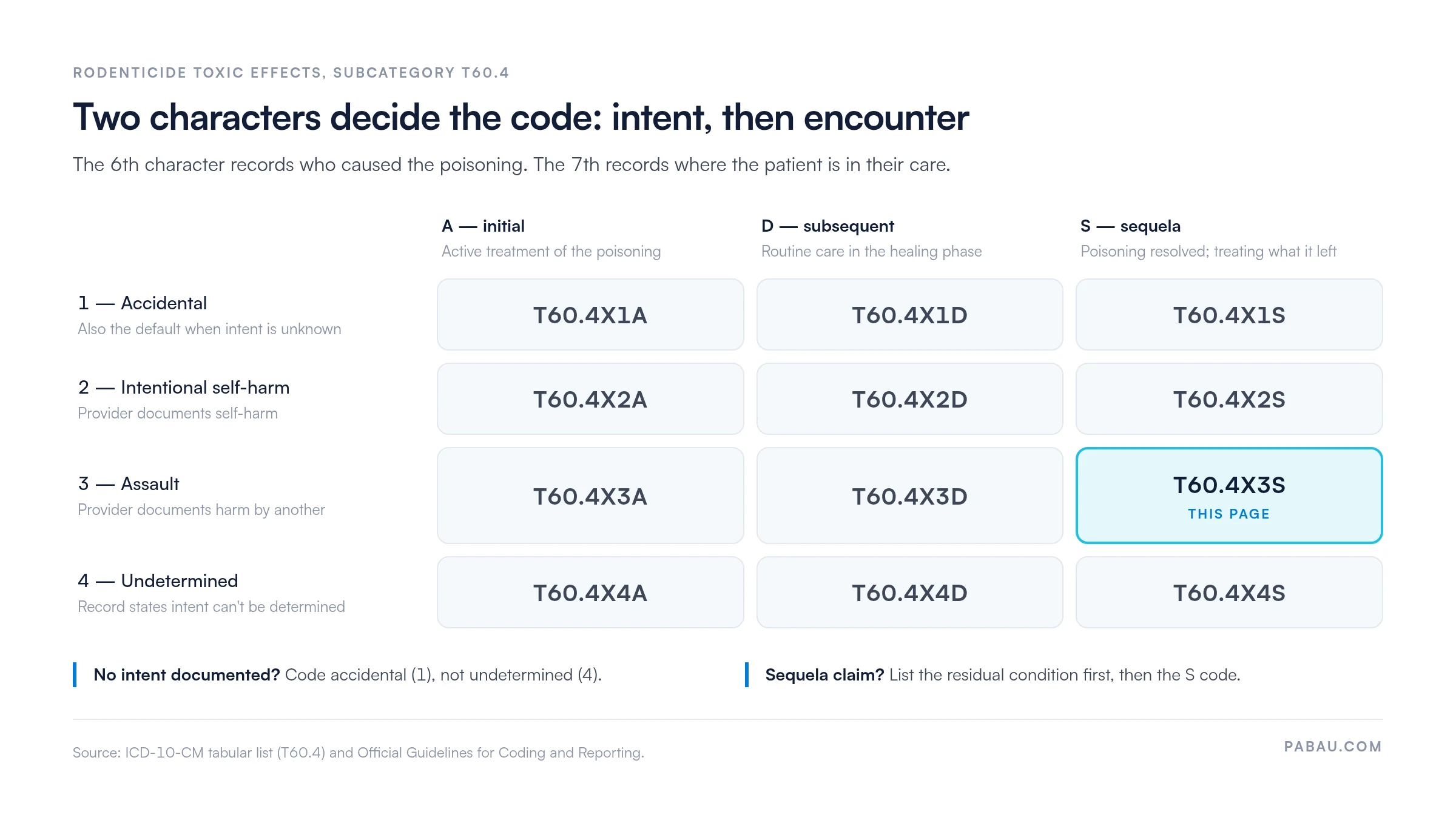
The 6th character encodes intent, following the CMS ICD-10-CM Official Guidelines. Assault (character 3) applies only when the provider documents that another person caused the poisoning. When intent is unknown or unspecified, the guidelines say to code it as accidental (character 1). Undetermined (character 4) is reserved for records that state the intent cannot be determined.
The 7th character S designates a sequela encounter. The original poisoning has resolved, and the patient now has a condition that is a direct consequence of that exposure. That separates it from the initial encounter (A), which covers active treatment, and the subsequent encounter (D), which covers routine care during healing.
A common error on T60.4X3 cases is defaulting to 7th character A for every encounter, wherever the patient is in their care. A patient seen three months after a brodifacoum poisoning, still needing vitamin K for residual coagulopathy, is a sequela encounter. The poisoning itself has resolved, so use S.
The two choices work together, as the grid below shows. Intent picks the row, and the encounter type picks the column.
According to the AAPC ICD-10-CM coding guidance, a sequela takes two codes. The residual condition, such as a coagulopathy, is sequenced first. T60.4X3S follows it to show the cause, so it can never be the first-listed code.
Always ask whether the poisoning is still being treated, or whether you’re treating what it left behind. If the acute episode has resolved and you’re managing a residual condition, 7th character S applies. State the link between the current condition and the prior exposure explicitly in the record.
Anticoagulant rodenticides inhibit vitamin K epoxide reductase, which blocks the synthesis of clotting factors II, VII, IX, and X in the liver. Superwarfarins do this far longer than pharmaceutical warfarin. Brodifacoum has a half-life of roughly 16 to 36 days, so patients may need vitamin K therapy for weeks to months after exposure.
Sequelae that justify the S encounter, and must be documented in the record, include:
Each of these sequelae needs its own ICD-10-CM code, listed first on the claim. T60.4X3S follows it, because the sequela code alone does not describe what is being treated. Coding the residual condition separately is what supports medical necessity.
On a sequela claim, the companion T60.4X3S always needs is the residual condition code. The assault intent already sits in the code’s 6th character. For that reason, the Official Guidelines don’t require a separate assault external cause code with it.
Y07 and Y92 codes have no 7th character, so there is no sequela version of them to match. Check your payer’s rules before adding an external cause code to a sequela claim.
Category T60 covers toxic effects of pesticides. Several sibling codes get confused with T60.4X3S, either because the substance is similar or because only one character differs.
Payers reviewing an assault-sequela claim look for a complete documentation chain. A missing link at any point raises a medical necessity question, which can trigger a denial or an additional documentation request (ADR). Claims software for billers that ties the encounter record to the submitted codes makes it harder to send T60.4X3S without its supporting notes.
The medical record must contain all of the following:
Prior authorization rules vary by payer and plan, and assault-intent codes can draw a medical necessity review. Following medical billing compliance guidance on assault encounters before submission cuts down these requests.
Key payer considerations for T60.4X3S:
For practices submitting electronically, a clearinghouse checks the 837P claim file before it reaches the payer. That check catches a missing 7th character or a malformed code as a format-level rejection, before it turns into a denial.
T60.4X3S denials cluster around six coding errors, and most are preventable at code selection. Denial management workflows catch them before submission rather than after.
When a T60.4X3S claim comes back denied, check the medical billing denial codes on the ERA to see which element failed. CO-4 points to an inconsistent modifier, and CO-11 means the diagnosis is inconsistent with the procedure. CO-22 means the care may be covered by another payer, which is common when a third party is liable for an assault.
Each code points to a different fix. Before resubmitting, review the clean claim submission requirements for this encounter type.
Check the ERA denial code before correcting a T60.4X3S claim. CO-22 (care may be covered by another payer) calls for coordination of benefits documentation. CO-11 means the diagnosis is inconsistent with the procedure, so check the codes against the service billed. Each denial reason has a different fix.
A clean T60.4X3S claim depends on notes that often live in different places. The linkage statement sits in the clinical note, the coagulopathy labs sit in results, and the claim goes out from a separate billing tool. When a payer asks for records, someone has to pull them together by hand.
Pabau, the practice management platform we build, keeps the clinical note, the diagnosis codes, and the claim on the same patient record. The coder picks T60.4X3S from the encounter where the provider documented the assault and the residual condition.
So when a payer sends an ADR, the assault statement, the labs, and the linkage note are already in one file. Your billing team answers it from one place instead of chasing three systems.

Pabau links ICD-10 codes like T60.4X3S to the encounter record, so the documentation behind an assault-sequela claim goes out with it. See the workflow from clinical note to clean claim.

On a T60.4X3S claim, most of the work happens before the code is chosen. Confirm that the provider documented the assault, that the acute poisoning has resolved, and that the residual condition is coded and listed first.
If one of those is missing, query the provider rather than assuming. Correcting a guessed intent or encounter type after a denial takes far longer than one query before submission. For the wider view, our guide to revenue cycle management traces how a code like this moves from encounter to payment.
Book a demo to see how Pabau keeps the record behind each assault-sequela claim in one place, ready for the payer.

Need to understand how clearinghouse submission affects ICD-10 claims? Claim.MD clearinghouse overview explains how electronic claim submission handles diagnosis code validation before claims reach the payer.
Want a broader framework for reducing claim rejections? Revenue cycle management guide covers the full workflow from encounter to payment, including where ICD-10 coding errors create the most friction.
Coding a denial-prone case and need to verify the code structure? Superbill documentation guide walks through how to structure the clinical record to support complex diagnosis code combinations at the point of billing.
ICD-10 Code T60.4X3S is the billable diagnosis code for toxic effect of rodenticides, assault, sequela. It’s used when a patient has a late or residual condition from a prior rodenticide poisoning inflicted by another person. The acute poisoning has resolved, and the 7th character S marks the visit as a sequela encounter rather than active treatment.
Yes, T60.4X3S is a valid, billable ICD-10-CM diagnosis code for FY2026. The subcategory code T60.4 and the incomplete stem T60.4X3 (without the 7th character) aren’t billable and can’t be submitted on claims.
T60.4X3A is the initial encounter code, used while the patient receives active treatment for the poisoning itself. T60.4X3S is the sequela code, used once the acute poisoning has resolved and the visit treats a late effect such as persistent coagulopathy. Both codes can appear in the same patient’s record at different points in their care.
Use the 7th character S when the original poisoning has resolved and the current encounter treats a condition that resulted from it. An example is a patient returning months after a brodifacoum assault, whose coagulopathy still needs vitamin K therapy. If the poisoning is still in active treatment, use A, and use D for routine care during healing.
None are required. T60.4X3S already carries the assault intent, so the Official Guidelines don’t call for a separate external cause code. Some payers or state rules ask for an assault code from X92–Y09, so check before submitting. The code you always need is the residual condition, listed first.
The record must include the provider’s documentation of assault and the rodenticide involved, where known. It also needs clinical evidence of the sequela condition and a provider statement linking it to the prior poisoning. A police report can support the assault, but ICD-10-CM doesn’t require one.