ICD-10 Code Z74.8: Other problems related to care provider dependency
ICD-10 Code Z74.8: Definition and code details ICD-10 Code Z74.8 is the billable...

Last Updated: Oct 19, 2026
Billable Code Specific Code
T55.0X4D is the billable ICD-10-CM code for toxic effect of soaps, undetermined, subsequent encounter. It sits in category T55, Toxic effect of soaps and detergents. It applies to a follow-up visit after active treatment for a soap exposure has ended.
Use it only when the provider documents that the intent of the exposure cannot be determined. A record that is silent on intent codes to accidental, T55.0X1D. Detergent exposures take the sibling subcategory, T55.1.
Let Pabau's smart automation suggest the right codes, reduce claim denials, and keep your practice compliant—effortlessly.
Automate repetitive tasks and focus on what matters most—your patients.
Reduce coding errors and ensure compliance with the latest regulations.
Clean claims, fewer denials, and faster reimbursements.
Powerful insights and reporting to help your practice thrive.
HIPAA compliant SOC 2 certified GDPR-compliant Trusted by 4,000+ clinics worldwide

T55.0X4D covers the toxic effect of soaps only. Detergents have their own sibling code, T55.1X4D, under the same T55 category.
The 6th character 4 means undetermined intent and needs a provider statement that intent cannot be determined. A record that is silent on intent codes to accidental.
The 7th character D marks a subsequent encounter, once active treatment has ended. Coding a follow-up visit with A is a common denial trigger.
T55.0X4D needs no separate external cause code for intent. Place-of-occurrence (Y92) and activity (Y93) codes belong on the initial encounter only.
ICD-10 code T55.0X4D is the billable ICD-10-CM code for toxic effect of soaps, undetermined, subsequent encounter. It is a 7-character code, so every character must be present before the claim can be submitted.
The code covers soaps only. A follow-up visit after a detergent exposure of undetermined intent is T55.1X4D, and a corrosive cleaner belongs in T54. Matching the substance in the record to the right subcategory is the first of three checks on every claim, shown below.
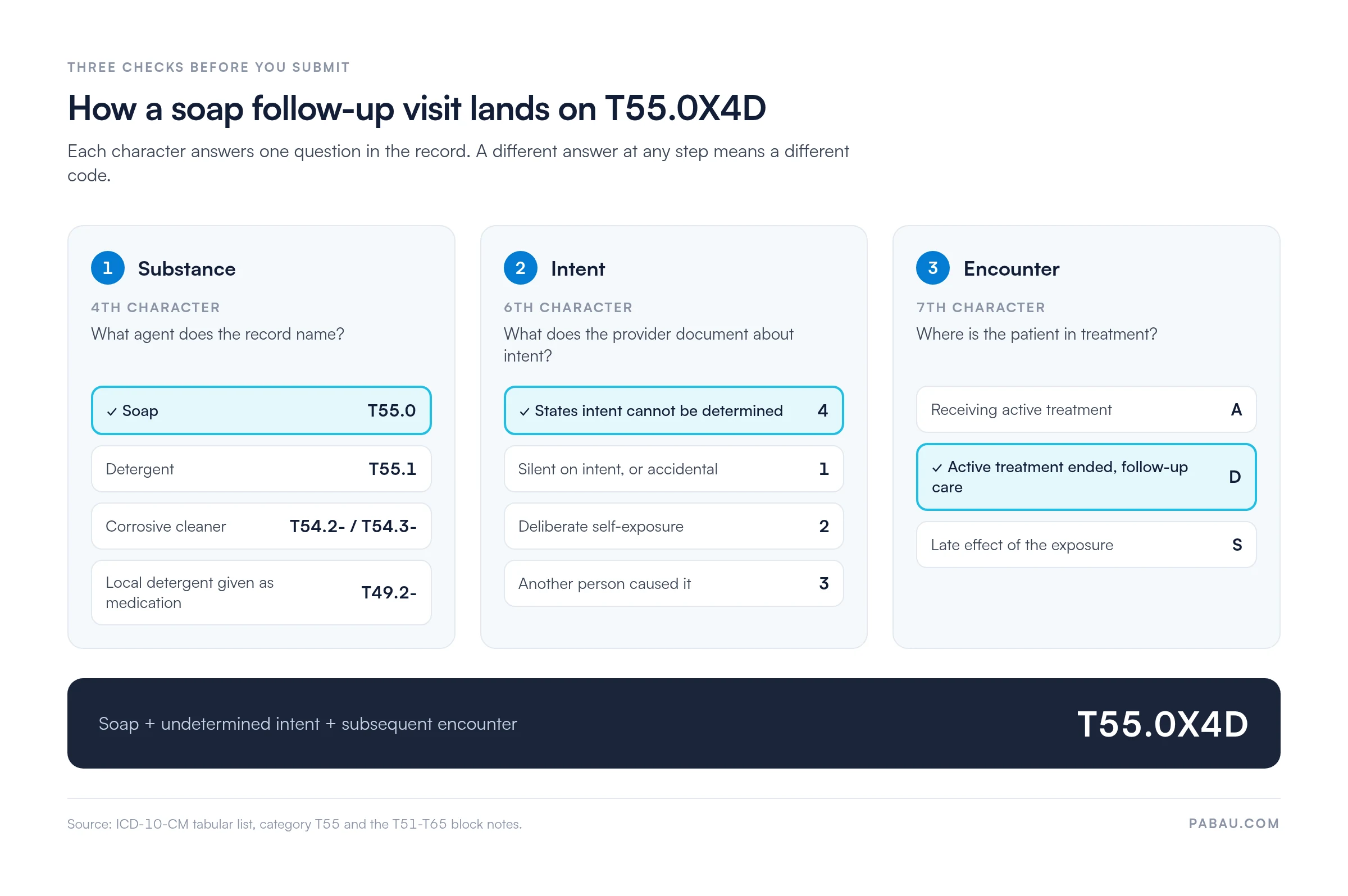
Each character in T55.0X4D adds a specific layer of clinical meaning. Coders who know what each position controls are far less likely to submit the wrong substance, intent, or encounter character.
The placeholder X in position 5 is required under the ICD-10-CM conventions published by CMS. Without it the code is invalid, and the claim is rejected at submission.
T55.0 covers the toxic effect of soaps, such as bar, liquid, and household soaps. Detergents sit in their own subcategory, T55.1, even though both share the T55 title “Toxic effect of soaps and detergents.”
Category T55 carries no tabular notes of its own. The notes that apply come from the T51-T65 block, Toxic effects of substances chiefly nonmedicinal as to source.
Four substance boundaries also come up often on soap claims.
Applying T55.0X4D outside these limits is a substance-specificity error. Payers can request records to confirm the substance, and a note that names a different agent will not support the code.
Undetermined intent, the 6th character 4, means the provider has documented that the intent of the exposure cannot be determined. It is not the default for a record that is silent on intent.
The T51-T65 note settles the silent record. When no intent is indicated, the code is accidental, so the follow-up visit is T55.0X1D. Undetermined intent needs a specific statement that intent cannot be established.
Undetermined intent usually arises when a patient is found after an ingestion and cannot give a history. It also fits when the provider cannot rule out an accidental or a deliberate exposure. A follow-up visit after a documented accidental soap ingestion by a child is T55.0X1D, not T55.0X4D.
Query the provider before assigning undetermined intent. A note that says only ‘unknown exposure history’ does not meet the threshold, and a silent record codes to accidental. A one-line query asking whether intent was undeterminable protects the claim.
The 7th character D designates a subsequent encounter. The patient has already received active treatment for the toxic effect and is now in routine care during healing or recovery.
A subsequent encounter is not simply the second visit. A patient seen several times in the emergency department for active management of a soap ingestion gets A on each of those visits.
The switch to D comes when active treatment ends and care moves to monitoring. A gastroenterologist reviewing labs two weeks after discharge is seeing the patient at a subsequent encounter.
Toxic effects and poisonings are separate concepts in ICD-10-CM, coded in different ranges. Picking the wrong range changes the whole claim, because it tells the payer a different story about the substance.
Soap is a nonmedicinal agent, so a soap exposure is coded in the toxic-effect range, not the poisoning range. The exception is a local detergent given as a medication, which belongs in T49.2-. The AAPC ICD-10-CM code lookup lets coders cross-check the range before submission.
T55.0X4D has three intent siblings, two encounter siblings, and several substance neighbors that trip up coders. The table below covers the most frequent mix-ups.
The intent siblings are where coders most often go wrong. They share the substance and encounter type and differ only in the 6th character, so check what the provider documented about intent first.
T55.0X4D carries the substance, the intent, and the encounter in a single code. Other codes complete the clinical picture, and their rules differ from ordinary injury coding.
There is no national mandate for external cause reporting. A state reporting rule or a payer contract can still require Chapter 20 codes, so check the payer policy before submission.
Sequencing matters as well. T55.0X4D is listed first when the toxic effect is the reason for the follow-up visit, and manifestation codes follow it.
Pabau, the practice management platform we build, generates each claim from the invoice in its claims management software. That gives billers one place to review the diagnosis order before the claim goes out.
A claim bearing T55.0X4D survives audit only when the medical record supports every character in the code. Confirm that all four documentation elements below are present before submission.
When the record is ambiguous on any of these points, query the provider instead of assuming. Practices that build consistent documentation workflows into their medical billing compliance programs catch these problems before claims are built.
Give providers who manage household-chemical exposures a short documentation prompt: the substance name, an intent statement, and the encounter type. Capturing all three at the point of care cuts queries after the visit closes.
Claims carrying T55.0X4D draw a predictable set of payer checks. Knowing the common denial reasons before submission prevents rework.
Understanding denial management workflows for toxic-effect codes helps billing teams prioritize appeals and track patterns across claim batches.
For an undetermined-intent appeal, attach the intent statement and the encounter notes rather than a generic letter. Review common denial codes to match each error above to its CARC reason code.
Verifying all four documentation elements before the encounter is built is the surest route to submitting a clean claim the first time. The CMS ICD-10 coding guidance is the reference for confirming code validity before submission.
Many practices code a toxic-effect follow-up from the visit note, then rekey the claim into a separate clearinghouse portal. Each handoff is another chance for the intent digit or the 7th character to slip.
Pabau generates the claim from the invoice you already raise and submits it electronically through Claim.MD, its clearinghouse integration for US insurance payers. A real-time eligibility check runs from the patient record before the visit.
Claim statuses and electronic remittance advice flow back into one claims dashboard, and denied claims are flagged for rework. A rejected T55.0X4D claim surfaces for correction instead of sitting unpaid.

Pabau builds claims from your invoices and tracks each claim and remittance through Claim.MD. A denied T55.0X4D follow-up is flagged for rework early.

T55.0X4D rewards a coder who checks three facts before submission: soap rather than detergent, an explicit undetermined-intent statement, and active treatment already finished. Miss one and the claim describes a different code.
When the record leaves any of those uncertain, query the provider instead of guessing, and code a silent record as accidental. Keep Y92 and Y93 on the initial encounter where they belong. Book a demo to see how Pabau turns coded follow-up visits into clean claims.

Need guidance on claim submission for toxic-effect encounters? Claim.MD clearinghouse overview explains how electronic claim submission works with ICD-10 coded encounters.
Want to understand what drives toxic-effect claim denials? Electronic remittance advice guide covers how to read ERA files and identify denial reason codes on returned claims.
Looking to build a stronger billing compliance program? Revenue cycle management overview outlines the end-to-end workflow from encounter documentation through payment posting.
ICD-10 code T55.0X4D is the billable code for toxic effect of soaps, undetermined, subsequent encounter. It applies to a follow-up visit after a soap exposure when the provider has documented that intent cannot be determined.
Use the D suffix when active treatment for the toxic exposure has ended and the visit is for routine monitoring or follow-up. Any visit with active treatment uses the A suffix, however many times the patient has been seen.
Toxic effects (T51-T65) apply to substances chiefly nonmedicinal as to source, such as soaps, solvents, metals, and gases. Poisoning codes (T36-T50) apply to drugs, medicaments, and biological substances. Soap is nonmedicinal, so a soap exposure is coded as a toxic effect.
Undetermined intent, the 6th character 4, means the provider has documented that the intent of the exposure cannot be established. A record that does not address intent is coded as accidental instead, per the T51-T65 tabular note.
T55.0X4D is billable on its own and needs no separate external cause code for intent. Add codes for any documented manifestations. Report Y92 place-of-occurrence and Y93 activity codes only at the initial encounter, not on a D visit.
The intent siblings T55.0X1D, T55.0X2D, and T55.0X3D differ only in the 6th character. T55.0X4A is the initial-encounter version, and T55.1X4D covers detergents. T65.5X4D is a look-alike code for nitroglycerin, not soap.
No. Both sit in category T55, but soaps are T55.0 and detergents are T55.1. A follow-up visit after a detergent exposure of undetermined intent is coded T55.1X4D.
Some payers review undetermined-intent codes more closely and may request clinical notes before paying. An explicit intent statement in the record shortens that review. Also check whether the payer or your state requires external cause codes, since there is no national mandate.