ICD-10 Code Y76.0: Diagnostic obstetric and gynecological devices
ICD-10 Code Y76.0: Definition and billable status ICD-10 Code Y76.0 is a valid, ...

Last Updated: Oct 23, 2026
Billable Code Specific Code
T45.3X5S is the billable ICD-10-CM code for adverse effect of enzymes, sequela. It reports a lasting condition left behind after a correctly prescribed enzyme drug, such as hyaluronidase, caused a reaction that has since been treated.
The code never stands alone. List the residual condition first, then T45.3X5S, so the payer sees what the patient has now and what caused it. Getting that pairing and the S character right keeps these claims out of rework. It starts with telling A, D and S apart and confirming the drug belongs in T45.3.
Let Pabau's smart automation suggest the right codes, reduce claim denials, and keep your practice compliant—effortlessly.
Automate repetitive tasks and focus on what matters most—your patients.
Reduce coding errors and ensure compliance with the latest regulations.
Clean claims, fewer denials, and faster reimbursements.
Powerful insights and reporting to help your practice thrive.
HIPAA compliant SOC 2 certified GDPR-compliant Trusted by 4,000+ clinics worldwide

T45.3X5S is a billable ICD-10-CM code for a lasting condition left by a reaction to a correctly used enzyme drug.
Check the Table of Drugs first, because alteplase, streptokinase and pancrelipase code outside T45.3.
Use the S character once the reaction itself has been treated and a named residual condition remains.
List the residual condition first and T45.3X5S second, since the code never stands alone.
Overdose, a wrong drug or missed doses point to poisoning or underdosing codes instead of T45.3X5S.
ICD-10 code T45.3X5S reports a condition that lingers after a patient reacted to a correctly used enzyme drug. The reaction itself has already been treated. What remains, such as a persistent skin condition, is the reason for the visit.
The code sits in Chapter 19 of ICD-10-CM, under subcategory T45.3 for enzymes. Here’s the reference data to confirm before a claim goes out.
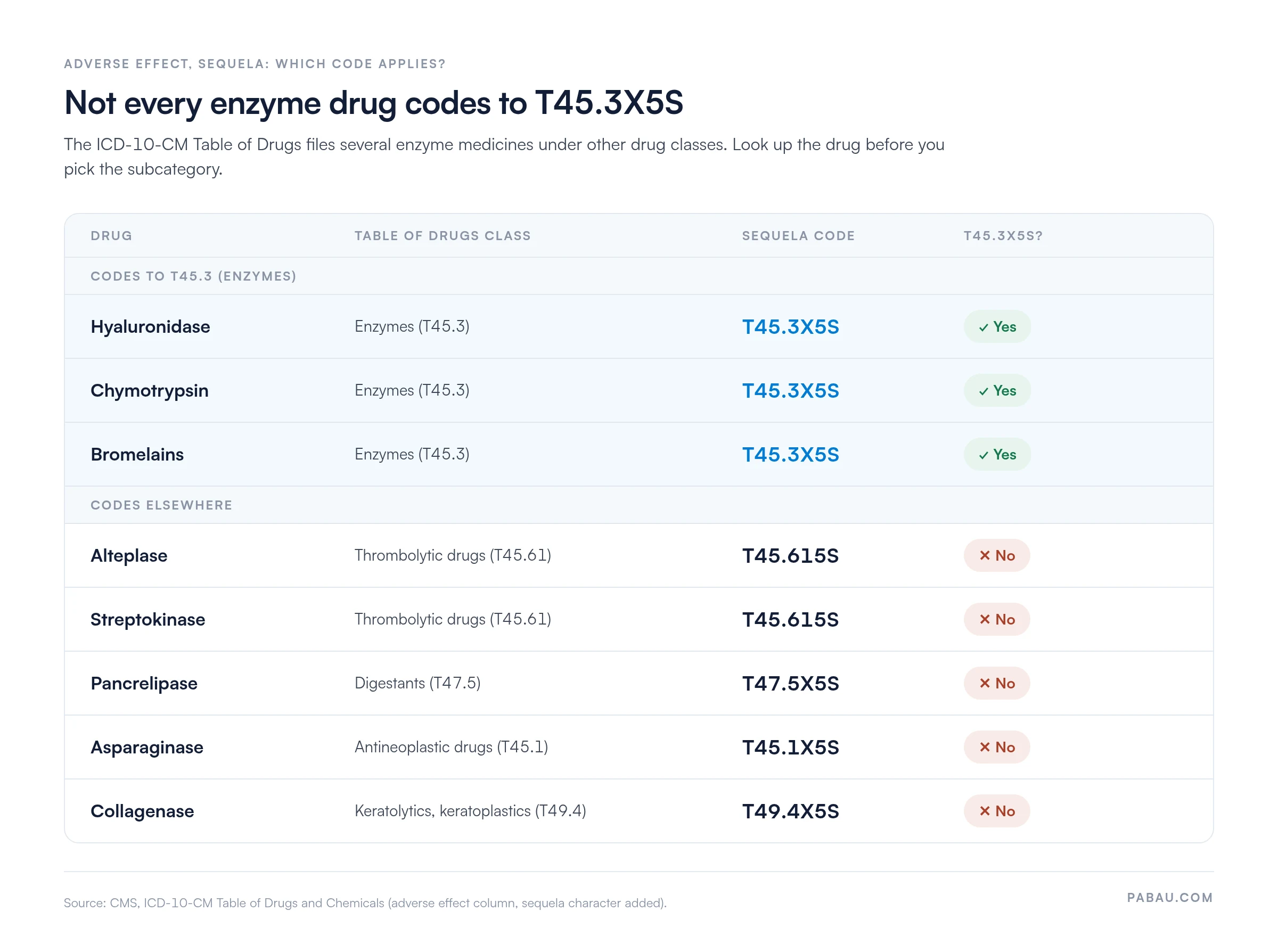
T45.3 only covers drugs the ICD-10-CM Table of Drugs files as enzymes. That list is shorter than the name suggests. Hyaluronidase, chymotrypsin, chymopapain and bromelains all code here.
Plenty of enzyme medicines land in other subcategories, so look the drug up before you commit:
The chart below puts the common ones side by side, so you can see where each one lands.
Aesthetic practices meet T45.3 more often than they expect. Hyaluronidase is the enzyme injected to dissolve hyaluronic acid filler. If a documented reaction to it was treated but left a lasting skin condition, T45.3X5S fits that later visit.
The Table of Drugs covers nonmedicinal substances too, and those leave the T36 to T50 drug blocks. An industrial solvent sequela takes a T51 to T65 code instead, such as T65.4X1S for carbon disulfide.
Table entries can change with each release, which CMS publishes annually. Confirm the drug in the current files rather than an old printout.
The seventh character S means sequela, a condition that results directly from an earlier injury or adverse effect. ICD-10-CM sets no time limit on it. The residual can appear weeks or even years later.
A worked example shows how the three characters differ. Picture a patient who reacts to a hyaluronidase injection and is treated for it.
Months later, the same patient returns with a skin condition the provider links to that reaction. That visit gets the skin condition code first, then T45.3X5S.
Ask one question first. Was the drug prescribed correctly and taken as directed? If yes, it’s an adverse effect. If not, you’re choosing between poisoning and underdosing codes.
Every code in this family needs a seventh character to be billable. If the note leaves intent or dosing unclear, query the provider before you choose T45.3X5_. The ICD List lookup tool shows the full T45.3 hierarchy when you need to check a neighboring code.
T45.3X5S never stands alone. The residual condition goes first, and T45.3X5S follows to explain its cause. That order comes from the ICD-10-CM guidelines for sequela, and reversing it trips payer edits.
Chapter 19 applies the same order beyond the drug blocks. A toxic effect sequela such as T59.3X2S takes the residual condition first and the cause code second.
Build the code set in three steps:
Next, check the tabular list for “Code first” or “Code also” instructions. CDC/NCHS can revise them in each annual update.
Before release, filter your claims for T45.3X5S and check that a residual condition code sits above it. Hold back any claim that lists T45.3X5S alone or first, and fix the order.
The provider’s note must support four points before you assign T45.3X5S. If one is missing, the fix is a provider addendum, not a coder’s guess.
Structured clinical note templates make this easier. They prompt the provider to record causation and status at every visit.
Medicare and Medicaid accept T45.3X5S as a valid diagnosis code. Acceptance isn’t payment, though. Coverage rules such as LCDs and NCDs apply to the service billed, and the diagnosis supports its medical necessity.
Here’s the path a typical claim takes:
Step three catches sequela visits out more than you’d think. Authorization for the original enzyme treatment may not cover later care for its after-effects. Confirm it separately with the payer.
When a T45.3X5S claim returns, the cause is usually one of four coding slips. The table pairs each one with its fix.
To find which slip caused a rejection, read the adjustment reason codes on the remittance. Our guide to common denial codes explains what each one means and how to respond.
Run through this list before a T45.3X5S claim leaves the practice. It takes a minute and catches each of the slips above.
Tick all six and you’re far closer to a clean claim that pays on the first pass.
Instructional notes in the tabular list are binding, and payer edits can enforce them automatically. For T45.3X5S, the key notes sit at the T36-T50 block level.
The T45 category and T45.3 subcategory can carry notes of their own. Check them each October in the AAPC Codify lookup or the CDC web tool.
Download the ICD-10-CM tabular list at the start of each fiscal year and save a copy for your coding team. It is the authoritative source for Includes and Excludes notes. Secondary lookup tools can lag behind the annual update by weeks.
Sequela claims tend to break down in the handoffs between the provider’s note, the coder and the clearinghouse. Practice management software like Pabau keeps those steps in one system.
Pabau’s tools for faster claims management pre-fill the claim form from the patient record. Built-in ICD-10-CM and CPT lookup libraries let coders find T45.3X5S and the residual condition code without leaving the claim.
Pabau also checks that required claim fields are complete before you can send. US claims go out through Claim.MD, with eligibility checks and ERA remittance posting in the same workflow. You see payer responses without logging into another portal.
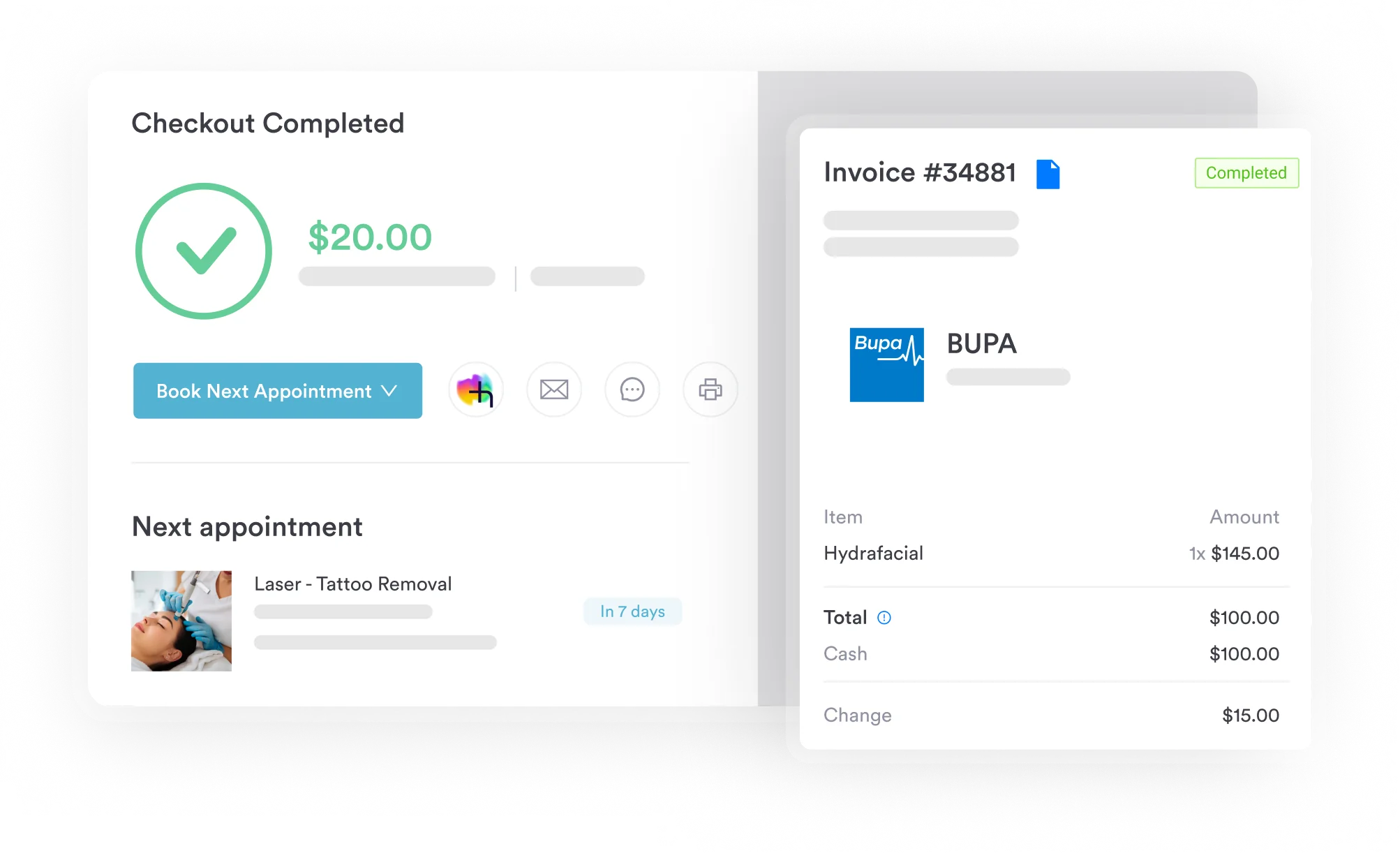

Pabau pre-fills claims from the patient record and gives coders a built-in ICD-10-CM lookup. It checks required fields and submits through Claim.MD, so fewer sequela claims bounce back.

T45.3X5S is rarely the hard part of the claim. The work sits upstream, in confirming the drug is a T45.3 enzyme and that the note names what the reaction left behind.
If your team adopts one habit, make it the Table of Drugs lookup before coding. It keeps thrombolytic and digestive enzyme cases out of the wrong subcategory, and a field check won’t flag that for you.
Pabau can lighten the admin around it, from pre-filled claim forms to Claim.MD submission and remittance posting. Book a demo to see how it handles adverse effect and sequela claims for your practice.

Want to know what happens after you hit send? Claim.MD clearinghouse guide explains how claims are checked and routed to payers.
Unsure whether a sequela visit needs its own authorization? Prior authorization process walks through when payers require approval and how to request it.
Reading adjustment codes on returned claims? Electronic remittance advice shows how to read an 835 and post payments accurately.
Building a process for repeat denials? Denial management in healthcare sets out a workflow for tracking, fixing and preventing rejections.
Want to benchmark your billing compliance? Medical billing compliance covers the documentation and coding standards that keep claims audit-ready.
No. ICD-10-CM doesn’t require a separate external cause code when the intent is already built into the code. The fifth-character 5 in T45.3X5S already reports an adverse effect of a correctly used drug.
There’s no time limit. ICD-10-CM guidelines let you report a sequela whenever the provider links a current condition to the earlier reaction. That could be weeks or years later. The link has to be documented, not assumed from timing.
Hyaluronidase codes to T45.3 in the Table of Drugs. Use T45.3X5A while the reaction is being treated. Once that treatment ends and a separate residual condition remains, code the condition first and add T45.3X5S.
No. The diagnosis, including the link to the enzyme drug, must come from the provider accountable for it. Nursing or pharmacy notes can support the record, but they can’t establish the diagnosis. Query the provider if their note doesn’t state the cause.