ICD-10 code S61.201A: Open wound of left index finger without nail damage
ICD-10 code S61.201A covers a left index finger wound of unstated type ICD-10 co...

Last Updated: Oct 16, 2026
Billable Code Specific Code
T31.10 is the billable ICD-10-CM code for burns involving 10-19% of body surface with 0% to 9% third degree burns. It records how much of the body surface is burned, while site and depth are coded separately.
Assign it alongside T20-T25 site codes when the burn location is documented, or on its own when the site is unspecified. T31.11 applies when 10-19% of the body surface is third degree, and T32.10 covers the same extent from a corrosive agent. T31.10 takes no 7th character.
Let Pabau's smart automation suggest the right codes, reduce claim denials, and keep your practice compliant—effortlessly.
Automate repetitive tasks and focus on what matters most—your patients.
Reduce coding errors and ensure compliance with the latest regulations.
Clean claims, fewer denials, and faster reimbursements.
Powerful insights and reporting to help your practice thrive.
HIPAA compliant SOC 2 certified GDPR-compliant Trusted by 4,000+ clinics worldwide

T31.10 covers thermal burns of 10-19% TBSA with no more than 9% third-degree involvement, which separates it from T31.11 and from corrosion code T32.10.
The provider must document the TBSA percentage, using the Rule of Nines or a Lund-Browder chart, before T31.10 can be assigned.
T31.10 is complete at 5 characters and takes no 7th character, unlike the T20-T25 site codes it pairs with, which need A, D, or S.
Claims management software like Pabau links diagnosis codes to encounter documentation and flags incomplete claims before they are submitted.
ICD-10 Code T31.10 is a valid, billable ICD-10-CM code for FY2026 encounters. It belongs to the T31 category, which classifies burns by the total body surface area (TBSA) affected rather than by site or depth. The official long descriptor reads “Burns involving 10-19% of body surface with 0% to 9% third degree burns.” The burn must cover 10-19% TBSA, and the third-degree share must stay below 10% of total body surface.
You can verify the code directly in the CDC/NCHS ICD-10-CM web tool, the authoritative US source for annual tabular list updates. The AAPC Codify ICD-10-CM lookup also confirms billable status and displays the T31 code hierarchy with 5th-character breakdowns. Both confirm T31.10 carries no retirement flag for the current fiscal year.
T31.10 applies to thermal burns from flame, contact, radiant heat, or scalds. The clinician must document 10-19% TBSA involvement, with a full-thickness (third-degree) component below 10% of total body surface. The code is deliberately broad by degree. A patient with mixed first-, second-, and third-degree burns across 15% TBSA still uses T31.10 if the full-thickness portion stays under 10%. Site and depth are captured through separate T20-T25 codes assigned alongside T31.10.
The thermal-vs-corrosion distinction carries compliance risk. If the burn agent is acid, alkali, or another chemical, T32.10 is the correct code, not T31.10. The CMS ICD-10-CM guidelines treat these as separate code families. Coding a thermal burn as a corrosion, or the reverse, creates a diagnosis mismatch that can flag on audit.
The TBSA percentage in the medical record drives which T31 code gets assigned. Clinicians use the Rule of Nines for adults and the Lund-Browder chart for children, whose head-to-body proportions differ from adults.
The Lund-Browder chart is preferred for patients under 15 because it adjusts the head and thigh percentages by age. That adjustment reduces the risk of overestimating TBSA in children. Whichever method the treating clinician uses, the method and the resulting percentage must both appear in the medical record. A documented figure of “approximately 15% TBSA” is sufficient, while vague language like “significant burns” is not.
The 5th character in the T31.1x subcategory specifies how much of the body surface carries full-thickness (third-degree) burns. T31.10 uses a 5th character of “0,” meaning the third-degree component is 0-9% of total body surface. Reading that figure as a share of the burned area instead is a common error in this subcategory.
A patient with 14% TBSA burns, of which 8% are full-thickness, still uses T31.10 because the third-degree component falls within 0-9%. A patient with 14% TBSA burns where 11% are full-thickness uses T31.11. The 5th character tracks the third-degree burn as a percentage of total body surface, not of the burned area alone.
Burn coding in ICD-10-CM works on two axes. The T20-T25 codes capture site and degree on the external body surface, and T31.10 captures extent. Under ICD-10-CM Official Guidelines Section I.C.19.d, T31 codes go with T20-T25 codes when the site is specified, or stand alone when it is not. Codes T26-T28 cover the eye and internal organs, which sit outside body surface calculations.
The WHO ICD-10 classification browser carries the same T31 extent category in the international edition. The category exists because TBSA carries clinical and prognostic weight, wherever on the body the burns are located.
Most T31.10 coding errors fall into one of three patterns: wrong TBSA threshold, wrong 5th character, or wrong code family (T31 vs T32). The table below covers all four codes a coder is most likely to confuse with ICD-10 Code T31.10.
The T31.0 vs T31.10 confusion arises when TBSA is borderline, for example documented as “approximately 9-10%.” In those cases, query the clinician rather than assuming. The four checks below run in the order a coder meets them on a 10-19% TBSA thermal burn.
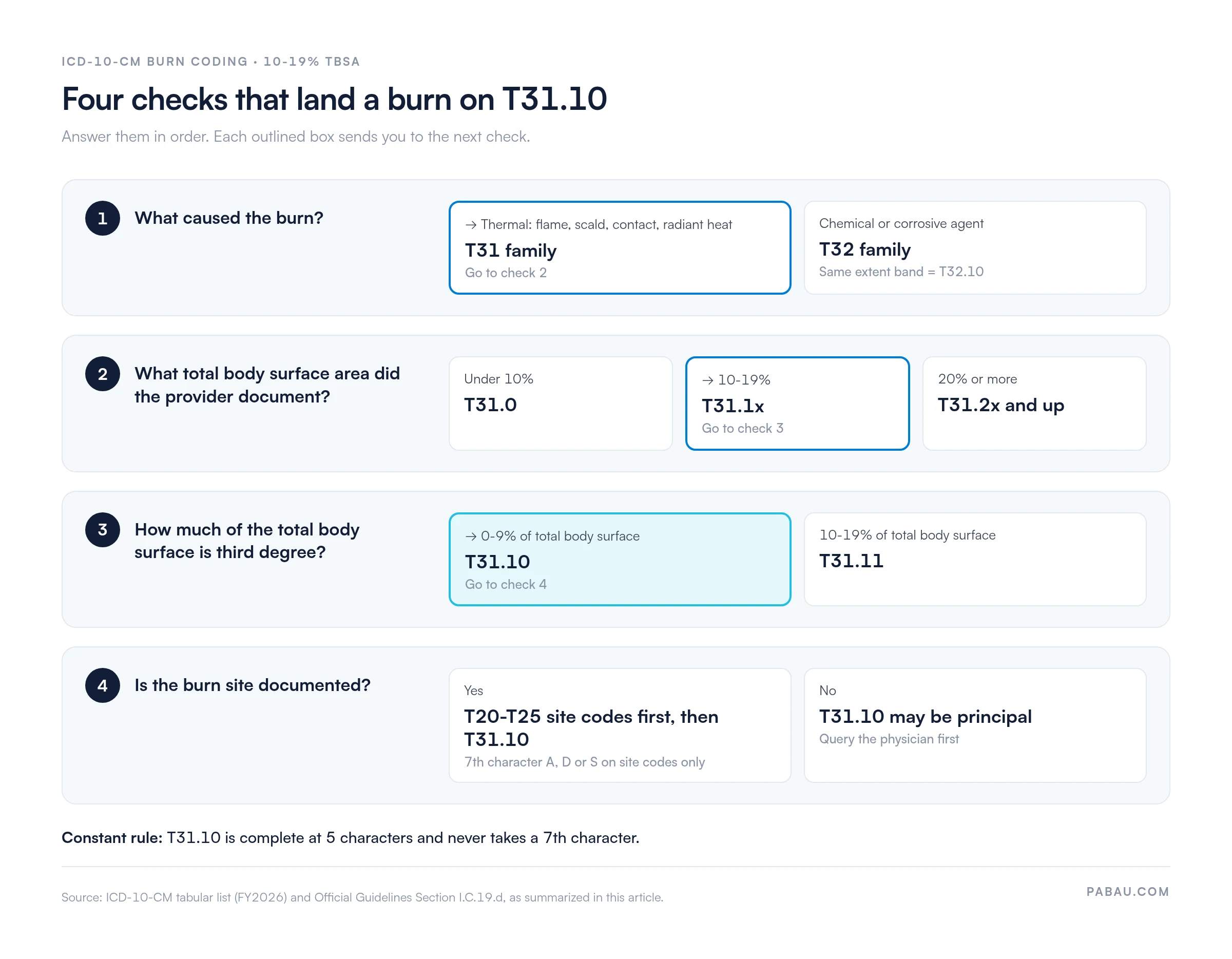
T31.10 does not require a 7th character. T31 codes are complete at 4 or 5 characters, which surprises coders used to the 7th-character rules for T20-T25 site codes. Most injury-chapter codes take a 7th character, but the T31 and T32 extent categories are exceptions.
When coding a burn encounter for subsequent wound care visits, the 7th character “D” is applied to the T20-T25 site codes, not to T31.10. T31.10 is submitted identically on initial and subsequent encounters. This distinction prevents the common error of appending “A,” “D,” or “S” to T31.10 in a claim, which would render the code invalid.
Without explicit TBSA documentation, T31.10 cannot be assigned. The percentage has to come from the treating provider, because coders cannot calculate or estimate burn extent themselves. The following elements should all appear in the medical record before T31.10 is used.
A clean claim for T31.10 starts with a pre-submission documentation check. If TBSA is missing, query the physician before billing. Post-submission queries cause delays and often lead to denial and appeal cycles that cost more than the original documentation effort. With claims management software like Pabau, billing teams can catch incomplete claims before they go out.
Build a burn admission checklist that mirrors the T31.10 documentation requirements above. For every burn patient above 10% TBSA, the attending physician should document the TBSA method and the resulting percentage. The checklist also asks for the causative agent and the degree by site before the encounter is closed. Attaching it to the burn admission order set removes the query step in most cases.
Payer requirements for T31.10 claims vary by plan and setting. The following general criteria apply to Medicare, Medicaid, and most commercial payers. Individual policies differ, so verify coverage requirements with each payer before submission.
One documentation standard that meets every payer’s requirements is easier to maintain than a separate version for each plan. Submitting through a clearinghouse with real-time eligibility checks confirms the patient’s coverage before the claim is built. That check also prevents denials caused by a coverage file showing a different effective date for the patient’s plan.
Most T31.10 denials trace back to missing documentation or a code-selection error. Each denial below maps to a specific prevention step.
Review T31.10 denials by CARC after each remittance cycle. For this code family, watch CARC 11 (diagnosis inconsistent with the procedure) and CARC 16 (claim lacks information or has billing errors). An appeal with the original encounter notes and a physician attestation resolves many of these, but fixing documentation upstream is faster. The guide to medical billing denial codes carries the full CARC and RARC crosswalk for burn claim appeals.
T31.10 itself carries no 7th character, so sequela coding does not apply to it directly. The 7th character “S” goes on the associated T20-T25 site codes when a practice treats the late effects of a burn. Typical examples are scar contracture, hypertrophic scarring, and reconstructive procedures months after the injury.
Take a patient who returns for scar revision six months after a 15% TBSA flame burn. The initial encounter was coded T25.221A and T31.10. The revision encounter reports the scar condition first, such as L90.5 for scar conditions and fibrosis of skin. T25.221S follows it as the sequela of the right foot burn. T31.10 is not re-reported unless TBSA is again clinically relevant to the care provided, which is not routine for uncomplicated scar care.
Knowing where ICD-10 Code T31.10 sits in the T31 hierarchy helps coders move quickly between TBSA ranges. The family runs from under 10% TBSA to 90% or more. Each TBSA tier has 5th-character options that specify the third-degree component. The table below covers the tiers most relevant to emergency and inpatient burn coding, where T31 codes also influence DRG assignment.
Each TBSA tier follows the same 5th-character pattern: the 5th character equals the tens digit of the third-degree TBSA percentage. As TBSA increases, the number of available 5th characters increases to match the range of possible third-degree fractions. Confirm specific code options for tiers T31.5 through T31.8 in the official CDC/NCHS ICD-10-CM tabular list.
Run a quarterly claim audit on all T31.x codes submitted alongside T20-T25 site codes. Filter for encounters where T31.10 was submitted but no T20-T25 code appears on the claim. This filter catches a frequent T31.10 sequencing error and often surfaces documentation habits shared by several coders.
Many billing teams only learn that a TBSA figure or a site code is missing when the remittance comes back. Each denial then restarts the cycle of physician query, correction, and resubmission.
Pabau keeps clinical notes, invoices, and insurance claims in the same patient record. Billing staff can compare the documented burn extent and site codes with the claim before it goes out. Claims are then submitted electronically through the Claim.MD clearinghouse integration.
Claim status and remittances return to the same system, so a denied T31.10 claim can be traced back to the encounter that produced it. Your team fixes the documentation habit once, rather than appealing the same denial every month.

Pabau’s claims management tools help billing teams check claims for completeness and verify eligibility before submission. That means fewer T31.10 denials and appeals to work.

T31.10 rewards patience more than speed. Treat the TBSA figure and the third-degree share as data only the provider can supply, and hold the claim until both are in the record.
The trade-off is a short delay while the physician confirms burn extent, which costs far less than a denial and appeal cycle. Book a demo to see how Pabau helps your billing team catch incomplete burn claims before they reach the payer.

Is 10-19% of the body surface third degree? ICD-10 Code T31.11 covers the same TBSA band when the full-thickness share reaches 10-19%.
Documented TBSA under 10%? ICD-10 Code T31.0 is the extent code for burns below the T31.1 threshold.
Need to understand how clearinghouse submissions work for ICD-10 claims? How the Claim.MD clearinghouse processes ICD-10 submissions walks through the path from diagnosis code to payer.
Working on reducing claim denials across your billing team? Understanding electronic remittance advice explains how to read ERA files and spot denial patterns by code.
Building a compliance program for your billing team? Medical billing compliance covers the documentation standards behind accurate ICD-10 assignment.
ICD-10 Code T31.10 is the billable ICD-10-CM code for burns covering 10-19% of total body surface area (TBSA), with 0-9% third degree. It classifies burns by extent rather than site. It is assigned alongside T20-T25 site codes when the location is documented.
Yes, T31.10 is a valid billable ICD-10-CM code confirmed active for FY2026. It is a 5-character code, complete without a 7th character, and accepted by Medicare, Medicaid, and commercial payers when supported by appropriate TBSA documentation.
Use T31.10 when the documented TBSA is 10-19%; use T31.0 when TBSA is less than 10%. If the record documents TBSA in the borderline range (around 9-10%), query the physician before assigning either code rather than estimating.
T31 codes cover thermal burns caused by heat sources such as flame, scalding water, or radiant heat. T32 codes cover corrosions caused by chemical or caustic agents such as acid or alkali. The causative agent documented in the record determines which family to use; they are not interchangeable and mixing them is a compliance risk.
The record needs an explicit TBSA percentage within 10-19% and confirmation that the agent was thermal. It also needs each burn site for T20-T25 coding, the degree at each site, the calculation method, and provider attestation. If any element is missing, query the physician before submitting the claim.
The usual causes are a missing TBSA percentage, or no T20-T25 site code when the burn location is documented. Others are using corrosion code T32.10 for a thermal burn, choosing T31.11 instead of T31.10, or appending a 7th character.