ICD-10 code S61.201A: Open wound of left index finger without nail damage
ICD-10 code S61.201A covers a left index finger wound of unstated type ICD-10 co...

Last Updated: Oct 16, 2026
Billable Code Specific Code
T31.96 is the billable ICD-10-CM code for burns involving 90% or more of body surface with 60-69% third degree burns.
Two documented percentages decide whether it applies, and both have to sit in the physician note as figures.
Let Pabau's smart automation suggest the right codes, reduce claim denials, and keep your practice compliant—effortlessly.
Automate repetitive tasks and focus on what matters most—your patients.
Reduce coding errors and ensure compliance with the latest regulations.
Clean claims, fewer denials, and faster reimbursements.
Powerful insights and reporting to help your practice thrive.
HIPAA compliant SOC 2 certified GDPR-compliant Trusted by 4,000+ clinics worldwide

ICD-10 code T31.96 is a billable ICD-10-CM code for burns covering 90% or more of the body surface.
The final digit sets the third-degree share, so T31.96 means 60-69% of the burned area is full thickness.
T31.96 is the primary code only when the burn site is unspecified. When the site is documented, a T20-T25 code comes first.
The third-degree percentage is a share of the burned area, not a share of total body surface.
Practice management software like Pabau carries the documented percentages straight into the claim, so coders never retype them.
ICD-10 Code T31.96 is a billable, specific ICD-10-CM diagnosis code. It classifies burns involving 90% or more of total body surface area (TBSA), where 60-69% of the burned area is third-degree (full-thickness) damage.
It is valid for claim submission in the 2026 ICD-10-CM edition. That edition applies to dates of service on or after October 1, 2025, per the CMS ICD-10 codes page.
The site-specific burn codes in the T20-T25 range record where the burn is. T31.96 records how much of the body it covers, which is what drives resource intensity and DRG assignment.
The T31 category sits within Chapter 19 (Injuries, Poisoning, and Certain Other Consequences of External Causes) of the ICD-10-CM tabular list. It classifies burns solely by how much of the body surface is involved, using a dual-axis system that no other burn category replicates.
The digit immediately after the decimal gives the range of total TBSA burned. The final digit gives the share of that burned area that is third degree. This dual-axis logic separates T31.96 from every adjacent code, and it is where most coding errors start.
The broader T31 category runs from under 10% TBSA (T31.0) up to 90% or more (T31.9x). The same third-degree sub-digit logic applies across T31.1x through T31.8x. Our ICD-10 diagnostic codes library breaks down the neighboring burn extent codes the same way.
The accuracy of T31.96 hinges on the TBSA calculation documented in the medical record. Two methods are accepted in clinical practice, and either one has to produce a percentage the coder can map to a T31 axis.
The Rule of Nines divides the adult body into regions worth roughly 9% of total surface area each.
Clinicians add up the burned regions to reach a total TBSA percentage. The method is fast, which is why emergency departments reach for it first.
The Lund-Browder chart adjusts surface area estimates for age-related changes in body proportion. That makes it more accurate for pediatric patients and preferable for definitive burn unit documentation. For adults burned at the T31.96 level either method is clinically acceptable, provided the calculated percentage appears in the physician note.
Both methods appear in AAPC’s ICD-10-CM coding resources as accepted tools for TBSA documentation. The third-degree percentage is calculated against the total burned area, not against total body surface.
If 90% of the body is burned and 63% of that burned area is third degree, the note has to carry both figures. A line reading “major burns” or “third-degree burns to trunk and bilateral lower extremities” will not support T31.96.
Coders working with T31.96 regularly reach for adjacent codes in the T31.9x subcategory, the T32 corrosion parallel, and the site-specific burn codes in T20-T25. The table below shows the ones referenced most often.
The T31.9 parent code is a header, not a billable code. Always pick the specific fifth-character code, T31.90 through T31.99, so the burn encounter leaves as a clean claim. The CDC/NCHS ICD-10-CM web tool confirms billable status and hierarchy for every T31 code.
Burn documentation failures are a leading cause of claim denial in burn unit and acute care billing. To support T31.96, the physician record has to carry all of the elements below. Miss one and the coder cannot assign the code with confidence.
Burn unit records draw retrospective audits often, because these cases carry high resource intensity and high reimbursement. Building the two percentages into the initial clinical note protects the clinician and the billing team at the same time.
Ask physicians to document TBSA percentage and third-degree percentage as two distinct numbers in the burn assessment note, not as a combined description. A note saying ‘90%+ TBSA, 63% full-thickness’ maps cleanly to T31.96 and gives the coder no ambiguity to resolve.
The ICD-10-CM Official Guidelines for Coding and Reporting, maintained by CMS and NCHS, direct how T31 codes work in practice. Three rules cover almost every T31.96 error.
The T31 category note is explicit. T31 serves as the primary code only when the site of the burn is unspecified. When the record documents the site, a T20-T25 code is sequenced first and T31.96 follows it as an additional code carrying the extent data.
Assigning T31.96 alone against a chart that names the burned sites is a sequencing error, and payers catch it. The reverse also costs money: a site code with no extent code hides how much of the body was involved.
T31.9 is a non-billable header code. Submitting T31.9 instead of T31.96, or another specific fifth-character code, results in an invalid claim. Always select the most specific code the documentation supports.
Corrosions, meaning injuries caused by chemical agents, use the T32 category, which mirrors the T31 structure exactly. If a chemical caused the burn, the correct code is T32.96. The cause has to be documented, because wound appearance alone does not always reveal it.
These sequencing rules separate a burn claim that passes medical review from one that comes back. The reviewer wants the correct first-listed code, with a correctly applied T31.96 behind it.
Boundary cases are where T31.95, T31.96 and T31.97 get mixed up, and the fix is a fixed order of questions. Work through the cause, then the TBSA, then the third-degree share, then the site. Where the documentation reads 30-39% third degree burns, the code is T31.93, which sits in the same 90% or more TBSA band.
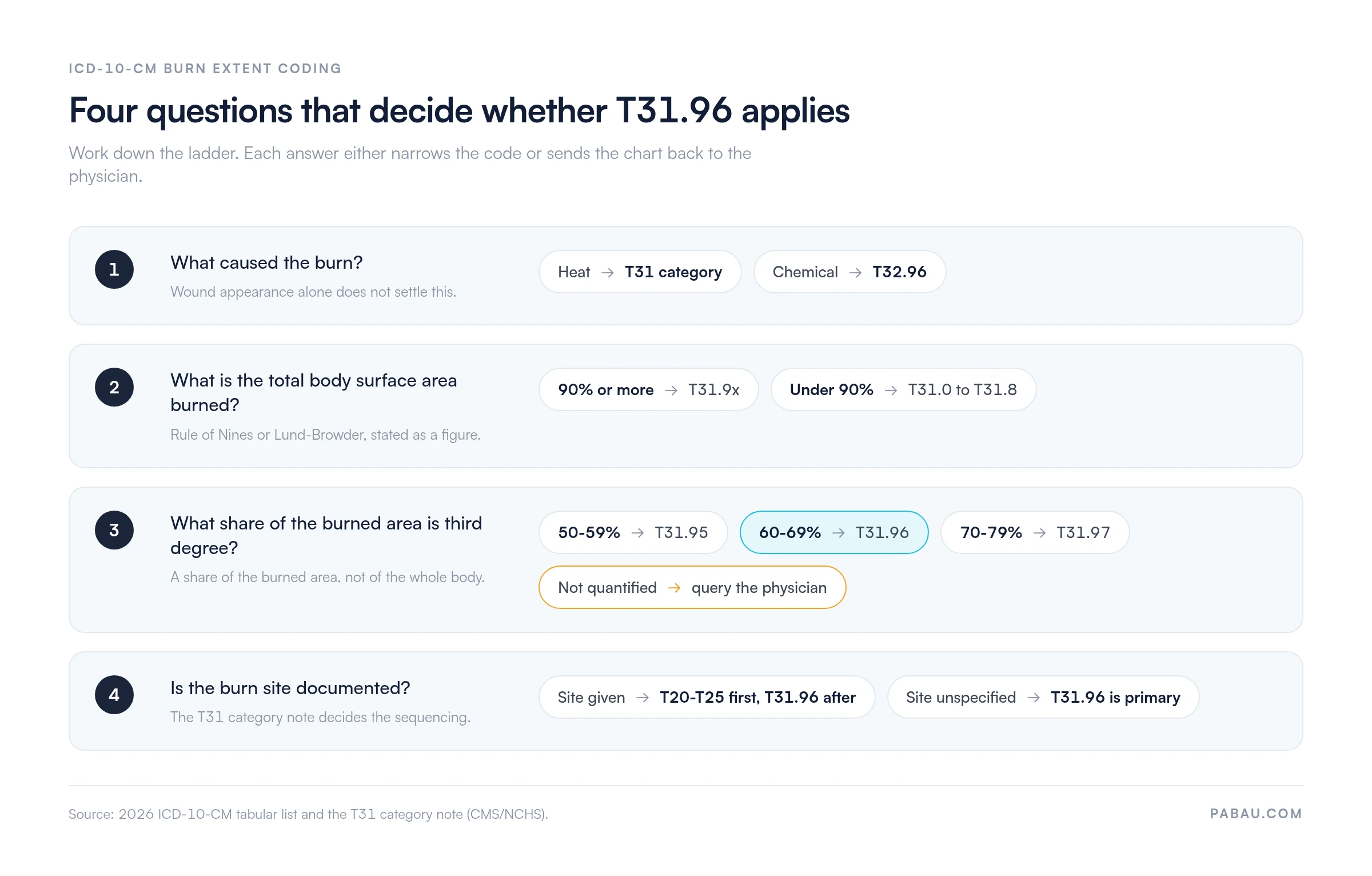
The scenarios below run that order against charts a burn unit coder sees every week.
When documentation lands on a boundary, query the attending physician rather than round toward a code. A note reading “approximately 60%” third degree is not enough to assign T31.96.
Accurate burn coding depends on two things. The clinical note has to capture the TBSA and third-degree percentages as figures. The billing workflow then has to move those figures into the claim without a retype.
Practices that run their records and their billing tools separately lose time in the handover. The coder ends up working from a copy of the note rather than the note itself.
Pabau is practice management software with billing built in, so the coded encounter and the claim sit in one record. Its claims management software puts ICD-10-CM code lookup in the same screen as the note. That removes the step where T31.96 and its companion site code get transposed.
For US payers, Pabau submits electronically through Claim.MD, our clearinghouse partner. That covers CMS-1500 and 837P claims, real-time eligibility checks, and electronic remittance advice for faster reconciliation on high-value burn claims.

Burn and wound care teams can also shape their note templates around the two fields the code needs. That cuts the query traffic which holds up claim turnaround on these cases.
Clinicians, coders and billing staff all work from the same record. A late correction to the burn assessment therefore reaches the claim before it goes out, instead of after a denial.

Pabau keeps ICD-10 code lookup, burn documentation, and electronic claim submission in one workflow. Your billing team stops retyping percentages between systems.

ICD-10 Code T31.96 covers one of the most severe burn profiles in ICD-10-CM. Correct assignment comes down to two documented percentages, the right sequencing against a T20-T25 site code, and the T31 versus T32 call on cause.
Get the query in early. A single message to the attending physician while the patient is still in the unit costs less than an appeal months later. Book a demo to see how Pabau keeps coded burn documentation and claim submission in one workflow.

Need to understand how ICD-10 coding errors drive revenue losses? Denial management in healthcare covers the systematic approach to identifying, correcting, and appealing denied claims.
Want to understand how claims move from code to payment? Medical claims clearinghouse explains how clearinghouses validate, route, and track claims before they reach payers.
Looking for a billing compliance reference? Superbill documentation covers the relationship between clinical documentation and the billing forms that support ICD-10 code submission.
ICD-10 Code T31.96 is a billable ICD-10-CM diagnosis code for burns covering 90% or more of total body surface area. Within that burned area, 60-69% is third degree. It follows a site-specific burn code from T20-T25 unless the record leaves the burn site unspecified.
Yes. T31.96 is a billable, specific ICD-10-CM code valid for claim submission. It is effective for dates of service on or after October 1, 2025 in the 2026 ICD-10-CM edition. The parent code T31.9 is not billable. Always use the five-character specific code.
T31 codes classify thermal burns, meaning injuries from heat sources. T32 codes classify corrosions, meaning injuries from chemical agents. Both categories use the same dual-axis structure for TBSA and third-degree percentages, so T32.96 is the corrosion parallel to T31.96. The cause of injury documented by the physician determines which category applies.
The physician must document two percentages. The first is total TBSA burned, which has to be 90% or more. The second is the third-degree share of the burned area, which has to fall between 60% and 69%. Either the Rule of Nines or the Lund-Browder chart may be used. General descriptions without percentages do not support T31.96.
T31.96 is effective October 1, 2025 as part of the 2026 ICD-10-CM edition, maintained by CMS and the National Center for Health Statistics (NCHS). It applies to claims with dates of service on or after that date.
Yes, but only when the record does not specify where the burn is. The T31 category note allows T31 as the primary code when the site is unspecified. Where the note names the burned sites, a T20-T25 code is sequenced first and T31.96 follows it.
The third-degree percentage in T31.96 is calculated as a proportion of the total burned area, not of total body surface. If 90% of the body is burned and 63% of that burned area is full thickness, the case falls in the T31.96 band.