

ICD-10 code S61.201A: Open wound of left index finger without nail damage
ICD-10 code S61.201A covers a left index finger wound of unstated type ICD-10 co...

Last Updated: Oct 16, 2026
Billable Code Specific Code
T31.93 is the billable ICD-10-CM code for burns involving 90% or more of body surface with 30-39% third degree burns. Both figures are percentages of total body surface area, so 30-39% of the whole body is full thickness.
T31.93 sits in the T31.9x subcategory, where the fourth character fixes the total burned surface and the fifth character carries the third-degree share. Accurate assignment depends on a physician note stating both percentages. The claim then needs the burn site, external cause, place, activity and encounter type in the right sequence.
Let Pabau's smart automation suggest the right codes, reduce claim denials, and keep your practice compliant—effortlessly.
Automate repetitive tasks and focus on what matters most—your patients.
Reduce coding errors and ensure compliance with the latest regulations.
Clean claims, fewer denials, and faster reimbursements.
Powerful insights and reporting to help your practice thrive.
HIPAA compliant SOC 2 certified GDPR-compliant Trusted by 4,000+ clinics worldwide

T31.93 is billable for FY2026 and covers burns over 90% of body surface, with 30-39% of the body third degree.
Both percentages are measured against the whole body, and both have to appear in the physician’s note.
The fifth character is the only difference between T31.93, T31.92 and T31.94.
T31 may stand alone where the burn site is undocumented, and pairs with T20-T25 where the site is specified.
Place of occurrence is Y92, activity is Y93, and exposure to electric current or radiation sits in W85-W99.
ICD-10 code T31.93 is a billable diagnosis code for burns involving 90% or more of body surface, with 30-39% third-degree burns. Both figures are percentages of total body surface area, not percentages of the burned area.
The CMS ICD-10-CM tabular list files it under Chapter 19, in category T31, which sorts burns by extent rather than by site.
That last row is worth pausing on. Encounter-type extensions (A for initial, D for subsequent, S for sequela) belong to the site-specific burn codes in T20-T25.
Append one to T31.93 and you have built an invalid code, which the payer’s edits will reject before a human ever reads the claim.
Every T31 code is built in two steps. The fourth character carries the total burned surface. The fifth carries how much of the body is third degree. So T31.90 through T31.99 all describe a burn covering 90% or more, and only the second number moves.
The breakdown below shows which character does what, and where T31.93 sits on that ladder.
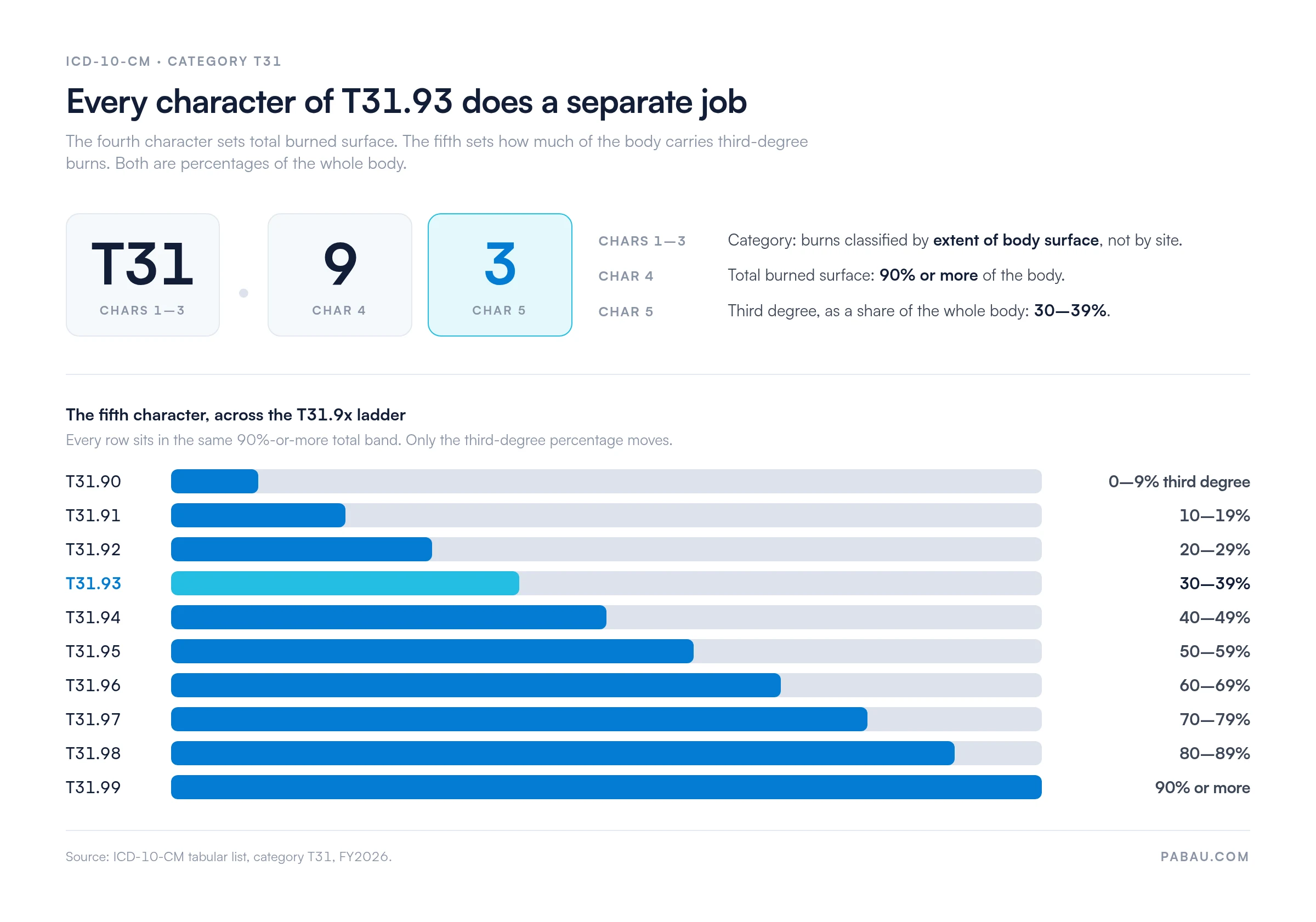
Every code in the T31.9x range is billable for FY2026. That makes the fifth character a coding decision rather than a validity one. Send T31.92 on a note that says 35% third degree and the claim still processes. It just describes a less severe injury than the patient had.
Coders do not estimate or calculate burn surface area. The treating physician documents the total percentage and the third-degree percentage, and the coder reads both off the note.
Knowing how those numbers are produced still helps, because it tells you when a note contradicts itself and a query is warranted.
The Rule of Nines splits the adult body into regions, each worth a set share of total surface area:
Add both legs, the anterior trunk and the posterior trunk and you are already at 72%. Burns reaching the head, neck and arms take the total past 90%. That picture supports T31.93 only where the physician also documents that 30% to 39% of the body is third degree.
The Rule of Nines is inaccurate for children, whose heads and limbs are proportioned differently from adults. The American Burn Association recommends the Lund-Browder chart for pediatric burn assessment.
It raises the head percentage, up to 19% in infants, and lowers the leg percentages. Check that the tool matches the patient’s age before you trust the figures in the note.
T31.93 can be the only burn code on a claim. The tabular note under category T31 is explicit about it. Use T31 as the primary code when the site of the burn is unspecified. Use it as a supplementary code alongside T20-T25 when the site is documented.
Official Guidelines section I.C.19.d covers burns and corrosions. Section I.C.19.d.6 calls the extra T31 code advisable where the site is specified, not mandatory.
It matters most for a third-degree burn covering 20% or more of the body. A site code usually belongs on the claim, but its absence is a documentation question rather than an automatic rejection.
Where the record supports them, the companion codes are:
One trap is worth naming here. X75, X76 and X77 read like burn mechanism codes, but they sit in the intentional self-harm block. Reach for them only where the record documents self-harm.
Sequencing follows the same section I.C.19.d. Where several burns are present, the burn of the highest degree is sequenced first. On a major burn admission the site code often leads, with T31.93 reported as an additional code. Confirm the order against AHA Coding Clinic guidance for the encounter in front of you.
Check that external cause codes carry the same seventh character as the burn site code they accompany. If the site code is A for initial encounter, every external cause code on that visit should be A as well. Mismatched extensions are a common claim edit trigger on burn cases.
All three codes describe a burn covering 90% or more of the body, so the fifth character is the whole decision. Read the third-degree percentage off the burn assessment note, then match it to the ten-point band it falls in.
Do not interpolate, and do not round to the nearer band. If the note says “approximately 30%” without saying which side of the line the patient falls on, query the physician before assigning anything.
T31 covers thermal burns from a heat source, which includes fire, hot objects, electricity and radiation. T32 covers corrosions, the injuries chemicals cause. The two categories mirror each other, so T32.93 applies the same two percentage bands to a chemical injury.
Sending a chemical injury to T31.93 instead of T32.93 creates a mismatch any payer can see. The external cause code names a chemical agent while the injury code says thermal burn. What settles the category is the etiology in the physician’s note, not how the wound looks on examination.
Five elements have to be in the record. Coders infer none of them, and a missing element calls for a compliant physician query under AHA Coding Clinic and AHIMA standards.
Burn units usually record all of this on a standard burn assessment flowsheet. A flowsheet only supports code assignment once the physician has authenticated it. An unsigned form is a query, not a source.
T31.93 lands in the extensive-burn MS-DRG family, 927 through 929. The sibling code you pick is not what decides which one. Assignment turns on how long the patient was ventilated, whether a skin graft was performed, and which complications and comorbidities were coded.
That puts the paid work in the secondary diagnoses. Respiratory failure, sepsis, acute kidney injury and prolonged mechanical ventilation each need a documented diagnosis and a code of their own. Capturing T31.93 and the site code alone leaves money unbilled, and it invites a review for under-coding.
Relative weights move with every annual IPPS rule. Check the current figures against the CMS acute inpatient PPS documentation rather than last year’s worksheet.
Each of these takes seconds, and each one maps to a rejection listed in the next section. Run them while the account is still open and the physician is still reachable.
Burn claims carry more moving parts than most inpatient accounts, so they bounce more often. These are the rejections worth planning for, with the correction that clears each one.
Sorting rejections before anyone touches them saves the most time. Reading the payer’s denial codes tells you whether a burn claim came back for a coding reason or a coverage one. On the pre-submission side, a clean claim checklist built for long inpatient stays catches most of the list above.
Audit your T31.9x claims monthly and look at how the fifth character is distributed. If every burn account lands on the same code, you have a documentation or coding uniformity problem. Investigate it before a payer’s own analytics do.
A burn encounter rarely resolves to one code. Knowing how the neighbors relate to T31.93 keeps crosswalk errors off the claim.
Confirm validity against the current fiscal year before you submit. Descriptors and billable status are refreshed every October 1, and the CDC/NCHS ICD-10-CM web tool is the quickest place to check both.
Most burn claims are assembled by hand. A coder reads the assessment, picks the extent code, hunts for the site code, then checks the external cause block against the encounter. Those steps usually live in three different systems, which is exactly where a companion code goes missing.
Practice management software like Pabau keeps coding, invoicing and payer responses on the same patient record. Claims run through validation before they are submitted, so an incomplete code set surfaces while the account is still open.
That is what cleaner claims management buys a burn unit: fewer accounts reworked weeks later, and fewer percentages chased from a discharged chart.
For the biller, the loop gets shorter. The code set, the documentation behind it, and the payer’s response sit together. A rejected burn claim gets corrected once instead of reconstructed from scratch.

Pabau validates the ICD-10 code set before a claim is submitted, flagging a missing companion code while the chart is still open. See how it handles long inpatient billing.

Assigning T31.93 is straightforward. Supporting it is where burn accounts come apart. Two percentages have to be in the physician’s note, both measured against the whole body, and the fifth character has to match the second one.
So build the check into the workflow rather than into memory. A burn assessment stating both figures, an authenticated flowsheet, and a site code where the sites are known will carry almost every T31.93 claim through. What the admission is actually worth is then decided by the comorbidities you capture alongside it.
The trade-off worth remembering is simple. A burn admission runs for weeks, and documentation chased after discharge is documentation you rarely get. Book a demo to see how Pabau validates a code set before the claim leaves your practice.

Need to understand how denials are tracked and resolved? Denial management in healthcare covers the end-to-end workflow for identifying, correcting, and resubmitting rejected claims.
Want a clean-claim checklist for complex inpatient cases? 837 file submission guide explains the electronic claim format requirements that govern how T31.93 and its companion codes are transmitted to payers.
Exploring clearinghouse options for burn unit billing? Medical claims clearinghouse overview breaks down how clearinghouses validate code sets before payer adjudication.
Of the whole body. Both percentages in T31.93 are measured against total body surface area. The burn covers 90% or more of the body, and 30% to 39% of the body is third degree. That is why category T31 pairs each total-surface tier only with the third-degree tiers that fit inside it.
T31.93. The 95% falls in the 90%-or-more tier, and 35% falls in the 30-39% third-degree band. Add a T20-T25 site code where the record names the sites burned, plus an external cause code for the mechanism.
No. Sunburn is coded in L55.-, outside the burn and corrosion categories. T31 counts thermal burns from a heat source, which includes fire, hot objects, electricity and radiation.
Only once the treating physician has authenticated it. An unsigned flowsheet is a working document, so a code assigned from it alone will not hold up in an audit. Query the physician, or wait for the signature.



