Pabau Engage inbox

Pabau Engage is here: every patient conversation in one inbox.

Learn more
ICD-10-CM Code

ICD code T31.95 – Burns involving 90% or more body surface area

Billable Code Specific Code


Code Definition

T31.95 is the billable ICD-10-CM code for burns involving 90% or more of body surface with 50-59% third degree burns. Both figures are shares of total body surface, and both must appear in the physician's note. If either figure is missing, the coder queries the physician before assigning the code.

The code classifies burns by extent, not location. It's the principal diagnosis only when the burn site is unspecified. When sites are documented, T20-T25 codes come first and T31.95 follows as a supplementary code. Chemical corrosions of the same extent take T32.95 instead.

Chapter
S00-T88 Injury, poisoning and certain other consequences of external causes
Category
T31 Burns classified according to extent of body surface involved
Group
T31.9 Burns involving 90% or more of body surface
Billable
Yes
Code also known as
major burns, extensive burns, large TBSA burns
Save time. Improve accuracy. Get paid faster.
Automate coding with Pabau

Let Pabau's smart automation suggest the right codes, reduce claim denials, and keep your practice compliant—effortlessly.

  • AI-powered code suggestions
  • Real-time compliance checks
  • Faster claims, fewer denials
Why practices choose Pabau
Save hours every week

Automate repetitive tasks and focus on what matters most—your patients.

Improve accuracy

Reduce coding errors and ensure compliance with the latest regulations.

Get paid faster

Clean claims, fewer denials, and faster reimbursements.

Grow with confidence

Powerful insights and reporting to help your practice thrive.

HIPAA compliant SOC 2 certified GDPR-compliant Trusted by 4,000+ clinics worldwide

Key takeaways

Key takeaways

ICD-10 code T31.95 covers burns on 90% or more of body surface, with third-degree burns on 50-59%.

The physician must document both percentages, because coders can’t calculate or infer either figure.

T31.95 is the principal diagnosis only when the burn site is unspecified, and otherwise supplements T20-T25 site codes.

T31 codes take no 7th character, so late effects of these burns are coded with T95 codes.

Chemical corrosions of the same extent use T32.95 instead of T31.95.

ICD-10 code T31.95 covers burns on 90% or more of the body

ICD-10 code T31.95 is a valid, billable ICD-10-CM code in category T31, which classifies burns by how much body surface they involve. The official descriptor reads “Burns involving 90% or more of body surface with 50-59% third degree burns.”

Two numbers sit inside the code. The fourth character, 9, places total burn extent at 90% or more. The fifth character, 5, says third-degree burns cover 50-59% of body surface. Both figures are shares of the whole body, not of the burned area.

That makes T31.95 one of the most severe codes in Chapter 19. Patients at this extent are almost always admitted for specialist burn care, so each claim carries high value and close review.

FieldValue
CodeT31.95
Full descriptorBurns involving 90% or more of body surface with 50-59% third degree burns
BillableYes, valid for claim submission
ICD-10-CM chapterChapter 19: Injury, poisoning and certain other consequences of external causes (S00-T88)
Parent categoryT31, burns classified according to extent of body surface involved
SubcategoryT31.9, burns involving 90% or more of body surface
Tabular noteUse as the primary code only when the burn site is unspecified. Use it as a supplementary code with T20-T25 when the site is specified.
Corrosion equivalentT32.95, a chemical corrosion of the same extent

Two percentages decide every T31 code

Category T31 works like a grid. The fourth character sets total burn extent in 10% bands, and the fifth sets the third-degree share. T31.95 sits where the 90%-or-more row meets the 50-59% column.

Physicians usually estimate extent with the Rule of Nines (Wallace method) for adults. For children they use the Lund-Browder chart, because a child’s head and legs make up different shares of the body.

Per the CMS ICD-10-CM guidelines, coders take both figures straight from physician documentation. They can’t calculate or infer them from wound descriptions.

Where T31.95 sits in the T31.9 row

The table lists every code in the T31.9 subcategory. T31.95 is in bold, so you can see the neighbors it’s most often confused with.

CodeThird-degree shareDescriptor (90% or more of body surface, with…)
T31.900-9% third degreeWith 0% to 9% third degree burns
T31.9110-19% third degreeWith 10-19% third degree burns
T31.9220-29% third degreeWith 20-29% third degree burns
T31.9330-39% third degreeWith 30-39% third degree burns
T31.9440-49% third degreeWith 40-49% third degree burns
T31.9550-59% third degreeWith 50-59% third degree burns
T31.9660-69% third degreeWith 60-69% third degree burns
T31.9770-79% third degreeWith 70-79% third degree burns
T31.9880-89% third degreeWith 80-89% third degree burns
T31.9990% or more third degreeWith 90% or more third degree burns

The most common mix-up is T31.95 versus T31.90. T31.90 records a documented third-degree share of 0-9% of body surface, so it needs explicit documentation too. When the note gives total extent but no third-degree figure, query the physician. Don’t settle on T31.90 because depth is missing, and don’t assume T31.95 either.

Thermal or chemical? The agent decides between T31 and T32

T31 and T32 mirror each other, so the cause of injury picks the category. T31 covers thermal burns from flame, hot liquids, steam, hot objects, electricity and radiation. T32 covers corrosions from acids, alkalis and other caustic chemicals.

T32.95 is the corrosion twin of ICD-10 code T31.95, with the same extent and third-degree share. Check the agent named in the history before you settle on either code. A T31 claim paired with a chemical external cause code invites a payer query.

  • Use T31.95: flame, fire, hot liquid, steam, hot objects, electrical and radiation burns.
  • Use T32.95: acid, alkali and other corrosive chemical burns.
  • Key check: match the external cause code to the agent. X00-X08 covers fire and flame, and X10-X19 covers heat and hot substances. For a chemical, code the documented agent through T51-T65 and its external cause.

The decision path below puts those checks in order, from the agent to the burn site.
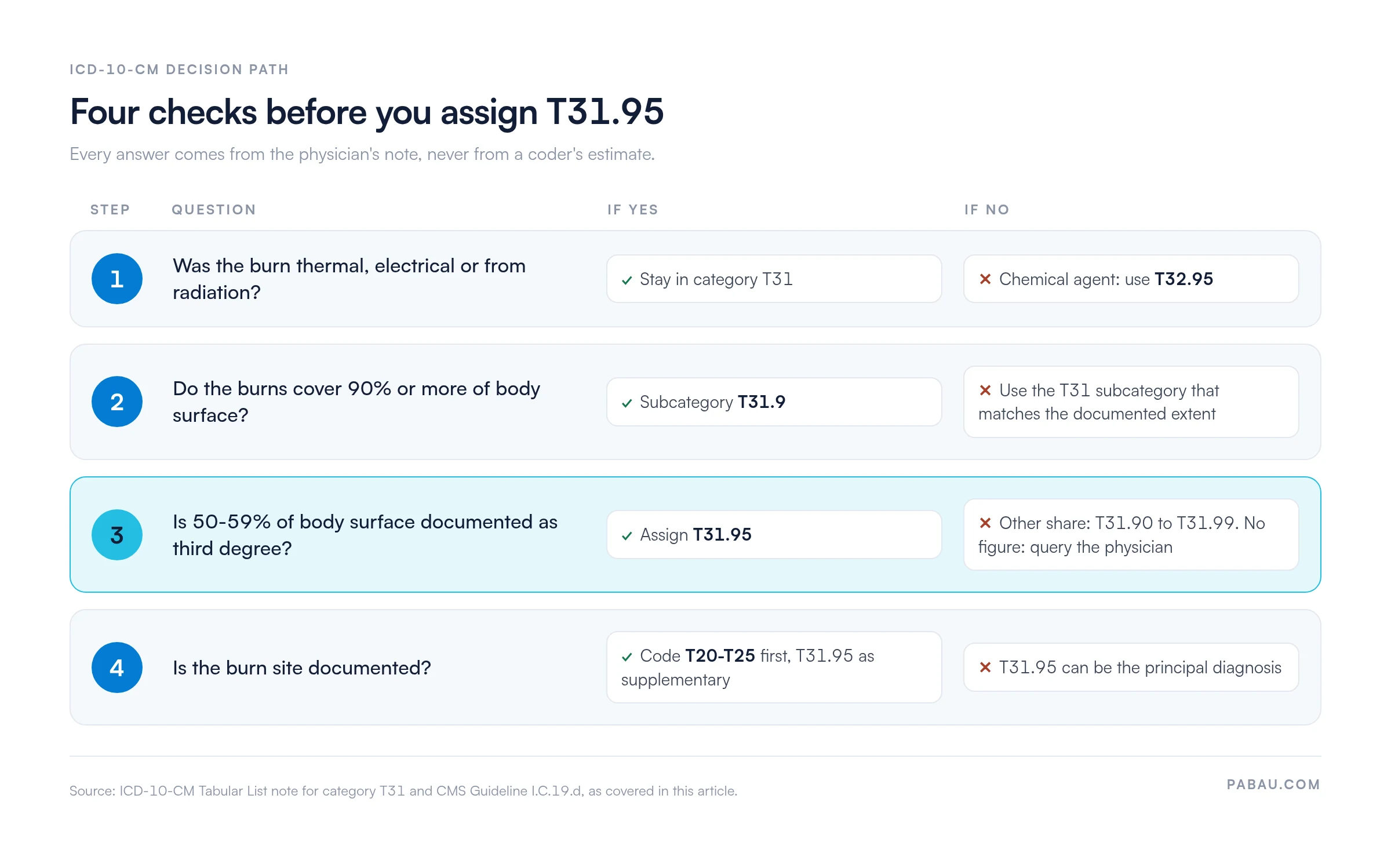
Four-step decision path for ICD-10 code T31.95
Step 3 is where most T31.95 queries start, because the third-degree share is the figure notes leave out. Based on the T31 Tabular note and CMS Guideline I.C.19.d.

What the Chapter 19 guidelines ask of a T31.95 claim

The ICD-10-CM Official Guidelines for Coding and Reporting come from CMS and the CDC/NCHS. Five of their rules shape every T31.95 encounter.

  1. Sequence the highest-degree burn first. With several burns, the highest-degree burn is the principal diagnosis. T31.95 serves as principal only when the burn site is unspecified.
  2. Add site codes when sites are documented. The T31 Tabular note makes T31.95 supplementary to T20-T25 whenever the site is specified. CMS Guideline I.C.19.d calls that pairing advisable.
  3. Report external cause codes. Chapter 20 codes record how, where and why the burn happened. Use X00-X08 for fire, Y92 for place of occurrence and Y93 for activity. Some payers reject claims without them.
  4. Code inhalation injury separately. T31.95 doesn’t include it. Add T59.811A for smoke inhalation, and J68.0 when the physician documents chemical or fume pneumonitis.
  5. Leave off the 7th character. T31 codes are complete at five characters, so A, D and S never attach to T31.95. The encounter type goes on the T20-T25 site codes instead.

Pro Tip

Query the attending physician whenever the note gives total burn extent but no third-degree percentage. T31.95 can’t be assigned without both figures in writing. A documented query also protects the claim if the payer audits it later.

Six facts the chart must show before you assign T31.95

Strong medical billing compliance starts in the chart. Check the note for these six elements before you code.

Required documentation elementWhy it matters for codingIf missing
Total body surface burned (90% or more)Selects the T31.9 subcategoryCode unsupported, so query the physician
Third-degree share (50-59%)Selects T31.95 over the other T31.9 codesQuery the physician. Never default to T31.90 or T31.95
Burn depth per body regionSupports the T20-T25 site codesSite codes can’t be assigned, so T31.95 stands alone as principal
Causative agentDecides T31 (thermal) or T32 (corrosion)T31 can’t be confirmed, and the payer may query it
Inhalation injury statusNeeds separate T59.811A or J68.0 codingUndercoding if inhalation is noted elsewhere in the chart
Encounter type for the site codesSets the A, D or S 7th character on T20-T25Wrong 7th character on the site code

Companion codes that complete a T31.95 claim

T31.95 rarely travels alone. A complete claim usually carries site, cause and complication codes next to it.

Code categoryExamplesWhen to report
Site-specific burn codesT20-T25 (head, trunk, limbs)Advisable when the site is documented (CMS Guideline I.C.19.d)
Inhalation injuryT59.811A (toxic effect of smoke, accidental), J68.0 (chemical or fume pneumonitis)When the physician documents inhalation injury
External cause (how)X00-X08 (fire and flame), X10-X19 (heat and hot substances), W85-W99 (electric current)Expected by many payers, so follow payer and state rules
Place, activity and statusY92 (place of occurrence), Y93 (activity), Y99 (external cause status)Once, at the initial encounter
Wound infectionT79.3 (posttraumatic wound infection), plus the organism code where documentedWhen infection is documented as a complication

How a T31.95 claim moves from admission to payment

Burns at this extent almost always mean an inpatient stay, so the claim runs through MS-DRG grouping. Here’s the usual path.

  1. Admission and eligibility. Confirm coverage and prior authorization rules on day one. Plans often require authorization for extended stays, repeat debridement and skin grafting.
  2. Documentation and coding. Coders build the code set from the physician’s TBSA figures, site notes and cause of injury.
  3. DRG grouping. DRG 927 covers extensive or full-thickness burns with ventilation over 96 hours and a skin graft. DRGs 928 and 929 cover full-thickness burns with a graft or inhalation injury, with and without CC/MCC. Burn cases without a skin graft generally group to DRGs 933-935.
  4. Submission and remittance. The claim goes out electronically, and the payer answers with electronic remittance advice. Its reason codes show why a line was cut or denied.

DRG definitions change every fiscal year. Check the current CMS MS-DRG definitions before relying on last year’s grouping. Some payers and plans may also require or prefer treatment at a verified burn center. Confirm that with each payer before admission where you can.

Run this checklist before you submit

Work through these checks on every T31.95 claim before it leaves the practice.

  • Total burn extent of 90% or more is written in the physician’s note.
  • The third-degree share is documented as 50-59% of body surface.
  • The agent is thermal, electrical or radiation, with no chemical involved.
  • T20-T25 site codes are added wherever sites are documented, each with its 7th character.
  • T31.95 itself carries no 7th character.
  • External cause, place (Y92), activity (Y93) and status (Y99) codes are on the initial claim.
  • Any documented inhalation injury is coded with T59.811A or J68.0.
  • Eligibility and prior authorization are confirmed for the stay and any grafting.

Six denial triggers and how to prevent them

Most T31.95 denials trace back to missing or vague chart documentation. Clear denial management workflows catch them at review, before the claim goes out.

Denial triggerRoot causeCorrective action
TBSA not documentedPhysician described the burns without a total percentageQuery before discharge. Don’t assign T31.95 without it
Third-degree share missingNote gives 90% or more in total but no depth breakdownQuery the physician. Never default to T31.90 or T31.95
Missing external cause codesClaim sent without X00-X08 or an equivalentBuild external cause codes into your standard burn code set
T31 used for a chemical burnAgent was corrosiveCheck the agent. Corrosions take T32, not T31
7th character added to T31.95Coder appended A, D or S to a five-character codeReport T31.95 as is, and put A, D or S on the T20-T25 site codes
Extent not supportedChart supports a lower T31 subcategoryCode the documented extent and never estimate upward

Read the payer’s remittance alongside a list of common denial codes. It shows whether a denial is a documentation, coding or payer policy problem. Each one needs a different appeal path, so a clean claim first time saves weeks of rework.

Late effects of a T31.95 burn move to T95 codes

Healed burns often leave scarring, contractures or disfigurement that need treatment months later. T31 has no sequela character, so T31.95S doesn’t exist. Code the late effect with category T95 instead.

  1. Active treatment: Report T31.95 with the T20-T25 site codes while the burns are being treated. That includes admission, debridement, grafting and dressing changes.
  2. Late effect: When the patient returns for a residual condition, such as a scar contracture or keloid, sequence that condition first.
  3. Cause of the late effect: Add T95.4, sequelae of burn classified only by extent of body surface. When the site is documented, use the site-specific T95 code instead.

Make sure the note reflects the shift. A scar revision billed with active-burn codes instead of T95 is an inconsistency that can draw audit attention.

How Pabau keeps complex burn claims moving

A T31.95 admission produces many codes, authorizations and remittance lines. Tracking them across spreadsheets and payer portals is how charges get missed.

Pabau, the practice management and billing platform we build, pre-fills each claim from the patient record. Its ICD-10-CM lookup library helps coders find site and external cause codes quickly. Required claim fields are checked before the claim can be sent.

US practices submit through Claim.MD, which connects to thousands of US payers. Real-time eligibility checks and ERA tracking sit in the same workflow. Our claims software for practices keeps each claim’s status and remittance on the patient record.
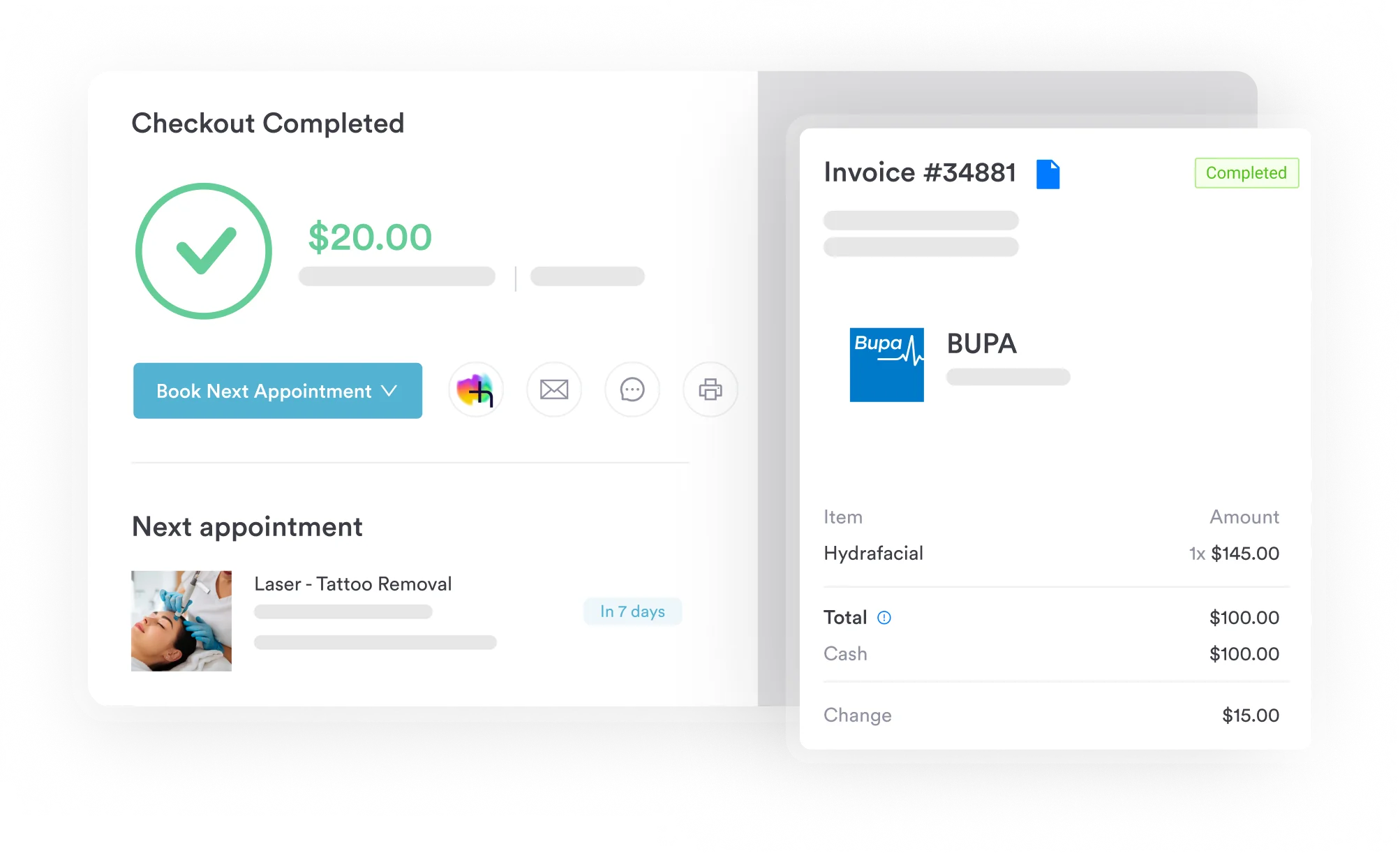
Pabau checkout and invoice screen showing a completed payment and the patient's insurer
Pabau’s invoicing links each charge to the patient’s insurer, so burn-care charges reach the claim without being rekeyed.

Send complex burn claims without the chasing

Pabau pre-fills claims from the patient record and checks required fields before sending. US practices submit through Claim.MD with real-time eligibility checks and ERA tracking.

Pabau claims management dashboard

Conclusion

T31.95 rewards precision. Two percentages, one agent and a handful of companion codes decide whether the claim pays first time. When the note lacks a figure, a physician query beats any educated guess.

Build the pre-submission checklist into your coding routine, and most of the denials covered here become far less likely. It costs a few minutes of chart review per burn admission, which is much cheaper than an appeal.

Book a demo to see how Pabau keeps high-value burn claims accurate from admission to remittance.

Continue your research

Continue your research

Need to understand how denials get resolved? Denial management in healthcare covers the workflow from denial identification through appeals and resubmission.

Looking for a reference on clearinghouse billing? Claim.MD clearinghouse overview explains how electronic claim routing works for complex diagnosis codes.

Want to reduce first-pass rejections across your code set? Medical billing compliance guidance outlines the documentation and submission standards that keep claims clean.

Mapping where burn claims lose money? What is revenue cycle management walks through each stage from registration to final payment.

Frequently asked questions

Is T31.95 billable, and can it be the principal diagnosis?

Yes, T31.95 is a billable ICD-10-CM code. It can be the principal diagnosis only when the burn site is unspecified. When sites are documented, T20-T25 codes come first and T31.95 is supplementary.

Do the T31.95 percentages refer to the whole body or the burned area?

Both refer to the whole body. Burns cover 90% or more of total body surface, and third-degree burns cover 50-59% of it. Working out the third-degree share as a fraction of the burned area points to the wrong code.

Does T31.95 cover electrical burns?

Yes. The burn categories T20-T32 include thermal burns from electricity, electrical appliances and lightning. Add a W85-W99 external cause code for the exposure. Other effects of the current, such as electrocution, take their own codes.

Can T31.95 be used for severe sunburn?

No. Sunburn is coded to category L55, which the burn categories exclude. Even extensive sunburn stays in L55, however much skin it affects.


Avatar photo
Monika Lazarevska
Content Writer

Monika Lazarevska writes content for owners and healthcare professionals who want clear, no-fluff content that actually helps them run their practice better. With a background in storytelling and SEO, she knows how to make even the driest topics worth reading. Off the clock, you'll find her in a café somewhere in Europe, probably with a good book and an even better coffee.
×