ICD-10 code S61.201A: Open wound of left index finger without nail damage
ICD-10 code S61.201A covers a left index finger wound of unstated type ICD-10 co...

Last Updated: Oct 16, 2026
Billable Code Specific Code
T31.80 is the billable ICD-10-CM code for burns involving 80-89% of body surface with 0% to 9% third degree burns.
Assigning it correctly means documenting two independent figures, not one. It also covers TBSA measurement tools, sibling code selection, sequencing rules, and the documentation a coder needs.
Let Pabau's smart automation suggest the right codes, reduce claim denials, and keep your practice compliant—effortlessly.
Automate repetitive tasks and focus on what matters most—your patients.
Reduce coding errors and ensure compliance with the latest regulations.
Clean claims, fewer denials, and faster reimbursements.
Powerful insights and reporting to help your practice thrive.
HIPAA compliant SOC 2 certified GDPR-compliant Trusted by 4,000+ clinics worldwide

ICD-10 code T31.80 is a billable ICD-10-CM code for burns covering 80-89% of body surface with 0-9% third degree.
Two figures drive the code: total body surface area burned, and the share of that surface that is third degree.
Measure surface area with the Rule of Nines for adults, or the Lund-Browder chart for pediatric patients.
Official guidelines require the local burn codes from T20-T25 alongside T31.80, so T31 codes never stand alone.
Practice management software like Pabau validates ICD-10 codes at claim submission, so a wrong fifth digit gets caught early.
ICD-10 code T31.80 is billable and specific, so no more specific code is required. It is valid for HIPAA-covered electronic transactions and can carry a diagnosis for reimbursement purposes. The FY 2026 edition of ICD-10-CM made T31.80 effective October 1, 2025.
Coders can check the code’s current status against the CDC official ICD-10-CM web tool. It mirrors the authoritative tabular list, which is updated each fiscal year.
ICD-10-CM organizes burn codes by mechanism, then location, then extent. T31.80 lives in the extent-of-involvement branch, separate from the anatomic-site codes. Knowing that branch helps coders find sibling codes for adjacent TBSA ranges and burn depth combinations.
The most extensive burn injuries are classified in the T31 category rather than the anatomic-site T20-T25 codes. That does not make T31 a substitute for site coding. The two sets are additive, and a complete burn claim carries both.
Arriving at the 80-89% TBSA figure is the clinical step that drives code selection. Two tools do the measuring: the Rule of Nines for adults, and the Lund-Browder chart for children, whose body proportions differ.
The Rule of Nines divides the adult body into segments, each representing roughly 9% or 18% of total body surface:
Children have proportionally larger heads and smaller lower limbs than adults. The Lund-Browder chart corrects for that by adjusting regional percentages by age. For a pediatric burn in the 80-89% range, it gives a more accurate TBSA figure than the Rule of Nines.
Record which tool was used, so the coded TBSA has support in the chart. Both tools measure only the area of skin destroyed or injured, never the volume of tissue damage. On this axis T31.80 records area alone. Depth is what the fifth digit captures.
The second axis in ICD-10 code T31.80 is how much of the burned area is third degree. This is measured separately from TBSA. A patient with 85% TBSA burns could have widely different amounts of full-thickness injury, and the fifth digit changes with it. The digits themselves show where each figure belongs.
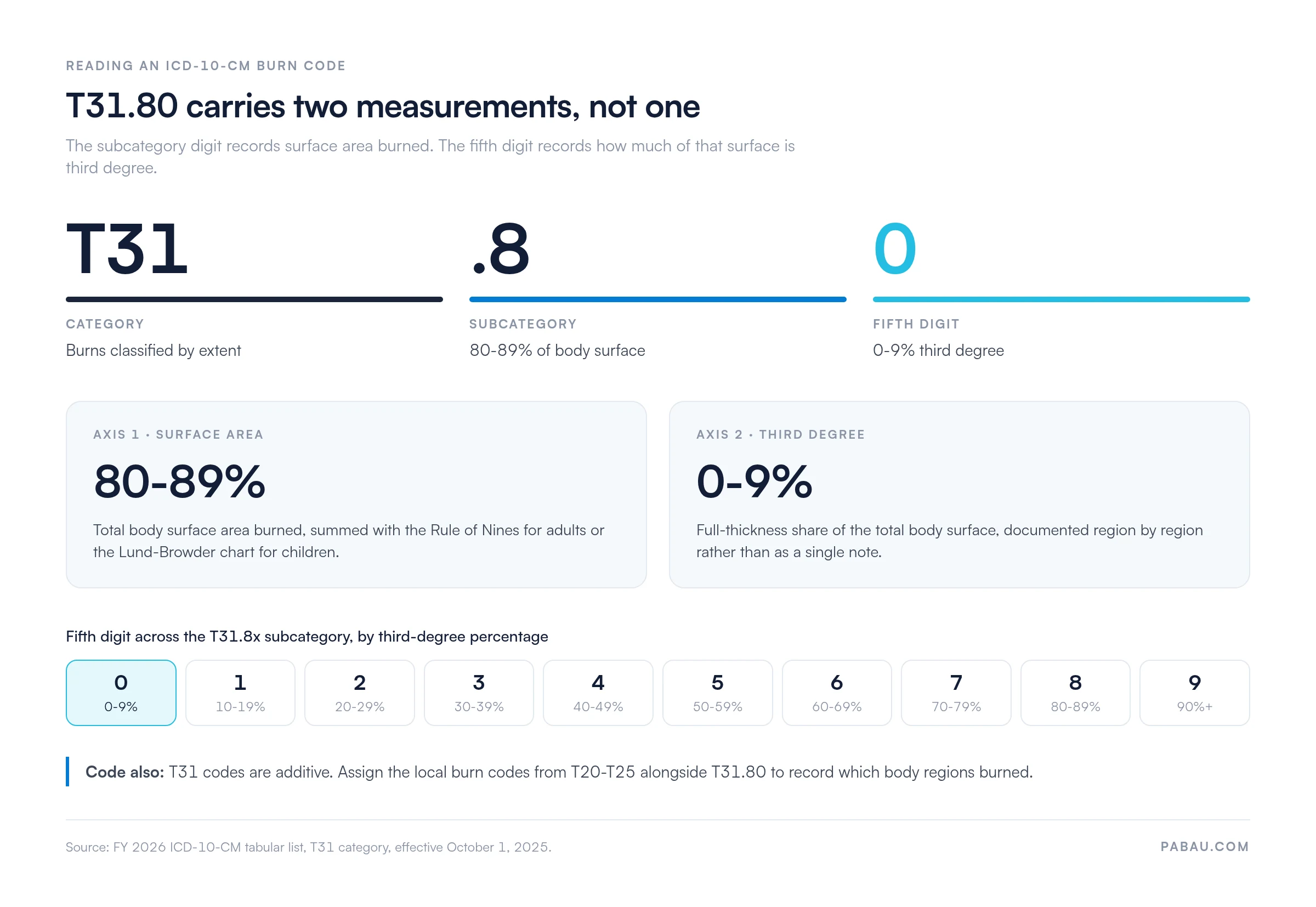
For T31.80, third-degree involvement is 0% to 9% of the total body surface. Most of the burn is superficial or partial thickness. Choosing the wrong fifth digit misrepresents the injury’s severity to clinical reviewers and payers alike.
Within the T31.8x subcategory, the fifth digit reflects the percentage of third-degree burns. Choosing among them requires documented burn depth by region. The neighboring code T31.81 covers the same TBSA band with 10-19% third-degree involvement. Further along that band, T31.83 applies when 30-39% of total body surface is third degree.
Deeper burns move the fifth digit up again, and T31.86 marks 60-69% third-degree involvement in that same TBSA band.
The CMS ICD-10 codes page carries the authoritative tabular list and the annual update files. Those files confirm each code’s validity for the current fiscal year.
Official ICD-10-CM guidelines from CMS and NCHS govern how T31.80 works with other codes. For extensive burns, one rule matters more than the rest. T31 codes are not standalone, and they work alongside the local anatomic burn codes.
Major burn claims carry many codes, and payers scrutinize them closely. Learning which denial codes come back most often on multi-code claims tells you which documentation to tighten first.
Coders working burn cases can also check the AAPC ICD-10-CM code lookup. It carries related guidelines and crosswalks for the whole T31 category.
Document TBSA and burn depth by region separately in the clinical record. A single percentage note without a regional breakdown leaves the coder unable to pick the correct T31.8x digit.
These terms map to T31.80 in documentation and coding reference tools. Each one describes the same clinical picture the code captures:
Notes using any of these phrases support T31.80, provided the record quantifies both figures. The total body surface area has to be there, and so does the third-degree proportion.
Facilities reconciling historical records may need to map T31.80 back to its ICD-9-CM predecessor. The conversion is approximate, because ICD-9 did not capture burn depth percentage at the granularity of the T31.8x structure.
The WHO ICD-10 browser gives the international classification context for burn extent codes. US payer rules then add sequencing layers on top of that base structure.
A total TBSA percentage and a general burn depth note are not enough for accurate T31.80 assignment. The coder needs regional detail to confirm both figures independently. Here is what the clinical record has to contain:
When a clinician writes ‘85% TBSA, predominantly partial thickness with scattered full-thickness areas on the trunk’, ask for the number. ‘Scattered’ is not codeable, and T31.80 needs the third-degree share quantified.
In most practices the burn claim waits on a message. The coder reads “85% TBSA, mostly partial thickness”, cannot see the third-degree share, and emails the clinician. Days pass, and the claim either goes out with a guessed fifth digit or sits unbilled.
Practice management software like Pabau closes that loop inside one record. Structured clinical documentation captures TBSA and depth by region at the point of care, so the figures are in the chart before coding starts. Our claims software for coders then checks each diagnosis code against a built-in ICD-10 catalog at submission.
Claims route electronically to thousands of US payers, and denials come back into the same queue the claim left from. So a coder catches a mistyped T31.8x digit before the payer does, and a burn encounter stops costing weeks of follow-up.


Pabau’s claims tools help burn and trauma practices submit accurate ICD-10 codes. Track denials and keep documentation tidy from first encounter to reimbursement.

Burn coding misses are usually documentation problems rather than coder errors. Once the record separates TBSA from burn depth by region, picking T31.80 over a sibling T31.8x code takes seconds. The work sits upstream, with the treating team.
So the improvement comes from a charting habit upstream of the coder. Ask for the third-degree percentage by region while the patient is still in front of the clinician. Book a demo to see how Pabau captures both burn figures at the point of care.

Need to know what makes a burn claim payable on first submission? Clean claim submission guidelines covers the criteria every claim must meet before adjudication.
Wondering where documentation weaknesses turn into lost revenue? Medical billing compliance explains what payers check on multi-code claims and how to prepare.
Want to see how ICD-10 codes are structured in an electronic claim? 837 electronic claim file guide walks through the diagnosis code segments in an EDI submission.
Getting denials back on complex burn encounters? Denial management in healthcare covers how to work a denial queue without losing the appeal window.
ICD-10 code T31.80 is the billable ICD-10-CM code for burns involving 80-89% of total body surface area, with 0% to 9% third-degree involvement. It sits in the T31 category, which classifies burns by extent rather than anatomic location. The code is valid for the FY 2026 edition, effective October 1, 2025.
Yes, T31.80 is a billable and specific ICD-10-CM code valid for HIPAA-covered electronic transactions. No more specific code is required to use it for diagnosis and reimbursement purposes.
Both codes cover burns involving 80-89% TBSA, but they differ on the second axis. T31.80 applies when third-degree burns represent 0-9% of total body surface, and T31.81 applies at 10-19%. The TBSA range is identical, so only the fifth digit changes.
The Rule of Nines divides the adult body into regions each representing 9% or 18% of TBSA. Coders add the percentages across all burned regions to arrive at the total. If the sum falls between 80% and 89%, and documented third-degree involvement is below 10%, T31.80 is the correct assignment. The Lund-Browder chart is preferred for pediatric patients.
T31.80 may be the principal diagnosis when burn extent is the main reason for the encounter and the documentation supports that. Guidelines also require the local anatomic burn codes from T20-T25 alongside it. Payer rules can change the sequencing order between inpatient and outpatient claims.
The approximate ICD-9-CM equivalent is 948.80, which covered burns of 80-89% of body surface. The mapping is approximate for one reason. ICD-9 did not separately capture the third-degree percentage that the T31.8x fifth digit requires, so crosswalk tables treat it as general-to-specific.