ICD-10 Code S42.444P: Medial epicondyle fracture, right humerus
ICD-10 Code S42.444P: full descriptor and code validity ICD-10 Code S42.444P car...

Last Updated: Oct 13, 2026
Billable Code Specific Code
T30.0 is the billable ICD-10-CM code for burn of unspecified body region, unspecified degree.
So T30.0 belongs on outpatient and emergency department claims, and nowhere else. Miss that, and the claim comes back or draws an audit, because an inpatient burn record needs a site and a degree.
Let Pabau's smart automation suggest the right codes, reduce claim denials, and keep your practice compliant—effortlessly.
Automate repetitive tasks and focus on what matters most—your patients.
Reduce coding errors and ensure compliance with the latest regulations.
Clean claims, fewer denials, and faster reimbursements.
Powerful insights and reporting to help your practice thrive.
HIPAA compliant SOC 2 certified GDPR-compliant Trusted by 4,000+ clinics worldwide

T30.0 is the billable ICD-10-CM code for a burn when the record names neither the body region nor the degree.
CMS keeps T30.0 off inpatient claims. The tabular note reads, “This code is not for inpatient use. Code to specified site and degree of burns.”
Use it only when both the site and the degree are missing from the whole record. If either one appears, a code from T20-T29 applies.
On an inpatient admission, query the provider for site and degree first. A lone T30.0 groups to MS-DRG 935, non-extensive burns.
Four companion codes ride with T30.0. They cover external cause, place of occurrence, activity, and external cause status.
T30.0 carries the official description “burn of unspecified body region, unspecified degree.” It is a billable, specific ICD-10-CM code, valid in HIPAA-covered transactions. The FY2026 edition took effect on October 1, 2025, and runs through September 30, 2026.
The code sits in the injury chapter, S00-T88, inside the burns and corrosions subrange T30-T32. Within that subrange it is the residual code. You reach for it when the note names neither the site nor the depth of the burn. The CMS ICD-10-CM code set confirms both the description and the billable status.
One restriction shapes every decision below. The tabular note reads, “This code is not for inpatient use. Code to specified site and degree of burns.” That puts T30.0 in outpatient and emergency department territory, where the site and the degree are sometimes genuinely missing at billing.
T30 on its own cannot go on a claim. The fourth character is what turns the category into a claim-ready code, so T30.0 is accepted and bare T30 is not. Its sibling T30.4 covers a corrosion of unspecified body region and degree, and it works the same way.
The path from chapter to code is short. The table below sets it out level by level, so you can see where the billable line falls.
Submitting T30 without the fourth character is a standard edit-based rejection, and most clearinghouses catch it before transmission. That parent-to-child pattern repeats across the tabular list, so the same fourth-character check applies to the other ICD-10-CM codes you assign.
T30.0 is a residual code, so both facts have to be absent before it fits. The body region has to be missing and the degree has to be missing, across the whole record. Cross-check the tabular instruction notes in the CDC ICD-10-CM web tool before you assign it.
One practical exception sits in the emergency department. Coders there sometimes handle records for patients brought in unconscious, where the first note says only “burns”. T30.0 can carry that initial encounter while the examination is pending. Drop it the moment the record gains a site or a degree before billing.
Provider notes rarely use the tabular wording, so the alphabetic index carries a set of accepted synonyms that land on T30.0. Recognizing them keeps a coder from hunting for a code that does not exist, or from picking a specific one the record cannot support.
Most EHR systems surface these as auto-suggest options, which is part of why T30.0 gets overused. If the note uses one of them and adds nothing else, T30.0 is the right call on an outpatient or emergency department claim.
The ICD-10-CM Official Guidelines require external cause reporting alongside any burn code, and T30.0 is no exception. A missing external cause code is the most frequent reason a burn claim comes back. Good denial management starts with catching that omission before submission.
Four code categories belong on the claim with T30.0:
Sequencing is straightforward. The burn code leads, and the external cause codes follow it. Never pair T30.0 with a site-specific code from T20-T29 for the same injury, because the two statements contradict each other.
A payer-specific checklist for those four categories cuts front-end edits sharply. Some Medicare contractors single out burn claims with missing external cause codes during probe reviews, so the checklist earns its keep twice.
Treat T30.0 as the last resort in burn coding rather than the first option. Any detail that specifies the burn moves the assignment to T20-T29, and those codes are both more accurate and usually better reimbursed.
The table below shows what the record has to capture, and which way each element pushes the code.
Structured burn assessment forms are the cheapest fix here. Prompt the provider for body region and degree at the point of care, and most cases move off T30.0 inside a quarter.
T30.0 sits inside a family of codes that classify burns by site, by degree, and by total body surface area. One rule runs through all of them, which is to code to the highest level of specificity the documentation supports.
The reference table maps the codes you will be choosing between most often.
When a TBSA percentage is documented alongside a T30.0 case, add the matching T31 code as a secondary. The AAPC’s ICD-10-CM code lookup tool lists the full T20-T32 range with the tabular notes attached to each code.
Assign the most specific code the documentation supports. That one rule settles most burn cases. The flow below runs it as three questions in order, starting with the one that rules T30.0 out entirely.
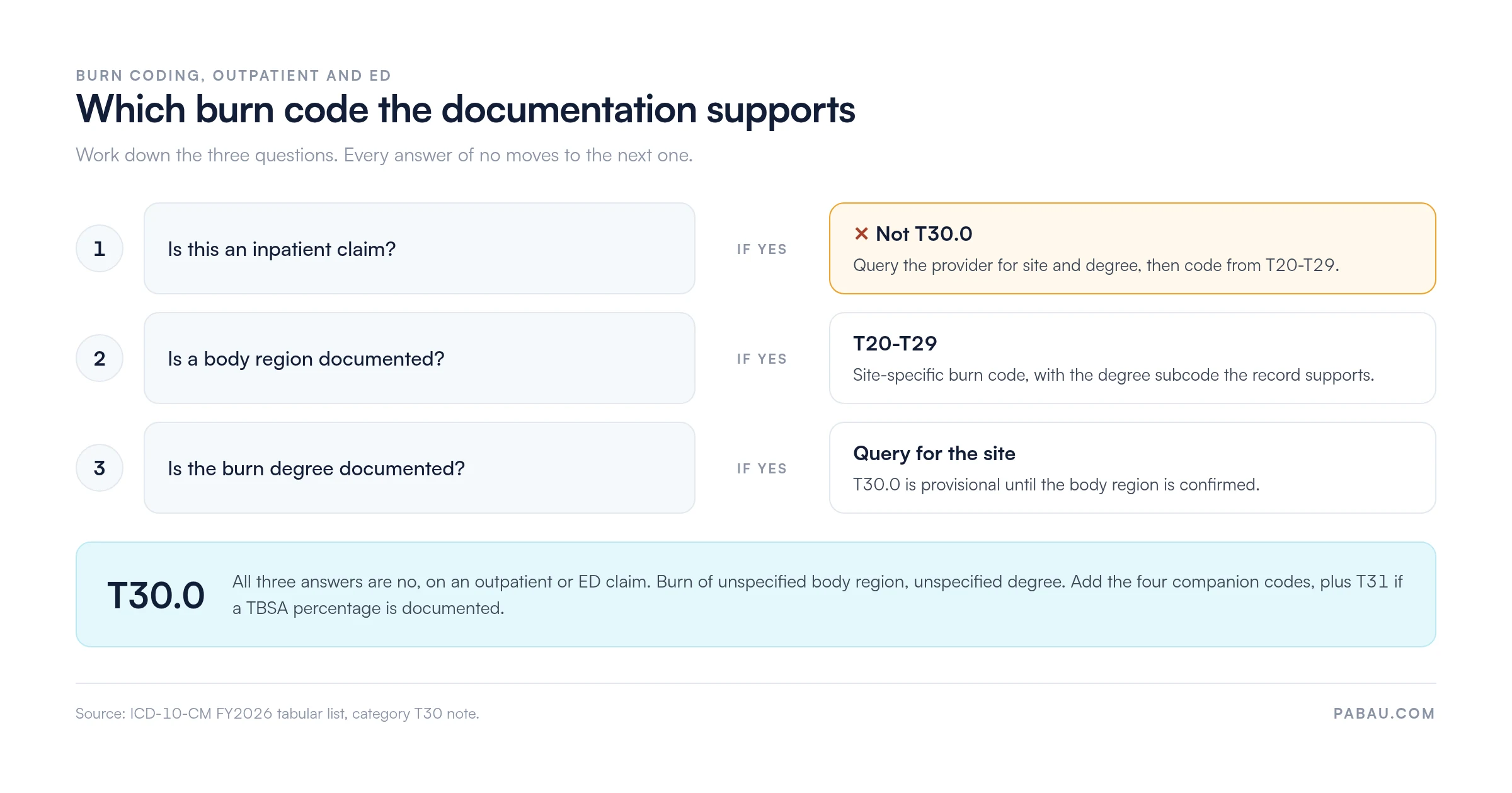
The scenarios that turn up in practice map onto that logic as follows.
Present on admission (POA) reporting never applies to a correctly coded T30.0. POA indicators are an inpatient requirement under the Medicare Inpatient Prospective Payment System, and the tabular list keeps T30.0 off inpatient claims.
That makes the choice of POA indicator a moot question on a clean claim. When a burn admission arrives without a site or a degree, the answer is a provider query rather than a POA value. The FY2026 Official Guidelines call category T30 extremely vague and say it should rarely be used.
Errors still slip through. A coder who assigns T30.0 on an inpatient record has to put something in the POA field, and abstraction software will accept it. The table sets out what each indicator means, and what it signals when T30.0 turns up on an inpatient claim.
An auditor reads a T30.0 with a POA indicator as a documentation problem, because the code should not be on the claim at all. Fix it upstream instead. Route unspecified burn admissions into a query workflow before the coder ever reaches the POA field.
MS-DRGs are an inpatient payment system, so T30.0 should never drive one. Treat any T30.0 on an IPPS claim as a coding error to unwind, not a grouping to work with.
It still helps to know where the code lands, because that is what missing specificity costs. A lone T30.0 sits in major diagnostic category (MDC) 22, burns, and groups to MS-DRG 935, non-extensive burns. That is the lowest-weighted DRG in the category.
The code carries no site, no degree, and no total body surface area, so the grouper has nothing to weight the stay with. MDC 22 holds six burn DRGs, and every other one needs documentation that T30.0 does not carry.
The distance between 935 and 934 is the price of a missing degree. A query that confirms a full thickness burn moves the case, and a query that confirms a site moves it out of T30.0 altogether.
Check current weights against the CMS FY2026 MS-DRG Definitions Manual before you use them for reimbursement modeling.
The most common mistake is also the simplest, which is putting T30.0 on an inpatient claim. The tabular note rules it out, so the code should never reach an IPPS bill in the first place.
Five errors account for most of the rework on burn claims:
Two minutes of checking prevents most T30.0 rework. Work down the list before the claim leaves the practice.
Here is how that plays out. An urgent care note reads “dressing change, burn injury, healing well”, with no site, no degree, and no TBSA. The coder queries and the provider adds nothing further.
T30.0 is correct here. It goes out with an X-code for the flame source, plus Y92, Y93, and Y99 for the place, the activity, and the patient’s status.
A burn claim coded to T30.0 has to meet the same clean claim standard as any injury code. The companion codes have to be on the form before it goes out. Missing supplemental codes are one of the top edit reasons clearinghouses flag on injury claims.
Practice management software like Pabau closes that loop in one place. Pabau’s claims management software connects the clinical note, the code assignment, and the submission.
Claims then go out as CMS-1500 and 837P files through its Claim.MD integration, which reaches thousands of payers. Code validation runs before the claim leaves the practice, so a missing companion code surfaces while you can still fix it.
Real-time eligibility checks and electronic remittance advice (ERA/835) then match each payment back to the claim that earned it. When a burn claim underpays, you see it against the expected amount rather than finding it a month later in a reconciliation.
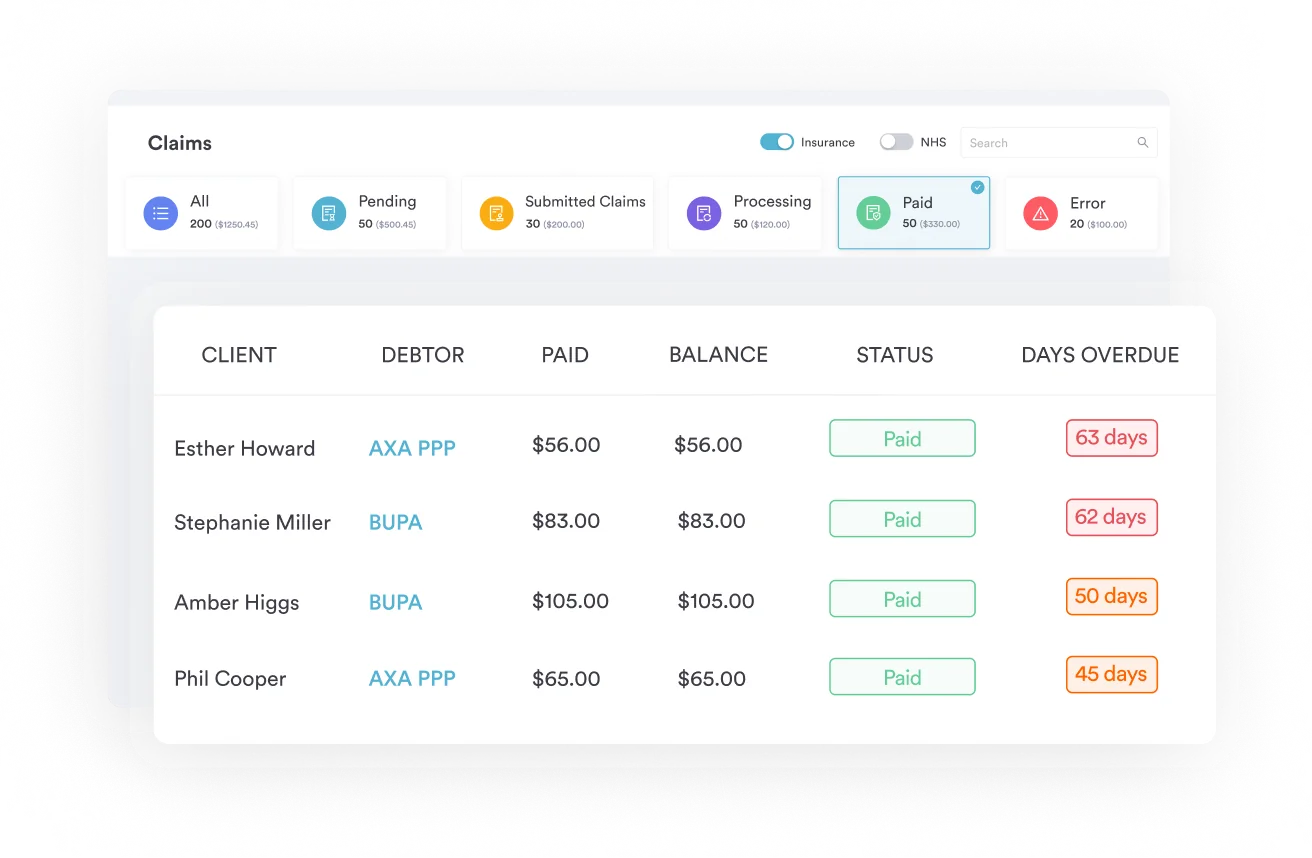

Pabau connects the clinical note, ICD-10 code assignment, and claim submission in one workflow. Code validation runs before the claim leaves the practice, so companion codes are not the reason it comes back.

T30.0 is a legitimate code with a narrow job. It belongs on outpatient and emergency department claims where the record genuinely says nothing about the site or the degree, and nowhere else. On an inpatient record, CMS expects a query and a code that names both.
So every T30.0 that could have been a T20-T29 code points back at documentation rather than at coding. Fix it upstream. Structure burn documentation at the point of care, run a consistent query process for thin notes, and let pre-submission edits catch the companion codes.
Accuracy on a code like this one is a billing habit more than a coding skill. Pabau keeps documentation, coding, and claim submission in one workflow, so the check happens before the claim goes out.
Book a demo to see how a burn claim moves through it from note to payment.

Need guidance on burn injury billing compliance? Medical billing compliance covers the key regulatory requirements for accurate injury code submission.
Want to understand how clearinghouses process ICD-10 claims? Claim.MD clearinghouse guide explains how electronic claims are validated and routed to payers.
Looking for denial management strategies for injury codes? Denial management in healthcare outlines workflows for tracking and appealing common burn claim denials.
Interested in clean claim best practices? Clean claim requirements breaks down what payers check before processing any ICD-10-CM claim.
No. T30.0 is complete at four characters, so no seventh character for the encounter applies. Site-specific burn codes in T20-T25 do take one, which trips up coders moving between the two families. Adding a seventh character to T30.0 creates an invalid code, and the claim rejects.
No. Sunburn is excluded from the burns and corrosions block and belongs in L55, alongside the other radiation-related skin disorders. T30.0 covers thermal, chemical, electrical, and friction burns where the record names no site or degree. Read the exclusion note before you assign either one.
The General Equivalence Mappings pair T30.0 with ICD-9-CM 949.0, burn of unspecified site, unspecified degree. That mapping still matters for old claims, workers’ compensation files, and legacy data. Treat it as a reference tool, not as a substitute for the current tabular list.
Read the denial reason first, because two causes dominate. Either a companion code is missing, or the code landed on an inpatient claim. A missing external cause code is a corrected claim. An inpatient T30.0 needs a provider query, then a resubmission with a code from T20-T29.