ICD-10 Code Y76.0: Diagnostic obstetric and gynecological devices
ICD-10 Code Y76.0: Definition and billable status ICD-10 Code Y76.0 is a valid, ...

Last Updated: Oct 23, 2026
Billable Code Specific Code
T25.529D is the billable ICD-10-CM code for corrosion of first degree of unspecified foot, subsequent encounter. It covers follow-up care for a superficial chemical burn of the foot while it heals, when the record doesn't say which foot.
The code sits in T25.5, first-degree corrosion of ankle and foot. Use T25.521D or T25.522D once laterality is documented, and T25.529A while active treatment is still under way.
Let Pabau's smart automation suggest the right codes, reduce claim denials, and keep your practice compliant—effortlessly.
Automate repetitive tasks and focus on what matters most—your patients.
Reduce coding errors and ensure compliance with the latest regulations.
Clean claims, fewer denials, and faster reimbursements.
Powerful insights and reporting to help your practice thrive.
HIPAA compliant SOC 2 certified GDPR-compliant Trusted by 4,000+ clinics worldwide

T25.529D is a fully billable ICD-10-CM code; its parent T25.529 is non-billable and will be rejected if submitted without the D suffix.
The D suffix means subsequent encounter: active treatment has ended and the patient is receiving routine wound care or monitoring during the healing phase.
T25.529D applies only when documentation does not specify left or right foot; T25.521D (right) or T25.522D (left) must be used when laterality is documented.
Sequence a T51-T65 code for the chemical and intent ahead of T25.529D. Place, activity and status codes (Y92, Y93, Y99) belong on the initial encounter only.
ICD-10 Code T25.529D is the billable code for a follow-up visit for a first-degree chemical burn of the foot, side not documented. The table below lists the fields to confirm in a first-pass claim check.
T25.529D is built from five components, each carrying specific clinical and billing information. Misreading any one of them is how claims go wrong. The breakdown below shows which neighboring code you land on when a single character changes.
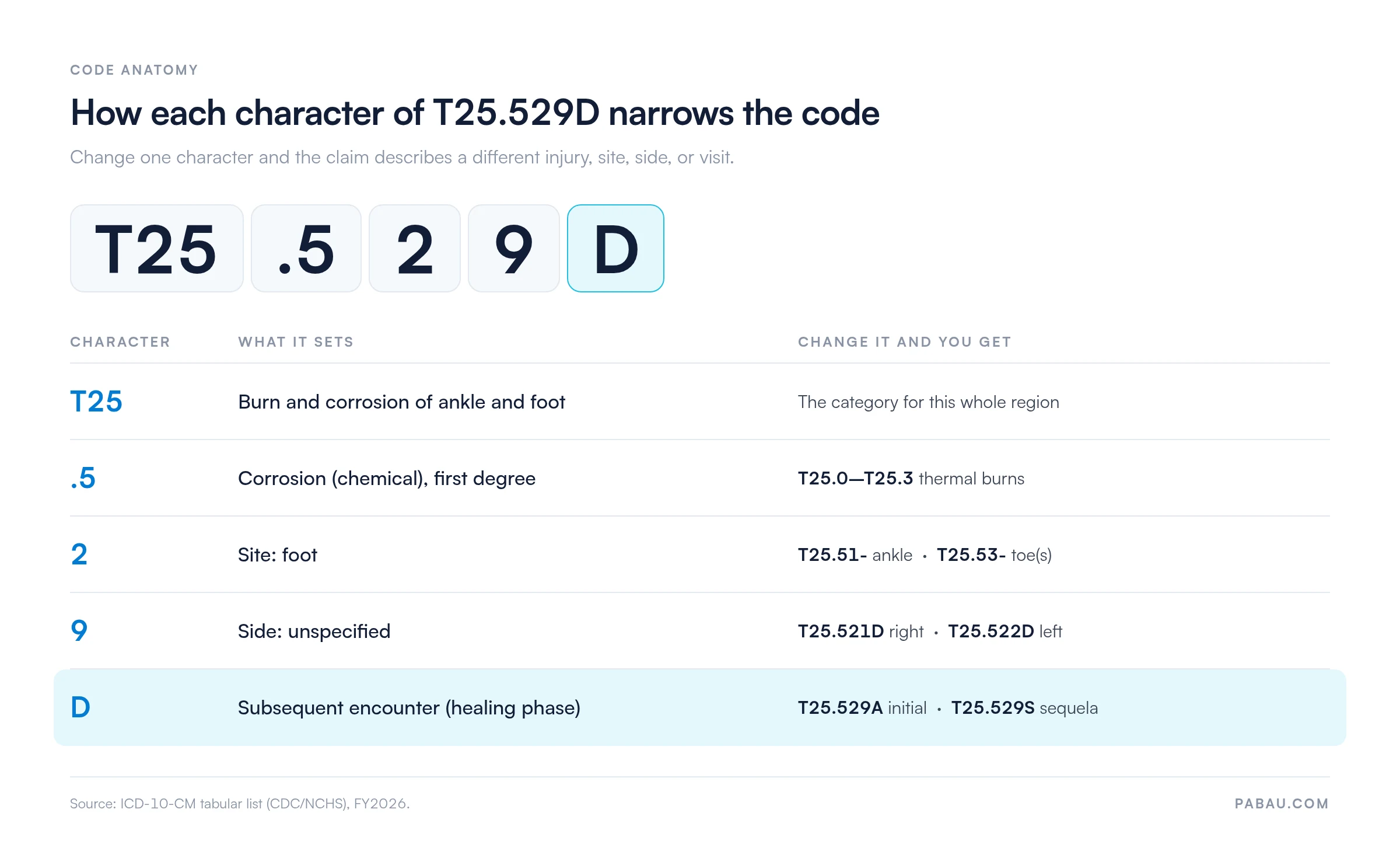
The CDC/NCHS ICD-10-CM web tool allows coders to look up the official descriptor and validity status by fiscal year before submitting any claim. Always verify against the current-year tabular list.
Yes, T25.529D is a fully billable ICD-10-CM code for FY2025 and FY2026. The key distinction to lock in: T25.529 (without the 7th character) is a non-billable header code. Submitting T25.529 on a claim produces an automatic rejection because the code is incomplete. T25.529D, with the D suffix attached, is the billable version.
A corrosion is a chemical or caustic injury, not a thermal burn. ICD-10-CM draws a hard line between the two, and crossing it generates a denial.
Thermal burns (heat, flame, scalding liquid) fall under T25.0 through T25.3. Chemical corrosions (acids, alkalis, caustic agents, and some topical medications applied inadvertently) fall under T25.4 through T25.7, with first-degree corrosions in T25.5. T25.529D is always a chemical injury.
If the clinical record shows a heat source caused the injury, this code is wrong and a burn code in the T25.0-T25.3 range is correct.
The tabular list, published alongside the CMS ICD-10 coding guidelines, makes the chemical explicit. Every T25.5 code carries a “code first” note for a T51-T65 code naming the substance and the intent. Coding a chemical injury as a thermal burn, or vice versa, is a coding error that may trigger an audit.
The D suffix in ICD-10 Code T25.529D means the patient is in the healing phase. The injury has been actively treated, and the patient is returning for wound care or monitoring. The provider is no longer delivering active treatment for the acute injury itself.
The ICD-10-CM Official Guidelines define three encounter types for injury codes. Coders need to select the correct suffix for every visit, not just the first one.
One common error: using T25.529A (initial encounter) when the patient is returning for their third dressing change. If active treatment has ended, D is the correct suffix regardless of how many visits have occurred. The suffix reflects the nature of the care being delivered, not the visit count.
T25.529D is the correct code only when documentation does not specify left or right foot and the encounter is a follow-up visit. Several adjacent codes are frequently confused with it.
ICD-10-CM coding guidelines require coders to use the most specific code available. If the provider documented “right foot,” T25.521D is required. Using T25.529D when laterality is documented is a specificity error some payers now flag in automated edits. Query the provider if laterality is unclear rather than defaulting to unspecified.
You can look up neighboring injury codes in our diagnostic codes library.
T25.529D rarely goes on a claim alone. The tabular list requires a chemical code ahead of it, while the Y-code supplements depend on which encounter you are billing.
External cause codes never take the first-listed position on a claim. The AAPC’s ICD-10-CM code ranges show where each of these supplementary categories sits.
Check each payer’s billing policy for T25 codes before submitting. On a follow-up claim, give the T51-T65 chemical code the same D 7th character as T25.529D, so the pair reads as one subsequent encounter.
Thorough documentation is what separates a clean claim from a denied one. For T25.529D, the clinical record must support every component of the code before a biller submits it.
Supporting billing compliance documentation for T25.529D requires all of the following elements in the encounter note:
Practices that submit electronic claims through Claim.MD can run pre-submission edits that flag missing diagnosis components before the claim reaches the payer. Paired with structured clean claim submission workflows, a missing detail gets caught at the point of care, not after a denial.
Claims for T25.529D get denied in predictable patterns. Understanding each denial type makes remediation straightforward.
Effective denial management workflows track these patterns across claims and flag systemic coder errors before they compound across a billing cycle.
First-degree corrosions are superficial injuries. They rarely need surgical debridement or complex wound management. The CPT codes paired with T25.529D reflect outpatient wound care and evaluation visits rather than surgery. A routine follow-up is often billed as 99213, with 99214 kept for more complex decision-making.
The following CPT codes are commonly associated with T25.529D in wound care and outpatient settings. Each code depends on what the provider performed. These are illustrative pairings, not universal requirements. For background on how these codes interact with payers, see our guide to medical billing fundamentals.
Several foot injuries look like a first-degree corrosion but are classified elsewhere. Rule each one out before finalizing T25.529D.
Chemical burns from a topical medication applied by mistake are one edge case. An acid-based corn or callus treatment on the wrong area of the foot is a typical example. It may still fall under T25.529D when the injury is first-degree, the foot is affected, and the encounter is a follow-up.
The WHO ICD-10 browser provides the underlying classification hierarchy for reference when coding edge cases.
Most T25.529D errors start in one of two places. Either the visit note misses a detail the code needs, or the claim goes out without a pre-submission check. Pabau’s claims management software, part of the practice management platform we build, covers both.
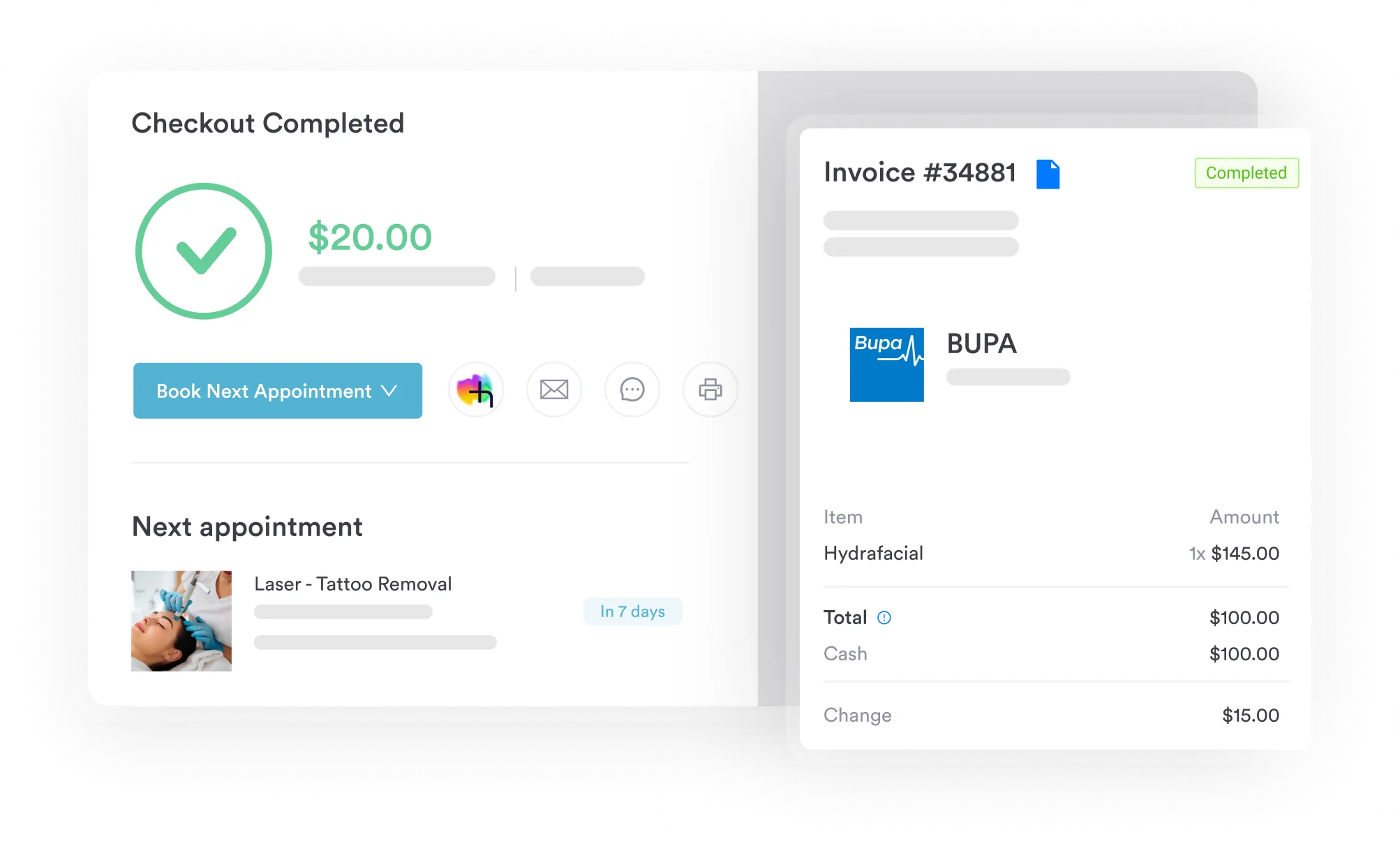
The platform’s pre-submission claim review flags incomplete diagnosis code sequences before a claim leaves the practice. A missing 7th character, a non-billable parent code, or a missing T51-T65 chemical code gets caught in-house instead of coming back as a payer denial.
Treatment note templates prompt providers to record the chemical agent, severity, side, and encounter type. Those details decide whether T25.529D or one of its sibling codes is correct.
Practices that route US claims through Claim.MD’s clearinghouse, which integrates with Pabau, also get eligibility checks and claim edits before transmission. That cuts corrosion code denials caused by submission errors.

Pabau’s claims management tools catch coding errors before they reach your payer. See how structured documentation and pre-submission edits cut corrosion code denials.

Rebuild T25.529D from the note at every visit instead of copying it forward from the last claim. The side, the encounter type and the chemical code can all change between the first presentation and the last dressing change.
If the note names a foot, switch to T25.521D or T25.522D. If active treatment is still under way, bill T25.529A. Sequence the T51-T65 chemical code first each time, and leave the Y92, Y93 and Y99 codes on the initial claim.
The trade-off is a short check per claim against a denial you would otherwise rework weeks later. Book a demo to see how Pabau flags incomplete corrosion codes before your follow-up claims reach the payer.

Need to understand how clearinghouse claims work? Medical claims clearinghouse overview explains how electronic claims move from practice to payer and where coding errors surface.
Seeing repeated denials across your billing team? Denial codes in medical billing breaks down the most common CARC reason codes and how to respond to each one.
Looking for electronic remittance guidance? Electronic remittance advice (ERA) covers how 835 transactions map denial reasons back to specific claim lines, including ICD-10 mismatches.
ICD-10 Code T25.529D is the billable diagnosis code for corrosion of first degree of unspecified foot, subsequent encounter. It applies when a patient returns for wound care or monitoring while a chemical foot injury heals. The code is valid for FY2025 and FY2026. CMS and the National Center for Health Statistics (NCHS) maintain the ICD-10-CM classification.
Yes. T25.529D is a fully billable ICD-10-CM code. Its parent T25.529 (without the 7th character) is a non-billable header code that produces an automatic claim rejection when submitted to a payer. The D suffix is what makes the code complete and billable.
T25.529A (initial encounter) is used when the patient is receiving active treatment for a first-degree chemical foot corrosion for the first time. T25.529D (subsequent encounter) is used when active treatment has ended and the patient is returning for routine wound care or healing monitoring. The suffix reflects the nature of the care delivered, not the number of visits.
In ICD-10-CM, a burn is a thermal injury caused by heat, flame, or scalding liquid. For the ankle and foot, burns are coded in T25.0-T25.3. A corrosion is a chemical or caustic injury caused by acids, alkalis, or caustic agents and is coded in T25.4-T25.7. T25.529D is always a chemical injury. Selecting the wrong category is a coding error that may trigger a payer audit.
T25.529D is appropriate only when the clinical documentation does not specify left or right foot. When laterality is documented, coders must use T25.521D (right foot) or T25.522D (left foot). ICD-10-CM guidelines require the most specific code the documentation supports, and some payers now flag T25.529D when laterality information is present in the record.
Use T25.529D when the patient is in the healing phase and receiving routine care for the active corrosion injury. Use T25.529S when the corrosion itself has resolved and a late effect is now the reason for the visit. Scarring, contracture, and chronic pain are typical examples. Sequela coding always pairs the S-suffix injury code with a code for the specific late-effect condition.
Sequence a toxic-effect code from T51-T65 first, to identify the chemical and the intent. Corrosive agents usually fall under T54. Place of occurrence (Y92), activity (Y93) and external cause status (Y99) codes are reported only once, at the initial encounter. They do not belong on a T25.529D claim.