ICD-10 code S61.201A: Open wound of left index finger without nail damage
ICD-10 code S61.201A covers a left index finger wound of unstated type ICD-10 co...

Last Updated: Oct 16, 2026
Billable Code Specific Code
T22.629S is the billable ICD-10-CM code for corrosion of second degree of unspecified elbow, sequela. It covers a partial-thickness chemical burn of the elbow at a late-effect encounter. The record names the elbow but not the side.
Two details decide whether the code is right. The 7th character S applies once the corrosion has healed and the patient returns for what it left behind. The 9 in the 6th position records an undocumented side, so it never stands for the left elbow.
Let Pabau's smart automation suggest the right codes, reduce claim denials, and keep your practice compliant—effortlessly.
Automate repetitive tasks and focus on what matters most—your patients.
Reduce coding errors and ensure compliance with the latest regulations.
Clean claims, fewer denials, and faster reimbursements.
Powerful insights and reporting to help your practice thrive.
HIPAA compliant SOC 2 certified GDPR-compliant Trusted by 4,000+ clinics worldwide

ICD-10 code T22.629S is billable and valid for FY 2026. It covers corrosion of second degree of unspecified elbow, sequela.
The site is the elbow, not a generic upper limb. In T22.6-, the 5th character carries the site and the 6th carries laterality.
The 9 does not mean left. Left elbow is T22.622S and right elbow is T22.621S, so use those whenever the chart names a side.
Sequencing runs the other way round from what most coders expect. The residual scar or contracture is listed first, and T22.629S follows it.
Practice management software like Pabau submits claims straight from the patient record, and checks insurer membership and authorization details first.
ICD-10 code T22.629S is a billable, specific ICD-10-CM diagnosis code, valid for FY 2026 claims. Its official descriptor reads Corrosion of second degree of unspecified elbow, sequela.
Four elements define it. The mechanism is corrosion, which ICD-10-CM uses for a chemical burn rather than a thermal one. The depth is second degree, meaning blisters and partial-thickness loss.
The site is the elbow. The encounter type is sequela, so the patient is being treated for a late effect of the corrosion rather than for the corrosion itself.
Laterality is the one element the code does not carry. That final 9 before the S tells the payer the record never named which elbow. It does not stand for the left side, and reading it that way causes the most common error on this code.
Read the code one character at a time and the ambiguity disappears. The T22.6- subcategory splits site and laterality across two positions. A coder who treats the 6th character as part of the site description lands on the wrong limb.
That 5th character runs through the whole T22.6- subcategory in a fixed order:
When the 5th character is 0, the site is unknown. There is no side to report, so ICD-10-CM inserts a placeholder X in the 6th position, giving T22.60XS.
Read T22.629S from the right instead of the left. The last character is the encounter type. The one before it is the side, and the one before that is the body part. Coders who read left to right tend to absorb the phrase corrosion of second degree of, then stop reading closely. That is how an elbow code ends up described as a shoulder code in a chart note or a payer appeal.
Each level narrows the clinical picture until the fully specified child code is reached. Walking the ladder takes seconds, and it catches a parent code that slipped onto the claim in place of the billable one.
T22.629 is a six-character subcategory and is not billable on its own. Every code in category T22 requires a 7th character, so a claim carrying T22.629 without A, D, or S is rejected as invalid.
S marks a sequela encounter. The patient is being treated for a condition the earlier corrosion left behind, rather than for the corrosion itself.
The FY 2026 ICD-10-CM Official Guidelines for Coding and Reporting are explicit in Section I.C.19.a. The S is added only to the injury code, never to the sequela code. The type of sequela is sequenced first, and the injury code follows it.
Section I.C.19.d.7 then confirms that late effects of burns and corrosions are what the S character is built for, scars and joint contractures included. Leaving the A character on a scar revision months after the original burn is a frequent slip.
The line between D and S causes most of the confusion, so here is what each character actually covers.
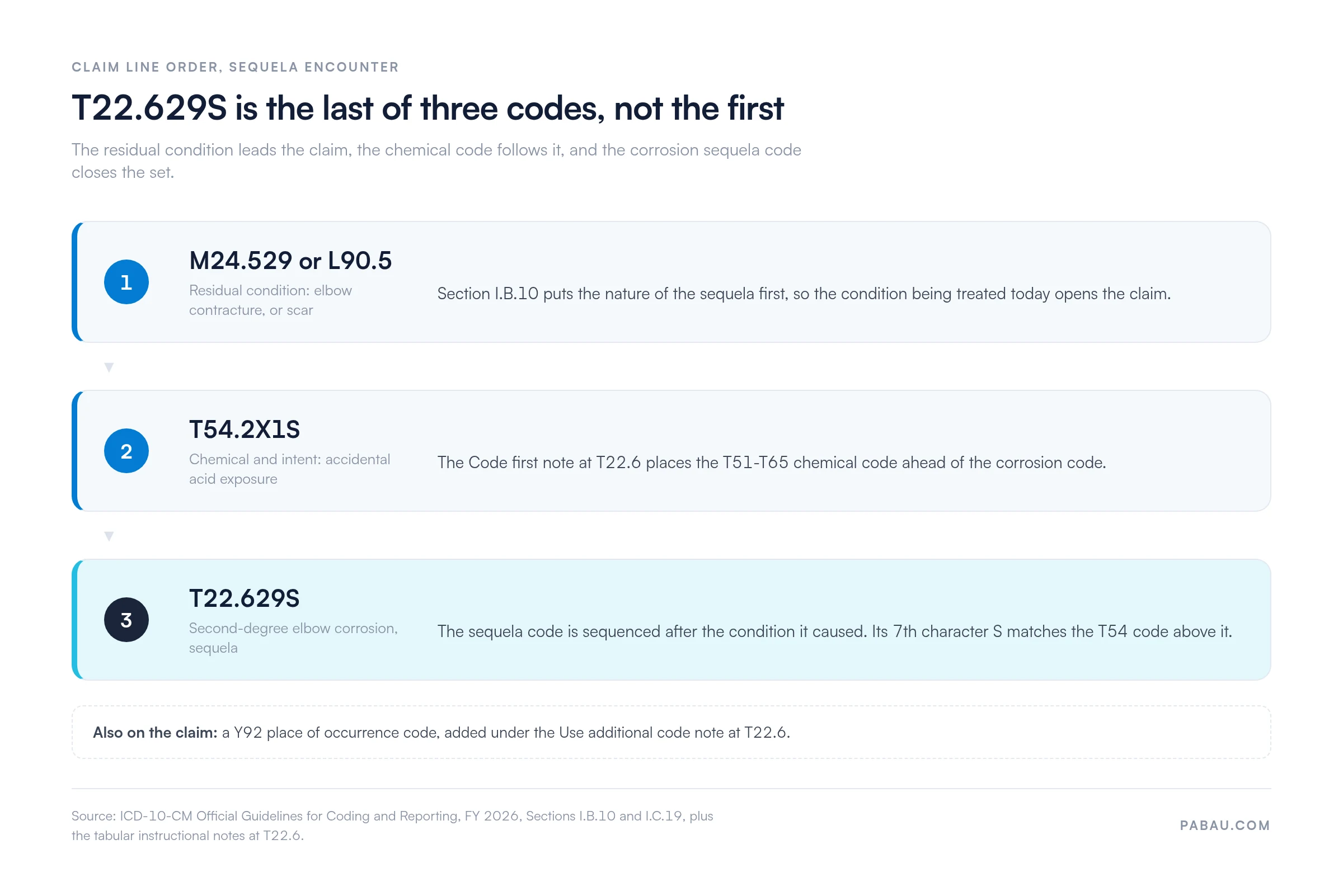
Sequencing is where this code goes wrong most often. Section I.B.10 says that coding a sequela usually takes two codes. The condition or nature of the sequela is sequenced first, and the sequela code second.
T22.629S is the sequela code, so the residual condition leads the claim. That is M24.529 for a contracture of the unspecified elbow, or L90.5 for scar conditions and fibrosis of skin. Which one leads depends on what is being treated today.
Add the Code first note at T22.6 and the finished claim looks like this.
Document the causal link in the clinical note, not just the finding. Write that the contracture is a direct late effect of a chemical corrosion sustained on a named date. Payers reviewing sequela claims look for that link. It is also what justifies putting the contracture code ahead of T22.629S on the claim.
The three sibling codes share one descriptor and differ only in the 7th character. Which one applies depends on where the patient is in their recovery.
One nuance gets missed. The D code covers routine follow-up during healing, and it is not a sequela code. Once the corrosion has healed and the visit is only about what it left behind, the character switches to S.
Section I.C.19.d.8 also allows two of them on one record. Say a patient has a fresh corrosion on one arm and an old scar on the other. That record carries an A or D code alongside an S code.
ICD-10-CM attaches notes at the block, the category, and the subcategory, and all of them reach this code. Includes notes define the terms, Excludes2 notes name what may be reported alongside it, and Code first notes fix the order.
The Code first note at T22.6 requires a code from T51-T65 that identifies the chemical and the intent. Leaving it off is one of the most common reasons corrosion claims get flagged by payers.
For corrosive substances, that range narrows to category T54, toxic effect of corrosive substances. These are combination codes. The 6th character carries the intent, with 1 for accidental, 2 for intentional self-harm, 3 for assault, and 4 for undetermined.
Because intent is built in, Section I.C.19.e confirms that no separate external cause code is needed for the substance itself. A place of occurrence code from Y92 is still added under the Use additional code note at T22.6.
Key rule: both codes describe the same encounter, so the T54 code carries the same 7th character as the corrosion code. On a sequela claim that means S on both, giving a pairing such as T54.2X1S with T22.629S.
T22.629S sits in a family of codes that share the elbow site but differ in laterality, in depth, or in mechanism. The first two rows are the ones to reach for whenever the record names a side.
That last row is worth holding on to. T22.60XS covers a record that never says which part of the limb was burned. T22.629S covers a record that names the elbow but not the side.
Depth and side are chosen independently, so a documented side moves the third-degree codes too. A record naming the right elbow with full-thickness loss reports T22.721S, not T22.729S.
Where the sub-site is something other than the elbow, the code moves to the matching 5th character, such as T22.619S for the forearm. Our ICD-10-CM code index lists the rest of the T22 family, and the CDC and NCHS ICD-10-CM web tool handles a quick one-off lookup.
Corrosion is the ICD-10-CM term for a chemical burn. Thermal, electrical, and radiation injuries belong to the burn codes instead. The official guidelines put it plainly. Corrosions are burns due to chemicals, and the coding rules for both are the same.
Second degree means partial-thickness injury involving the epidermis and the superficial dermis. The Includes note at the head of the T20-T25 block defines the three depths in terms a coder can match to a chart:
Depth comes from the clinical findings documented at the encounter. The chemical involved and its concentration do not decide it.
The elbow is one of seven named sites inside T22. That category spans the shoulder and upper limb, but stops short of the wrist and hand. A corrosion that crosses from the elbow into the forearm is coded to the site the provider documents. Injuries confined to the wrist or hand belong in T23.
The same logic runs through the lower-limb categories. Where the record names an ankle corrosion sequela but gives neither depth nor side, the code is T25.419S.
Unspecified laterality reflects what the record failed to say, and it is never a coding preference. Section I.B.13 says codes for the unspecified side should rarely be used. They apply only where the record cannot establish the side and clarification cannot be obtained. The guideline also allows the side to come from clinicians other than the provider. A nursing note naming the right or left elbow moves the claim to T22.621S or T22.622S.
The note, the code sequence, and the companion codes all have to agree before the claim goes out. These five checks, run in order, catch the errors behind most denials on this code.
From there the claim travels the usual route. It leaves the practice for the clearinghouse, reaches the payer, and comes back as a remittance.
Seventh-character mismatches tend to surface at that last step. The denial reason points at an invalid code combination when the chemical and injury codes disagree. A steady denial management routine catches the pattern early, before it turns into a stack of unpaid balances.
Most practices code a corrosion sequela in two places at once. The clinical note sits in the patient record, the code list sits in a browser tab, and the claim is built in a third system.
Each switch between them is a chance to lose a documented side. It is also how the S slips off one code and not the other.
Pabau, practice management software for medical and aesthetic practices, keeps the record and the claim in one system. Its claims software for practices builds the claim straight from the patient record. Insurer membership and authorization details are checked before that claim is submitted.
The result is fewer corrections after the fact. A laterality or sequencing error shows up while the chart is still open. The provider is still there to answer a query, so the fix happens before the claim goes out.

Pabau builds claims straight from the patient record, and checks insurer membership and authorization details before submission. See how it works for practices treating burn and wound patients.

T22.629S describes a second-degree chemical burn of the elbow, seen at a late-effect visit, on a record that never named the side.
Two mistakes account for most of the trouble it causes. The 9 gets read as left when it only ever means unspecified. The code gets sequenced first when the guidelines put the scar or the contracture ahead of it.
Both start as documentation problems, so the fix sits upstream of the claim. Query the side while the chart is still open, and the unspecified code stops appearing on claims that never needed it. Book a demo to see how Pabau builds burn and wound claims from the patient record.

Working through denials on injury codes? Denial management in healthcare covers the most common denial patterns and how to resolve them systematically.
Want to see how an ICD-10 claim reaches the payer? How the Claim.MD clearinghouse works explains the electronic submission path from practice to payer.
Need the documentation behind a clean claim? Superbill documentation requirements outlines what practices need to include to support clean claim submission.
Checking your coding process against the rules? Medical billing compliance sets out the checks that keep coded claims defensible on audit.
No. ICD-10-CM sets no waiting period and no cut-off date. The S character applies as soon as active treatment ends and a residual condition remains, whether that is two months later or two years.
Code each side separately, using T22.621S for the right elbow and T22.622S for the left. T22.6- carries no bilateral option, so one code cannot cover both sides.
No. The 7th character reports the phase of care, not the provider. A practice seeing the patient for the first time still uses S when it treats the late effect of a healed corrosion.
No. It names the cause of the problem, while the residual condition code carries the medical necessity for whatever is being treated. Keep the contracture or scar code first-listed and T22.629S second.
No. The sequela character reports a condition the injury left behind. With no residual problem to treat, there is no sequela to report, so T22.629S does not belong on the claim.