ICD-10 code I27.20: Pulmonary hypertension, unspecified
ICD-10 code I27.20 covers PH with no stated type or cause ICD-10 code I27.20 is ...

Last Updated: Nov 18, 2026
Billable Code Specific Code
S99.011G is the billable ICD-10-CM code for Salter-Harris Type I physeal fracture of right calcaneus, subsequent encounter for fracture with delayed healing.
It describes a child or adolescent whose fracture through the heel bone's growth plate is healing more slowly than expected after active treatment. The 7th character G separates this visit from routine healing (D) and from nonunion (K), so the provider's note has to state the healing status.
Let Pabau's smart automation suggest the right codes, reduce claim denials, and keep your practice compliant—effortlessly.
Automate repetitive tasks and focus on what matters most—your patients.
Reduce coding errors and ensure compliance with the latest regulations.
Clean claims, fewer denials, and faster reimbursements.
Powerful insights and reporting to help your practice thrive.
HIPAA compliant SOC 2 certified GDPR-compliant Trusted by 4,000+ clinics worldwide

ICD-10 code S99.011G reports a Salter-Harris Type I growth plate fracture of the right calcaneus at a follow-up visit where healing is delayed.
The code sits in S99.0-, physeal fracture of the calcaneus, so it never describes a metatarsal. A displaced right first metatarsal fracture with delayed healing is S92.311G.
The 5th character sets the Salter-Harris type and the 6th sets the side. S99.012G is the left heel and S99.019G is an unspecified side.
G applies only after active treatment, when the provider documents slower healing than expected. Nonunion is K, and a late first visit is still A.
Report the physeal fracture code alone. The official guidelines say not to add a separate code for the bone, such as one from S92.0-.
ICD-10 code S99.011G is the billable code for a Salter-Harris Type I fracture of the right calcaneus at a follow-up visit with delayed healing. The CDC’s FY2027 ICD-10-CM tabular list places S99.011 under physeal fracture of calcaneus, with G for delayed healing. It is a billable, specific code in category S99. It applies to a child or adolescent whose heel bone growth plate is still open.
The parent code S99.011 is not billable on its own, because it needs a 7th character to complete it. The code sits in the CDC/NCHS ICD-10-CM tabular list under chapter 19. That chapter asks for a secondary code from chapter 20 to show how the injury happened, such as a fall or a sports landing.
Each character in S99.011G narrows the diagnosis. The 4th, 5th and 6th positions are where this code is most often misread, because category S99 groups several different growth plate injuries.
The 4th character decides the bone. S99.0- is the calcaneus, S99.1- is a metatarsal and S99.2- is a phalanx of a toe. The 5th character then gives the Salter-Harris type, from 1 for Type I to 4 for Type IV. A 0 means the type is unspecified, and 9 covers other physeal fractures.
Reading the 5th character as a bone number is the classic error with this code. A displaced fracture of the right first metatarsal at a delayed-healing visit is S92.311G, in a different category altogether. A Type I growth plate fracture of a right metatarsal is S99.111G. The diagram below maps every value that positions 4 to 7 can take.
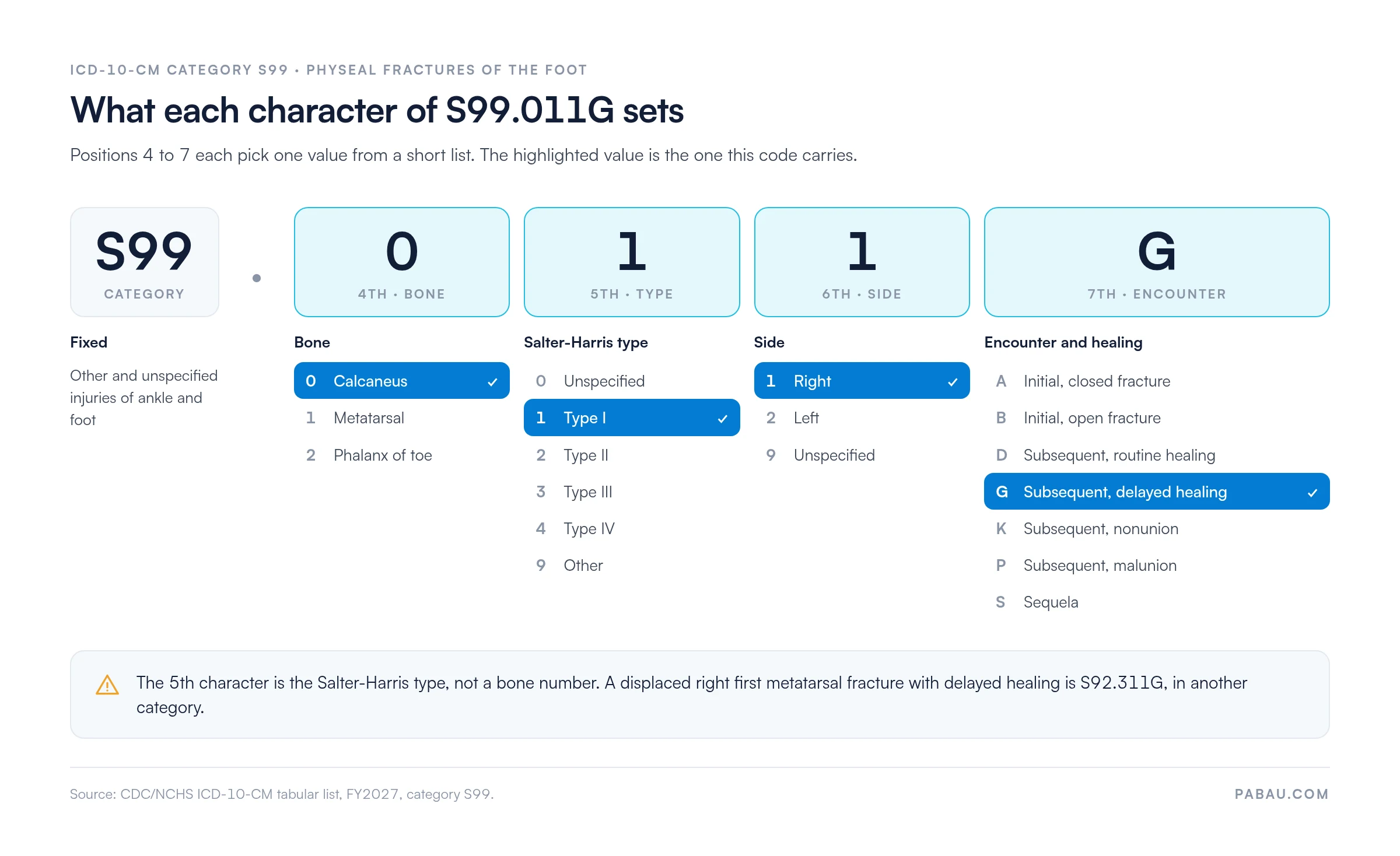
The 7th character G means active treatment is complete and the fracture is healing more slowly than expected. It sits between routine healing (D) and nonunion (K). The ICD-10-CM Official Guidelines for Coding and Reporting FY 2027, Section I.C.19.c, set out how fracture 7th characters work. Our guide to medical billing fundamentals covers how those characters reach the claim.
When G applies: The treating provider documents at a follow-up visit that the fracture is not healing within the expected timeframe. Serial X-rays, persistent tenderness over the heel, or pain on weight bearing beyond the usual window usually support that statement. The threshold depends on the patient’s age and the injury.
When G does not apply: Routine progress at a scheduled check takes D, and K is for a documented nonunion. A child who first presents weeks after the injury still gets A, because the guidelines assign A to any patient who delayed seeking treatment.
The guidelines also rule out the aftercare Z codes for traumatic fractures. Follow-up care for this injury is reported with S99.011 plus the right 7th character.
A Salter-Harris Type I fracture runs through the physis, the cartilage growth plate, without breaking into the bone on either side. The epiphysis separates from the metaphysis along the plate. Because no bony fragment shows, a Type I injury can look normal on early X-rays.
In the calcaneus, the growth plate sits at the back of the heel. There, the apophysis that anchors the Achilles tendon joins the body of the bone. These fractures are uncommon and occur only while the plate is open. Typical mechanisms are a fall or jump landing on the heel, or a sudden pull through the Achilles tendon.
Children’s fractures usually heal quickly, so delayed healing at the heel is a notable finding. A G-coded visit should carry the evidence the provider relied on, such as serial imaging and how long weight bearing has stayed painful.
Calcaneal apophysitis, known as Sever disease, causes heel pain at the same site in active children. It is an overuse condition, not a fracture. It codes to M92.6-, juvenile osteochondrosis of tarsus, and never to S99.0-.
Each part of the descriptor needs support in the record:
S99.011G sits in a dense family of codes. Its neighbors change the 7th character, the side, the Salter-Harris type or the bone. The table lists the ones most often confused with it.
Two rules govern how this code pairs with others. Category S92.0-, fracture of calcaneus, carries an Excludes2 note for physeal fracture of calcaneus (S99.0-). That note allows both codes only when the patient has two separate injuries.
For a single growth plate fracture, Section I.C.19.c.3 of the guidelines settles it. Assign only the code that identifies the type of physeal fracture, with no separate code for the bone.
Five elements make S99.011G defensible on a claim. Missing any one of them gives a payer grounds to deny the line or return it with a query. Keep each one current through billing compliance documentation at every visit.
The word “delayed” does not need to appear verbatim. The clinical picture in the note does need to show impaired progress, though.
Ask providers to record weeks since injury and the latest imaging finding in every G-coded note. A line such as “7 weeks post-injury, persistent posterior heel tenderness, no radiographic progress since the last film” shows why G fits rather than D.
Most S99.011G denials trace back to a character that does not match the note. Sending claims through the Claim.MD clearinghouse adds eligibility checks before submission. Denial management workflows then catch what slips through after it.
A rejected S99.011G line comes back on the remittance with a reason code. Our guide to denial codes for billers explains what each common code asks you to fix.
Medicare and Medicaid follow the official guidelines for fracture 7th characters, and most commercial plans do too. Patients with an open growth plate are children and adolescents, so these claims usually go to Medicaid, CHIP or a commercial plan. Run insurance eligibility verification before the follow-up visit, not after a denial.
Physical therapists often see these patients once immobilization ends, to restore ankle motion and a normal gait. The therapy note for each visit should record the healing status behind the code.
Audit your G-coded fracture claims each quarter. If G appears more often than D, check whether those notes support delayed healing or whether G has become a default for long treatment episodes.
In many practices, the healing status lives in a free-text note and the billing desk picks the 7th character days later. That is where a G turns into a D, or a Type I code lands on a Type II injury.
Pabau, the practice management platform we build, keeps the visit note, the diagnosis code and the claim on the same patient record. US practices send CMS-1500 claims through Claim.MD, with eligibility checks before the visit and ERA remittances returned to the record. Prior authorization codes, dates and sessions are tracked on the case, with a warning when one is missing.
Pabau’s claims management software then tracks each claim to payment. The code on the claim matches the note it came from, so your team spends less time answering payer queries months after the visit.

Pabau keeps the visit note, the ICD-10 code and the claim on one patient record. The 7th character on the claim then reflects what the provider documented. US claims go out through Claim.MD with eligibility checks built in.

S99.011G is narrow by design: One growth plate injury, one bone, one side and one healing status. Most errors come from reading it as a metatarsal code, or from a G that the note does not support. Check the 4th to 7th characters against the imaging report and the provider’s words before the claim goes out.
Children’s fractures usually heal quickly, so a delayed-healing code on a heel growth plate injury needs a clear reason in the note. Build that reason into each follow-up visit and the code will hold up. Book a demo to see how Pabau links fracture documentation to clean claims for orthopedic and pediatric practices.

Coding a growth plate fracture of a toe? ICD-10 code S99.221G covers a Salter-Harris Type II fracture of a right toe phalanx at a delayed-healing visit.
Has a metatarsal growth plate fracture failed to heal? ICD-10 code S99.121K reports a Salter-Harris Type II right metatarsal fracture with nonunion.
Is the heel fracture outside the growth plate? ICD-10 code S92.002G covers an unspecified left calcaneus fracture at a delayed-healing visit.
Confused about claim clearinghouse options? Claim.MD clearinghouse overview explains how the integration handles CPT and ICD-10 validation before claims reach the payer.
Want to reduce overall denial rates? Denial management in healthcare covers the workflows that cut denial rates across fracture and musculoskeletal coding categories.
ICD-10 code S99.011G means a Salter-Harris Type I physeal fracture of the right calcaneus at a subsequent encounter with delayed healing. It is a billable code for a child or adolescent whose heel growth plate fracture is healing more slowly than expected. Routine follow-up is D and nonunion is K.
No. S99.011G is a calcaneus code. Physeal fractures of the metatarsals sit under S99.1-, such as S99.111G for a Type I fracture of the right metatarsal. A displaced fracture of the right first metatarsal with delayed healing is S92.311G.
S99.011G means healing is slower than expected but still progressing. S99.011K means the provider has documented nonunion, where the fracture has failed to heal. The choice comes from the provider’s note and imaging, not from how long treatment has lasted.
No. Section I.C.19.c.3 of the ICD-10-CM Official Guidelines says to assign only the code for the type of physeal fracture. Do not add a separate code for the bone. A code from S92.0- belongs on the claim only when the patient has a second, separate calcaneal fracture.
The note must state the Salter-Harris type, the right side, and that healing is delayed, with the basis for that finding. The record should also show active treatment at an earlier encounter. A secondary external cause code records how the injury happened.
No. G is a subsequent-encounter character. The guidelines assign the initial character, A for closed or B for open, to every encounter with active treatment. That includes a child who first presents weeks after the injury.
S99.012G is the left calcaneus equivalent of S99.011G. S99.019G covers an unspecified side, and it belongs on a claim only when the record states no side.