ICD-10 code I27.20: Pulmonary hypertension, unspecified
ICD-10 code I27.20 covers PH with no stated type or cause ICD-10 code I27.20 is ...

Last Updated: Nov 18, 2026
Billable Code Specific Code
C18.9 is the billable ICD-10-CM code for malignant neoplasm of colon, unspecified. It covers primary colon cancer when no record names the colon segment where the tumor started.
The code sits in category C18 (Malignant neoplasm of colon) and is valid for HIPAA-covered transactions in FY2027. Denials tied to C18.9 usually trace to one of two errors. Coders use it when pathology names a colon segment, or confuse primary colon malignancy with metastasis to the colon (C78.5).
Let Pabau's smart automation suggest the right codes, reduce claim denials, and keep your practice compliant—effortlessly.
Automate repetitive tasks and focus on what matters most—your patients.
Reduce coding errors and ensure compliance with the latest regulations.
Clean claims, fewer denials, and faster reimbursements.
Powerful insights and reporting to help your practice thrive.
HIPAA compliant SOC 2 certified GDPR-compliant Trusted by 4,000+ clinics worldwide

C18.9 covers primary malignant neoplasm of the colon when no anatomical sub-site is documented in the pathology report or clinical notes.
Use a site-specific C18.x code (C18.0 through C18.8) whenever the pathology report or operative note names a colon segment. Keep C18.9 for records that name none.
C18.9 applies to primary colon malignancy only. Metastatic spread to the colon from another primary site uses C78.5, not C18.9.
Pabau, the practice software we build, pre-fills each claim from the invoice, submits it through Claim.MD and flags rejected claims with the payer’s reason.
ICD-10 code C18.9 is the billable code for a primary malignant neoplasm of the colon when no record names the sub-site. CMS’s FY2027 ICD-10-CM code set covers encounters from October 1, 2026, through September 30, 2027, and C18.9 stays valid and billable in it.
The official descriptor in the CDC/NCHS ICD-10-CM tabular list is “Malignant neoplasm of colon, unspecified.” The tabular list also files “malignant neoplasm of large intestine NOS” under it.
The code is accepted in HIPAA-covered electronic transactions, and the ICD-10-CM code library lists its neighbors in category C18.
C18.9 covers primary malignant neoplasms of the colon when the sub-site is undocumented. The ICD-10-CM guidelines require coders to use the most specific code the documentation supports. So C18.9 belongs on the claim only when the pathology report and clinical notes, read together, never say where in the colon the tumor started.
Typical C18.9 encounters are those where the operative note says “colon cancer” without naming a segment. Another is an early staging workup, before a site-specific pathology result exists. Once a biopsy or surgical specimen identifies the sub-site, the coder moves to the matching C18.x code.
The five checks below run in the order a coder meets them in the chart. The first “yes” decides the code, and C18.9 is what remains when every answer is no.
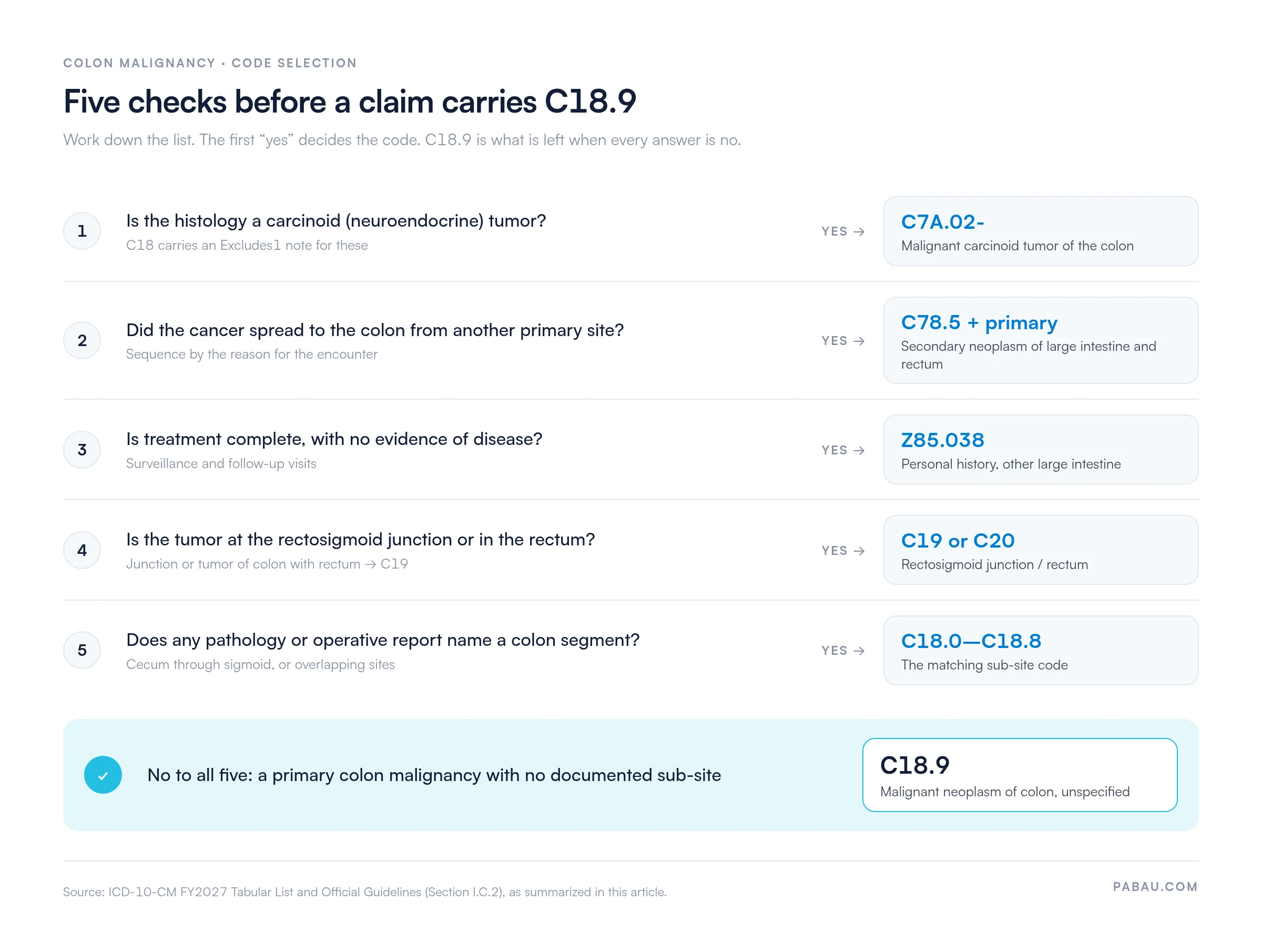
Category C18 carries one Excludes1 note and no Excludes2 note. The Excludes1 note removes malignant carcinoid tumors of the colon, which code to C7A.02- and are never reported with C18.9.
Metastasis to the colon (C78.5) and benign colon polyps (D12.-) are not Excludes notes on C18. They are different diagnoses with their own codes, covered in the sections below.
The C18 category runs from C18.0 (cecum) to C18.9 (unspecified). The FY2027 ICD-10-CM coding guidelines tell coders to assign the highest level of specificity the documentation supports. C18.9 is therefore appropriate only after the pathology report or operative note has been reviewed and no sub-site is named.
Three adjacent codes cover the lower gastrointestinal tract, and the boundary between them trips up coders regularly. C18.9 covers the colon with no sub-site named, C19 covers the rectosigmoid junction, and C20 covers the rectum.
In the ICD-10-CM Index and Tabular List, C19 includes “colon with rectum” and “rectosigmoid (colon).” A tumor straddling the sigmoid and the rectum therefore takes C19, not C18.7 or C20.
When the operative or endoscopy report states “rectosigmoid tumor” without saying which side of the junction holds the primary, C19 is the correct assignment. In ambiguous lower-GI cases, query the treating physician before defaulting to C18.9.
C18.9 is strictly a primary malignancy code. When cancer starts in another organ and spreads to the colon, the correct code is C78.5 (secondary malignant neoplasm of large intestine and rectum).
Under guideline I.C.2.b, the primary and secondary codes are sequenced by the reason for the encounter. Reporting C18.9 for metastatic colonic involvement misstates the primary site, and payers and auditors look for it.
Section I.C.2 of the ICD-10-CM Official Guidelines governs neoplasm coding. To support C18.9 specifically, the medical record should show:
A record that is complete before submission leaves the payer little to question. For practices coding oncology at volume, a clean claim starts with structured documentation at the point of care.
Before assigning C18.9, run a quick three-check review: (1) Does any report name a colon segment? If yes, use the matching C18.x. (2) Does any note indicate metastatic origin? If yes, use C78.5. (3) Has curative surgery occurred with no residual disease? If yes, switch to Z85.038. C18.9 passes only if all three checks are negative.
Z85.038 (personal history of other malignant neoplasm of large intestine) replaces C18.9 once active treatment ends and no residual malignancy remains.
ICD-10-CM Official Guidelines Section I.C.2.d sets the rule. The history code applies once the primary has been excised or eradicated and no further treatment is directed to it. The record must also show no evidence of disease.
Leaving C18.9 on routine surveillance colonoscopies or follow-up oncology visits after a successful resection misstates the patient’s status. Payers may deny or down-code claims where the documentation shows “no evidence of disease” but C18.9 remains on the claim.
Oncology and gastroenterology claims for colon cancer usually pair C18.9 with procedure and companion diagnosis codes. A diagnostic colonoscopy billed as CPT 45378 and a CEA tumor marker test billed as 82378 are two of the most frequent.
The table below reflects common combinations, and payer-specific bundling rules may apply.
A C18.9 claim passes through six steps, and each one can stop it. Here is the path for a US professional claim.
Payers can request pathology confirmation before they pay a C18.9 claim. Check each plan’s prior authorization rules before scheduling chemotherapy or surgery, because a missing authorization denies the claim whatever the diagnosis code.
C18.9 denials follow a predictable pattern. Most stem from specificity errors, primary/secondary confusion, or a missed switch to the history code after treatment. Each one can be caught before submission when the coder checks the record against the table below.
Tracking denials by code shows whether the same C18.9 specificity error keeps coming back. Denial management in healthcare covers how to sort those patterns and fix the step that causes them.
Yes. C18.9 is valid and billable for FY2027, which took effect on October 1, 2026, with the same descriptor. CMS updates the ICD-10-CM code set every October 1. Check each new release on the CMS ICD-10 codes page before the fiscal year starts.
Run these checks on every claim that carries C18.9. If one fails, change the code or hold the claim.
In many practices, a colon cancer claim passes through the scheduling system, a clearinghouse portal and a spreadsheet of denials before it is paid. Each hand-off is a place where a rejected claim can sit unnoticed.
With Pabau’s claims management software, the claim is pre-filled from the invoice and submitted through Claim.MD. Eligibility is checked before the visit, and each claim is tracked from Pending to Paid.
When a payer rejects a claim, Pabau flags it as Needs action with the payer’s reason. Your coder fixes the sub-site or the sequencing and resends it. Code selection stays with your coder, so the checklist above still applies.

Pabau pre-fills claims from the invoice, submits them through Claim.MD and flags rejected claims with the payer’s reason. See how it fits your gastroenterology or oncology practice.

Pick C18.9 only after the record has been searched twice, once for a named segment and once for a primary site elsewhere. If either search turns something up, a different code is correct, and the claim is stronger for it.
The step that saves the most rework comes later. Set a review point when treatment ends, so surveillance visits move to Z85.038 instead of carrying an active cancer code for years.
Book a demo to see how Pabau tracks each colon cancer claim from submission to payment and puts rejections in front of your team.

Looking for an overview of the claims submission process? Understanding medical claims clearinghouses explains how 837P electronic claims reach payers and what happens when they are rejected.
Need to understand how payer denials are categorized? Denial codes in medical billing covers CARC and RARC denial reason codes that appear on remittance advices for oncology claims.
Want to reduce eligibility-related denials before submission? Insurance eligibility verification outlines eligibility checks that confirm coverage before the claim is filed.
Coding a screening colonoscopy that found cancer? ICD-10 code Z12.11 covers the screening encounter code that comes first on that claim.
C18.9 is the billable ICD-10-CM code for malignant neoplasm of colon, unspecified. It covers primary colon cancer when no pathology or operative report names the segment where the tumor started.
It covers only the colon part. Colorectal cancer spans three categories: C18 for the colon, C19 for the rectosigmoid junction and C20 for the rectum. A rectal tumor coded as C18.9 is a specificity error.
Z85.038, personal history of other malignant neoplasm of large intestine. Use it once treatment has ended and the record shows no evidence of disease, instead of C18.9.
C78.5, secondary malignant neoplasm of large intestine and rectum, reported with the primary site’s code. Sequence the two by the reason for the encounter.
Yes. When a screening colonoscopy finds cancer, Z12.11 is listed first for the screening encounter and the C18.x code is added, per guideline I.C.21.c.5.
Most denials come from using C18.9 when pathology names a colon segment, or from coding metastasis to the colon as a primary cancer. Billing it with a C7A.02- carcinoid code also breaks the Excludes1 note.