ICD-10 code S61.201A: Open wound of left index finger without nail damage
ICD-10 code S61.201A covers a left index finger wound of unstated type ICD-10 co...

Last Updated: Oct 16, 2026
Billable Code Specific Code
S99.221G is the billable ICD-10-CM code for Salter-Harris Type II physeal fracture of phalanx of right toe, subsequent encounter for fracture with delayed healing.
The G suffix separates this code from the initial encounter (A) and the routine subsequent encounter (D). Payers reviewing a G-suffix claim look for imaging that shows healing behind the expected timeline.
Let Pabau's smart automation suggest the right codes, reduce claim denials, and keep your practice compliant—effortlessly.
Automate repetitive tasks and focus on what matters most—your patients.
Reduce coding errors and ensure compliance with the latest regulations.
Clean claims, fewer denials, and faster reimbursements.
Powerful insights and reporting to help your practice thrive.
HIPAA compliant SOC 2 certified GDPR-compliant Trusted by 4,000+ clinics worldwide

S99.221G is a billable ICD-10-CM code valid for FY2026 (October 1, 2025 through September 30, 2026)
The G suffix designates a subsequent encounter for fracture with delayed healing, distinct from routine healing (D), malunion (P), and nonunion (K)
Documentation must explicitly support delayed healing; without it, payers will expect the D suffix for routine follow-up visits
Practice management software like Pabau supports ICD-10 code entry and clean claim submission for orthopedic and multi-specialty practices
ICD-10 Code S99.221G is a valid, billable ICD-10-CM diagnosis code for the 2026 fiscal year, effective October 1, 2025 through September 30, 2026.
It covers a Salter-Harris Type II physeal fracture of the phalanx of a right toe. The suffix applies at a follow-up visit where the fracture is healing more slowly than expected. The code is specific, meaning it can be submitted directly on HIPAA-covered transactions without additional specificity qualifiers.
The CDC/NCHS ICD-10-CM web tool is the official source for verifying current-year billable status. Coders should confirm FY2026 validity for any code before submission, particularly after October 1 when annual updates take effect.
S99.221G sits within a structured hierarchy that runs from broad injury chapters down to specific laterality and encounter-type designations. Checking each level confirms that the most granular applicable code has been selected. Our ICD-10-CM code index covers the neighboring categories in the same chapter.
The 7th character G designates a subsequent encounter for a fracture healing more slowly than the clinically expected timeline. It does not cover a fracture that has failed to heal entirely (nonunion) or one that healed in poor alignment (malunion). That distinction changes how the claim is paid. Applying the wrong suffix when the documentation supports a different clinical picture triggers denials. Reworking those claims costs coder review time and delays payment on the encounter.
The full set of 7th character options for S99.221 is shown below. Only G requires documented evidence of delayed healing at the specific visit being billed.
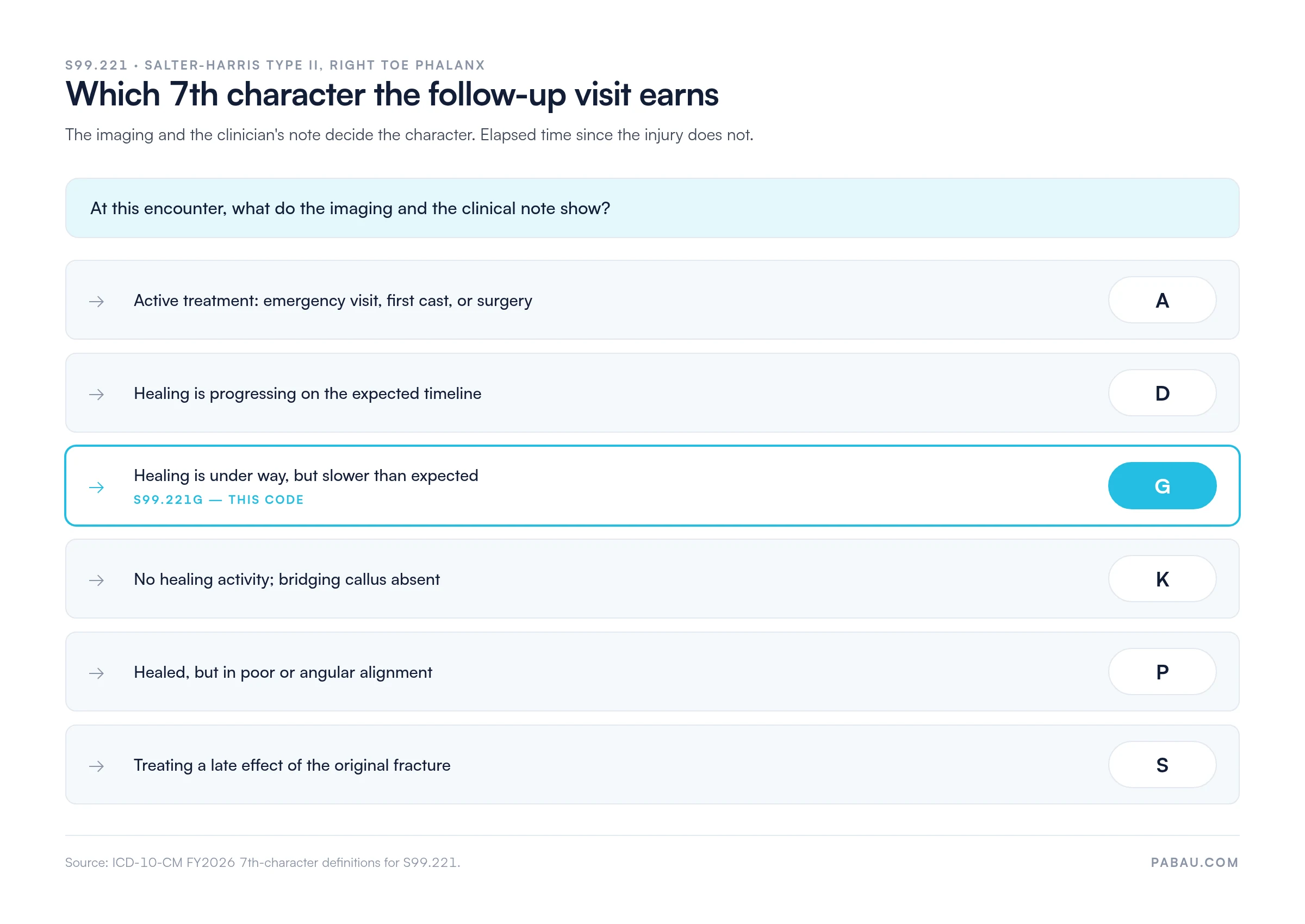
Per the CMS ICD-10-CM coding guidelines, the 7th character reflects the patient’s status at each individual encounter. A patient who began with a D suffix on early follow-up visits may transition to G if subsequent imaging reveals slowed callus formation. The code can revert to D if healing normalizes, or progress to K if no union occurs. The chart below maps each finding to the character it earns.
A Salter-Harris Type II physeal fracture is a growth plate injury where the fracture line runs through the physis and exits through the metaphysis. The epiphysis stays intact. It is the most common type in the Salter-Harris classification system. AAPC coding resources and orthopedic literature put it at the majority of physeal fractures seen in practice. The metaphyseal fragment that stays attached to the epiphyseal side is called the Thurston-Holland fragment and is a defining feature on imaging.
For S99.221G specifically, the fracture involves a phalanx of a toe on the right foot. That covers the proximal, middle, or distal phalanx of any toe on the right side. While Salter-Harris fractures occur predominantly in skeletally immature patients, they can present in older adolescents with open growth plates. Documentation should note which right toe and which phalanx are affected, the imaging findings, and the skeletal maturity status.
The Excludes and Includes notes for the S99 category govern what can and cannot be coded alongside S99.221G. The same notes apply to every injury code in this block, so read them before assigning any S99 code.
Excludes2 notes for S99.221G (conditions that may be coded separately when present):
Excludes2 is an advisory note, not a mandatory exclusion. Both S99.221G and an Excludes2 condition may appear on the same claim when clinically appropriate and documented. This contrasts with Excludes1 notes, which represent true “cannot occur together” scenarios.
Applicable to notes: S99.221G inherits the applicable-to guidance from its parent categories, which covers physeal fractures of the toe phalanges in skeletally immature patients. Coders should note that fractures of the great toe carry their own code block. Verify the anatomical site in the documentation before assigning S99.221G.
The sibling codes sharing the S99.221 base differ only in their 7th character. Coders selecting from this group should check the documentation for the encounter type at each visit. Defaulting to the code used at the previous visit invites a mismatch. The S90-S99 block holds the full ankle and foot injury set for adjacent categories.
CPT procedure codes paired with ICD-10 Code S99.221G depend on the service rendered at the delayed-healing follow-up encounter. Pair the diagnosis with what the clinician actually did at that visit, not with the care given for the original injury.
CPT codes must be verified against current code year data before submission. The codes above reflect commonly paired procedures. Confirm against a current CPT manual that each code is still active. Check that it suits the payer and the clinical scenario as well.
When billing a delayed-healing encounter, confirm the radiology report is dated and in the record before submission. Payers reviewing G-suffix claims will look for objective imaging evidence of the healing delay. A clinical note alone, without supporting imaging findings, increases denial risk substantially.
ICD-9-CM was retired in the United States on October 1, 2015. The General Equivalence Mapping (GEM) files published by CMS map ICD-10-CM codes back to their closest ICD-9-CM equivalents. Those mappings are approximate. ICD-9-CM lacked both the anatomical specificity and the 7th character system of ICD-10-CM.
For S99.221G, the closest ICD-9-CM equivalent falls within the 826.x range (fracture of one or more phalanges of foot). The 7th character distinctions for delayed healing, nonunion, and malunion had no direct ICD-9-CM parallel. For audit trail documentation or historical claim research, refer to the CMS GEMs file for the official crosswalk mapping. Third-party conversion tools may not reflect the most current CMS mapping logic.
Delayed healing is the clinical finding that justifies ICD-10 Code S99.221G over the routine subsequent-encounter code S99.221D. Coders should not assign G based on assumption or elapsed time alone. Payers expect specific documentation elements in the record before they accept the suffix.
Documentation that supports S99.221G:
Common coding errors to avoid:
For practices submitting claims electronically, submitting a clean claim depends on the documentation supporting the 7th character assigned. A mismatch between the G suffix and the documentation findings is a common audit flag for orthopedic billing.
Practices managing fracture care across multiple follow-up encounters face a recurring documentation challenge. The 7th character must be reassessed at each visit, and the supporting record must be complete before the claim goes out. When the notes live in one system and the claims in another, that reassessment gets lost between them.
Pabau’s claims management software integrates clinical documentation with claim preparation, so the visit note and the ICD-10 code assignment happen in one workflow. The coder reads the same imaging finding the clinician recorded, on the same screen, before the claim goes out. Practices that align documentation capture with billing tend to produce cleaner first submissions for fracture care.

Structured visit note templates carry most of the load on S99.221G encounters. They prompt the clinician for imaging findings, healing status, and encounter type while the patient is still in the room. The coder then works from a record that already holds what the payer will ask for.
Run a monthly audit on all G-suffix fracture claims your practice submitted. Pull the corresponding visit notes. Confirm each one contains a dated imaging report, a clinician statement about healing status, and a comparison to prior films. Ten minutes a month on this check surfaces a missing radiology report before a payer audit does.

Pabau’s claims management software helps orthopedic and multi-specialty practices document, code, and submit fracture care claims accurately. See how integrated documentation and billing workflows reduce denial rates.

S99.221G codes one specific clinical scenario. It covers a Salter-Harris Type II growth plate fracture of a phalanx in the right toe. The code applies at a follow-up visit where healing is objectively behind schedule. The documentation must match the suffix, and the suffix must match the imaging. Without both, the claim carries denial risk.
Pabau’s integrated documentation and billing workflows let practices build the record and the claim together. A G-suffix claim then leaves the practice with its imaging evidence already attached. Book a demo to see how Pabau handles fracture care billing from visit note to clean claim submission.

List Item #1
List Item #2
ICD-10 Code S99.221G is the billable diagnosis code for a Salter-Harris Type II physeal fracture of the phalanx of a right toe. It applies to a subsequent encounter where the fracture shows delayed healing. It is valid for the FY2026 ICD-10-CM edition, effective October 1, 2025 through September 30, 2026.
The 7th character G designates a subsequent encounter for a fracture with delayed healing, meaning the fracture is healing more slowly than clinically expected. It differs from D (routine subsequent healing), K (nonunion), and P (malunion), and requires objective documentation such as an imaging report confirming inadequate callus formation.
S99.221A covers the initial encounter during active treatment, such as the emergency visit, first casting, or surgical intervention. S99.221G is used at subsequent follow-up visits when healing is documented as delayed. Using A for a follow-up visit is a coding error, even if the follow-up provider is different from the original treating provider.
Yes, S99.221G is a valid, billable, and specific ICD-10-CM code for FY2026. It is effective from October 1, 2025 through September 30, 2026, and is accepted on HIPAA-covered transactions without additional specificity qualifiers.
Delayed healing for ICD-10 coding requires objective clinical evidence that the fracture is healing more slowly than expected, typically confirmed by imaging. It is distinct from nonunion (K), where no healing activity is occurring, and from malunion (P), where healing has completed but in poor alignment. The treating clinician’s note should explicitly describe the healing status and reference the supporting imaging findings.
G applies when imaging shows some healing activity but at a slower-than-expected rate. K applies when no healing is occurring and bridging callus is absent. P applies when healing has completed but the bone has united in poor alignment. Each designation requires specific imaging and clinical documentation; the 7th character cannot be assigned based on elapsed time alone or clinical suspicion without objective findings.