ICD-10 code I27.20: Pulmonary hypertension, unspecified
ICD-10 code I27.20 covers PH with no stated type or cause ICD-10 code I27.20 is ...

Last Updated: Nov 18, 2026
Billable Code Specific Code
J21.9 is the billable ICD-10-CM code for acute bronchiolitis, unspecified. It applies when the physician diagnoses acute bronchiolitis but the record names no causative organism.
The code sits in category J21 and is valid in the FY2027 code set, effective October 1, 2026. When the note documents RSV, human metapneumovirus or another organism, code J21.0, J21.1 or J21.8 instead.
Let Pabau's smart automation suggest the right codes, reduce claim denials, and keep your practice compliant—effortlessly.
Automate repetitive tasks and focus on what matters most—your patients.
Reduce coding errors and ensure compliance with the latest regulations.
Clean claims, fewer denials, and faster reimbursements.
Powerful insights and reporting to help your practice thrive.
HIPAA compliant SOC 2 certified GDPR-compliant Trusted by 4,000+ clinics worldwide

J21.9 is the billable ICD-10-CM code for acute bronchiolitis with no identified organism, and it is unchanged in the FY2027 code set.
Use J21.9 only when the note documents no RSV, hMPV or other organism. Otherwise, code J21.0, J21.1 or J21.8.
J21.9 carries an Excludes1 note for chronic bronchiolitis (J44.89), so the two never share a claim. Respiratory bronchiolitis interstitial lung disease (J84.115) is an Excludes2 and may be coded alongside it.
As the principal diagnosis on an inpatient claim, J21.9 groups to MS-DRG 202 or 203 and needs a POA indicator.
Pabau, our practice management platform, sends electronic claims through Claim.MD with eligibility checks and ERA remittances. Denial patterns on J21.9 then show up in your reporting.
ICD-10 code J21.9 is the billable ICD-10-CM code for acute bronchiolitis, unspecified, used when the physician diagnoses bronchiolitis but documents no organism. It sits in CMS’s FY2027 ICD-10-CM release, used for discharges from October 1, 2026, and is unchanged in that edition.
You’ll see it most on pediatric emergency and inpatient claims during respiratory virus season. Here are the core facts before the detail.
J21.9 is the unspecified code at the end of category J21. Work through its siblings first, because a documented organism always points to a more specific code.
The path below adds the excludes check and the inpatient step, so the whole decision fits on one screen.
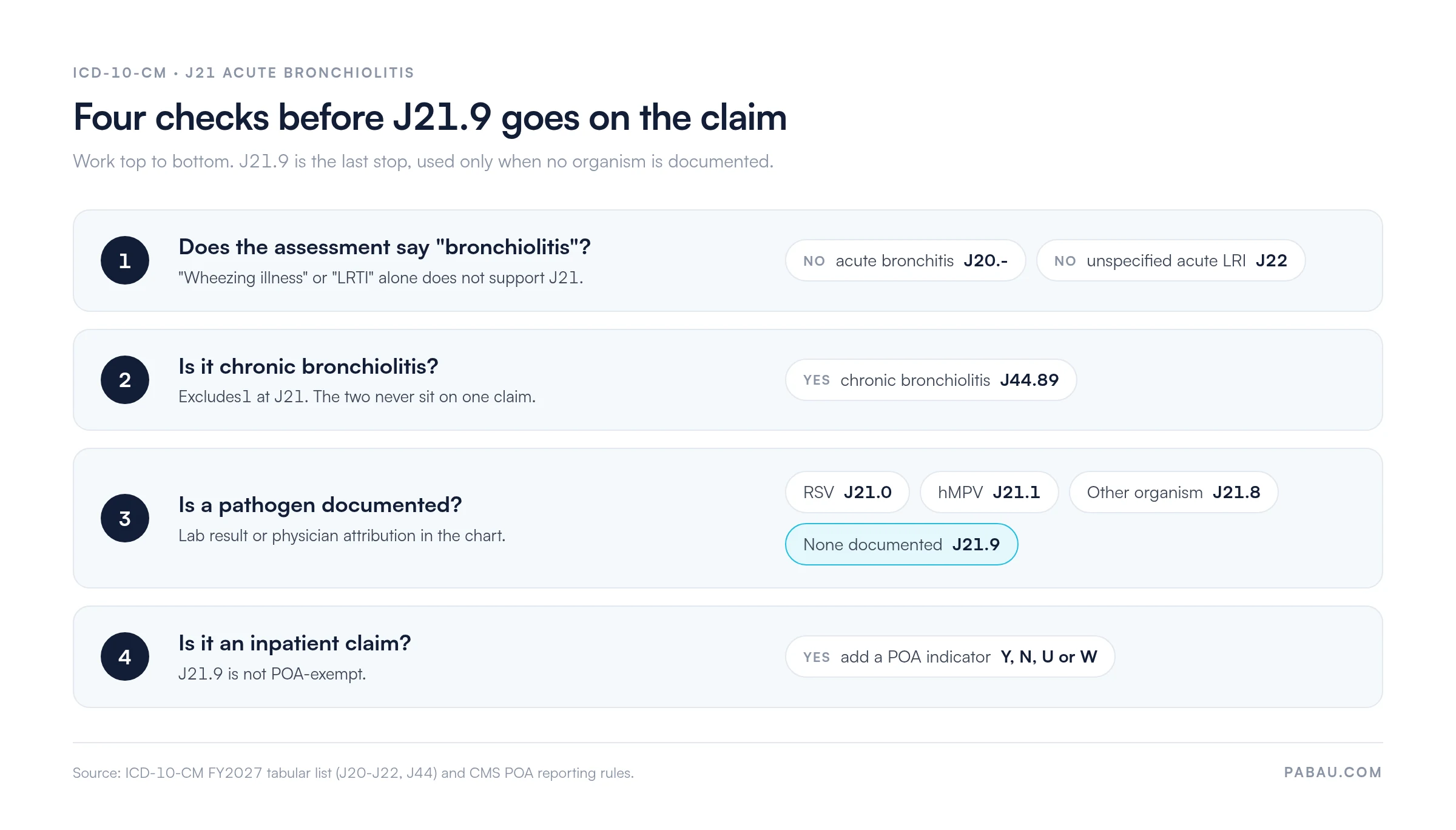
Confirm descriptors and hierarchy in the CDC/NCHS ICD-10-CM web tool. Defaulting to J21.9 without reviewing J21.0 through J21.8 under-codes the encounter and invites audit findings. The ICD-10-CM Official Guidelines require the most specific code the documentation supports.
Category J21 carries one Excludes1 note and one Excludes2 note. Between them, they tell you which condition can never share a claim with J21.9 and which one can.
An Excludes1 note marks conditions that are never coded together. J21 excludes chronic bronchiolitis, which ICD-10-CM codes to J44.89. Chronic bronchiolitis is a long-term airway condition, so when the physician documents it, assign J44.89 in place of J21.9.
An Excludes2 note means the condition isn’t part of J21.9 but may be coded alongside it when both are documented. At J21, that condition is respiratory bronchiolitis interstitial lung disease, J84.115.
One more note sits a level higher. The J20-J22 block carries an Excludes2 for chronic obstructive pulmonary disease with acute lower respiratory infection (J44.0), so it doesn’t bar J21.9 either.
These two aren’t excludes notes on J21. They’re differential diagnoses that change the code when the physician names them.
Before assigning J21.9, search the physician’s note for chronic bronchiolitis and interstitial lung disease, and for any named pathogen such as RSV or metapneumovirus. A match moves you to J44.89, adds J84.115, or points to a sibling J21 code.
Most acute bronchiolitis coding errors come from two habits. Coders assign J21.9 when a pathogen is documented, or they confuse J21 (bronchiolitis) with J20 (bronchitis).
The anatomy explains the split. Bronchiolitis affects the small bronchioles and is mainly a disease of infants. Bronchitis affects the larger bronchi and is common in adults. An adult J21.9 claim without clear documentation of bronchiolitis often draws a medical necessity edit.
The note has to show three things: a confirmed bronchiolitis diagnosis, the pathogen testing status, and the patient’s age and presentation. Missing any of them weakens the claim in medical billing compliance audits.
Clinical documentation improvement (CDI) teams often query the physician about pathogen testing when a J21.9 case is admitted.
Resolving that query before discharge avoids a recode afterward and keeps the DRG assignment clean. It also hands the rest of the medical billing workflow a finished diagnosis rather than a provisional one.
Here’s the path a typical bronchiolitis claim follows, and where each step tends to stall.
Steps one and two decide most J21.9 outcomes. A claim that leaves coding with the right specificity rarely gets stuck later on code choice.
J21.9 isn’t on the CMS POA-exempt list, so inpatient claims must report a present-on-admission (POA) indicator for it. The value is Y (present on admission), N (not present), U (documentation insufficient) or W (clinically undetermined).
Medicare and most commercial payers rely on POA data for quality reporting and hospital-acquired condition (HAC) payment adjustments. A missing indicator on an inpatient J21.9 claim usually triggers an edit before adjudication.
National LCD or NCD policies for bronchiolitis are uncommon, so coverage usually turns on a medical necessity review of the documentation.
When J21.9 is the principal diagnosis on an inpatient claim, it groups to the bronchitis and asthma MS-DRGs under grouper v44.0 (FY2027). The split depends on whether a complication or comorbidity (CC) or a major complication or comorbidity (MCC) is documented.
Run every assignment through your current grouper before submission, because DRG logic can change with each annual update. CMS publishes the definitions manual on its MS-DRG classifications and software page.
J21.9 shows up on both outpatient and inpatient claims. The CPT codes paired with it reflect the emergency and hospital care that infants with bronchiolitis tend to need.
When CPT 87633, the respiratory multiplex panel, returns a positive RSV result, update the diagnosis from J21.9 to J21.0 before the claim is finalized. Submitting J21.9 after a positive result is one of the most common specificity errors on these claims. The AAPC ICD-10 lookup tool helps you cross-check clinical terms against code ranges.
Denials on unspecified bronchiolitis claims trace back to five root causes. Each one has a fix you can build into your workflow.
Each denial comes back with a CARC reason, and our denial code reference explains what each one asks for. Structured denial management workflows then close the loop on repeat J21.9 denials.
Run a quarterly audit of all J21.9 claims submitted in the previous quarter. Pull any encounter where RSV, hMPV, or another pathogen appears anywhere in the chart and compare against the submitted code. Any mismatch is a recode candidate and a CDI feedback opportunity.
Run through these seven checks on every J21.9 claim before it leaves your system.
ICD-9-CM 466.19 (Acute bronchiolitis due to other infectious organisms) maps forward to J21.9 through the CMS General Equivalence Mappings (GEMs). The mapping is approximate, not exact.
ICD-9’s “other infectious organisms” category covered presentations that ICD-10-CM now splits into J21.1 (hMPV) and J21.8 (other specified).
Legacy data converted with the GEMs forward map may therefore overstate J21.9 against current coding practice. Account for this when comparing pre-2015 and post-2015 bronchiolitis volumes.
The ResDAC guidance on ICD codes in Medicare files explains the GEMs method for researchers working with the transition period.
Many billing teams code in one system, submit through a separate clearinghouse portal and read remittances in a third. Denials arrive weeks later, and the pattern behind them is hard to spot.
Pabau, the practice management and billing platform we build, sends claims electronically through Claim.MD. It runs eligibility checks and brings ERA remittances back to each claim. Code selection still rests with your coder.
With remittances tied to the claim, a run of J21.9 denials shows up in your reporting. You can then fix the documentation habit behind it early. That flow, from submission to remittance, is the core of Pabau’s claims software for billers.

Pabau sends electronic claims through Claim.MD, with eligibility checks and ERA remittances, so denial patterns on J21.9 show up in your reporting. Book a demo to see the workflow.

J21.9 is the right code when the chart supports bronchiolitis and nothing more specific. Trouble starts when it becomes the default while lab results sit unread in the chart.
The fix sits upstream of billing. Make the viral panel result part of final coding, record testing status in every bronchiolitis note, and audit J21.9 claims each quarter. Those three habits remove the most common reasons a J21.9 claim comes back.
Book a demo to see how Pabau sends your claims through Claim.MD and brings denial patterns into one report.

Need to understand how claims reach the payer? Medical claims clearinghouse guide explains how clearinghouses validate and route electronic claims before payer adjudication.
Getting CARC denial codes back on remittances? Denial codes in medical billing breaks down the most common CARC codes and what each one requires for a successful appeal.
Want to understand the 837 file your claims travel in? 837 file overview covers the EDI transaction set structure that carries professional and institutional claims electronically.
J21.0 codes acute bronchiolitis due to respiratory syncytial virus. Use it when a lab result or the physician attributes the bronchiolitis to RSV. J21.9 is only for cases with no documented organism.
Yes, the code has no age limit, but bronchiolitis is mainly diagnosed in children under 2. On an adult claim, make sure the assessment names bronchiolitis and the findings support it. Otherwise, expect a medical necessity review.
Wheezing on its own is coded R06.2, a symptom code. J21.9 needs the word bronchiolitis in the physician’s assessment. If the note describes an unspecified acute lower respiratory infection instead, J22 applies.
Yes. As the principal diagnosis, J21.9 groups to MS-DRG 202 with a CC or MCC, or to MS-DRG 203 without one. The inpatient claim also needs a POA indicator for it.
ICD-9-CM used 466.11 for RSV bronchiolitis and 466.19 for bronchiolitis due to other infectious organisms. The GEMs map 466.19 forward to J21.9 as an approximate match.