ICD-10 code I27.20: Pulmonary hypertension, unspecified
ICD-10 code I27.20 covers PH with no stated type or cause ICD-10 code I27.20 is ...

Last Updated: Nov 18, 2026
Billable Code Specific Code
J45.901 is the billable ICD-10-CM code for unspecified asthma with (acute) exacerbation. It applies when the provider documents an asthma flare but names no severity level.
It is one of three unspecified asthma codes, sitting ahead of J45.902 (status asthmaticus) and J45.909 (uncomplicated). The note must document the exacerbation itself, through symptom escalation, objective worsening or treatment escalation. A chronic asthma diagnosis alone does not support it.
Let Pabau's smart automation suggest the right codes, reduce claim denials, and keep your practice compliant—effortlessly.
Automate repetitive tasks and focus on what matters most—your patients.
Reduce coding errors and ensure compliance with the latest regulations.
Clean claims, fewer denials, and faster reimbursements.
Powerful insights and reporting to help your practice thrive.
HIPAA compliant SOC 2 certified GDPR-compliant Trusted by 4,000+ clinics worldwide

J45.901 is a billable ICD-10-CM code for unspecified asthma with acute exacerbation, valid for the current fiscal year (FY 2027).
Use J45.901 only when the note names no severity level. If it says mild intermittent, mild persistent, moderate persistent or severe persistent, use the matching J45.x1 code.
J45.902 (status asthmaticus) needs a prolonged attack that doesn’t respond to initial bronchodilator therapy, so it isn’t interchangeable with J45.901.
Thin documentation of the acute episode is the leading cause of J45.901 denials. Documentation of the acute exacerbation (symptom escalation, objective worsening or treatment escalation) is required.
Before submission, confirm the exacerbation language, the absence of a severity label, and a diagnosis pointer from every related procedure line.
ICD-10 code J45.901 is the billable diagnosis code for unspecified asthma with (acute) exacerbation. CMS lists it in the FY 2027 ICD-10-CM code files, which cover encounters from October 1, 2026 through September 30, 2027. Use it when the provider documents an asthma flare but names no severity level.
The parenthetical “(acute)” in the official descriptor marks the exacerbation as an acute episode, as opposed to a gradual worsening.
ICD-10-CM codes update every October 1, so confirm J45.901 against the current release before you submit. Our ICD-10-CM codes library lists the neighboring respiratory codes in the same chapter.
J45.901 applies when a provider documents an acute worsening of asthma without a severity classification. The record confirms an acute episode but lacks the detail a severity-specific code needs. It fits presentations like these.
“Unspecified” doesn’t mean the asthma is undiagnosed. It means the note doesn’t support a severity-specific subcategory. If the physician writes “moderate persistent asthma with acute exacerbation,” the correct code is J45.41.
Excludes1 (never coded together): The J45 category excludes detergent asthma (J69.8), eosinophilic asthma (J82.83), miner’s asthma (J60), wheezing NOS (R06.2) and wood asthma (J67.8). Wheezing NOS sits in Chapter 18, and the others are coded elsewhere in Chapter 10. None of them may appear on the same claim as J45.901.
Excludes2 (both may be coded when both are present): COPD (J44.-) carries an Excludes2 note at J45. A patient with confirmed asthma and confirmed COPD may carry J45.901 and a J44 code, when both are documented and treated at the encounter.
The J45 category runs on two axes. Severity sets the subcategory, from mild intermittent through severe persistent, or unspecified. Acuity sets the last digit, for uncomplicated, acute exacerbation or status asthmaticus.
Check descriptor text and hierarchy in the CDC/NCHS ICD-10-CM web tool before you submit a claim.
The three unspecified asthma codes split on one point, what the note says about the episode. Payers compare the note with the submitted code, so J45.902 or J45.909 in the wrong place is a coding error and a medical necessity risk.
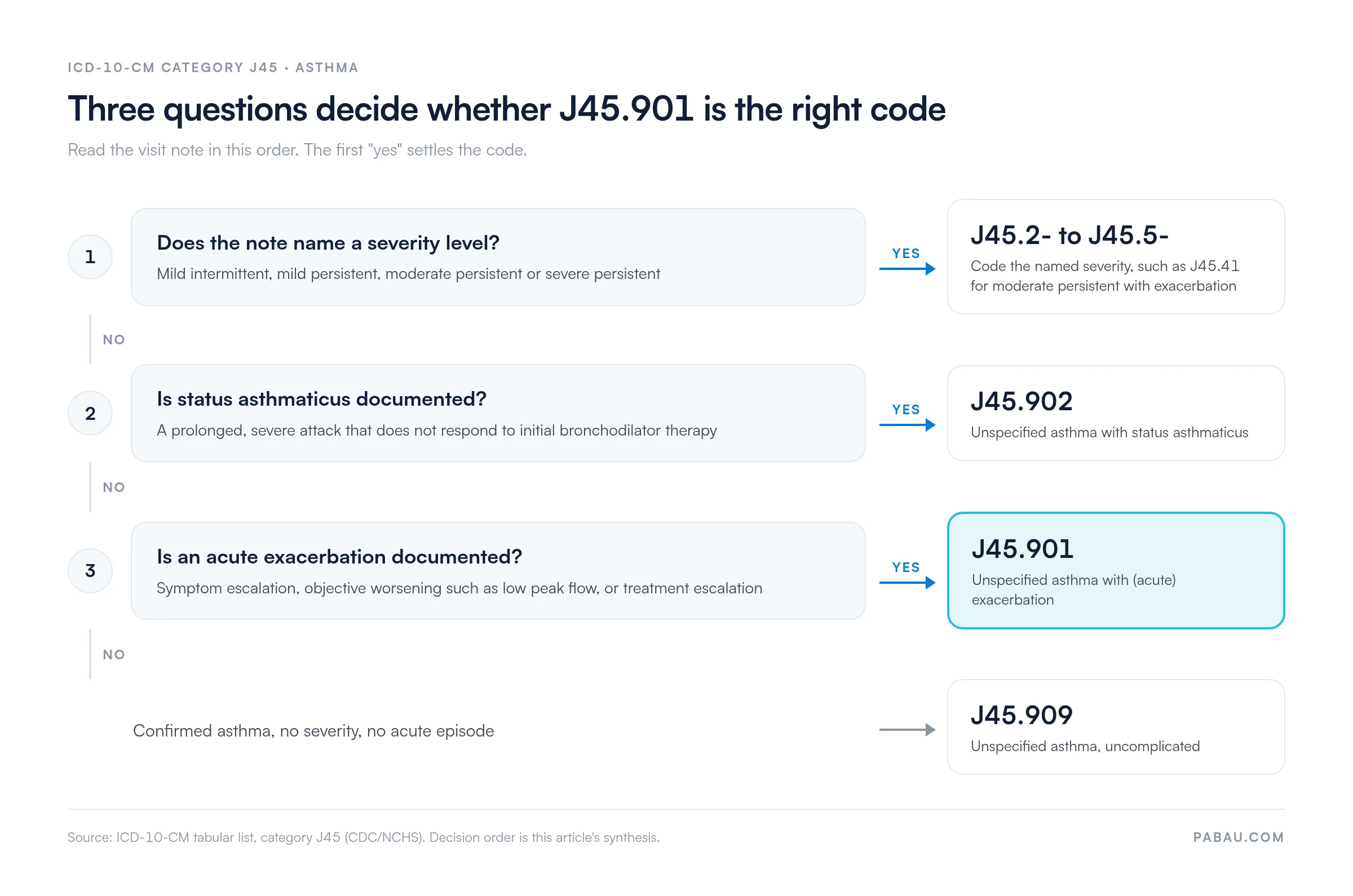
Status asthmaticus is a prolonged, severe asthma attack that doesn’t respond to initial bronchodilator treatment. That lack of response is the deciding criterion. A bad flare that settled with treatment still codes to J45.901, and coding it as J45.902 is an error that can draw payer audits.
J45.901 fits only when severity is undocumented. Once the note names a severity level, code the matching J45.x1 code, even if you doubt the provider’s classification. Move to a severity-specific code when the record carries any of these cues.
The ICD-10-CM Official Guidelines require coding to the highest specificity the documentation supports. A note reading “moderate persistent asthma with acute exacerbation” therefore takes J45.41. If the note describes severity-level symptoms without naming a level, query the provider rather than assume one.
Run a quarterly audit of encounters coded J45.901. For each one, check the note for any of the four severity descriptors above. Severity indicators without a formal classification call for a provider query, never a coding assumption. Record the query and the answer in the medical record before you amend the code.
COPD exacerbation and asthma exacerbation are easy to confuse in older patients who carry both diagnoses. The Excludes2 note at J45 sets three rules.
If the physician writes “asthma/COPD overlap” without saying which condition drove the episode, query the provider. Don’t default to COPD coding for a patient with an asthma diagnosis unless the note ties the acute episode to COPD.
The record needs three elements for J45.901 to survive a medical necessity review. Missing any one of them is the most direct route to a denial.
When providers know what coders look for, fewer queries go back and more claims pass on first submission. Sharing these three elements with new providers is a simple place to start.
A J45.901 claim passes five checkpoints on its way to payment, and each one can stop it.
Medicare and Medicaid don’t require prior authorization for the visit itself when J45.901 is the primary diagnosis. For most asthma-related services, authorization applies at the procedure code level.
NCCI edit pairs change quarterly, so pull them from the current CMS tables rather than a saved list. A clean claim clears these edits before submission, not after a denial. Commercial payers may add requirements of their own.
Here’s how an illustrative visit plays out. A 34-year-old with known asthma arrives at urgent care after two days of worsening wheeze and cough. Her peak flow reads well below her personal best.
The provider gives two nebulized albuterol treatments and starts a short course of oral corticosteroids. The note reads “asthma exacerbation” and names no severity level. She improves and goes home the same day.
Symptom escalation and treatment escalation are both on record. She responded to treatment, which rules out status asthmaticus, and no severity is named, so J45.901 is the code. The coder points it to the E/M line and the nebulizer treatment line, then confirms the urgent care place of service.
J45.901 denials follow a predictable pattern. Most trace back to one of five root causes, and each has a prevention step.
Effective denial management for asthma claims starts at documentation, well before the remittance arrives. A pre-submission checklist catches most of these errors before the claim leaves the practice.
Many J45.901 denials start when the note and the claim are built in separate systems. Diagnoses get retyped into a claim form, pointers slip, and the supporting note is hard to find on appeal.
Pabau, the practice management and billing platform we build, keeps the encounter, codes and claim together in its claims management software. For US practices, its Claim.MD clearinghouse integration connects to thousands of US payers for real-time eligibility checks and electronic claim submission.
Running eligibility before the visit surfaces payer-specific requirements early. That cuts the medical necessity denials that catch asthma claims after the fact.

Pabau connects coding, documentation and Claim.MD submission in one place. See how practices keep J45.901 claims clean with eligibility checks before the visit.

Treat J45.901 as a conclusion the note has to earn. If the provider named a severity, the claim belongs on a J45.x1 code. If no flare was documented, it belongs on J45.909.
The fix sits upstream. Give providers the three documentation elements, query when severity is only implied, and run the checklist before every submission. Practices that link documentation to claim submission, with real-time eligibility checks, catch these errors before they become denials.
Book a demo to see how Pabau carries an asthma claim from the encounter note through to remittance.

Seeing CARC or RARC codes on a rejected asthma claim? Denial codes in medical billing explains what each code means and where to start the fix.
Is the episode prolonged and unresponsive to bronchodilators? ICD-10 code J45.902 covers unspecified asthma with status asthmaticus and the documentation it needs.
Did the patient also have a COPD flare? ICD-10 code J44.1 covers COPD with acute exacerbation and how it pairs with asthma codes.
New to the claim cycle as a whole? What is medical billing walks through each stage from patient registration to payment.
J45.901 maps back to ICD-9-CM 493.92, asthma, unspecified, with (acute) exacerbation. US claims have used the ICD-10-CM code since October 1, 2015.
Exercise-induced bronchospasm is J45.990, under J45.99 (other asthma). It sits in a separate subcategory, so J45.901 doesn’t replace it.
Cough variant asthma is J45.991, also under J45.99 (other asthma). ICD-10-CM gives it no separate exacerbation code.
Yes. J45.901 carries no age restriction, so it covers pediatric asthma flares too. The note still has to document the exacerbation and name no severity level.
Severity sets the subcategory, from J45.2- for mild intermittent to J45.5- for severe persistent. The acuity suffix (0 = uncomplicated, 1 = acute exacerbation, 2 = status asthmaticus) completes the code. J45.901 applies only when no severity level is documented.
J45.901 is an acute exacerbation that may respond to standard bronchodilator treatment. J45.902 is status asthmaticus, a prolonged severe attack that doesn’t respond to initial bronchodilator therapy.