ICD-10 code J21.9: Acute bronchiolitis, unspecified
ICD-10 code J21.9 covers acute bronchiolitis with no named organism ICD-10 code ...

Last Updated: Nov 18, 2026
Billable Code Specific Code
I27.20 is the billable ICD-10-CM code for pulmonary hypertension, unspecified.
The 2022 ESC/ERS guidelines lowered the diagnostic mPAP threshold from 25 mmHg to 20 mmHg, so older records citing 25 mmHg still meet the new clinical standard, but coders should note which threshold the treating physician referenced.
Let Pabau's smart automation suggest the right codes, reduce claim denials, and keep your practice compliant—effortlessly.
Automate repetitive tasks and focus on what matters most—your patients.
Reduce coding errors and ensure compliance with the latest regulations.
Clean claims, fewer denials, and faster reimbursements.
Powerful insights and reporting to help your practice thrive.
HIPAA compliant SOC 2 certified GDPR-compliant Trusted by 4,000+ clinics worldwide

I27.20 is the billable ICD-10-CM code for pulmonary hypertension, unspecified, used when the record documents PH without its type or cause.
Confirmed secondary PH takes a specific code: I27.21 to I27.24, or I27.29 for other secondary pulmonary hypertension.
Query the physician when the notes name a cause, such as left heart disease or lung disease, because a specific code then applies.
On an outpatient claim, suspected or rule-out PH is not coded. Report the symptoms until the physician confirms the diagnosis.
Right heart catheterization confirming the mean pulmonary arterial pressure is the strongest support for any PH code in a payer audit.
Pabau, the practice management platform we build, tracks prior authorization codes, dates and sessions on each case and warns you when one is missing.
ICD-10 code I27.20 is the billable code for pulmonary hypertension, unspecified. The FY 2027 tabular list in the CDC/NCHS ICD-10-CM browser files it under subcategory I27.2, with one inclusion term, “Pulmonary hypertension NOS”. Coders use it when the record confirms PH but names no type, group or cause.
The table below sums up its status and family. For the other diagnosis codes in a PH workup, start from our ICD-10-CM code library.
I27.20 is the code for pulmonary hypertension when the record names the condition but not its type or cause. A note that reads “pulmonary hypertension” or “PH” with nothing more points here. It is not the code for confirmed secondary PH.
Early in a workup, the cause is often unknown, and I27.20 is the honest code for that stage. Once the physician names a cause, the claim should move to the code that matches it.
The I27.2x codes follow the WHO clinical groups. Associated pulmonary arterial hypertension (Group 1) is I27.21. Group 2 (left heart disease) is I27.22, and Group 3 (lung disease and hypoxia) is I27.23. Group 4 (chronic thromboembolic PH) is I27.24, and Group 5 (unclear or multifactorial causes) is I27.29. Idiopathic and heritable PAH sit outside this subcategory, at I27.0.
The decision diagram below asks that one question and maps each answer to its code.
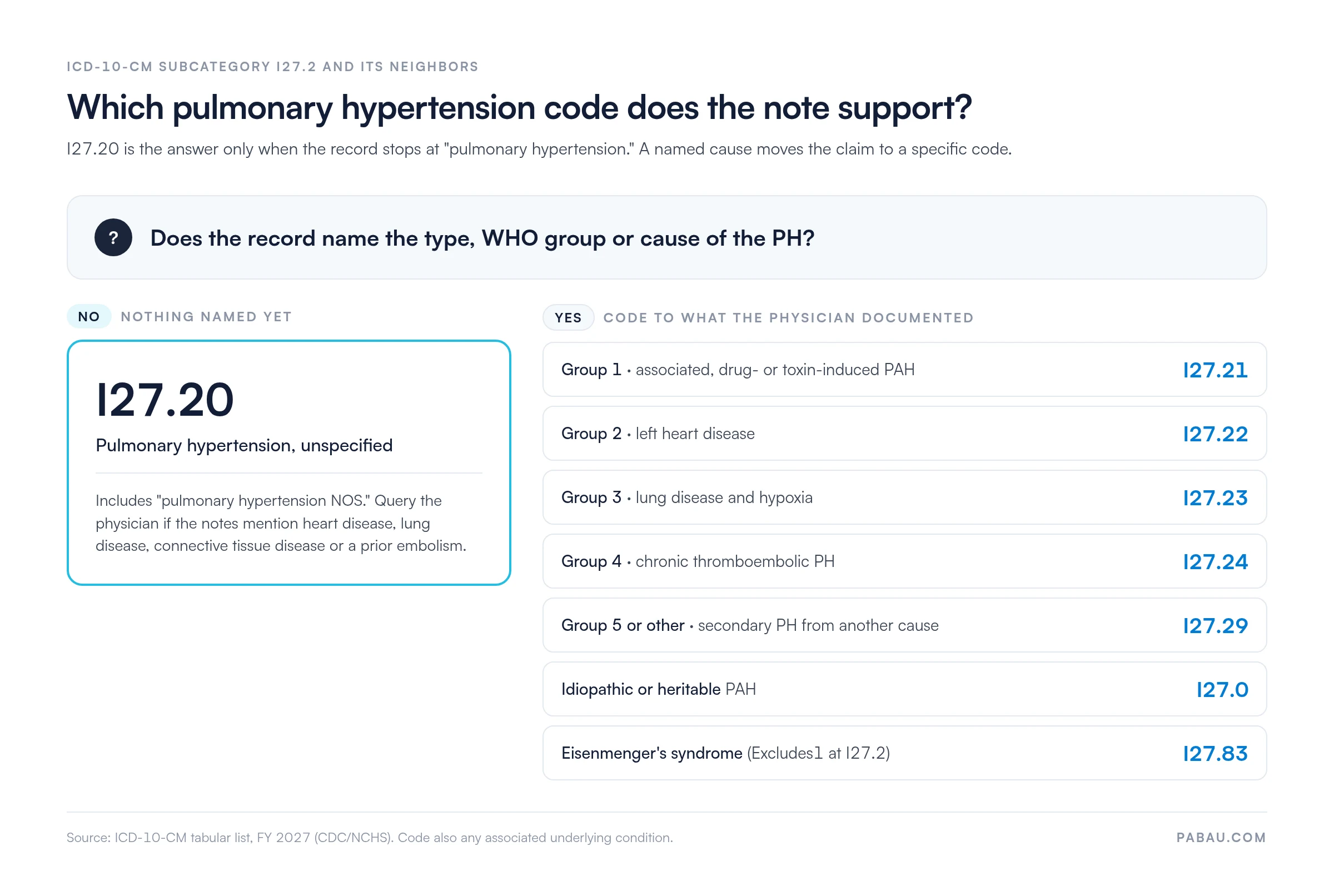
I27.20 sits in subcategory I27.2, beside five codes for PH with a known type or cause. Before you assign it, confirm that none of them fits the documentation. Choosing I27.20 when the chart supports a specific code is a common cause of payer queries.
The I27.20 versus I27.29 choice trips coders most often. I27.29 needs a documented secondary cause, while I27.20 needs none. If the physician writes “PH secondary to sarcoidosis”, the answer is I27.29 with the sarcoidosis code, not I27.20.
I27.21 is narrower than its name suggests. It covers Group 1 pulmonary arterial hypertension linked to a condition, a drug or a toxin. Right heart catheterization usually confirms it, with an elevated pulmonary vascular resistance (PVR).
Before you settle on I27.20, scan the note for a named cause: cardiac, pulmonary, thromboembolic, connective tissue or systemic. If you find one, a specific I27.2x code almost certainly fits. Query the physician to confirm it rather than leaving the claim on the unspecified code.
Apart from its inclusion term, I27.20 carries no notes of its own. The notes that apply come from its parent subcategory, I27.2, and from the neighboring code I27.0.
Pulmonary hypertension in a newborn is coded elsewhere, at P29.30 in the perinatal chapter. The tabular list sets no Excludes1 note between I27.20 and the other I27.2x codes. Coding convention still applies, though. Once a specific code describes the same PH, the unspecified code drops off the claim.
The code-also note matters most once PH is specified. For PH due to COPD, that means I27.23 plus a COPD code such as J44.9.
Documentation must show that pulmonary hypertension exists and how it was assessed. Payer criteria for PH generally follow the clinical standard for diagnosis, so the record that satisfies the cardiologist also satisfies the reviewer.
These billing compliance requirements belong in the encounter record before coding. Adding them after a denial is a red flag in a payer audit.
The tests that diagnose and monitor pulmonary hypertension carry their own CPT codes, often billed with I27.20 while the cause is still being worked up. Matching each procedure to a supported diagnosis helps avoid NCCI bundling edits and medical necessity denials.
Right heart catheterization, billed as 93451, is the test that confirms the diagnosis. When left heart pressures are measured in the same session, 93453 replaces it.
NCCI bundling edits change quarterly, so check any CPT pair before you submit it. The CMS ICD-10 codes page is the authoritative source for the current code set and its effective dates.
Here is how the code changes across one illustrative outpatient workup. The figures are illustrative, so keep them out of any payer policy or template.
Inpatient coding works differently. There, a diagnosis still documented as probable or suspected at discharge may be coded as if confirmed.
Prior authorization (PA) rules for services billed under I27.20 vary by payer, plan year and service. No single rule covers every Medicare Advantage or commercial plan. Still, some service types often trigger PA review when PH appears on the request. A written prior authorization process keeps those requests from stalling the workup.
Payers usually approve PA against the same criteria used to confirm the diagnosis. These include the documented mPAP, PVR from the RHC, WHO functional class and the specialist’s attestation. Pabau’s claims management software keeps the authorization code, its dates and its sessions on the patient’s case. It warns your team when an authorization is missing, before the service goes ahead.
Denials on I27.20 usually trace back to thin documentation, a code less specific than the chart allows, or a missing authorization. Structured denial management workflows catch these before they become write-offs.
The AAPC ICD-10-CM code lookup and the ICD List reference tool both show the tabular notes for I27.2 and its codes.
Run these before the claim leaves the practice. Each one maps to a denial reason above or to a coding rule earlier in this guide.
Patients with pulmonary hypertension often carry right heart and thromboembolic diagnoses too. Each one has its own code, and the names are easy to mix up.
A claim with I27.20, a cor pulmonale code and other comorbidities is legitimate in complex cardiology patients. Each code must reflect a separately documented condition, not one diagnosis split across several codes.
Before you add I27.81 to an I27.20 claim, confirm the physician addressed chronic cor pulmonale at that visit. A historical mention in the problem list does not support the code on its own.
PH claims pull from several places: the RHC report, the echo, the physician’s note and the payer’s authorization. When those live in separate systems, coders chase paperwork and claims go out late or incomplete.
In Pabau, the clinical record, the authorization and the claim sit on one patient case. The authorization code, its dates and its sessions are tracked there, and your team sees a warning when one is missing. US claims go out electronically through Claim.MD, which also runs eligibility checks before the visit.
The result is fewer missed authorizations and less time spent chasing documents. Your coders can focus on picking the right I27.2x code.

Pabau keeps authorization codes, dates and sessions on each patient case and warns you when one is missing. Claims and eligibility checks run through Claim.MD.

I27.20 is the right code only while the type or cause of pulmonary hypertension is undocumented. Treat it as a holding code during the workup, and recode once the physician names a cause. Confirmed secondary PH that fits nowhere else belongs to I27.29, not I27.20.
The biggest gain comes from asking one question before every PH claim: does the note name a cause? If it does, the claim needs a specific code. Book a demo to see how Pabau tracks authorizations on each case and sends PH claims through Claim.MD.

Want electronic claim submission and eligibility checks in one place? Pabau’s Claim.MD clearinghouse guide explains how the integration handles claim submission for cardiology practices.
Confused by denial codes on a pulmonary hypertension claim? Denial codes in medical billing breaks down CARC and RARC codes so you can find the root cause of a rejected I27.20 claim.
Looking to understand the full claim submission workflow? The 837 electronic claim file covers how ICD-10 diagnosis codes like I27.20 are structured in the HIPAA-mandated electronic transaction format.
It means pulmonary hypertension, unspecified, also called pulmonary hypertension NOS. It applies when the record confirms PH but gives no type, group or cause.
No. Since October 1, 2017, the start of FY 2018, I27.2 has been a subcategory heading. Claims need a full code such as I27.20, I27.23 or I27.29.
Use I27.23, pulmonary hypertension due to lung diseases and hypoxia. Code the COPD as well, for example J44.9, under the code-also note for the underlying condition.
Idiopathic and heritable PAH take I27.0, primary pulmonary hypertension. PAH linked to a condition, a drug or a toxin takes I27.21, secondary pulmonary arterial hypertension.
Use P29.30, pulmonary hypertension of newborn, from the perinatal chapter. I27.20 is not used for a newborn’s PH.