ICD-10 Code V91.84XS: Other burn due to burning watercraft
ICD-10 Code V91.84XS: overview and key facts ICD-10 Code V91.84XS identifies the...

Last Updated: Oct 30, 2026
Billable Code Specific Code
S92.909D is the billable ICD-10-CM code for unspecified fracture of unspecified foot, subsequent encounter for fracture with routine healing. It applies to follow-up visits after active treatment, while the fracture heals as expected.
Assignment turns on two choices. The 7th character is D, not A, once the patient is in follow-up care. The side stays unspecified only when the record does not say which foot is fractured.
Let Pabau's smart automation suggest the right codes, reduce claim denials, and keep your practice compliant—effortlessly.
Automate repetitive tasks and focus on what matters most—your patients.
Reduce coding errors and ensure compliance with the latest regulations.
Clean claims, fewer denials, and faster reimbursements.
Powerful insights and reporting to help your practice thrive.
HIPAA compliant SOC 2 certified GDPR-compliant Trusted by 4,000+ clinics worldwide

Use S92.909D only when the record does not say which foot is fractured. Once right or left is charted, code S92.901D or S92.902D instead.
The 7th character D means a subsequent encounter with routine healing, distinct from G (delayed healing), K (nonunion), P (malunion) and S (sequela).
Z47 aftercare codes are not reported with S92.909D, because the D character already records the follow-up visit under ICD-10-CM Official Guidelines Section I.C.19.a.
Pabau’s claims management software sends S92.909D claims through its Claim.MD integration, checks eligibility in real time and flags denials when remittances return.
ICD-10 Code S92.909D is the billable ICD-10-CM code for a follow-up visit on a foot fracture that is healing normally. It applies when the record names neither the fractured bone nor the injured side. The code is valid for dates of service from October 1, 2015, and is confirmed active for FY2025 and FY2026.
The table below gives coders the at-a-glance reference they need before the first claim goes out.
S92.909D describes a foot fracture with no named bone and no recorded side, seen at a follow-up visit while it heals normally. Each character carries its own meaning, and misreading one produces the wrong code.
The breakdown below lays out each position, plus the codes to switch to when the record says more.
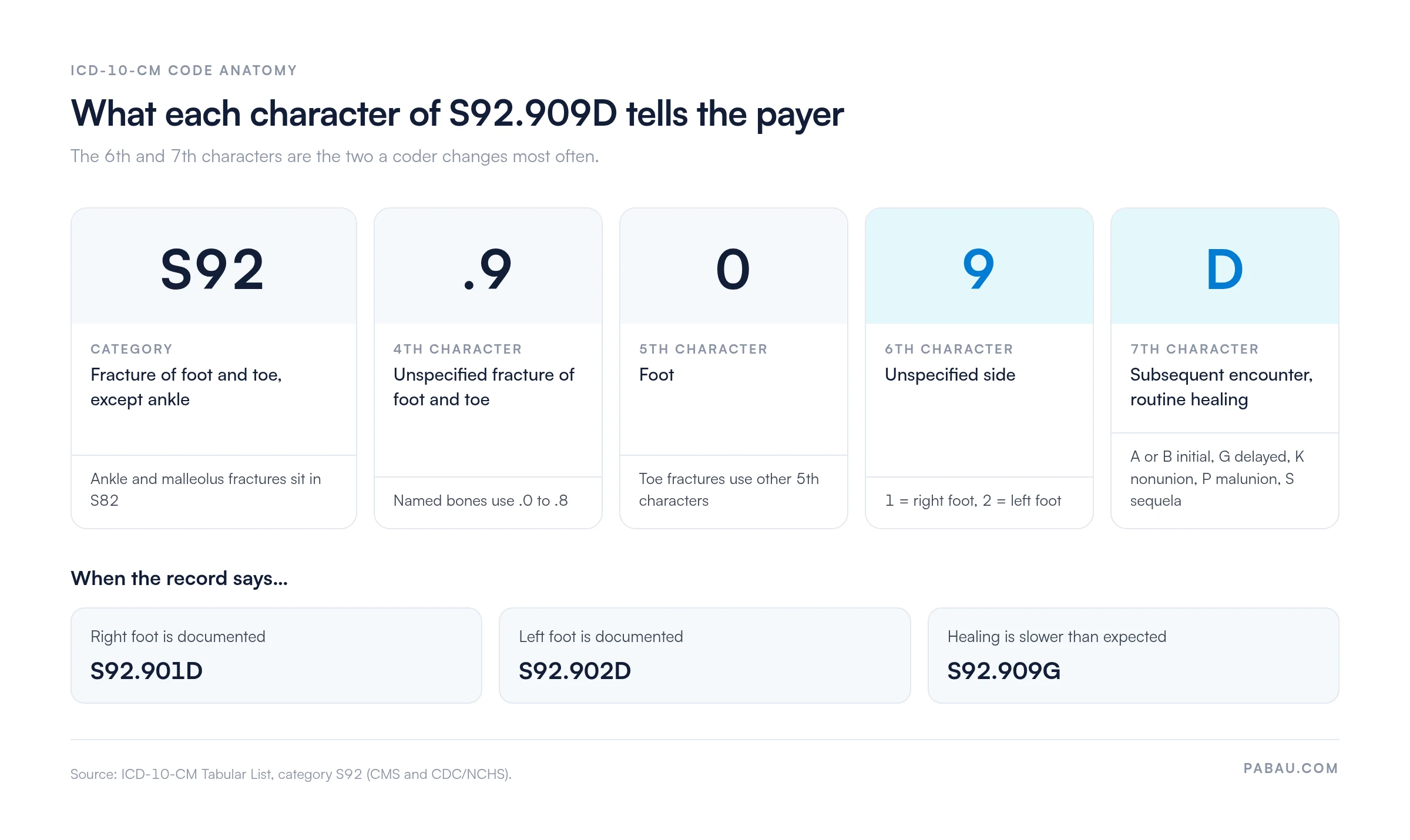
The code holds two separate “unspecified” choices, which trips up newer coders. The 4th character leaves the fractured bone unspecified, while the 6th character leaves the side unspecified. Each choice follows its own documentation rule.
The 7th character D marks a follow-up visit after active treatment has ended, while the fracture heals as expected. Under ICD-10-CM Official Guidelines Section I.C.19.a, D is used once active treatment is complete and the patient receives routine care during healing or recovery.
The switch from A to D happens when active treatment ends and routine follow-up begins. There is no fixed number of days. It is a clinical determination based on whether the provider is still applying or adjusting active treatment, or is monitoring the healing course.
Code S92.909D when the patient returns for care after the initial treatment decision, the fracture is healing as expected and the side is undocumented. A typical visit is a cast or boot check, an X-ray review or a physical therapy progress evaluation.
Linking each encounter type to the correct 7th character in the clinical note at the point of care removes a manual code review step.
Document the healing status in every subsequent fracture note. A phrase such as ‘fracture healing as expected on today’s imaging’ supports the D character if the claim is audited. A progress note that says nothing about healing leaves the D character without support.
The 6th character 9 in S92.909D means the side is unspecified, so neither the right nor the left foot is coded. The Uniform Hospital Discharge Data Set (UHDDS) principle asks coders to assign the code that most accurately reflects the diagnosis. Laterality must therefore be coded whenever it is documented or readily determinable from the record.
The safest workflow is to query the provider before submission instead of after a denial. If the treating clinician confirms the side, amend the code to the specific variant. If the record stays ambiguous and the provider cannot be reached in time, S92.909D is appropriate. Document the query attempt in the coding log.
Coders routinely need to tell S92.909D apart from neighboring codes in the same family. The table below covers the most common choices and the deciding factor for each.
Excludes notes: The S92 category carries an Excludes2 note for fractures of the ankle and malleolus (S82.-). S92.909D does not apply to ankle fractures, even when the foot and ankle are injured together. Code ankle fractures from S82 separately.
A claim for S92.909D that survives payer scrutiny rests on four documentation elements. Missing any one of them can trigger a denial or a RAC recoupment demand.
For Medicare and Medicaid claims, medical billing compliance requires documentation for every coded element within the same date-of-service record. A query-and-addendum workflow can support the claim, but the addendum must predate submission. Running insurance eligibility verification before the encounter also lowers the risk of billing the wrong payer.
S92.909D denials cluster around predictable patterns. Orthopedic and urgent care teams resolve them faster at the workflow level than case by case on appeal. The table below maps each pattern to its fix, a core step in denial management workflows.
Getting a clean claim accepted on the first submission keeps orthopedic follow-up revenue on track. When a claim does come back denied, the denial codes reference explains what each reason code on the remittance means.
Practices using Pabau submit S92.909D claims as CMS-1500 forms through its Claim.MD integration, with real-time eligibility checks before the visit. Claim status tracking and denial flags then show which claims need attention once the payer responds.
The right CPT code for a subsequent fracture encounter depends on the service performed, not on the ICD-10 code alone. The table below lists common pairings for standard follow-up scenarios. Confirm each one against the current NCCI edit file at CMS.gov, because the edits change with annual updates.
CPT fracture care codes such as 28470 (closed treatment of metatarsal fracture) belong to the initial treatment encounter (A). Billing one on a D-coded follow-up with no new fracture management triggers a bundling edit. Use E&M codes for monitoring visits unless the provider performed an active procedure.
In Pabau’s claims software for coders, the CPT and ICD-10 codes for each visit go out together on one CMS-1500 claim.

Z47 aftercare codes are not used when an injury code with a 7th character D is available. The rule is often misunderstood, and breaking it puts every affected claim at risk of an edit or a denial.
ICD-10-CM Official Guidelines Section I.C.19.a sets the rule. For follow-up visits during healing, the injury code with the appropriate 7th character is the correct code. Z47.89 (encounter for other orthopedic aftercare) and Z47.1 (aftercare following joint replacement surgery) are not used alongside it. S92.909D already records the follow-up for a healing fracture.
Once healing is complete and a late effect remains, the sequela code S92.909S is used instead. Applying the injury-versus-aftercare rule consistently prevents the same error on every subsequent encounter code, not just S92.909D.
Follow-up fracture claims often stall in the billing office. A biller rechecks coverage by phone, keys the claim into a payer portal and hears about a denial weeks later.
Pabau connects to Claim.MD, so the claim leaves from the same patient record that holds the follow-up note. Eligibility is checked in real time, and the CMS-1500 goes out electronically with its status tracked in one place.
When the payer responds, Pabau matches the electronic remittance to the claim and flags denials. Your team can then work each flagged S92.909D claim, such as one needing a corrected 7th character, while the filing window is still open.

Pabau sends your follow-up fracture claims through Claim.MD, checks eligibility in real time and flags denials when remittances arrive. See how the workflow fits your practice.

Treat S92.909D as a code the note has to earn. Assign it only when the record shows a follow-up visit on a healing fracture and says nothing about the side. If any report names the foot, S92.901D or S92.902D is the right code.
Build the provider query into the workflow before submission. A code corrected at that point costs a few minutes, and it keeps the claim out of the appeal queue.
Pabau’s electronic remittance advice processing through Claim.MD gives orthopedic and urgent care teams a real-time view of claim status, remittance data and flagged denials. Book a demo to see how Pabau handles fracture follow-up claims from the eligibility check to payment.

Struggling with high denial rates across your claim portfolio? Denial management in healthcare covers the systematic approach to reducing rejection rates across ICD-10-coded claims.
Need to verify eligibility before the fracture follow-up visit? Insurance eligibility verification outlines how real-time eligibility checks reduce downstream billing failures on subsequent encounter codes.
Want to understand how clean claims prevent orthopedic billing rework? Clean claim submission explains the elements payers require before they process a fracture follow-up claim without a request for information.
Has the fracture healed with a lasting late effect? ICD-10 Code S92.909S covers the sequela code for the same unspecified foot fracture.
Applying new strapping at the follow-up visit? CPT code 29540 explains how to bill ankle and foot strapping alongside the diagnosis.
ICD-10 Code S92.909D is the billable diagnosis code for an unspecified fracture of an unspecified foot, subsequent encounter for fracture with routine healing. It applies when the patient receives follow-up care after the initial treatment phase and the fracture is healing without complication. The “unspecified foot” portion means the record does not document the right or left side.
Use S92.909A at the first active-treatment visit for a closed fracture, typically the emergency department, urgent care or the first orthopedic appointment. Switch to S92.909D for follow-up visits where the provider is monitoring healing rather than starting new treatment. There is no fixed number of days. The transition is a clinical determination based on whether active treatment is still in progress.
Yes. S92.909D is appropriate when laterality is unknown or undocumented at the time of coding. The operative note, radiology report or provider dictation may still name the right or left foot. If any of them does, use S92.901D (right foot) or S92.902D (left foot) instead. Defaulting to unspecified at that point is a coding error and an audit risk.
Yes. S92.909D is billable to Medicare Part B for outpatient orthopedic and primary care follow-up visits, and Medicaid coverage varies by state. CMS and Medicare Administrative Contractors scrutinize high volumes of unspecified fracture codes. Limit S92.909D to encounters where laterality is undocumented, rather than using it to avoid a specificity decision.
No. Per ICD-10-CM Official Guidelines Section I.C.19.a, Z47 aftercare codes are not used when an injury code with the 7th character D is available. S92.909D already captures the follow-up context. Using Z47.89 alongside S92.909D is a double-coding error that can trigger a claim edit or denial.
The most common pairing is an office visit E&M code (99211-99215) for the follow-up encounter. When imaging is obtained at the visit, 73630 (foot X-ray) is often added. Physical therapy visits pair S92.909D with therapeutic exercise codes such as 97110. Fracture care CPT codes (28470, 28475) are for initial treatment, so they rarely fit a D-coded follow-up without new fracture management.