





ICD-10 code T86.829: Unspecified skin graft complication
ICD-10 code T86.829: Definition, billable status, and quick reference ICD-10 cod...

Last Updated: Sep 15, 2026

Billable Code Specific Code
S92.403K is the billable ICD-10-CM code for displaced unspecified fracture of unspecified great toe, subsequent encounter for fracture with nonunion.
This page covers the official description, the code hierarchy, and the 7th character logic. It also covers the sibling codes and the documentation payers expect before they pay a K-suffix claim. Two characters carry most of the risk. The 7th sets the encounter type, and the 5th sets how specific the claim looks.
Let Pabau's smart automation suggest the right ICD codes, reduce claim denials, and keep your practice compliant—effortlessly.
Automate repetitive tasks and focus on what matters most—your patients.
Reduce coding errors and ensure compliance with the latest regulations.
Clean claims, fewer denials, and faster reimbursements.
Powerful insights and reporting to help your practice thrive.
HIPAA compliant SOC 2 certified GDPR-compliant Trusted by 4,000+ clinics worldwide

ICD-10 code S92.502K means displaced unspecified fracture of left lesser toe(s), subsequent encounter for fracture with nonunion. It is billable and HIPAA-valid.
The 7th character K marks a visit for a fracture that failed to unite. It is not routine follow-up (D) and not delayed healing (G).
The 5th character 0 means the record never named the phalanx. Documenting proximal, middle, or distal moves the code to S92.51-, S92.52-, or S92.53-.
Lesser toes are the second through fifth toes. The great toe sits in its own subcategory, S92.4-, so a hallux fracture never belongs here.
Pabau, our practice management software, files CMS-1500 claims through the Claim.MD clearinghouse and runs real-time eligibility checks.
S92.502K is a billable, specific ICD-10-CM diagnosis code. Its full official description is: Displaced unspecified fracture of left lesser toe(s), subsequent encounter for fracture with nonunion. The code is valid on HIPAA-covered claim transactions across all payer types, including Medicare, Medicaid, and commercial insurers.
The code has been valid since the first ICD-10-CM edition in FY2016 and carries into FY2026, effective October 1, 2025. It has no age or sex edits and is exempt from present on admission reporting. Confirm continued validity in the CDC/NCHS ICD-10-CM web tool at the start of each fiscal year.
Every character in S92.502K carries a separate clinical fact, and misreading one produces a code for a different body part or a different encounter. The breakdown below follows the FY2026 tabular list.
Three of those characters do the work that separates S92.502K from its neighbors. The diagram below sets them side by side.
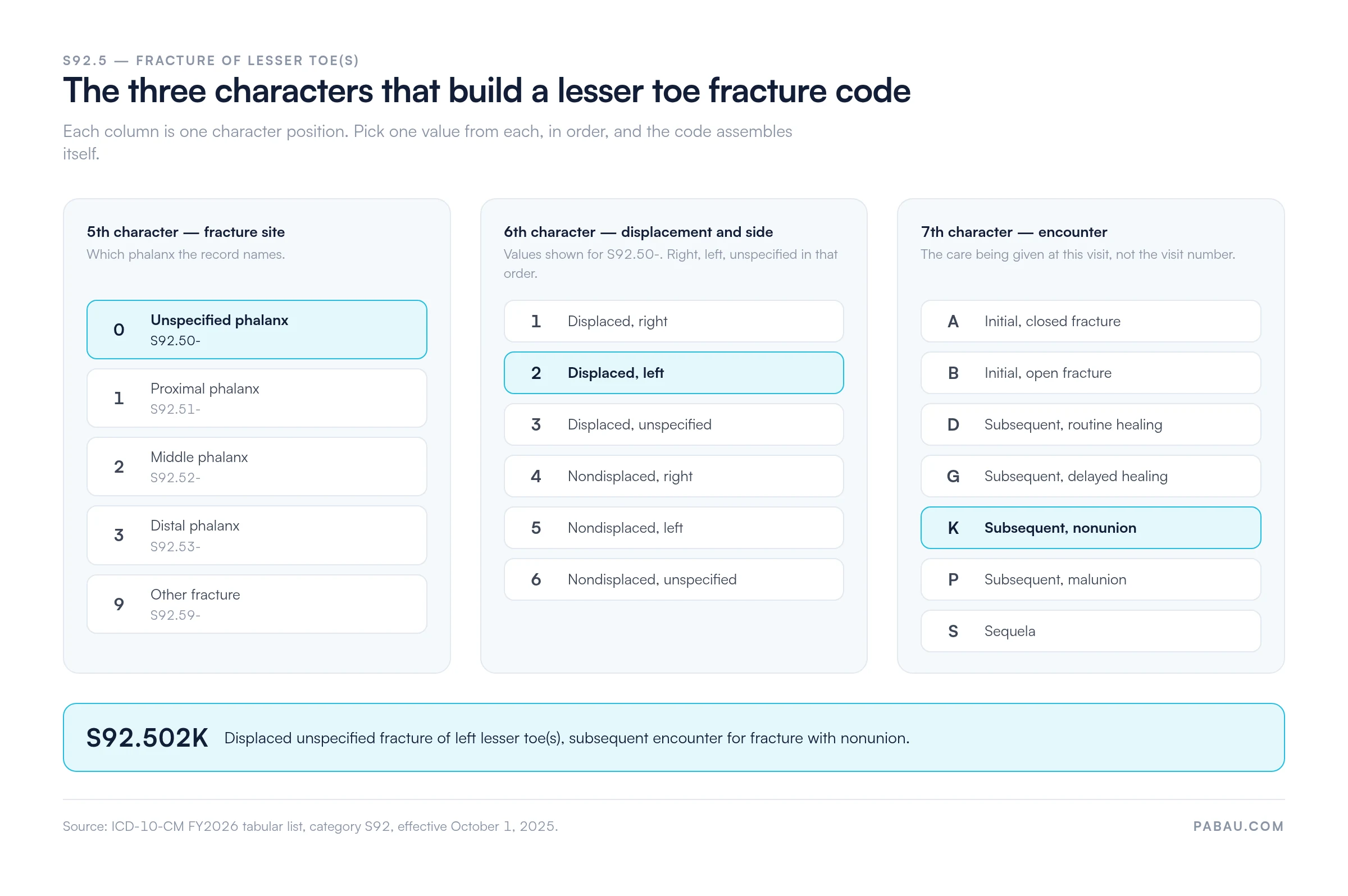
S92.5 covers the lesser toes only, meaning the second through fifth toes. The great toe has its own subcategory, S92.4-, so a hallux fracture never belongs in this family. ICD-10-CM does not offer a code for an individual lesser toe. That makes “lesser toe(s)” as narrow as the toe axis gets, whatever the chart says about the third toe.
The specificity that is available runs along a different axis: the phalanx. S92.51- is the proximal phalanx, S92.52- the middle phalanx, and S92.53- the distal phalanx. A record that names the fractured phalanx earns one of those codes. The unspecified subcategory S92.50- is what the coder is left with when it does not.
One more sibling sits outside that pattern. S92.59- covers other fracture of lesser toe(s). A physeal fracture of a toe phalanx is coded outside S92.5 entirely, in S99.2-, so a growth-plate injury never lands here.
Displacement means the bone fragments have moved out of anatomical alignment, and the treating clinician or radiologist establishes it. The 6th character carries displacement and laterality together. Under S92.50-, values 1, 2 and 3 are displaced right, left and unspecified, and values 4, 5 and 6 are the nondisplaced equivalents.
The tabular note at category S92 sets two defaults that coders often misapply. A fracture not indicated as displaced or nondisplaced is coded to displaced, and a fracture not indicated as open or closed is coded to closed. So silence in the chart lands on S92.502K rather than on the nondisplaced code S92.505K.
That default is a coding convention, not a substitute for documentation. It protects the coder from an invalid code, but it will not defend the claim if a payer asks what the imaging showed. Query the provider when displacement status is genuinely unclear.
The 7th character is the most consequential part of fracture coding and the place where S92.502K is most often miscoded. K has a precise meaning: the patient is under active management for a fracture that has failed to unite, not under observation while it heals.
Per the ICD-10-CM Official Guidelines for Coding and Reporting, Section I.C.19.a, the 7th character reflects the type of encounter. It does not reflect the age of the injury or the number of visits.
Nonunion is a clinical determination, and ICD-10-CM sets no week count for it. The provider documents the failed union, usually on imaging, and the coder follows that documentation.
Nonunion also has to be distinguished from its two neighbors. Delayed union means the fracture is still progressing, just slower than expected, and that encounter takes G instead. Malunion means the fracture healed in an abnormal position, which takes P instead. Using K for either one is a coding error.
Document the specific reason the K suffix applies at every encounter. Write “fracture nonunion confirmed by X-ray dated [date]” or “no callus formation at [weeks] post-injury on examination.” A note that says only “follow-up, toe fracture” leaves the payer free to read the visit as routine healing and pay the claim as D.
S92.502K sits at the bottom of the ICD-10-CM injury code hierarchy, under five parent levels that narrow from chapter to individual code. Every level above it is a header, so none of them can be submitted on a claim.
Every code in the S92.502 family shares one base description and differs only by 7th character. Move one character to the left and laterality changes instead. Knowing both axes is what stops a right-foot code or an initial-encounter code from reaching the clearinghouse. Pabau’s diagnostic code reference lists the sibling pages for the other ICD-10-CM categories.
The unspecified-laterality codes S92.503K and S92.506K exist for records that never state a side. Many payers treat unspecified laterality as a documentation failure on a paired body part, so a left-foot chart should reach the claim as S92.502K.
Every character in S92.502K has to be supported by the record, and one missing element is enough to have the claim denied or downcoded. Incomplete fracture documentation is a common reason these claims come back, so denial management for an orthopedic practice starts at the coding desk.
The checklist below is what payers look for before they accept a K-suffix fracture claim.
Practices that run post-fracture rehabilitation in house should carry the same laterality and healing status into the rehab notes. Coding consistency across the episode is what keeps the therapy claims aligned with the orthopedic ones.
Nonunion of a lesser toe fracture usually means extended management. That covers repeat imaging, a decision about fixation, and often therapy afterward. The codes below are the ones that commonly appear alongside S92.502K, though procedure coding always follows what was performed and documented. Check that each associated code reflects a service rendered and documented at that encounter.
Note the body part in those descriptors. The 28470 and 28485 codes that coders often reach for cover metatarsal fractures, not toe phalanges. They do not belong on a lesser toe claim. The great toe has its own pair as well, 28490 and 28505. That is why the “other than great toe” wording in 28510 through 28525 matters.
CPT also has no nonunion repair code for a toe phalanx. The nonunion and malunion repair family stops at the tarsal bones with 28320 and the metatarsal with 28322. A repaired lesser toe nonunion is therefore reported with 28525. When the work performed does not match a listed code, use 28899 for an unlisted procedure of the foot or toes.
The billing workflow for a nonunion case usually spans several encounters and more than one provider type. A charge-capture system that carries the diagnosis code and its 7th character forward across visits keeps the encounter type from drifting. That matters most between the orthopedic assessment and the rehabilitation claims.
Two of those need care. A pathological fracture and a traumatic fracture are not both coded for the same break. M80.872 and S92.502K describe alternative clinical pictures rather than a pair. And the external cause code takes the 7th character that matches the encounter, so a nonunion visit pairs with W19.XXXD, not W19.XXXA.
S92.502K is valid on CMS-1500 claim forms and 837P electronic transactions, and payers expect it as the primary diagnosis on a nonunion management visit. The visit may also carry an E/M service. In that case the level has to be supported by the medical decision-making or the time documented for the nonunion assessment.
Practice management software like Pabau can route these claims for you. Pabau’s paperless claims management turns the invoice into an electronic CMS-1500 claim. That claim goes out through the Claim.MD clearinghouse to thousands of US payers. Real-time 270/271 eligibility checks run from the patient’s record, so coverage problems surface before the visit rather than after the denial.
Nonunion cases are long, which is where claim visibility earns its keep. Every claim’s status comes back into Pabau as it moves through submission, acceptance, payment, or denial. Each electronic remittance advice is tied to the claim it settles. Your billers reconcile a multi-visit episode without re-keying figures into a separate portal.
Submitting through the Claim.MD integration also keeps the paper trail in one place. A coder revisiting a six-month-old encounter can see which 7th character went out on the claim.
For additional coding context, the AAPC Codify entry for S92.502K carries crosswalk data linking the code to related procedures and Medicare coverage policies.

Pabau turns invoices into electronic CMS-1500 claims through Claim.MD, with real-time eligibility checks and electronic remittance advice for orthopedic and musculoskeletal practices.

Nonunion fracture coding fails most often when the 7th character goes on the claim ahead of the documentation that supports it. S92.502K is a narrow code. It needs a left-sided lesser toe, a displaced fracture, a confirmed failure to unite, and an active-management visit rather than routine follow-up. Get one of those four wrong and the claim is exposed.
The specificity trap is quieter. S92.50- exists because the record did not name the phalanx. A note that says “displaced fracture of the proximal phalanx, fourth toe, left” belongs in S92.512K instead. Reading the operative or imaging note before coding is usually all it takes.
Pabau’s billing workflows and the Claim.MD integration help musculoskeletal practices submit these multi-visit claims accurately and follow them through to payment. To see how Pabau handles fracture billing end to end, book a demo.

Need to understand how clearinghouse submissions work? Claim.MD vs Office Ally compares the two most-used US clearinghouses for orthopedic and musculoskeletal billing.
Want to reduce claim denials across your practice? Denial codes in medical billing covers the most common CARC and RARC codes that affect fracture and musculoskeletal claims.
Managing a multi-provider orthopedic or rehab practice? How to get credentialed with insurance companies walks through the payer enrollment steps required before submitting claims under a new provider.
Coding one fracture episode across several visits? What a superbill is explains how to carry the diagnosis code and its 7th character forward between encounters.
Reconciling payment on a long-running claim? Electronic remittance advice covers how to read an ERA and match it to the claim it settles.
S92.502K is a billable ICD-10-CM diagnosis code for a displaced unspecified fracture of left lesser toe(s), subsequent encounter for fracture with nonunion. It applies when a patient returns for active management of a left lesser toe fracture that has failed to unite. The word unspecified refers to the phalanx, which the record did not name, not to the side or the toe.
Yes. S92.502K is a billable, specific ICD-10-CM code valid on HIPAA-covered transactions, including Medicare, Medicaid, and commercial payer claims. It is also exempt from present on admission reporting. Its parents S92.502, S92.50, S92.5 and S92 are all non-billable headers, because they stop short of the character specificity a claim needs.
Commonly paired codes include 73630 for a complete foot X-ray and 99213 through 99215 for the office visit. Closed treatment of a phalanx fracture other than the great toe is 28510 or 28515, and 28525 covers open treatment with fixation. The 28470 and 28485 codes cover metatarsal fractures and do not apply to a toe. Procedure coding always follows what was performed and documented.
The record has to state the side (left foot) and characterize the fracture as displaced. It also needs imaging findings and a date that evidence the nonunion. Finally, it has to show the visit is for active nonunion management rather than initial treatment. Name the phalanx if it is known, because that moves the case to a more specific code. Those elements together support S92.502K without a provider query.