ICD-10 Code X95.02XS: Assault by paintball gun, sequela
ICD-10 code X95.02XS: Quick reference and billable status ICD-10 code X95.02XS i...

Last Updated: Oct 29, 2026
Billable Code Specific Code
Y74.2 is the billable ICD-10-CM code for prosthetic and other implants, materials and accessory general hospital and personal-use devices associated with adverse incidents.
Coders report it alongside a primary condition code when an implant from the general hospital and personal-use class breaks down or malfunctions. It is never the principal diagnosis. Specialty implants take their own code instead, such as Y71.2 for a pacemaker or Y79.2 for a hip prosthesis.
Let Pabau's smart automation suggest the right codes, reduce claim denials, and keep your practice compliant—effortlessly.
Automate repetitive tasks and focus on what matters most—your patients.
Reduce coding errors and ensure compliance with the latest regulations.
Clean claims, fewer denials, and faster reimbursements.
Powerful insights and reporting to help your practice thrive.
HIPAA compliant SOC 2 certified GDPR-compliant Trusted by 4,000+ clinics worldwide

Y74.2 covers implants, prosthetic materials and accessories from the general hospital and personal-use device class. Examples include devices in the FDA general hospital class, such as implantable patient-ID transponders.
It is a billable supplementary external cause code and can never be sequenced as the principal diagnosis.
Specialty implants take their own code: Y71.2 for cardiovascular devices, Y79.2 for orthopedic devices, Y77.2 for ophthalmic devices and Y72.2 for ENT devices.
Codes in Y70-Y82 need a documented device breakdown or malfunction. A complication with an intact, working device goes to Y83-Y84 instead.
Claims are most often denied because of incorrect sequencing as a primary diagnosis or a missing paired condition code.
Pabau’s claims management software supports electronic claim submission through the Claim.MD clearinghouse.
ICD-10 code Y74.2 is assigned the official descriptor “Prosthetic and other implants, materials and accessory general hospital and personal-use devices associated with adverse incidents.”
It is a supplementary external cause code. You report it after the condition code when an implant from this device class breaks down or malfunctions.
Y74.2 is valid and billable under ICD-10-CM for fiscal year 2027, confirmed by the CDC/NCHS ICD-10-CM code lookup tool. The table below gives the quick-reference profile.
Y74.2 applies when an implant, prosthetic material or accessory from the general hospital and personal-use device class breaks down or malfunctions. The ICD-10-CM note for the Y70-Y82 block limits these codes to device breakdown or malfunction, whether during use, after implantation or in ongoing use.
General hospital and personal-use devices are the equipment used across every ward rather than in one specialty, so few implants belong to this class. The ICD-10-CM index does not name individual devices under Y74.2. The examples below come from the FDA’s general hospital and personal-use device panel (21 CFR Part 880), which shares the Y74 category’s name:
Two conditions must both hold. The device is an implant, prosthetic material or accessory, and it belongs to the general hospital and personal-use class. Therapeutic nonsurgical and rehabilitative devices in that class, such as medical support stockings, go to Y74.1. Diagnostic and monitoring devices go to Y74.0.
Specialty implants use their own Y-code. The Y70-Y82 block is sorted by device specialty first. The fourth character then sets the device type, and .2 means prosthetic and other implants, materials and accessory devices in every specialty. So most implants are coded outside Y74:
Reserve Y74.2 for implants in the general hospital and personal-use class that no specialty category fits.
Y74.2 sits within the Y70-Y82 block of ICD-10-CM, which covers medical devices associated with adverse incidents. The CDC/NCHS tabular list publishes the block and its notes. Within that block, the Y74 category groups all general hospital and personal-use device codes together. The table below shows the full sibling structure of the Y74 family.
Use the AAPC Codify ICD-10-CM lookup to verify the current hierarchy and any Excludes notes before finalizing a code selection. Y74 has no .4 to .7 or .9 subcodes. A device complication without a breakdown or malfunction falls outside the block, under Y83-Y84 codes such as Y83.9.
Within Y74, the device type decides the subcode, not the nature of the adverse incident. Every Y74 code describes a device breakdown or malfunction, and only the type of device differs. The examples below follow the FDA’s general hospital and personal-use device list.
Key test: First, name the device’s specialty. A cardiovascular, orthopedic, ophthalmic or other specialty device takes its own category, so a pacemaker lead goes to Y71.2 and a hip component to Y79.2. Only a general hospital or personal-use device stays in Y74. Then pick the fourth character by device type, and use .2 for an implant, prosthetic material or accessory. The path below runs those checks in order.
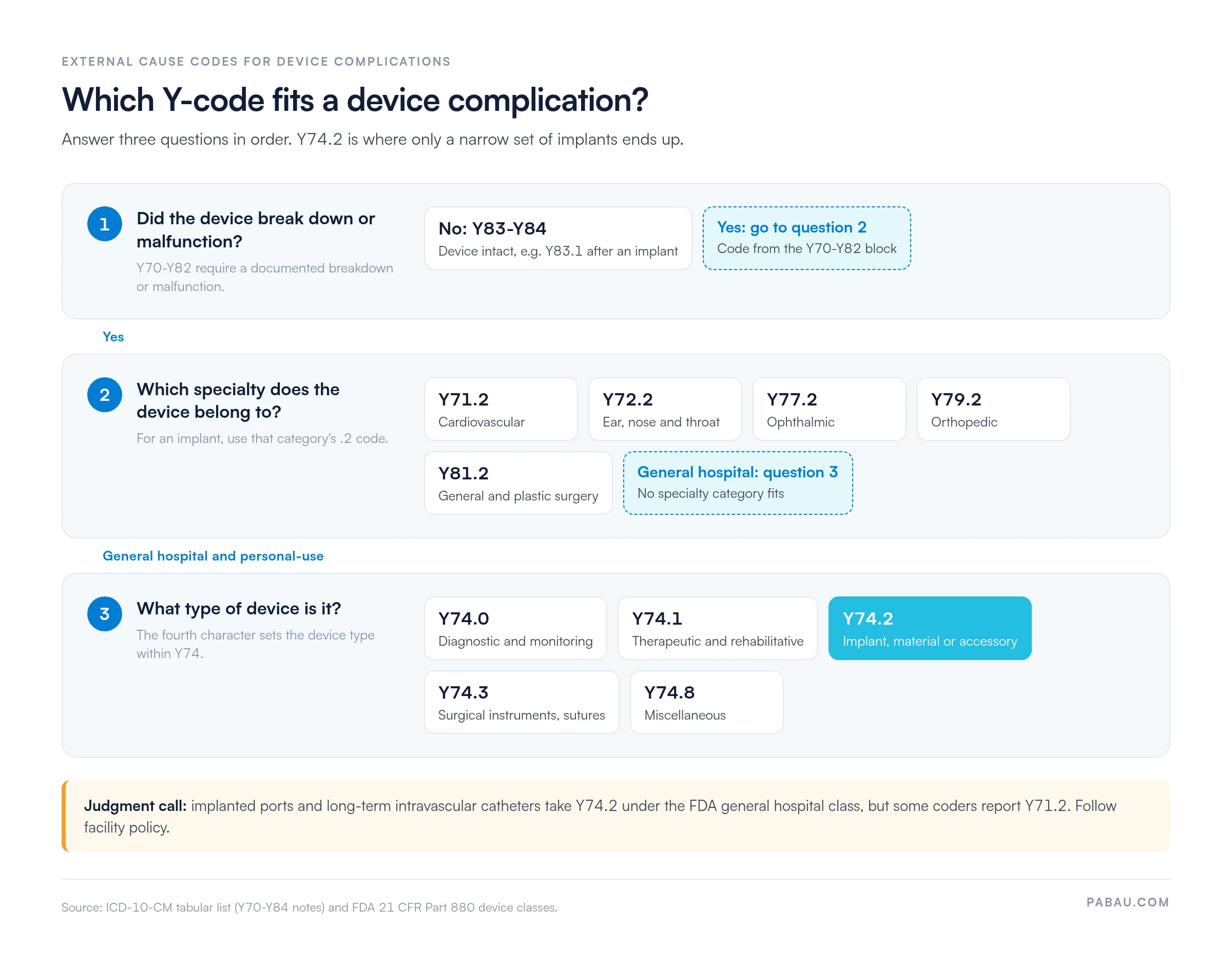
Implanted ports and long-term intravascular catheters are the hard case. Their Y74.2 examples come from the FDA general hospital class, and ICD-10-CM does not list devices. Because these devices sit in the vascular system, some coders assign them to Y71.2 instead.
Y74.2 is an external cause code. Under ICD-10-CM Official Guidelines Section I.C.20, external cause codes are always supplementary. They describe the circumstances of an injury or adverse effect. They are reported after the condition or complication code that describes what happened to the patient. A grounding in medical billing fundamentals helps billers apply this sequencing rule consistently.
The sequencing rules for Y74.2 in practice:
Y74.2 cannot be the principal diagnosis under any circumstance. A claim filed with Y74.2 as the first-listed code will be rejected. The code also cannot stand alone on a claim. Payers need the paired condition code to see the full clinical picture.
When pairing Y74.2 with a Chapter 19 T-code, confirm the 7th character matches the episode of care. Use A for initial, D for subsequent and S for sequela. A mismatch between the T-code encounter type and the clinical narrative is a common reason for claim review requests.
Medical record documentation must support every element of the Y74.2 code assignment. Payers and auditors look for three facts: the device, its failure, and the link between the two.
The medical record must contain all of the following to support Y74.2:
Coders should query the treating physician when the adverse incident is documented but no explicit device linkage statement appears. Query as well when the record does not name the device type, because the specialty decides the Y-code.
Medicare and Medicaid accept Y-series external cause codes as supplementary codes on inpatient and outpatient claims, but do not typically require them for reimbursement. Prior authorization is triggered by the primary procedure or condition codes, not by Y74.2 itself. Commercial payers vary. Some require external cause codes for adverse device events as part of medical necessity documentation, and others treat them as informational only.
Practical payer considerations for Y74.2 claims:
A clearinghouse that runs claim edits before transmission catches many errors before they reach the payer. Our guide to the Claim.MD clearinghouse covers real-time claim editing and payer enrollment.
Claims carrying Y74.2 are denied for a predictable set of reasons. Each denial type has a specific resolution path.
Our denial codes reference and denial management workflow guide show how to track and resolve denials across code types.
The following vignettes show correct code sequencing for Y74.2 and two cases where a different external cause code applies. Each example includes the clinical scenario, the correct primary code, and the external cause assignment.
A patient receiving chemotherapy through a subcutaneous implanted port presents because the port no longer flushes. Imaging shows a fractured port catheter. The breakdown is the primary reason for the visit.
A patient is admitted with symptomatic bradycardia traced to a fractured lead of a previously implanted cardiac pacemaker.
A patient develops a deep infection around a spinal internal fixation device placed six weeks earlier. The hardware is intact and working as intended. The infection is the primary reason for the hospital admission.
ICD-11 restructures how medical device adverse incidents are classified. The concept covered by Y74.2 carries over to ICD-11 but is coded differently. Device type and failure mode (such as structural failure or dislodgement) are coded in Chapter 23.
For US billing purposes, this is informational only. ICD-10-CM 2027 remains the operative classification for all US clinical billing. CMS has not adopted ICD-11 for claim submission, and no transition date has been announced. Coders working in the US should continue using Y74.2 under ICD-10-CM and monitor CMS announcements for any future transition guidance.
Reference the WHO’s ICD-11 browser to explore how prosthetic and implant adverse incidents are classified in the ICD-11 framework for research or international reporting purposes.
A Y74.2 claim usually comes back over a detail. A missing condition code, a wrong seventh character or a thin device record sends it to rework, and each resubmission costs your billing team time.
Pabau, the practice management platform we build, includes claims software for practices. It validates each claim for missing or invalid details before it is sent to the Claim.MD clearinghouse. The integration supports electronic claim submission to thousands of US payers and real-time eligibility checks.
Treatment notes and invoices sit in the same patient record. When a payer queries the device link, your coder can check the documented device and failure without switching systems.

Pabau’s claims management workflow validates claims for missing or invalid details before submission, so your billing team spends less time on rework.

Y74.2 is a narrow code, so reach for it last. Most implant failures belong to a specialty category, and a complication with an intact device belongs in Y83-Y84.
The judgment call is vascular access devices. Ports and long-term catheters follow the FDA general hospital class into Y74.2, but some coders report Y71.2. Set a facility rule, document it, and apply it the same way on every claim, so an audit finds one consistent answer.
Pabau supports electronic claim submission through the Claim.MD clearinghouse, with validation for missing or invalid details before each claim goes out. Book a demo to see how that cuts rework on device-complication claims.

Need a framework for managing device-related claim denials? Denial management in healthcare covers the end-to-end workflow for tracking, appealing, and resolving denied claims.
Want to understand how clearinghouse validation prevents coding errors? How Claim.MD clearinghouse works explains real-time claim editing, ERA processing, and payer enrollment.
Looking for a reference on denial code categories? Denial codes in medical billing maps common CARC and RARC codes to resolution steps.
Coding a complication where the device still works? ICD-10 code Y83.9 covers a surgical procedure behind a later complication, with no misadventure at the time.
ICD-10 code Y74.2 is a billable external cause code for the breakdown or malfunction of a general hospital or personal-use implant, prosthetic material or accessory. It is always reported as a supplementary code alongside a primary condition or complication code, never as a standalone or principal diagnosis.
No. Y74.2 is an external cause code and cannot be sequenced as the principal or first-listed diagnosis. ICD-10-CM Official Guidelines Section I.C.20 requires external cause codes to be supplementary to the condition code describing the patient’s clinical presentation.
Y74.1 covers therapeutic (nonsurgical) and rehabilitative general hospital and personal-use devices, such as medical support stockings. Y74.2 covers implants, prosthetic materials and accessories in the same general hospital and personal-use class. Neither code fits a specialty implant. A pacemaker takes Y71.2, and a hip prosthesis takes Y79.2.
Common denial reasons are Y74.2 coded as the primary diagnosis, a missing primary condition code, and weak documentation linking the device to the incident. Another problem is reporting Y74.2 for a specialty implant, such as a pacemaker or hip prosthesis, which belongs in Y71.2 or Y79.2.
The medical record must name the specific device, describe the breakdown or malfunction, and include a provider statement linking the device to the patient’s condition. Operative notes, imaging reports, and the original implantation date strengthen the documentation and reduce audit exposure.
Y74.2 pairs with the T-code that describes the complication of a general hospital implant. For an implanted port or long-term intravascular catheter, the T82.5- code (T82.514A breakdown, T82.524A displacement) pairs with Y74.2 under the FDA general hospital class. Some coders choose Y71.2 instead. T82.1- cardiac electronic device complications pair with Y71.2. T84 mechanical complications (breakdown or malfunction) of orthopedic devices pair with Y79.2.