ICD-10 Code Y74.2: General hospital and personal-use implant failure
ICD-10 code Y74.2: Definition, descriptor, and billable status ICD-10 code Y74.2...

Last Updated: Oct 29, 2026
Billable Code Specific Code
S12.390D is the billable ICD-10-CM code for other displaced fracture of fourth cervical vertebra, subsequent encounter for fracture with routine healing.
It applies when the record places the fracture at C4, shows it displaced or never states its alignment, and describes a follow-up during routine healing. S12.391D is its nondisplaced twin. The subcategory digit sits one behind the vertebra, so S12.3 is C4.
Let Pabau's smart automation suggest the right codes, reduce claim denials, and keep your practice compliant—effortlessly.
Automate repetitive tasks and focus on what matters most—your patients.
Reduce coding errors and ensure compliance with the latest regulations.
Clean claims, fewer denials, and faster reimbursements.
Powerful insights and reporting to help your practice thrive.
HIPAA compliant SOC 2 certified GDPR-compliant Trusted by 4,000+ clinics worldwide

S12.390D codes an “other” displaced fracture of the fourth cervical vertebra (C4) at a follow-up visit with routine healing.
It is the displaced code, and S12.391D is its nondisplaced twin. A note that never states alignment defaults to displaced, so it lands here.
The subcategory digit sits one behind the vertebra: S12.3 is C4, while C7 fractures live under S12.6.
Use D only while the fracture heals as expected; switch to G for delayed healing, K for nonunion, and S once it has healed.
Any associated cervical spinal cord injury is coded first, from S14.0 or S14.1-, with S12.390D listed after it.
ICD-10 code S12.390D is the billable code for an “other” displaced fracture of the fourth cervical vertebra (C4). It is reported at follow-up visits while the fracture heals as expected. Each attribute below matches the current ICD-10-CM tabular list on the CMS ICD-10 codes page.
S12.390D covers a traumatic fracture of the fourth cervical vertebra (C4) in which the fragments have moved out of normal alignment. It applies at follow-up visits after the patient has already received active treatment, while the fracture heals as expected.
The word “other” is the key qualifier. It separates S12.390 from the unspecified C4 fracture codes, S12.300 and S12.301. It also separates it from the C4 traumatic spondylolisthesis codes in S12.33, S12.34, and S12.35. So S12.390D fits a displaced C4 fracture that the record describes, but that none of those subcategories match.
C4 sits in the subaxial cervical spine, the C3 to C7 segment below the atlas and axis. It is injured less often than the lower levels, where C5 to C7 take the peak flexion and extension loads. Motor vehicle collisions, falls in older adults, and diving injuries account for most C4 fractures.
The 7th character defines the phase of care, and payers check it against the visit history on the claim. The S12.390 root code takes six 7th characters, one for each stage of the fracture.
Per ICD-10-CM Official Guidelines Section I.C.19.a, the D extension applies to encounters after active treatment, while the patient receives routine care during healing. That holds even when a different provider sees the patient.
A patient treated in the ED on Monday who sees a spine surgeon on Friday for a brace check gets S12.390D on that Friday claim.
The same section says aftercare Z codes are not used for injuries. A displaced C4 fracture in routine follow-up is reported with S12.390D, not with a general aftercare code.
Flag the 7th character at scheduling, not at claim time. When a follow-up is booked for a cervical fracture patient, mark it as a subsequent encounter in the calendar. Coders who see the encounter type before the note is signed avoid the A-to-D correction that holds up payment.
The S12 category holds dozens of codes that differ from S12.390D by a single character. One wrong digit changes the vertebral level, the displacement status, or the phase of care.
Cross-check the final code against the CDC/NCHS ICD-10-CM web tool before submission. The decision path below settles the four choices in the order a coder makes them.
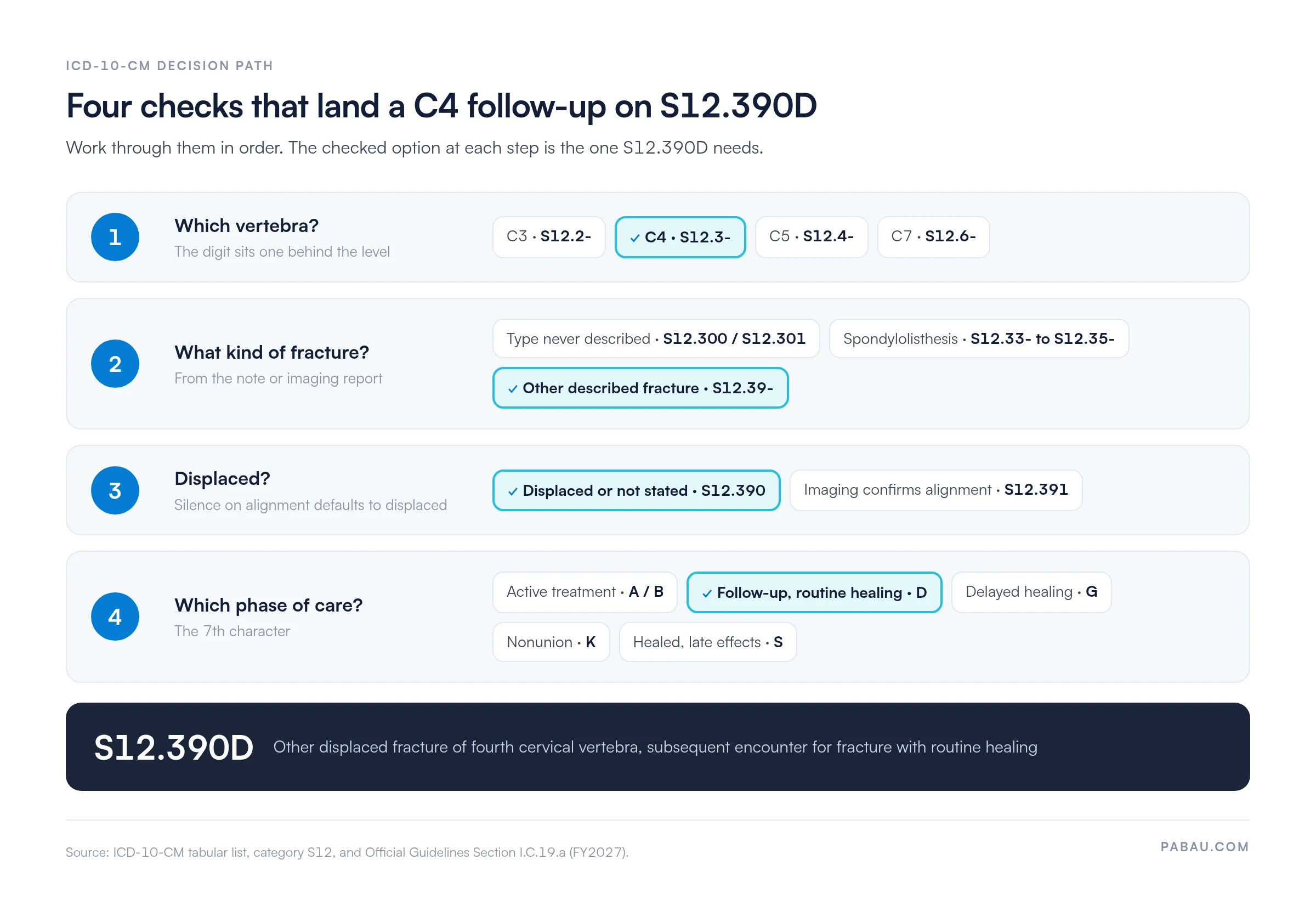
Two mix-ups are easy to make in this family. The first is mixing up displacement: S12.390D is displaced, and S12.391D is nondisplaced. If the imaging report confirms alignment, the code is S12.391D.
The second is reading the subcategory digit as the vertebra. S12.0 starts at C1, so the digit always sits one behind: S12.3 is C4, and S12.6 is C7. Check the digit against the level named in the imaging report before the claim goes out.
The S12 category carries instructional notes that shape every S12.390D claim. None of them is an Excludes1 note, but each one changes what goes on the claim or in which order.
The code-first note is the one that reorders the claim. A follow-up for an incomplete cord lesion at the same level lists S14.154D first, with S12.390D after it.
Accurate documentation separates a clean S12.390D claim from a denial. The record must support each part of the code: the vertebral level, the displacement status, and the encounter type. A note template that asks for each field before the provider signs keeps those details on the record.
Attach the superbill to the encounter note before the claim is built. A missing element then surfaces in-house, before the payer’s edits catch it.
Most payers do not require prior authorization for routine cervical fracture follow-up billed with S12.390D. Several scenarios still trigger closer review. Checking eligibility before the visit flags a coverage problem while there is still time to sort it out.
When submitting clean claims for S12.390D, include the date of the original injury in the claim field your payer specifies. Payers use it to check that the follow-up timeline is clinically plausible.
S12.390D denials follow predictable patterns, and most can be stopped at documentation or charge entry. Effective denial management workflows for cervical fracture claims target these five root causes.
S12.390D is a diagnosis code, so it does not map to one procedure. The CPT code must match the service documented at that visit. Billing teams can check the full descriptor of each pairing below in our CPT reference for coders.
Practices using claims management software can pre-map these CPT and ICD-10 pairings. That cuts charge-entry time on busy follow-up days.
When billing physical therapy alongside S12.390D, confirm that the treatment note names the C4 fracture as the condition treated. Payers audit CPT-to-ICD alignment on cervical fracture claims. Mechanical traction is generally avoided while a displaced fracture heals, so check the referral before adding it.
S12.390D has been a valid billable code since the US moved from ICD-9-CM to ICD-10-CM on October 1, 2015. Its descriptor has not changed in any annual update since, including the FY2027 release effective October 1, 2026.
ICD-10-CM codes update every year on October 1. Coders should confirm S12.390D against the current release, because changes to nearby S12 entries can affect code choice. The AAPC Codify ICD-10-CM lookup reflects the current US code set. An automated validity check before each October update catches a revised or deleted code before it reaches a claim.
A displaced C4 fracture produces a long trail of evidence. The surgeon’s note, the imaging reports, and the brace changes often sit in different systems. When a payer asks why S12.390D was billed, someone has to rebuild that history by hand.
Pabau, the practice management and billing platform we build, keeps the injury date, the vertebral level, and every imaging report on one patient record. You record the level and displacement once, and each follow-up note reads from it.
On the billing side, Pabau builds the claim from the coded encounter and sends it electronically through its Claim.MD integration. Your coder confirms the 7th character once, before submission. The result is fewer returned claims, faster audit responses, and less unpaid admin time.

Pabau keeps the fracture level, alignment findings, and encounter type on one patient record. Your coders send C4 follow-up claims with the evidence already attached.

S12.390D holds three coding decisions. The level is C4, the fracture is displaced or its alignment was never documented, and the visit is a follow-up while healing goes to plan. Get any one wrong and the claim comes back for rework, a query, or an appeal.
Those decisions are settled in the record before a coder opens the code book. A note that names C4, states alignment, and tracks healing will hold up at review. Book a demo to see how Pabau keeps cervical fracture follow-up claims ready to submit.

Need to understand how clearinghouse submissions work for fracture claims? How Claim.MD clearinghouse works explains the end-to-end electronic claim submission process for US practices.
Seeing denials you can’t trace back to a coding error? Reading electronic remittance advice (ERA) walks through how to interpret 835 remittance files and match CARC denial codes to specific S12.390D claim edits.
Want a broader picture of coding compliance for musculoskeletal claims? Medical billing compliance for practices covers documentation standards, audit risk areas, and payer policy alignment across trauma codes.
ICD-10 code S12.390D is the billable code for other displaced fracture of the fourth cervical vertebra, subsequent encounter for fracture with routine healing. It is used on follow-up claims after active treatment of a displaced C4 fracture.
S12.390D is the displaced code, and S12.391D is the nondisplaced one. Both cover follow-up visits for an “other” C4 fracture with routine healing. Imaging decides between them, and a note silent on alignment defaults to displaced.
No. The S12 subcategory digit sits one behind the vertebra, so S12.3 is C4. The matching C7 codes are S12.690D for displaced and S12.691D for nondisplaced fractures.
Use D once the patient has received active treatment and is in routine follow-up while the fracture heals. Per Official Guidelines Section I.C.19.a, this applies even when a new provider takes over follow-up care.
The S12 category says to code first any associated cervical spinal cord injury, from S14.0 or S14.1-. List the cord injury first and S12.390D after it. The two codes can appear on the same claim.
Common pairings are 99213 and 99214 for office follow-up, and 99024 for postoperative visits inside a global period. Cervical imaging codes 72040, 72050, and 72125 also appear often. Each must match the service documented at that visit.