ICD-10 Code S49.011P: Salter-Harris physeal fracture, right humerus, malunion
ICD-10 Code S49.011P: Quick reference ICD-10 Code S49.011P is the billable code ...

Last Updated: Oct 15, 2026
Billable Code Specific Code
S92.522A is the billable ICD-10-CM code for displaced fracture of middle phalanx of left lesser toe(s), initial encounter for closed fracture. It covers a break in the second of the three bones of toes 2 to 5 on the left foot, where the fragments have shifted.
Its closest siblings are S92.521A for the right side, S92.523A when the side is not documented, and S92.525A for a nondisplaced left fracture. A fracture not documented as displaced defaults to displaced, and an open fracture takes S92.522B.
Let Pabau's smart automation suggest the right codes, reduce claim denials, and keep your practice compliant—effortlessly.
Automate repetitive tasks and focus on what matters most—your patients.
Reduce coding errors and ensure compliance with the latest regulations.
Clean claims, fewer denials, and faster reimbursements.
Powerful insights and reporting to help your practice thrive.
HIPAA compliant SOC 2 certified GDPR-compliant Trusted by 4,000+ clinics worldwide

S92.522A codes a displaced fracture of the middle phalanx of the left lesser toe(s), initial encounter for a closed fracture.
The code is left-specific, so a right-side injury is S92.521A and an undocumented side is S92.523A.
When the record does not say displaced or nondisplaced, ICD-10-CM defaults to displaced, and the nondisplaced left-side code is S92.525A.
An open fracture of the same bone takes 7th character B (S92.522B), and a proximal phalanx fracture belongs in S92.51-.
Pabau, the practice management platform we build, connects to the Claim.MD clearinghouse, so US practices can send claims with the correct ICD-10 and CPT pairing.
ICD-10 Code S92.522A is the billable code for a displaced fracture of the middle phalanx of the left lesser toe(s), initial encounter for closed fracture. Each part of that descriptor narrows the choice, so accurate medical billing workflows start with the anatomy, the side, and the fracture type.
Each lesser toe has three phalanges: proximal, middle, and distal. The great toe has only two, which is why its fractures sit in the separate S92.4- subcategory. A fracture of the proximal phalanx of a lesser toe is coded in S92.51-, not S92.52-.
Middle phalanx fractures usually follow direct trauma, such as a dropped object, a stubbing injury, or a crush. They are commonly managed in podiatry, emergency medicine, and orthopedic settings.
S92.522A belongs to Chapter 19 of the ICD-10-CM tabular list (Injury, poisoning and certain other consequences of external causes). Per the CMS ICD-10 codes page and the official tabular, the full path is:
The S92 category covers open and closed fractures alike, and the 7th character tells them apart. An open fracture of the same bone, with a wound that exposes it, is coded S92.522B. The tabular also says a fracture not documented as open or closed is coded as closed.
The 7th character in S92.522A is a frequent source of coder error. Under the ICD-10-CM Official Guidelines for Coding and Reporting, “initial encounter” means the patient is receiving active treatment. It does not mean the patient’s literal first visit.
A specialist who sees a patient referred from the emergency department is still providing active treatment, so the code keeps its initial encounter character. Move to D only when active treatment has ended and the provider is monitoring healing.
A displaced fracture means the bone ends have moved out of their normal position. A nondisplaced fracture means the bone has cracked but the fragments stay aligned. For the left middle phalanx, that distinction decides between S92.522A and S92.525A.
ICD-10-CM guideline I.C.19.c and the S92 tabular note both say a fracture not documented as displaced or nondisplaced is coded as displaced. That makes S92.522A the default for an unspecified left middle phalanx fracture. Still, query the clinician when the imaging report and the note disagree.
Check whether the treating clinician’s note mirrors the radiologist’s impression. If the imaging report says ‘nondisplaced’ but the clinician’s note says ‘displaced,’ query the clinician before assigning S92.522A. Document the query and response in the medical record.
Most errors with S92.522A come from picking the wrong side, the wrong displacement status, or the wrong bone. The siblings below differ from S92.522A by a single element.
Assigning S92.521A to a left-foot injury, or S92.523A when the note names the left side, creates a mismatch with the clinical record. Payers that audit against documentation will deny it. The decision path below runs the five checks in the order a coder meets them in the note.
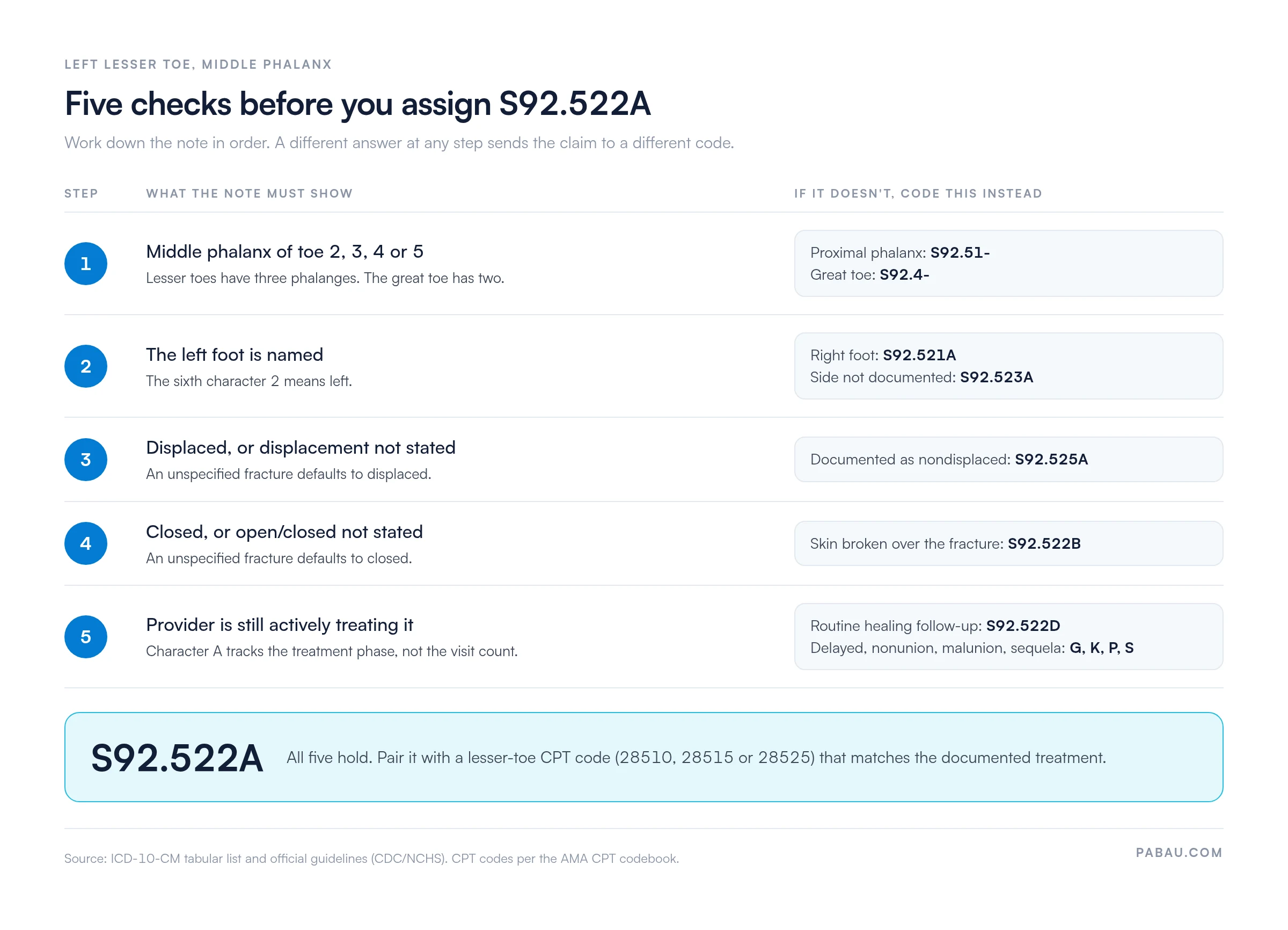
Missing documentation is a common cause of claim denial for fracture codes. The clinical note should support every element of the descriptor before S92.522A is assigned.
Building these elements into the visit template means the coder finds side, bone, displacement, and skin status in one place before the claim goes out.
S92.522A carries no notes of its own, but it inherits instructions from the levels above it. Per the CDC/NCHS ICD-10-CM tool, these apply:
Typical external cause codes include W22.8XXA for striking against or being struck by other objects. Place of occurrence comes from Y92 and activity from Y93. National guidelines do not mandate external cause reporting, but many states and payers require it. Missing codes are a frequent finding in denial management in healthcare.
S92.522A is a diagnosis code only, so the claim also needs a matching CPT code describing the procedure. Lesser toe fractures use the 28510 to 28525 range, while 28490 to 28505 are reserved for the great toe. Confirm pairings against the current AMA CPT codebook, as coverage rules vary by payer.
Payers check that the CPT code and the diagnosis code are clinically consistent. Billing CPT 28525 against a note that only documents buddy taping will draw a medical necessity denial. Practices that submit through the Claim.MD clearinghouse can catch CPT-to-ICD-10 mismatches before the claim reaches the payer.
Displaced middle phalanx fracture claims carry a handful of predictable denial triggers. Fixing each one before submission costs far less than an appeal. The clean claim submission standard expects every required element to be present at billing.
Run a pre-submission check on every S92.52- claim. Confirm the side, the bone, the displacement status, open or closed, and the 7th character. Then check that the CPT code from 28510 to 28525 matches the documented procedure.
Medicare and most commercial payers expect medical necessity documentation to support claims coded with S92.522A. Requirements vary by payer and plan year, so verify current local coverage determinations before billing. Common expectations include:
The AAPC ICD-10-CM code reference is a useful secondary resource for checking code validity and payer billing notes.
Many podiatry practices still code fractures from free-text notes, then key the claim into a separate billing portal. Side, bone, and displacement details get lost between the two, and the denial arrives weeks later.
Pabau keeps the treatment note, the diagnosis code, and the invoice on the same patient record. Its error-catching claims software sends US claims through the Claim.MD clearinghouse, which checks each claim before it reaches the payer. The coder reads side, bone, and displacement from the note that sits beside the claim.
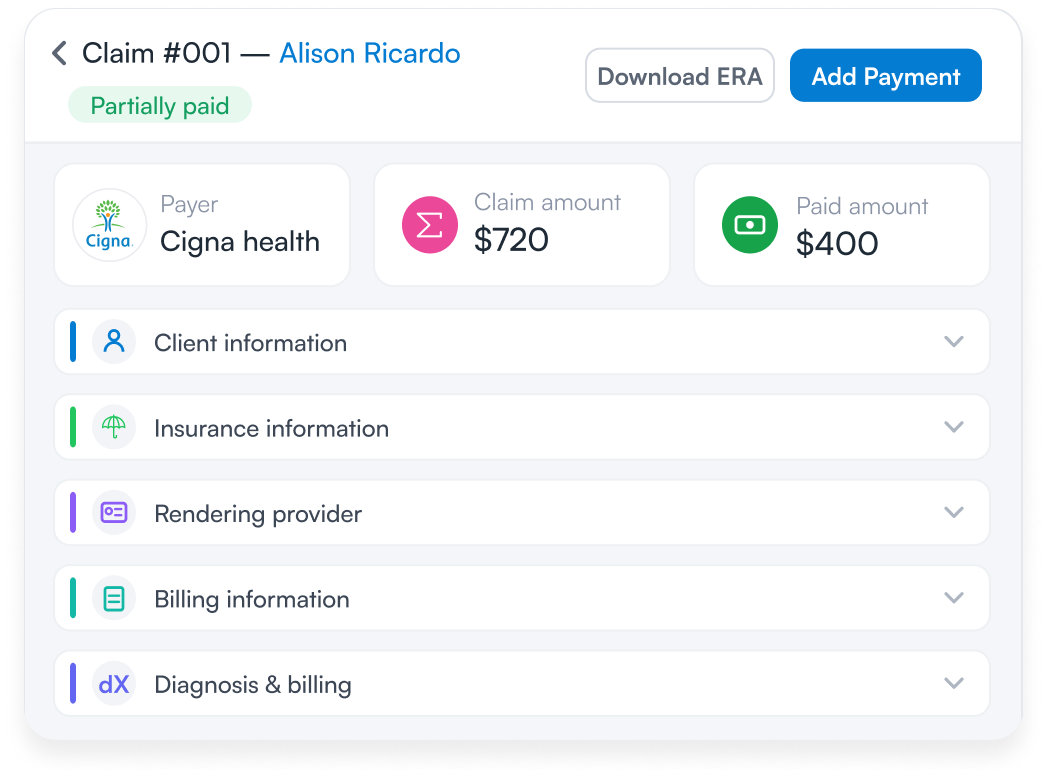
The outcome is fewer side and displacement errors leaving the practice, and less time spent reworking rejected fracture claims.

Pabau keeps notes, diagnosis codes, and invoices on one patient record and integrates with the Claim.MD clearinghouse for US claims. That helps podiatry practices send fracture claims with the right ICD-10 and CPT pairing.

S92.522A is only correct when four facts line up: left side, middle phalanx of a lesser toe, displaced (or undocumented), and closed. Change any one and the code changes with it, to S92.521A, S92.525A, S92.51-, or S92.522B.
The practical step is to make the note capture those four facts at the visit, rather than leaving the coder to infer them. Pair that with a lesser-toe CPT code that matches the documented treatment, and these claims should clear on the first pass.
Pabau keeps the note and the claim on one record and sends US claims through its Claim.MD clearinghouse integration. Book a demo to see how Pabau helps your practice submit cleaner fracture claims.

Need to understand denial codes and how to respond? Denial codes in medical billing covers the most common CARC codes and corrective action steps.
Want to understand how clean claims are built? Medical billing compliance explains the documentation and coding standards that keep claims out of the denial queue.
Submitting claims electronically through a clearinghouse? Claim.MD clearinghouse explains how Pabau’s US clearinghouse integration routes and validates claims before they reach the payer.
ICD-10 Code S92.522A is the billable code for a displaced fracture of the middle phalanx of the left lesser toe(s), initial encounter for closed fracture. The 7th character A means the fracture is closed and under active treatment. It does not mean the patient’s first-ever visit.
S92.522A codes a displaced fracture of the left middle phalanx, where the fragments have shifted out of alignment. S92.525A codes a nondisplaced fracture of the same bone on the same side. When the record does not specify, ICD-10-CM defaults to displaced, so S92.522A applies.
Use A while the provider is actively treating the fracture, including evaluation by a new specialist. Switch to D once active treatment has ended and the provider is monitoring routine healing. The choice depends on the treatment phase, not the visit number.
Yes. The sixth character 2 in S92.522A means the left side. A right lesser toe fracture is S92.521A, and S92.523A is reserved for records that do not state the side.
The Chapter 19 tabular note tells coders to add secondary codes from Chapter 20 for the cause of injury. W22.8XXA, for being struck by an object, is a common example. Place of occurrence (Y92) and activity (Y93) codes may follow. National guidelines do not mandate them, but many states and payers do.
Yes. If the provider is still actively treating the displaced fracture, S92.522A remains correct. Switch to S92.522D only when active treatment has ended and care has moved into routine healing.