ICD-10 Code Y74.2: General hospital and personal-use implant failure
ICD-10 code Y74.2: Definition, descriptor, and billable status ICD-10 code Y74.2...

Last Updated: Oct 29, 2026
Billable Code Specific Code
S14.144A is the billable ICD-10-CM code for Brown-Sequard syndrome at C4 level of cervical spinal cord, initial encounter. It reports a hemicord injury with same-side motor and proprioception loss and opposite-side pain and temperature loss. It applies while the patient receives active treatment.
The code sits in category S14, injuries of nerves and spinal cord at neck level. Assignment turns on two documented facts: the named Brown-Sequard pattern and C4 as the neurological level. Without the named pattern, the injury codes to S14.154A instead.
Let Pabau's smart automation suggest the right codes, reduce claim denials, and keep your practice compliant—effortlessly.
Automate repetitive tasks and focus on what matters most—your patients.
Reduce coding errors and ensure compliance with the latest regulations.
Clean claims, fewer denials, and faster reimbursements.
Powerful insights and reporting to help your practice thrive.
HIPAA compliant SOC 2 certified GDPR-compliant Trusted by 4,000+ clinics worldwide

ICD-10 Code S14.144A reports Brown-Sequard syndrome at the C4 level of the cervical spinal cord, a named incomplete cord injury with its own code.
The 7th character A covers active treatment only. Switch to D for inpatient rehab and follow-up care, and to S for late effects.
The note must name Brown-Sequard syndrome or describe the crossed-deficit pattern at C4. Vague ‘incomplete SCI’ language downcodes to S14.154A.
When a cervical vertebra fracture is also documented, S14.144A is listed first and the S12 fracture code follows it.
Pabau, the practice management platform we build, runs real-time eligibility checks and flags denied claims through its Claim.MD integration.
ICD-10 Code S14.144A is the billable ICD-10-CM code for Brown-Sequard syndrome at the C4 level of the cervical spinal cord, initial encounter. It applies while the patient receives active treatment for a hemicord injury at C4.
The code is valid in the FY2027 code set, effective October 1, 2026, per the CMS ICD-10 codes release. The table below confirms its key attributes.
Brown-Sequard syndrome is an incomplete spinal cord injury (SCI) caused by damage to one lateral half of the cord. Typical causes are penetrating trauma, disc herniation, and spinal cord contusion. At C4, it produces a crossed-deficit pattern that sets it apart from every other incomplete SCI syndrome.
The hallmark presentation pairs ipsilateral motor and proprioception loss below the lesion with contralateral loss of pain and temperature sensation. The pattern crosses because the corticospinal tract and dorsal columns stay on the same side until they cross in the brainstem. The spinothalamic tract crosses within one or two segments of where it enters the cord.
At C4, the patient presents with same-side arm and leg weakness. Pain and temperature loss sits on the opposite side, in the chest, arm, and leg below C4.
For rehabilitation planning, the ASIA Impairment Scale (AIS) grade is critical context. Brown-Sequard syndrome most commonly classifies as AIS grade C or D, because some voluntary motor function survives below the injury.
The clinician assigns the AIS grade. The coder selects S14.144A from what the physician documents and never interprets the AIS assessment independently.
The 7th character in S14.144A signals the episode of care, not the number of times the patient has been seen. The ICD-10-CM Official Guidelines for Coding and Reporting (Section I.C.19) allow three 7th characters for S14.144. Each one has a distinct clinical trigger.
A common error is using 7th character A for rehabilitation. Rehab is not active treatment, so inpatient rehab admissions and outpatient therapy visits take the D character. Using A on those encounters creates a mismatch that Medicare claim reviewers flag.
S14.144A sits at the most granular level of the S14 category. Understanding the hierarchy helps coders recognize when a more specific or less specific code applies.
Six codes in the S14.1 series are regularly confused with ICD-10 Code S14.144A. In every case, the syndrome pattern and level the provider documents decide the code, not the severity of the injury.
The most consequential downcode error is selecting S14.154A when Brown-Sequard syndrome is documented. S14.154A still reports an incomplete cervical cord injury at C4. It lacks the named-syndrome specificity that payers and quality registries need for rehabilitation authorization and risk stratification.
The three questions below walk the same decision in the order a coder meets it in the note.
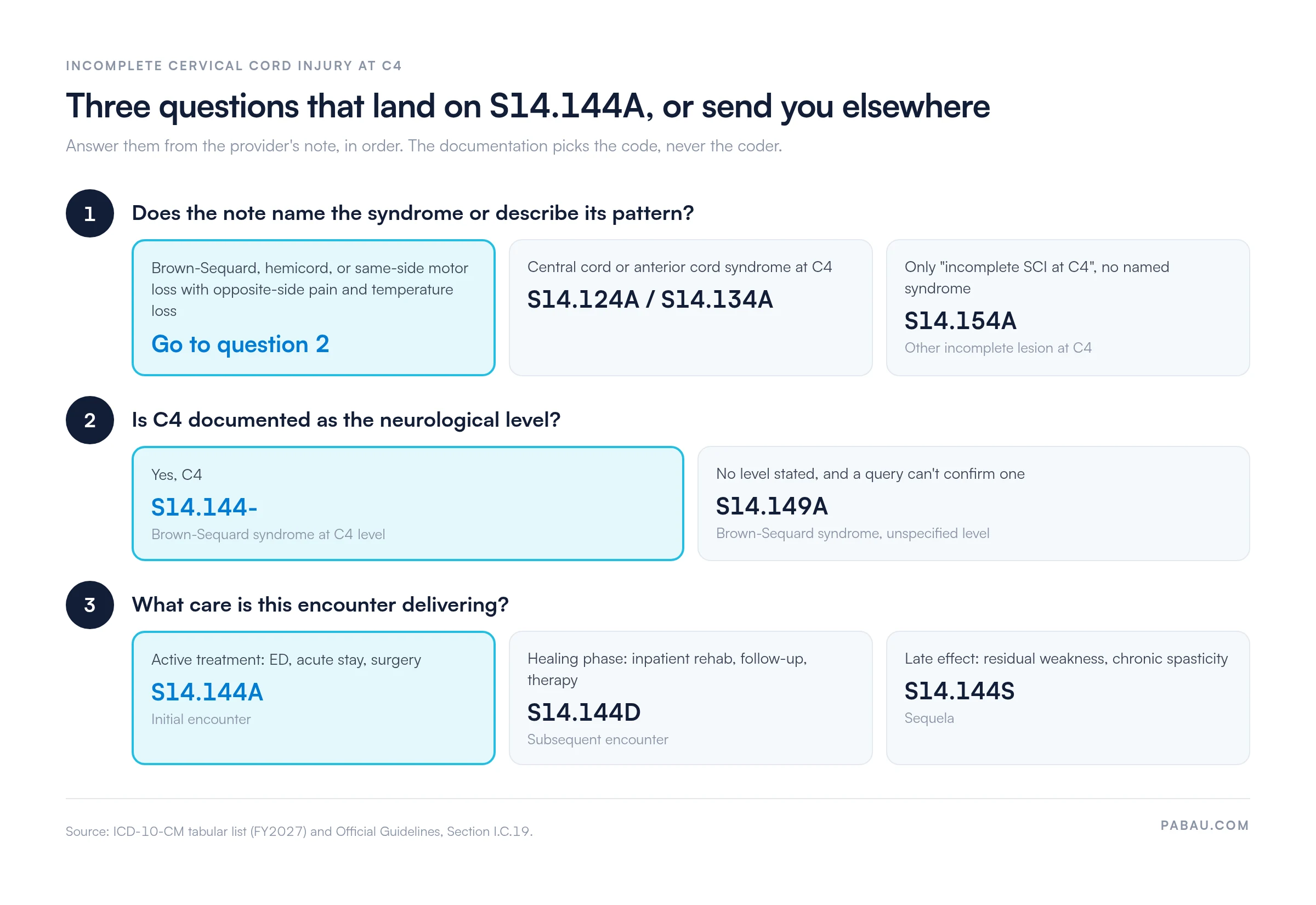
Check the note before you code. Does it state ‘Brown-Sequard syndrome,’ ‘hemicord syndrome,’ or same-side motor loss with opposite-side pain and temperature loss? If only ‘incomplete SCI at C4’ appears, query the provider before selecting S14.144A. A query takes minutes and saves a denial.
The provider note must contain specific elements for S14.144A to withstand audit. Vague documentation results in a downcode to S14.154A or an outright denial. Meeting clean claim requirements starts with the clinical note, not the claim form.
Required documentation elements for S14.144A:
Medicare and commercial payers treat cervical spinal cord injury claims as high-cost, high-scrutiny submissions. Requirements vary by payer and change each year, so check current Local Coverage Determinations (LCDs) before submitting.
Billers who route claims through dedicated claims software catch payer-rule errors before submission on complex neurological injury codes.
S14.144A claims deny for predictable, correctable reasons. Denial management workflows that map each denial category to a root cause cut rework time on spinal cord injury claims.
The payer states each reason on the remittance as a claim adjustment reason code. Our guide to claim denial codes explains which code points to which fix.
The ICD-10-CM Official Guidelines for Coding and Reporting, Section I.C.19, governs injury code sequencing and 7th character application across the S14 category. Several specific instructions apply directly to S14.144A claims. Refer to the CDC/NCHS ICD-10-CM web tool for the current FY tabular list and index.
A firm grasp of medical billing fundamentals for traumatic injuries, including sequencing priority and encounter type, reduces errors across the full S14 range.
Run a secondary-diagnosis check on every S14.144A claim before submission. Is a cervical fracture (S12 series) also documented? If yes, confirm S14.144A sits first and the fracture code follows it. Is an external cause code (V, W, X, or Y) on the claim? If not, add the mechanism code. Both checks are quick and prevent the most common sequencing denials on cervical SCI claims.
Most S14.144A denials start before the claim leaves the practice. A coverage change after the accident goes unnoticed, a rehab visit keeps the A character, or a denied claim sits unworked in a clearinghouse portal.
Pabau connects to the Claim.MD clearinghouse and turns the invoices your team already raises into electronic CMS-1500 claims. Staff run a real-time eligibility check from the patient record. A switch from auto liability to commercial coverage then shows up before the claim goes out.
Claim statuses update from the payer, and electronic remittance advice comes back into Pabau matched to each claim. Denied claims are flagged for rework, so your billing team can fix a wrong 7th character or a missing external cause code and resubmit.

Pabau connects to Claim.MD to send ICD-10-coded claims to thousands of US payers, check eligibility in real time, and flag denials for rework. Your billing team catches S14.144A errors before the payer does.

S14.144A holds on audit when two facts are in the provider’s note: the named Brown-Sequard pattern and C4 as the neurological level. Both are the provider’s to document, and neither is the coder’s to infer.
When either element is missing, query the provider before you submit. That takes minutes, while a denial and appeal can hold up payment for weeks.
Then watch the 7th character as the patient moves on, because the day active treatment ends, the same injury becomes S14.144D. Book a demo to see how Pabau checks eligibility and flags S14.144A denials before they stall your cash flow.

Looking for documentation standards that survive payer audits? Medical billing compliance outlines the documentation and coding practices that reduce audit risk across injury code categories.
ICD-10 Code S14.144A is the billable code for Brown-Sequard syndrome at the C4 level of the cervical spinal cord, initial encounter. It reports a hemicord injury with same-side motor and proprioception loss and opposite-side pain and temperature loss below C4. The A character limits it to the period of active treatment.
Use A (S14.144A) while the patient receives active treatment, such as the emergency visit, the acute inpatient stay, surgery, or specialist evaluation. Switch to D (S14.144D) once active treatment ends and care supports healing, including inpatient rehabilitation and outpatient therapy. Use S (S14.144S) only for a late effect of the past injury.
S14.144A codes Brown-Sequard syndrome at the C4 level of the cervical spinal cord, and S14.145A codes it at C5. The neurological level is the only difference, and the provider must document it. A note reading “Brown-Sequard at C4” takes S14.144A, while “Brown-Sequard at C5” takes S14.145A. Never assign a level the provider hasn’t documented.
A common cause is a 7th character A on a rehab or follow-up visit. Another is a note that says “incomplete SCI at C4” without naming the syndrome, which downcodes to S14.154A on review. A missing external cause code and an S12 fracture code listed ahead of S14.144A also trigger denials. Each one can be corrected before or after submission.
The ASIA Impairment Scale (AIS) is the American Spinal Injury Association’s standard classification of spinal cord injury severity. Grade A is complete, with no motor or sensory function below the level, and grades B through D are incomplete. Most Brown-Sequard cases score C or D on the scale. The AIS grade doesn’t select the code, but it strengthens the record in payer audits and rehab authorization reviews.