

ICD-10 Code S42.444P: Medial epicondyle fracture, right humerus
ICD-10 Code S42.444P: full descriptor and code validity ICD-10 Code S42.444P car...

Last Updated: Oct 13, 2026
Billable Code Specific Code
S92.354P is the billable ICD-10-CM code for nondisplaced fracture of fifth metatarsal bone, right foot, subsequent encounter for fracture with malunion.
Follow-up visits are where this code family goes wrong, because the 7th character has to match what the imaging shows.
Let Pabau's smart automation suggest the right codes, reduce claim denials, and keep your practice compliant—effortlessly.
Automate repetitive tasks and focus on what matters most—your patients.
Reduce coding errors and ensure compliance with the latest regulations.
Clean claims, fewer denials, and faster reimbursements.
Powerful insights and reporting to help your practice thrive.
HIPAA compliant SOC 2 certified GDPR-compliant Trusted by 4,000+ clinics worldwide

ICD-10 Code S92.354P describes a nondisplaced fracture of the fifth metatarsal bone in the right foot, coded at a subsequent encounter with malunion.
The 7th character P marks a subsequent encounter where the bone healed in a malunited position. K means nonunion and S means sequela.
Laterality sits in the 6th character. S92.354 is the right foot, S92.355 the left foot, and S92.356 an unspecified foot.
S92.154P is not a metatarsal code at all. It sits under S92.1, the talus, so reaching for it on a foot claim is a coding error.
Pabau’s claims management integration with Claim.MD supports ICD-10-coded claim submission, real-time eligibility checks, and ERA processing across thousands of US payers.
S92.354P is a billable, specific ICD-10-CM code valid for fiscal year 2026, which runs from October 1, 2025 through September 30, 2026. The CDC/NCHS ICD-10-CM coding tool lists it as active for the current fiscal year.
The CMS ICD-10-CM coding page publishes the annual update files that confirm active status. Verify code validity at the start of each fiscal year, because ICD-10-CM codes change every October 1.
A nondisplaced fifth metatarsal fracture is a break in the outer long bone of the foot where the fragments stay in normal alignment. The fifth metatarsal runs along the lateral edge of the foot, and most fractures cluster at its base.
A sudden inversion of the foot loads the peroneus brevis tendon and the bone gives way. That mechanism sits behind many injuries first treated as ankle sprains.
Nondisplaced means the fragments have not shifted meaningfully out of anatomical position. That one word separates S92.354 from the displaced code S92.351, and it changes both the treatment pathway and the claim.
Displacement status is a documentation element the coder cannot infer, so the imaging report or the physician note has to state it.
The 7th character records the stage of care, and S92.354 accepts seven of them. Picking the wrong one is a frequent cause of denial, because payers cross-check the character against the documented clinical findings.
Malunion (character P) and nonunion (character K) are frequently confused. Malunion means the fracture has healed, but the fragments consolidated in a position that deviates from normal anatomy. The bone is united, just united incorrectly. Nonunion means healing has not happened at all, and the fracture line persists.
Malunion of the fifth metatarsal can cause persistent lateral foot pain, gait changes, and trouble with footwear. X-ray or CT imaging usually confirms the malunited position. In post-fracture rehabilitation, documenting malunion clearly matters twice over. It shapes the treatment plan, and it supports the clinical rationale for continued visits.
Document the radiographic or clinical findings that confirm malunion before you submit S92.354P. Payer audits on malunion codes routinely request the imaging report or the clinical note describing the abnormal healing position. A claim without that documentation is a denial risk even when the code itself is right.
Reading the parent structure helps coders apply S92.354P correctly and find related codes quickly. The WHO ICD-10 classification browser holds the hierarchical framework that ICD-10-CM builds on.
S92.354 is not billable on its own, because it needs a 7th character before submission. Only the extensions A, B, D, G, K, P and S produce a valid, billable code.
Submitting S92.354 bare will be rejected at the clearinghouse. Read left to right, each character narrows the diagnosis. The breakdown below marks the position where one wrong digit changes the bone.
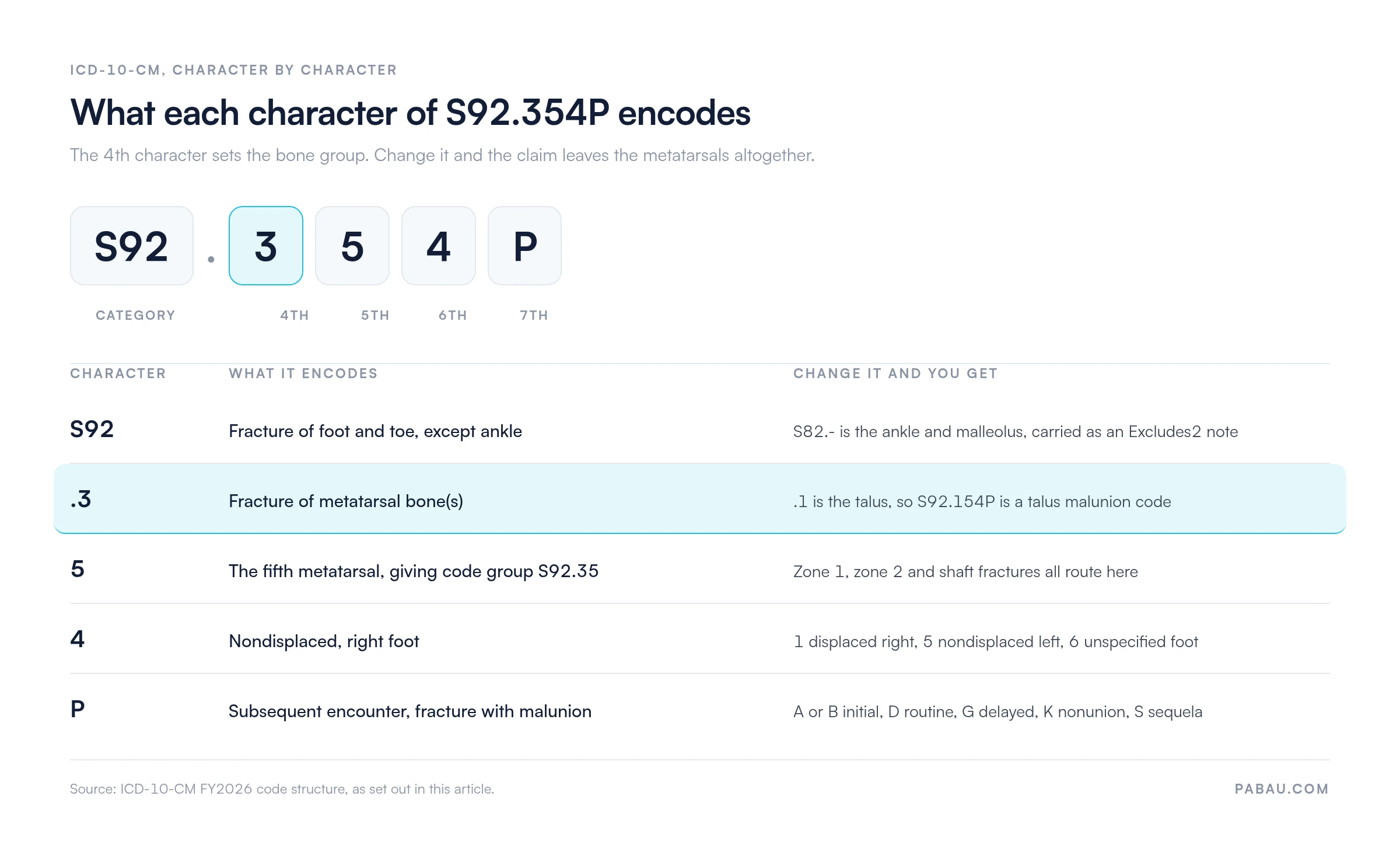
Watch the first digit after the decimal point. S92.1- is the talus and S92.3- is the metatarsals, so S92.154P is a talus malunion code rather than a fifth metatarsal one. The two strings look almost identical in a code search box, and picking S92.154P on a metatarsal claim puts the wrong bone on the record.
Category S92 carries Excludes2 notes rather than Excludes1 notes. That means the excluded conditions are not part of a foot fracture, but a patient can have both at once. When that happens, report S92.354P and the excluded code together.
Two ICD-10-CM defaults also apply across the whole category. A fracture that is not documented as displaced or nondisplaced is coded as displaced. A fracture that is not documented as open or closed is coded as closed. Both defaults push the claim away from S92.354P, so the note has to say nondisplaced for this code to hold up.
The ICD-10-CM Official Guidelines for Coding and Reporting govern how subsequent encounter codes are applied. Several rules decide directly whether S92.354P is the right choice.
Initial encounter, character A, does not mean first visit. It means the patient is receiving active treatment for the condition. A first specialist visit, a casting or splinting appointment, or surgical management all still take the A extension. The AAPC ICD-10-CM code reference applies this distinction consistently across the fracture families.
Subsequent encounter, characters D, G, K and P, applies once the patient reaches the healing or aftercare phase. Treatment has been established and the visit is about monitoring, rehabilitation, or managing a complication. S92.354P sits squarely there, because malunion is found or managed after the acute treatment phase.
The 6th character carries the side, so the same clinical picture produces three different codes. Only one of them holds up under review.
Unspecified laterality should be rare on a fracture follow-up, because the treating clinician knows which foot was imaged. Payers read S92.356P as a documentation shortfall and often pend the claim. Query the record instead of defaulting to the unspecified code.
Coders cannot select S92.354P on clinical assumption. The physician documentation has to state malunion or clearly support it. Acceptable documentation usually includes:
When you query the physician, ask specifically whether imaging confirms healing in a non-anatomical position. Vague wording like healing poorly or not improving does not support malunion.
It could equally point to delayed healing (character G) or nonunion (character K). Systematic denial management on musculoskeletal codes depends on tight documentation-to-code alignment.
Three axes separate S92.354P from its neighbors in the S92.35 family. They are displacement, laterality, and the stage of care. The table below runs the common follow-up scenarios against each one.
The displaced versus nondisplaced call belongs to the treating clinician and the imaging, not to the coder. Where the record is silent on displacement, ICD-10-CM instructs coders to default to displaced. The displaced code then applies until the record is clarified. Billing teams working in software built for coders can flag incomplete displacement documentation before the claim goes out.

If the note reads fracture, fifth metatarsal with no displacement status, query it before you code. ICD-10-CM defaults to displaced when displacement is undocumented, which moves the claim into the S92.351 group and changes the payer review criteria.
On an inpatient claim, S92.354P groups to one of three musculoskeletal MS-DRGs. Which one applies depends on whether a complication or comorbidity is also reported.
Most malunion follow-ups happen in the outpatient setting, so the MS-DRG rarely drives payment for this code. It matters when the malunion is corrected during an inpatient stay. The grouping above reflects MS-DRG v43.0, and S92.354P is exempt from present-on-admission reporting.
Clinicians and referral sources describe the same injury in different words. The terms below are the approximate synonyms and common clinical phrasings that map to ICD-10 Code S92.354P. Knowing them helps coders match documentation language to the code before a claim is built.
ICD-10-CM does not split the fifth metatarsal by fracture zone. A styloid avulsion in zone 1, a Jones fracture in zone 2, and a shaft fracture all route to the S92.35- codes. The coder decides on displacement, laterality and encounter stage instead.
Labels like dancer fracture and pseudo-Jones fracture are clinical shorthand, so read the imaging report for the details that drive the code. The wider ICD-10-CM code index covers the neighboring fracture families a foot and ankle coder works through in the same session.
Accurate coding is only half the billing equation. The claim still has to reach the payer, clear eligibility, and return an ERA before the practice sees revenue. Practice management software like Pabau integrates with the Claim.MD clearinghouse to support ICD-10-CM coded claim submission across thousands of US payers. That includes CMS-1500 and 837P electronic claims for musculoskeletal diagnoses such as S92.354P.
The integration covers real-time eligibility verification before the appointment, electronic remittance advice processing after adjudication, and CARC denial reason tracking. Orthopedic and sports medicine practices run high volumes of fracture follow-up visits, so catching eligibility issues before the visit cuts rework sharply.
Tracking denial patterns by diagnosis code shows which fracture codes keep coming back. Claim validation also confirms that ICD-10 codes pair correctly with the CPT codes billed on the same encounter.
The Claim.MD integration in Pabau also supports secondary and corrected claims. Those come up often when a malunion encounter goes out with thin documentation and is resubmitted with a physician addendum.

Pabau integrates with Claim.MD to support ICD-10-coded claim submission across thousands of US payers. From real-time eligibility checks to ERA processing, manage your billing workflow in one place.

S92.354P is only as good as the note behind it. Confirm three things in the record before you submit. Imaging has to show union in an abnormal position. The note has to name the right foot and describe the fracture as nondisplaced.
The 7th character carries more denial risk than the base code, because a payer can check it against the imaging report. So query the physician when healing status is ambiguous, instead of picking the character that fits the visit best.
Pabau’s claims management workflow, integrated with the Claim.MD clearinghouse, flags coding and eligibility problems before a malunion claim goes out. Book a demo to see how the ICD-10 catalog and denial tracking work on a fracture claim.

Checking that ICD-10 and CPT codes pair up? Clean claim sets out what has to line up on a claim before it reaches the payer.
Exploring clearinghouse options? Medical claims clearinghouse guide explains how clearinghouses fit into the revenue cycle and what to look for when evaluating one.
Reconciling payments after adjudication? Electronic remittance advice shows how to read an ERA and match it back to the claim you submitted.
ICD-10 Code S92.354P is a billable ICD-10-CM diagnosis code. It covers a nondisplaced fracture of the fifth metatarsal bone in the right foot, at a subsequent encounter with malunion. It is valid for fiscal year 2026, which runs from October 1, 2025 through September 30, 2026, for HIPAA-covered claim submissions.
Yes. S92.354P is a specific, billable ICD-10-CM code confirmed as valid for FY2026. The parent code S92.354 is not billable on its own, because it requires a 7th character extension to produce a submittable code.
No. S92.154P sits under S92.1, which covers fractures of the talus. It describes a nondisplaced avulsion fracture of the right talus at a subsequent encounter with malunion. Metatarsal fractures live under S92.3, which makes S92.354P the correct code for the right fifth metatarsal.
S92.354P covers a subsequent encounter where the fracture healed in a malunited position. S92.354K covers a subsequent encounter where the bone failed to heal at all, which is nonunion. S92.354S is the sequela code, used after healing is complete to report a residual condition caused by the original fracture.
S92.355P covers a nondisplaced fracture of the left fifth metatarsal bone at a subsequent encounter with malunion. S92.356P covers the same picture with an unspecified foot, and payers often pend that code because laterality should be documented.
ICD-10-CM expects malunion to be stated or clearly supported by imaging before a P extension is assigned. The record should confirm the fracture has healed in an abnormal anatomical position. Do not infer malunion from symptoms alone, and query the treating clinician when healing status is ambiguous.
The 7th character P marks a subsequent encounter where the fracture complication is malunion. It applies after the acute treatment phase, once follow-up shows the bone has united in an incorrect position. That separates it from routine healing (D), delayed healing (G), nonunion (K), and sequela (S).




