ICD-10 Code I27.20: Secondary pulmonary hypertension, unspecified
ICD-10 code I27.20: Quick reference Use this table to verify billable status, ef...

Last Updated: Nov 18, 2026
Billable Code Specific Code
S92.225K is the billable ICD-10-CM code for nondisplaced fracture of lateral cuneiform of left foot, subsequent encounter for fracture with nonunion. Most foot fracture follow-up visits use D (routine healing). K signals that the bone has failed to consolidate and the visit is managing that complication.
The 7th character is a common source of errors on this code, so check it against the imaging report before submitting. Using A (initial encounter) for a follow-up visit misrepresents the encounter type and can trigger a denial or payer audit. Using D when nonunion is documented leaves the complication off the claim.
Let Pabau's smart automation suggest the right codes, reduce claim denials, and keep your practice compliant—effortlessly.
Automate repetitive tasks and focus on what matters most—your patients.
Reduce coding errors and ensure compliance with the latest regulations.
Clean claims, fewer denials, and faster reimbursements.
Powerful insights and reporting to help your practice thrive.
HIPAA compliant SOC 2 certified GDPR-compliant Trusted by 4,000+ clinics worldwide

S92.225K codes a nondisplaced fracture of the lateral cuneiform of the left foot, at a follow-up visit where the fracture has not healed.
The 6th character 5 carries two facts at once: the fracture is nondisplaced, and it is in the left foot.
When the record does not say whether the fracture is displaced, ICD-10-CM defaults to displaced, which makes the code S92.222K.
The 7th character K needs imaging and a physician’s assessment that both document nonunion, not just a slow recovery.
Pabau’s claims management software keeps the code, the side and the supporting note in one patient record, so the claim matches the chart.
ICD-10 code S92.225K is the billable, specific ICD-10-CM code for a nondisplaced left lateral cuneiform fracture that has gone on to nonunion. The CMS FY 2027 ICD-10-CM files list its official descriptor as: Nondisplaced fracture of lateral cuneiform of left foot, subsequent encounter for fracture with nonunion.
The lateral cuneiform is one of the tarsal bones of the midfoot. That places the code in subcategory S92.2, Fracture of other and unspecified tarsal bone(s). Verify billability against the current fiscal year release, because CMS updates the tabular list every October 1.
Each level of the hierarchy narrows the diagnosis, from injuries in general down to one bone, one side and one encounter type. Coders who need a neighboring diagnosis can walk the same levels in our ICD-10-CM library for coders.
Only the full seven-character code is billable. S92, S92.2, S92.22 and S92.225 are header codes, and a claim that stops at any of them will reject.
Every character in S92.225K encodes a specific clinical fact. Reading them in sequence confirms you have selected the right code.
The 6th character does two jobs. It records displacement and laterality together, so the code itself says left foot. The diagnosis needs no extra code to show the side.
Six codes share the S92.22 stem, and only the 6th character separates them. Characters 1 to 3 are displaced fractures, and 4 to 6 are nondisplaced. Within each half, the order runs right, left, then unspecified.
The step from 4 to 5 changes only the side. S92.224K and S92.225K are both nondisplaced fractures of the same bone, in opposite feet.
Some records never say whether the fracture is displaced. For those, the S92 category note and the ICD-10-CM Official Guidelines (Section I.C.19.c) direct coders to code it as displaced. A left lateral cuneiform nonunion with no displacement statement is therefore S92.222K, not S92.225K. Query the provider before applying the default, because the radiology report often answers the question.
The unspecified-side codes, S92.223K and S92.226K, are valid but weak. Many payers edit claims for unspecified laterality, and a foot imaging report names the side.
Put together, four checks decide whether a left lateral cuneiform nonunion lands on S92.225K or on one of its neighbors. Each check is read from a document already in the record.
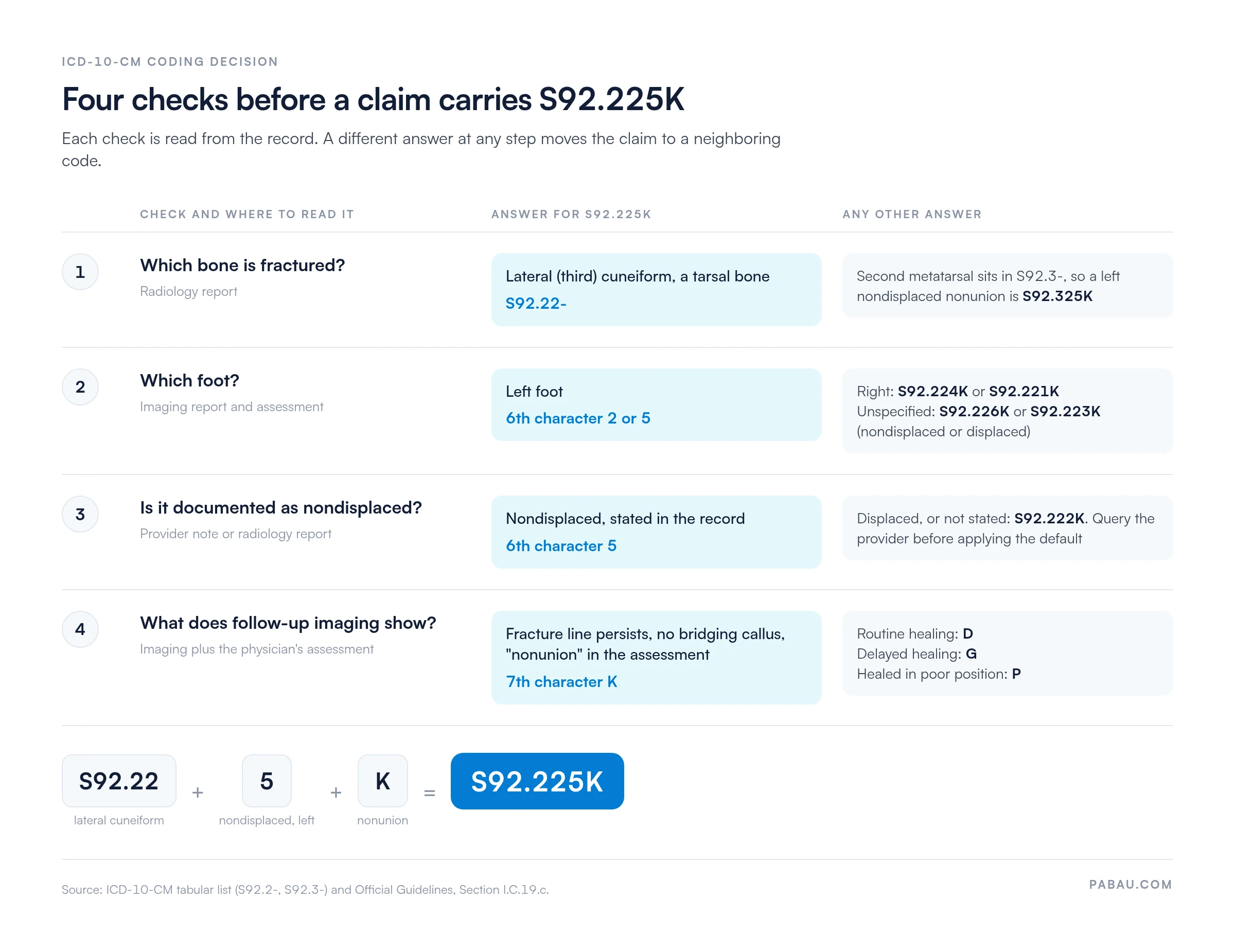
Do not confuse S92.225K with a second metatarsal fracture. Metatarsal fractures sit in subcategory S92.3, and a nondisplaced second metatarsal nonunion in the left foot is S92.325K. Check the bone named in the radiology report before you pick the code.
The 7th character K means the visit is a subsequent encounter for a fracture that has developed nonunion. Nonunion is the failure of a fracture to achieve bony consolidation within the clinically expected timeframe. There is no single timeframe. The FDA treats nonunion as no progress for three months at nine or more months after injury. Medicare NCD 150.2 requires healing to have stopped for three or more months. Payers may apply their own criteria.
K records a complication confirmed by imaging, so it never stands in for a routine follow-up visit. The patient has already had active treatment and follow-up care, and now presents with evidence of failed healing.
The S92 subsequent-encounter characters do not split open from closed fractures. A nonunion of a fracture that was originally open still takes K.
Nonunion and malunion are distinct clinical outcomes coded by different 7th characters. Payers link each one to different treatment pathways and coverage criteria, so confusing them changes what gets paid.
When imaging shows callus but the physician documents deformity or functional impairment, S92.225P is correct. When the fracture line persists with no bridging callus, S92.225K applies. The imaging report and the physician’s interpretation together decide the 7th character, never symptom duration alone.
The S92 category carries Excludes2 notes. An Excludes2 condition is not part of S92, but both codes may be reported together when the patient has both.
S92.225K is also exempt from present-on-admission (POA) reporting. The AAPC Codify ICD-10-CM lookup lets you browse the rest of the S92.2 tarsal range.
S92.225K belongs on visits after initial care, once imaging shows that a nondisplaced left lateral cuneiform fracture has not united. Typical encounters are nonunion follow-ups, bone stimulation planning, and surgical review for fixation or fusion.
The lateral cuneiform, also called the third cuneiform, is a midfoot bone. It sits between the intermediate cuneiform and the cuboid, at the base of the third metatarsal.
Isolated cuneiform fractures are uncommon. They often come with other midfoot injuries, such as tarsometatarsal (Lisfranc) injuries, which take their own codes. Nondisplaced cuneiform fractures can be hard to see on plain X-rays, so CT is often used to judge healing.
Nonunion is diagnosed from imaging and clinical findings, and elapsed time alone does not establish it. The note must support each part of the code before a coder assigns S92.225K. A missing element creates denial exposure when the payer audits the claim.
Templated follow-up notes help each element appear on every visit, whichever provider sees the patient.
S92.225K supports claims from office visits through to surgical repair. Tarsal fractures other than the talus and calcaneus have their own CPT family, 28450 to 28465, separate from the metatarsal codes. Check the CMS Physician Fee Schedule lookup for current RVUs and Medicare payment rates.
Related follow-up visits inside the 90-day global period of the original fracture care are bundled. Bill an E&M on the same date as a procedure only when a separately identifiable evaluation is documented, and add modifier 25. Add modifier LT to foot procedures, so the procedure side matches the left-foot diagnosis.
Our page on CPT code 28450 covers the closed-treatment code in more depth. Thorough superbill documentation reduces incomplete submissions. Sending electronic claims through Claim.MD builds them from the invoices you already raise.
Medicare and most commercial payers want strong documentation before they pay for nonunion treatment, especially bone stimulation. Requirements vary by MAC jurisdiction and plan, but these patterns hold broadly.
Understanding medical billing fundamentals for subsequent encounters helps billing teams anticipate payer review triggers before they become audits. Structured electronic remittance advice workflows then map each denial code back to the documentation that caused it.
ICD-10 code S92.225K triggers denials for a predictable set of reasons. Most can be prevented with documentation checks before the claim leaves the practice. Systematic denial management workflows help practices track these patterns across providers and payers.
The CMS General Equivalence Mappings convert S92.225K approximately to ICD-9-CM 733.82, Nonunion of fracture. The match is approximate, because the ICD-9 code names neither the bone nor the side. Use it only to read legacy records, never on a claim for a service on or after October 1, 2015.
Without a shared record, the nonunion diagnosis makes two trips. The provider records it in the follow-up note, and the billing desk later reads that note and picks a code. Any detail the note leaves vague becomes a coding guess. For S92.225K, the bone, the side, the displacement and the encounter type all have to agree.
Pabau, the practice management and billing platform we build, keeps the note and the claim in the same patient record. Structured follow-up forms capture the bone, side and healing status at the point of care. Pabau’s claims management software then carries the codes from that record onto the claim.
The result is a claim that matches the chart it came from, which is the core of a clean claim. Your team spends less time answering payer record requests months after the visit.

Pabau keeps clinical notes and insurance claims in one patient record. The code on each claim comes from the note your provider signed, so nonunion claims match the chart.

S92.225K is narrow by design. It fits one bone, one side, one displacement status and one encounter type. The note has to support all four before the code reaches a claim.
Check the bone and the side against the radiology report first, and the metatarsal mix-up and the laterality mismatch disappear. Then assign K only when imaging and the assessment both say nonunion. For stimulator claims, check the coverage policy before the device is ordered, because Medicare’s electrical stimulator indication names long bones.
Book a demo to see how Pabau keeps fracture documentation and claims in step for orthopedic and podiatry practices.

Coding a metatarsal nonunion instead? ICD-10 code S92.316K covers a nondisplaced first metatarsal fracture with nonunion, in the S92.3 subcategory next door.
Struggling with claim denials across your billing team? Denial management in healthcare covers the workflows and appeal strategies that reduce recurring rejection patterns.
Want a structured reference for ICD-10 coding errors? Denial codes in medical billing explains common CARC and RARC codes coders see on EOBs for musculoskeletal claims.
ICD-10 code S92.225K means a nondisplaced fracture of the lateral cuneiform of the left foot, seen at a subsequent encounter for nonunion. It is a billable code. The K character means imaging shows the fracture has failed to heal after earlier treatment.
Yes. S92.225K is a billable, specific ICD-10-CM code that can be used as a primary or secondary diagnosis. It is also exempt from present-on-admission (POA) reporting.
All three are nondisplaced lateral cuneiform fractures at a nonunion encounter. The 6th character sets the side: 4 is the right foot, 5 is the left foot, and 6 is unspecified. Use the unspecified code only when the record does not name a side.
Code the fracture as displaced. The S92 category note and the ICD-10-CM guidelines default an undocumented fracture to displaced. For a left lateral cuneiform nonunion, that is S92.222K. Query the provider first if the imaging report may settle the question.
No. S92.225K covers the lateral cuneiform, a tarsal bone in the midfoot. Second metatarsal fractures sit under S92.32-, and a nondisplaced left second metatarsal nonunion is S92.325K.
S92.225K is a nonunion, where the fracture line persists and no bridging callus has formed. S92.225P is a malunion, where the fracture healed in an abnormal position. The imaging report and the physician’s interpretation decide which applies.
Common pairings are E/M codes 99213 or 99214, foot X-rays with 73630, CT with 73700, and open treatment with 28465. Bone stimulation uses 20974 or 20979, subject to payer coverage rules. Add modifier 25 to a same-day E/M only when the evaluation is separately identifiable.