ICD-10 code T31.65: Burns 60-69% body surface with 50-59% third degree
ICD-10 code T31.65: Definition and code details ICD-10 code T31.65 is the billab...

Last Updated: Oct 22, 2026
Billable Code Specific Code
S92.155P is the billable ICD-10-CM code for nondisplaced avulsion fracture (chip fracture) of left talus, subsequent encounter for fracture with malunion.
Use it at follow-up visits once the provider documents that the fracture healed in a faulty position. The code describes both the fracture and the malunion, so no second code is needed. A separate late effect after normal healing takes S92.155S instead.
Let Pabau's smart automation suggest the right codes, reduce claim denials, and keep your practice compliant—effortlessly.
Automate repetitive tasks and focus on what matters most—your patients.
Reduce coding errors and ensure compliance with the latest regulations.
Clean claims, fewer denials, and faster reimbursements.
Powerful insights and reporting to help your practice thrive.
HIPAA compliant SOC 2 certified GDPR-compliant Trusted by 4,000+ clinics worldwide

S92.155P codes a nondisplaced avulsion (chip) fracture of the left talus at a subsequent encounter, after the fracture has healed with malunion.
The 7th character P means subsequent encounter for fracture with malunion, while S92.155S is the separate sequela code.
A malunion encounter takes one code, because S92.155P already describes both the fracture and the faulty healing.
The most common errors are the wrong side, the wrong bone, and a P assigned without the word malunion in the provider’s note.
Pabau’s claims management software validates each claim for missing or invalid details before it reaches the clearinghouse.
ICD-10 Code S92.155P is the billable ICD-10-CM code for a nondisplaced avulsion fracture (chip fracture) of the left talus, subsequent encounter for fracture with malunion. Use it when the patient returns after the initial fracture care and the provider documents that the fracture healed in a faulty position.
The code carries four facts at once. The bone is the talus, the fracture is an avulsion, the fragment is nondisplaced, and the side is left. The 7th character P then says the visit is follow-up care for a fracture that united with malunion.
The code sits in category S92, fracture of foot and toe, except ankle, within the injury chapter of ICD-10-CM. Subcategory S92.1 covers the talus, and S92.15 is reserved for avulsion fractures of that bone. The CMS ICD-10-CM code set lists six S92.15 codes, split by displacement and side.
An avulsion fracture of the talus happens when a ligament or joint capsule pulls a small piece of bone off the talus. The talus is the ankle bone that sits between the tibia, the fibula and the calcaneus. In older texts it is called the astragalus.
These chip fractures usually follow an inversion injury, the same twisting motion that causes an ankle sprain. The fragment is small and stays in place. That makes the injury easy to miss on a first X-ray, so it is often treated as a sprain at first.
“Nondisplaced” describes the fracture when it was first diagnosed. A fracture that started nondisplaced keeps a nondisplaced code at every later encounter, even if it heals with malunion. The displaced versions, S92.151 to S92.153, are only correct when the provider documented displacement.
The 7th character P means subsequent encounter for fracture with malunion. Under the ICD-10-CM Official Guidelines, section I.C.19.c.1, care for a malunion is reported with the malunion 7th character for subsequent care.
Category S92 uses seven 7th characters. Each one tells the payer where the patient is in the course of the fracture.
P and K describe opposite outcomes. With K the bone has not united, and with P it has united in the wrong position. D covers normal healing, so a provider note must state malunion before D changes to P.
P and S are also different encounters. P keeps the focus on the malunited fracture itself. S applies once the fracture has healed and the visit treats a separate residual condition, such as post-traumatic arthritis. The chart below sets out the three questions in the order a coder should ask them.
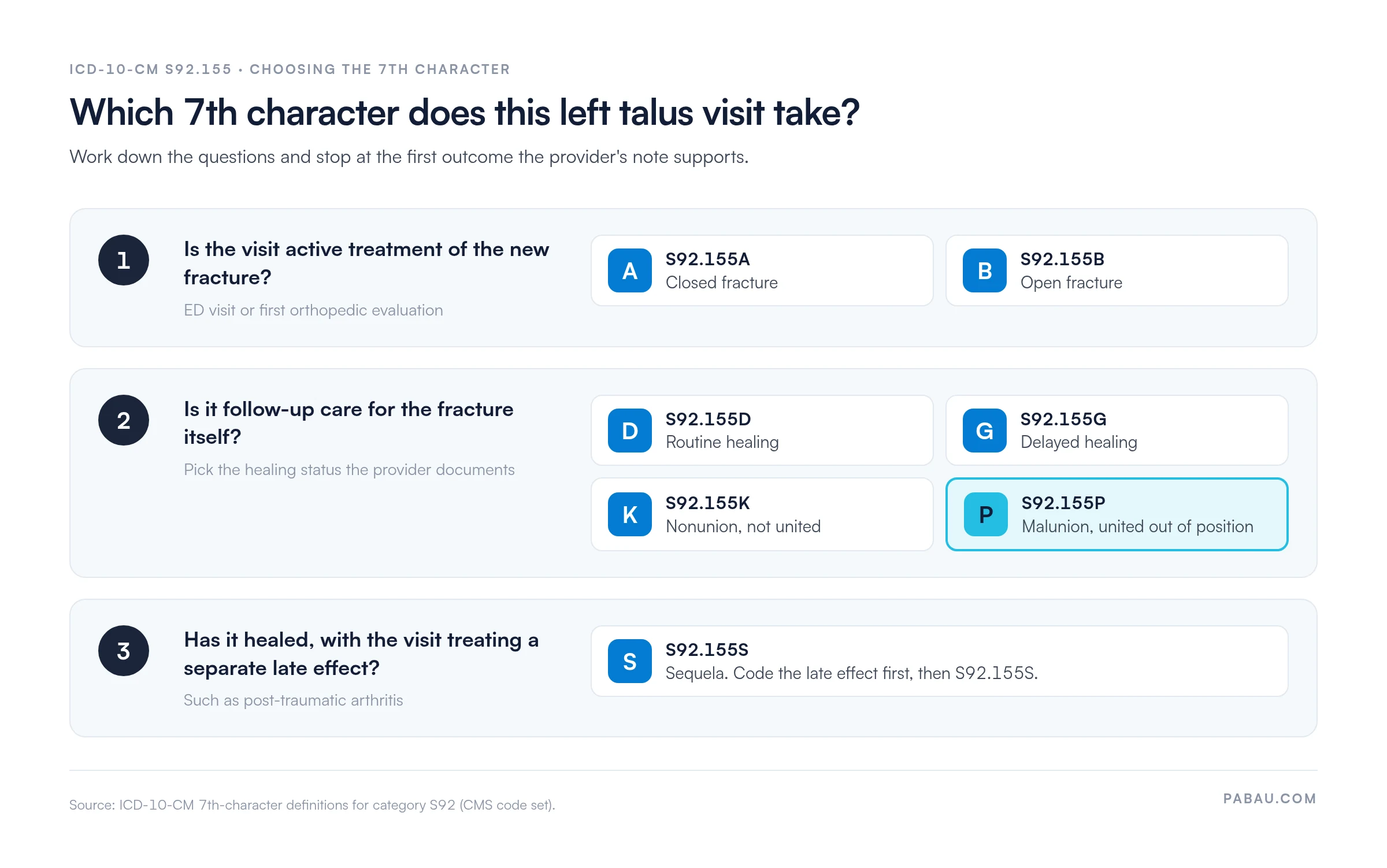
Before you assign P, search the provider’s note for the word malunion or a clear equivalent. Imaging that shows union is not enough on its own. The coder cannot infer malunion from the images.
Subcategory S92.15 splits talar avulsion fractures by displacement and side. Choosing the wrong side or the wrong displacement is one of the fastest ways to a denial with this family.
The ICD-10-CM guidelines ask for the most specific code the record supports. When the imaging report or the clinical note names the left ankle, the unspecified code S92.156P is incorrect and creates audit risk. Workers’ compensation carriers also compare the side against the original injury report.
Keep the bone straight as well. An avulsion fracture of the calcaneus, the heel bone, is coded in subcategory S92.03, not S92.15. Check the original imaging report for the bone and the fracture type before you assign any S92.155 code.
Documentation for ICD-10 Code S92.155P has to support five elements. If one is missing, the payer can deny the claim or ask for more records.
A malunion encounter needs one diagnosis code. S92.155P already tells the payer about the fracture and the faulty healing, so ICD-10-CM has no separate malunion code to add. Report P for every subsequent encounter that treats the malunion, including surgical correction.
The two-code sequela rule in guideline I.B.10 covers the 7th character S, not P. With S, the residual condition is coded first and S92.155S second. Use it only when the fracture healed and the visit treats a different late effect.
Here is how the code choice changes across one patient’s course of care:
Each row is a separate claim, so the 7th character is re-checked at every visit in the medical billing cycle.
Several coding errors cluster around S92.155P. Each one follows a pattern that payer edits and auditors are built to catch.
Malunion claims get more payer scrutiny than routine follow-up claims. The payer has to see why the patient needs further care for a fracture that has already united.
Maintaining medical billing compliance for these encounters means keeping the original fracture record easy to find. Payers often request the first imaging report during review, and a missing report is a common reason for denial.
Practices that submit S92.155P electronically through Claim.MD can confirm coverage before the visit. The Claim.MD clearinghouse runs real-time eligibility checks with over 400 payers and checks the claim structure before it reaches the carrier.
Most S92.155P denials follow six patterns. Recognizing them before submission is easier than appealing afterward, and effective denial management in healthcare starts there.
S92.155P pairs with procedure codes for the evaluation and treatment of the malunion. Linking each CPT code to S92.155P on the claim is part of submitting a clean claim.
Check that each therapy line on the claim points to S92.155P, from the evaluation codes through 97110 exercise sessions. When a therapy claim is denied, the electronic remittance advice usually names the diagnosis pointer or documentation problem.
For extra code validation, the AAPC Codify ICD-10-CM lookup and Check ICD-10 are useful reference tools.
When you bill physical therapy with S92.155P, document a functional measure at each visit, not just the diagnosis. Payers reviewing therapy for a healed fracture expect range of motion, pain scores or outcome measures to justify continued care.
Most S92.155P errors start with a manual step. A biller copies the side from the wrong note, keeps the D code after the provider documents malunion, or leaves a diagnosis pointer blank.
In Pabau’s practice management system, claims management software comes with every subscription. Claims are pre-filled from the invoice, and claim validation scrubs each one for missing or invalid details before it leaves Pabau. A flagged claim links straight to the field that needs correcting.
In the US, Pabau submits CMS-1500 claims through Claim.MD and returns electronic remittance advice to the patient’s invoice. Your billing team sees which claims are paid, pending or denied, and why, without logging in to a separate portal.

Pabau’s claim validation checks each claim for missing or invalid details before it leaves Pabau. Your team fixes laterality and code errors before a payer denies the claim.

S92.155P is a narrow code. It is correct only for a left talus, a chip fracture that started nondisplaced, and a follow-up visit where the provider has documented malunion. Get any of those wrong and the claim describes a different patient.
Before you submit, read the provider’s note for the word malunion and confirm the side on the imaging report. If the fracture healed normally and the visit treats a late effect, switch to S92.155S instead.
Book a demo to see how Pabau validates fracture claims before they reach the payer.

Want to see how clearinghouse submission works? Medical claims clearinghouse explains how claims are validated and transmitted to payers electronically.
Want the full picture of the billing cycle? What is revenue cycle management covers the end-to-end billing lifecycle for healthcare practices.
ICD-10 Code S92.155P means nondisplaced avulsion fracture (chip fracture) of left talus, subsequent encounter for fracture with malunion. It is used at follow-up visits after the provider documents that the fracture healed in a faulty position. The talus is the ankle bone above the heel bone.
The 7th character P means subsequent encounter for fracture with malunion. It applies after the initial treatment, once the fracture has united in a faulty position. It does not mean sequela, which is the 7th character S.
S92.155P is for care of the malunited fracture itself. S92.155S is for a late effect after the fracture has healed, such as post-traumatic arthritis. With S, the late effect is coded first and S92.155S second.
No. S92.155P already describes the fracture and the malunion, so ICD-10-CM has no separate malunion code to add. Add other codes only for separate conditions treated at the same visit.
No. S92.155P is for the left talus, the ankle bone. Avulsion fractures of the calcaneus, the heel bone, are coded in subcategory S92.03.
Common CPT codes billed with S92.155P include 99213-99214 for office visits and 73610 or 73700 for imaging. Therapy codes include 97161-97163, 97110, 97140 and 97760. Each one must be medically necessary for the treatment of the malunion.