ICD-10 code S61.201A: Open wound of left index finger without nail damage
ICD-10 code S61.201A covers a left index finger wound of unstated type ICD-10 co...

Last Updated: Oct 16, 2026
Billable Code Specific Code
S91.122D is the billable ICD-10-CM code for laceration with foreign body of left great toe without damage to nail, subsequent encounter.
Two details in that descriptor cause most of the denials on this code. The foreign body puts the injury in S91.12 rather than S91.11. The digit 2 in the sixth position means the great toe, not toes 2 through 5. Get either one wrong and you have billed a different injury.
Let Pabau's smart automation suggest the right codes, reduce claim denials, and keep your practice compliant—effortlessly.
Automate repetitive tasks and focus on what matters most—your patients.
Reduce coding errors and ensure compliance with the latest regulations.
Clean claims, fewer denials, and faster reimbursements.
Powerful insights and reporting to help your practice thrive.
HIPAA compliant SOC 2 certified GDPR-compliant Trusted by 4,000+ clinics worldwide

S91.122D is the billable ICD-10-CM code for a laceration with a foreign body of the left great toe, without nail damage, at a follow-up visit
The 5th character 2 marks a wound with a foreign body (S91.12). The 6th character 2 marks the left great toe, not a lesser toe
The 7th character D marks a subsequent encounter. Use it for wound checks, dressing changes, and suture removal during healing
Do not switch to S91.112D once the foreign body is removed. The injury code stays the same and only the 7th character changes
Practice management software like Pabau carries claims tools that check code specificity before a claim reaches the payer
S91.122D is a specific, billable ICD-10-CM code for the current fiscal year. The table below carries the facts coders need before the claim goes out.
Check current billable status in the CDC/NCHS ICD-10-CM web tool before you submit. Code validity changes every October 1.
S91.122D describes a laceration of the left great toe that contained a foreign body, with the toenail undamaged, at a follow-up visit during healing. Every part of that descriptor changes the code, so it pays to read it one element at a time.
The breakdown below maps each character to the detail it carries, and to the code you bill if you misread it.
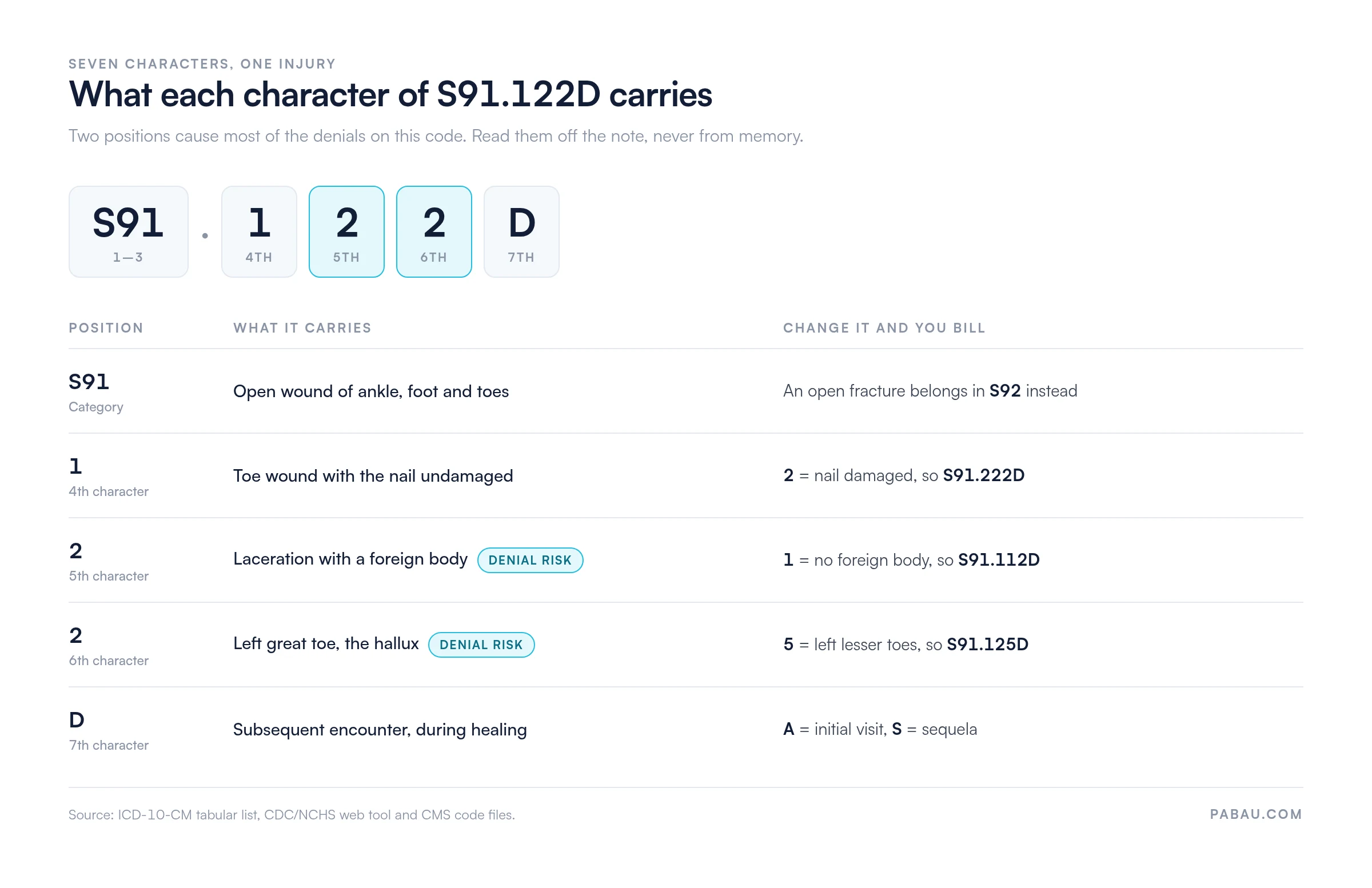
In day-to-day use, S91.122D lands on wound-check appointments, dressing changes, suture removal, and healing reviews for a big-toe laceration that had something in it. The mechanism is usually stepping on broken glass, a nail, or a metal fragment while barefoot or in open footwear.
Embedded material in the wound is what moves a toe laceration out of S91.11 and into S91.12. The two subcategories are otherwise worded identically, which is exactly why they get mixed up.
The foreign body is usually removed at the initial encounter, so the wound is clear by the time the patient returns. The code still stays S91.122D.
ICD-10-CM codes the injury as it presented, and only the 7th character advances through the episode of care. Re-coding the follow-up visit as S91.112D would report a second, different injury to the payer. It also breaks the link between the claim and the initial-encounter claim already on file.
Answer three questions from the provider note before you pick a code here. Was there embedded material in the wound? Which toe was injured? Is the nail involved? Those three answers fix the code at the 6-character level. Only then apply the 7th character.
The 6th character in S91.12 carries the toe and the side together. Great toe and lesser toe are separate values, so a mis-read here bills the wrong anatomy even when the wound type is right.
Every code in that table shares the same wound type: laceration with foreign body, nail undamaged. Only the toe and the side change. The unspecified values, S91.123 and S91.126, invite payer scrutiny, so use them only when the note genuinely does not name the toe.
Every S91.122 claim must carry one of three 7th character values. Per the CMS ICD-10-CM guidelines and code files, the character reflects the phase of care rather than the number of visits.
Critical distinction: Subsequent encounter is not the same as aftercare. Aftercare Z codes apply when the original condition is resolved and the patient needs continued services for something else. While the injury itself is still healing, D is correct.
The 7th character also survives a change of provider. If a patient is repaired in an emergency department and follows up at your practice, your visit is still a subsequent encounter. Encounter-type accuracy is part of routine medical billing hygiene, and it protects the claim on first submission.
Knowing where S91.122D sits in the tabular list helps you catch specificity errors before submission. The hierarchy runs from a broad category down to the billable code across five levels.
S91.122 without a 7th character is not billable, and payers reject any claim that stops at six characters. S91.122A, S91.122D, and S91.122S are the only valid submissions for this wound type, site, and side.
Once the encounter type is settled, the remaining risk is picking a neighboring code by mistake. The table below shows the codes that sit closest to S91.122D and the single detail that separates each one.
Change the side, the foreign body, and the nail status all at once and no row above fits. A right great toe laceration with no foreign body and nail damage, at a subsequent encounter, is S91.211D.
Podiatry, sports medicine, and urgent care teams see these codes together in the same wound-management workflow. Comparing siblings side by side in a lookup tool is faster than reading the tabular list. It also catches laterality slips before the claim leaves the practice.
The S91 category carries instructional notes that govern when S91.122D can be reported. Read them before you assign any code in this category.
Sprains leave S91 as well. A ligament injury to the left great toe metatarsophalangeal joint, seen at a follow-up visit, is S93.522D rather than an open wound code.
Chapter 19 also expects external cause codes where the payer or the guidelines call for them. Those codes matter most at the initial encounter, when the mechanism of injury is documented. At a subsequent encounter they are generally optional unless your payer asks for them.
Five elements have to appear in the clinical record to support S91.122D. Miss one and the code is exposed on audit, even when it is clinically correct.
The foreign body element is the one that fails most often. It is captured in the emergency department note and then never repeated, so the follow-up note reads as a plain laceration. Building a wound-detail prompt into your follow-up template fixes that in one step.
S91.122D is a diagnosis code, so it needs a procedure code to support the claim. At a subsequent encounter that is usually an established-patient office visit rather than a repair code.
Watch the global period before you bill an office visit at a follow-up. Wound repair codes carry a post-operative period, and a routine wound check inside that window is normally bundled into the repair. Check each code’s global days in the Medicare Physician Fee Schedule and confirm your payer’s own policy.
Practices that keep legacy records or reopen historical claims still run into the ICD-9 codes that S91.122D replaced. The General Equivalence Mappings published by CMS give approximate translations only. ICD-9 had no laterality and no encounter-type character, so a single ICD-9 code fans out into many ICD-10 codes.
The ICD-10 transition took effect on October 1, 2015. Confirm any GEM value against the official CMS mapping files before you rely on it for a legacy claim.
S91.122D produces a predictable set of denials. Each one below maps to a workflow fix rather than an appeal.
Most of these never need to reach the payer. A pre-submission scrub that validates code specificity catches truncated codes and laterality conflicts inside the practice. The clean claim checklist covers the wider set of fields payers expect on a first-pass-accepted submission.
Audit your S91-series claims once a month. Group denials by the 7th character you submitted and by the wound-type digit. Denials clustered on A-suffix codes billed more than ten days after the injury date point to a systematic follow-up coding habit. One training session usually clears it within a billing cycle.
Verify the descriptor and the billable status against a primary source every fiscal year. Three references cover it between them.
When a descriptor on a third-party site disagrees with the CDC tool, the CDC tool wins. Third-party lookups lag the October 1 update and occasionally carry stale wording.
S91 coding errors usually surface when the denial arrives. The note is written, the code is picked from memory, and the claim goes out. The payer sends it back weeks later. By then the coder has to reconstruct which toe, which side, and whether material was embedded in the wound.
Practice management software like Pabau moves that check to the point of documentation. Clinical note templates prompt the provider for laterality, the specific toe, foreign body detail, and nail status while the patient is still in the room. The claims management tools then carry an ICD-10 code search, so the coder picks a complete seven-character code rather than typing a truncated one.
Claims are validated before submission and tracked afterwards in one place. Denials come back into the same record as the original note, so the pattern behind them is visible instead of buried in a spreadsheet.
The outcome is fewer reworked claims on injury codes, and less of your coder’s week spent chasing detail that was available at the visit.

Pabau pairs structured clinical notes with claims management and an ICD-10 code search, so wound codes go out complete and specific the first time. See how it fits your workflow.

S91.122D is the billable ICD-10-CM code for a laceration with a foreign body of the left great toe, nail undamaged, at a subsequent encounter. It holds only when the record confirms four details. Those are the foreign body, the great toe, the left side, and a follow-up visit for an injury already treated.
Two characters do most of the damage on this code. The 5th character separates a wound with embedded material from a clean one. The 6th separates the great toe from toes 2 through 5. Neither is a judgment call, and both are answered by the provider note.
The practices that stop losing money on injury codes do two things. They capture wound detail at the visit, and they validate the code before the claim leaves the building. To see how Pabau handles ICD-10 validation and claim submission for wound codes, book a demo.

Need to understand how claims are processed end to end? Medical claims clearinghouse guide explains how claims move from practice to payer and where ICD-10 code errors get caught.
Handling a denied injury code claim? Denial codes in medical billing covers CARC codes and how to read payer rejection reasons for diagnosis code issues.
Want fewer reworked claims overall? Denial management in healthcare sets out the appeal workflow and the payer patterns behind repeat denials.
S91.122D is the billable ICD-10-CM code for a laceration with a foreign body of the left great toe, nail undamaged, at a subsequent encounter. It applies at follow-up visits during healing, such as a wound check, a dressing change, or suture removal after the initial treatment visit.
S91.122D covers the great toe, also called the hallux or first toe, on the left foot. Toes 2 through 5 are the lesser toes and take a different code. For a left lesser toe laceration with a foreign body at a subsequent encounter, the correct code is S91.125D.
Both codes describe a laceration of the left great toe with the nail intact at a subsequent encounter. S91.112D is for a wound with no foreign body. S91.122D is for a wound that contained embedded material such as glass, grit, wood, or metal. The 5th character is what separates them.
No. The injury code stays the same across the episode of care, and only the 7th character advances. A left great toe laceration that contained a foreign body remains S91.122 even after the material is removed. Code the follow-up visit S91.122D, not S91.112D.
Subsequent encounter, the 7th character D, means the patient has already had active treatment for the injury and is back for routine care during healing. It does not mean the injury is resolved. It also still applies when a different provider takes over the follow-up care.
Yes. S91.122D is a specific, billable ICD-10-CM code for the current fiscal year. The six-character parent code S91.122 is not billable on its own. Only the three complete codes, S91.122A, S91.122D and S91.122S, can go on a claim.
Five elements must appear in the record. Laterality is confirmed as left. The site is named as the great toe. A foreign body is documented in the wound. The toenail is confirmed intact. The note shows this is a follow-up for an injury already treated. Missing any one creates audit exposure.
Nail involvement moves the code out of S91.1 and into S91.2. A laceration with a foreign body of the left great toe with damage to the nail at a subsequent encounter is coded S91.222D. Check the note for nail status before you settle on S91.122D.