ICD-10 Code S42.444P: Medial epicondyle fracture, right humerus
ICD-10 Code S42.444P: full descriptor and code validity ICD-10 Code S42.444P car...

Last Updated: Oct 13, 2026
Billable Code Specific Code
S91.211D is the billable ICD-10-CM code for laceration without foreign body of right great toe with damage to nail, subsequent encounter.
It applies to follow-up wound care once definitive treatment is finished, so the 7th character D covers every visit in the healing phase. Denials on this code usually trace back to a coder who kept using character A on routine wound checks.
Let Pabau's smart automation suggest the right codes, reduce claim denials, and keep your practice compliant—effortlessly.
Automate repetitive tasks and focus on what matters most—your patients.
Reduce coding errors and ensure compliance with the latest regulations.
Clean claims, fewer denials, and faster reimbursements.
Powerful insights and reporting to help your practice thrive.
HIPAA compliant SOC 2 certified GDPR-compliant Trusted by 4,000+ clinics worldwide

S91.211D is a fully billable ICD-10-CM code valid for FY2026, specific to the right great toe with nail involvement.
The 7th character D marks the healing phase of care, which can run across many follow-up visits.
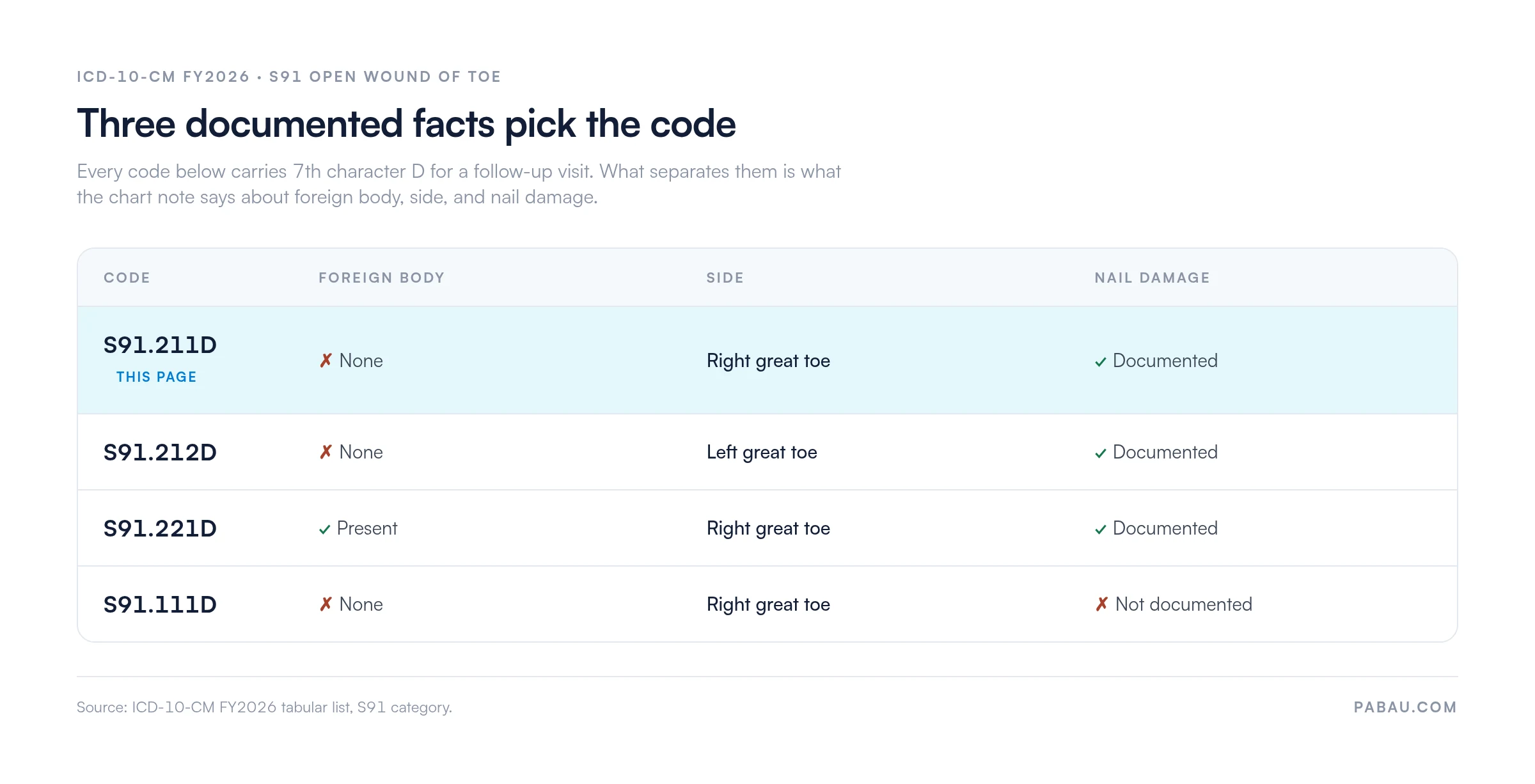
Without documented nail damage in the chart note, the correct code drops to S91.111D.
S91.211D needs a paired wound care CPT code, because the diagnosis alone does not justify a claim.
Practice management software like Pabau flags laterality mismatches and 7th-character errors before submission.
ICD-10 Code S91.211D sits within the S90-S99 chapter (Injuries to the ankle and foot) under category S91 (Open wound of ankle, foot and toes).
The table below captures the core reference data coders need before submitting a claim. Confirm the code is active for the date of service using the CDC/NCHS ICD-10-CM web tool.
S91.211D describes a laceration without foreign body of the right great toe with damage to nail. Each character carries a distinct clinical meaning, and together they decide whether the claim passes payer edits. Reading the structure also makes it easier to pick the right adjacent code when the documentation is thin.
Without foreign body means the wound is a clean laceration with no retained material. If a foreign body was removed at the initial visit, later follow-up visits still use the “without foreign body” code, provided the documentation confirms removal. Damage to nail means the nail plate, nail bed, or nail fold is involved, either disrupted or at risk. If the note describes periungual involvement, that satisfies this qualifier. Laterality is non-negotiable: S91.211D applies strictly to the right great toe. A left-toe laceration with nail involvement is S91.212D.
The 7th character D means the patient has already had definitive treatment for this wound. The visit being billed falls in the healing or recovery phase, per the ICD-10-CM Official Guidelines for Coding and Reporting, Section I.C.19.a. This is the most misunderstood rule in injury coding, and it drives the most auditable billing errors on open-wound claims.
What “subsequent” does NOT mean: it does not mean the second visit. Take a patient who receives wound irrigation, debridement, and primary closure at the emergency department on day one. That visit sits in the initial encounter phase, and the wound takes 7th character A on that claim. Every follow-up wound check afterward uses character D, whether it is the second visit or the tenth. The calendar date does not decide the character. The phase of care does.
All three codes describe an identical anatomical wound and differ only in the phase of care. That is why the wrong 7th character is both common and easily flagged by payer claim-edit systems. Using A for a routine wound check is one of the most auditable coding errors on open-wound claims, according to AAPC coding guidance.
Audit your open-wound claims for 7th character A on any visit dated more than 14 days post-injury. Wounds still coded with A beyond the expected acute treatment window are prime targets for payer take-back audits. Switch to D from the first follow-up visit once definitive treatment is complete.
Selecting the wrong code from the S91.2xx cluster is a documentation-driven error. The most common misses involve failing to specify laterality, nail involvement, or the presence of a foreign body. Use AAPC’s ICD-10-CM lookup alongside the chart notes to confirm all five code components before submitting.
A great toe injury that turns out to be a ligament sprain falls outside the S91 open wound category. A follow-up visit for a left great toe metatarsophalangeal joint sprain codes to S93.522D. That code keeps the same 7th character D, but it covers the left toe rather than the right, and carries no nail damage component.
The chart note must support every component of the code at the specific encounter being billed. Incomplete documentation forces a downgrade to a less-specific code, which pays less and gives an auditor something to pull on. Match each of the code’s five components to explicit language in the note before the claim goes out.
When nail damage is not explicitly documented, the clinically appropriate code becomes S91.111D, which covers the same right great toe laceration without nail involvement. Querying the treating provider for clarification beats assuming the nail was involved. The matrix below shows how three documented facts separate the four codes a coder is choosing between.
Medicare and most commercial payers expect S91.211D to travel with a wound care procedure code. The diagnosis on its own does not establish medical necessity without a linked service. According to CMS ICD-10 coding guidance, diagnosis codes must be linked to procedures that reflect the service rendered. For a subsequent wound care encounter, the CPT code chosen has to match what the note documents.
S91.211D must link to a procedure code that reflects the service documented at the subsequent encounter. The diagnosis code answers why the patient was seen, and the CPT code answers what was done for them. Selective debridement billed as 97597 is the most frequent pairing at a wound care follow-up, and it carries documentation requirements of its own.
Denials on S91.211D cluster around three failure points. The encounter type is wrong, the nail documentation is missing, or the CPT and ICD codes do not agree. Each failure carries a distinct remark code, and tracing the remark back to the coding error beats resubmitting the same claim unchanged. Our reference on denial codes explains what each payer remark is telling you.
Run a monthly query of all claims with 7th character A on injury codes older than 21 days from the date of service. Flag any S91.11x, S91.21x, or S91.22x codes still using A beyond that window for coder review. This catches the most common auditable error before a payer does.
A coder working from a printed superbill cannot see that the note says left toe while the claim says right. The mismatch surfaces weeks later as a denial with a remark code attached, and by then the wound check is long finished.
Pabau, practice management software for busy practices, keeps the chart note and the claim in one record. When a wound care visit is coded, the diagnosis, the laterality and the encounter type all read from what the clinician documented. Our claims management software then checks the diagnosis against the paired CPT code before the claim leaves the practice.
For a practice running weekly wound checks, that means fewer resubmissions on injury codes and a shorter path from the visit to the payment.

Pabau’s built-in claims management tools flag 7th-character mismatches, laterality errors, and CPT-ICD misalignments before your claims reach the payer. See how practices reduce open-wound denials with smarter pre-submission checks.

Accurate use of ICD-10 Code S91.211D rests on three habits. Apply the correct 7th character from the first follow-up visit. Confirm nail involvement in the note before coding. Then pair the diagnosis with a CPT code that matches the service. Get those three right and the code rarely gives trouble.
The two denials that cost the most on this code are wrong encounter type and laterality mismatch. Both are caught at review, by someone reading the note against the claim, which makes them a workflow problem rather than a coding one. Book a demo to see how Pabau runs that check on injury codes across a multi-provider practice.

Need to understand how claim edits catch coding errors before adjudication? Clean claim submission best practices walks through the pre-submission checks that keep wound care claims out of the denial queue.
Want to decode denial remark codes after a rejected S91.211D claim? Denial management in healthcare covers how to categorize, track, and resolve CARC-coded rejections systematically.
Looking for the remark codes on a claim that has already been adjudicated? Electronic remittance advice explains how to read an ERA and pull the denial reason for each line.
Building a documentation standard your coders can audit against? Medical billing compliance sets out the note requirements that keep injury coding defensible.
S91.211D is the ICD-10-CM code for a laceration without foreign body of the right great toe with damage to nail, subsequent encounter. It is a fully billable, specific code valid for FY2026. It applies to follow-up wound care visits after definitive treatment is complete.
S91.211A is used when the visit involves active or definitive treatment of the laceration. That includes the emergency visit where the wound is irrigated and sutured. S91.211D applies to all subsequent follow-up visits, wound checks, and suture removals once definitive treatment is complete. The key distinction is phase of care, not visit number.
Yes. S91.211D is a specific, fully billable ICD-10-CM code for FY2026. It cannot be used as a principal diagnosis without a linked CPT procedure code documenting the service rendered at the subsequent encounter visit.
The 7th character D in ICD-10-CM injury codes means subsequent encounter. It designates routine care during the healing or recovery phase, after active treatment is complete. It does not mean the second visit. A patient can have many D-suffix visits while the wound heals. The character switches back to A only if a new acute intervention is required.
Common CPT pairings depend on the service documented at the subsequent visit. Use 99213 or 99214 for E&M wound checks, and 97597 or 97602 for selective and non-selective debridement. Use 11042 for subcutaneous tissue debridement, and 11720 or 11721 for nail debridement. The CPT code must match what the chart note documents for that specific encounter.
Subsequent encounter (D) applies while the wound is still actively healing and the patient is receiving routine follow-up care. Sequela (S) applies only after the original wound has completely healed. It covers a late effect such as nail deformity or scar contracture that results directly from the original injury. Using S while the wound is still healing is a coding error.
Four reasons account for most denials. The claim uses 7th character A instead of D for a follow-up visit. The chart note is missing nail-damage documentation, which forces a downgrade to S91.111D. The laterality does not match the documented site. The CPT code does not align with the wound care service rendered. Medical necessity denials occur when continued wound care visits are not supported by healing-progress documentation.