ICD-10 Code S62.664D: Nondisplaced ring finger fracture
ICD-10 Code S62.664D: quick reference ICD-10 Code S62.664D reports a follow-up v...

Last Updated: Oct 21, 2026
Billable Code Specific Code
S91.151D is the billable ICD-10-CM code for open bite of right great toe without damage to nail, subsequent encounter. It applies when the patient returns for routine healing care, such as a wound check, after the bite's active treatment is complete.
Three details decide the code: the right great toe, an intact nail, and a healing-phase visit. Documented nail damage moves the claim to S91.251D, and new active treatment moves it back to S91.151A.
Let Pabau's smart automation suggest the right codes, reduce claim denials, and keep your practice compliant—effortlessly.
Automate repetitive tasks and focus on what matters most—your patients.
Reduce coding errors and ensure compliance with the latest regulations.
Clean claims, fewer denials, and faster reimbursements.
Powerful insights and reporting to help your practice thrive.
HIPAA compliant SOC 2 certified GDPR-compliant Trusted by 4,000+ clinics worldwide

S91.151D is a billable 7-character ICD-10-CM code, valid for FY 2026 and FY 2027.
The 7th character D marks a subsequent encounter, when active treatment is done and the patient returns for routine healing care.
The note must state that the nail is intact, because documented nail damage moves the code to S91.251D.
Pabau, our practice management software, pre-fills claims from the patient record and checks required fields before they go to Claim.MD.
ICD-10 code S91.151D is the billable code for an open bite of the right great toe without nail damage, at a subsequent encounter. You use it when the patient comes back for routine healing care after the bite has already been treated.
The code sits in Chapter 19 of ICD-10-CM, inside the S91 category for open wounds of the ankle, foot and toes. Here is the full hierarchy at a glance.
Check validity for your date of service in the CDC/NCHS ICD-10-CM web tool. It publishes the official tabular list for each fiscal year update.
Inclusions and exclusions are where laterality and nail-status errors get caught, ideally before they turn into denials.
The most frequent miscode is picking S91.251D when nail involvement was never confirmed on re-examination. If the chart only says “wound check, healing well,” ask for the nail finding before you assign a code.
The decision path below runs these exclusions in the order a coder meets them in the note.
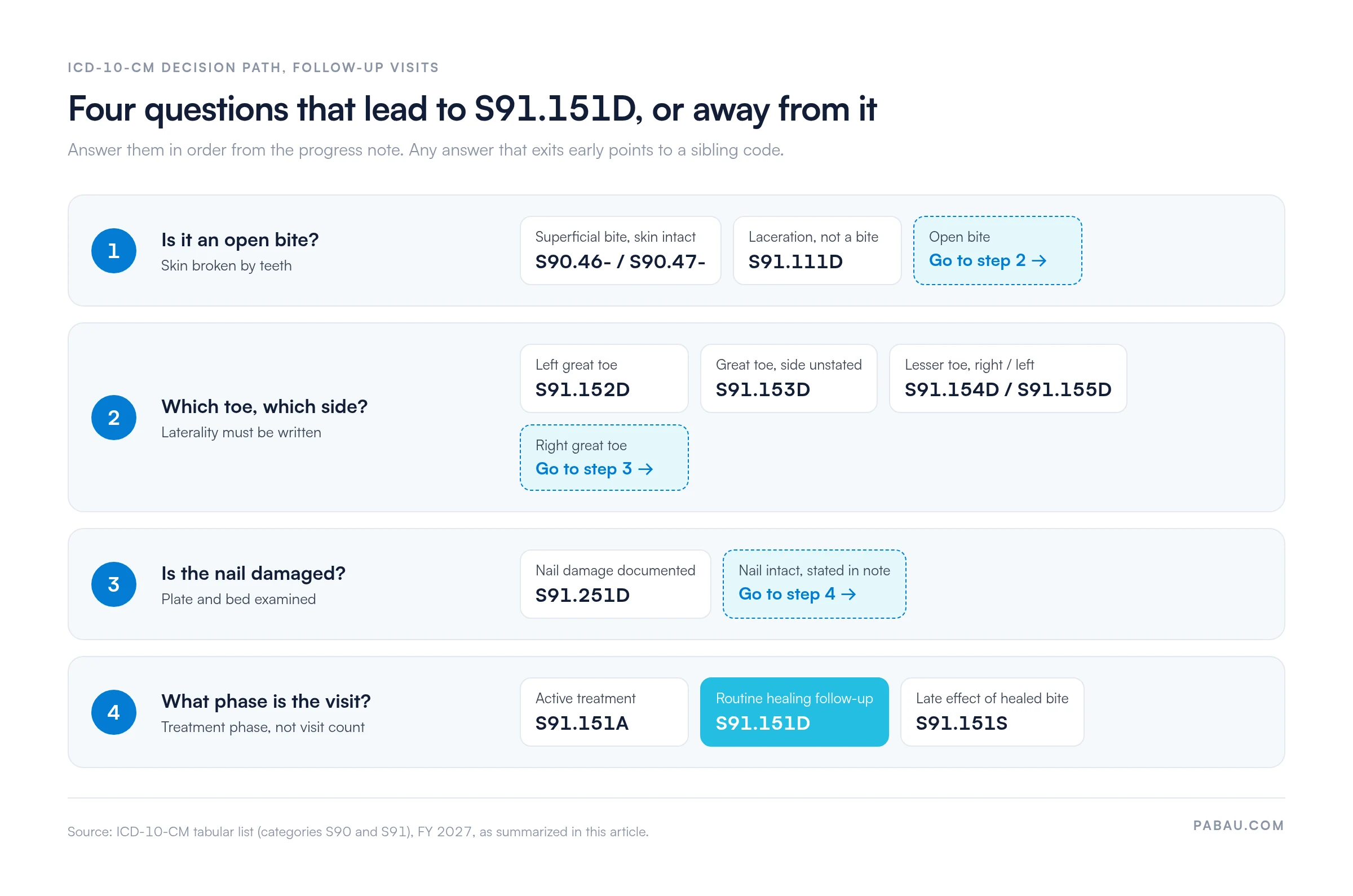
The 7th character sets the encounter type, and it is a frequent reason wound follow-up claims bounce. ICD-10-CM Official Guidelines Section I.C.19.a tie A to active treatment and D to routine care during healing.
Here is a practical test. If the note describes a wound check, dressing change or suture removal with no new decisions about the wound, D is almost always right. If the wound has reopened, become infected or needs new debridement, go back to A.
Per CMS ICD-10-CM guidance, the encounter character reflects the current phase of treatment. It does not count how many times the patient has been seen.
Laterality, nail status and wound type all branch inside the S91 family. This crosswalk maps the codes most often confused with S91.151D.
A bite to the second toe on the same foot belongs to S91.154D instead, because the right lesser toes share one code. For wider browsing, the AAPC ICD-10-CM lookup filters by range and keyword. It is a quick way to confirm laterality and nail-status variants.
Two visits for the same bite show how one finding changes the code.
A patient returns to a primary care office five days after a dog bite to the right hallux. The ED note documented irrigation, tetanus prophylaxis and no nail involvement. Today’s note reads: “Wound healing well, no signs of infection, nail intact, dressing changed.” Active treatment is complete, the nail is confirmed intact, and the visit is routine follow-up. S91.151D is correct.
Same patient, same original injury. This time the provider notes a subungual hematoma and a partial nail bed laceration that weren’t visible at first. The wound now involves the nail, so the code switches to S91.251D. The chart must document the finding explicitly, because a coder can’t infer nail damage from a photograph.
Make the nail exam its own line in your wound assessment note. A note that reads “wound check, looks good” can’t support S91.151D over S91.251D. Add: “Nail plate intact, no subungual hematoma, no nail bed laceration.” That single line protects the claim.
ICD-10-CM guidelines expect documentation to be as specific as the code. For S91.151D, four elements must appear in the progress note. Good medical billing compliance starts with a note template that prompts for each one.
Medicare Administrative Contractors (MACs) may also ask for wound assessment findings to support medical necessity. That means wound size, depth, drainage and the condition of the surrounding tissue. Recording them at every visit also covers most commercial payer audits without separate addenda.
The ICD List reference shows the official code notes, including Excludes1 entries that affect paired diagnoses.
Medicare, Medicaid and commercial plans generally cover S91.151D follow-up visits. The claim needs a fitting E/M or wound care CPT code and documented medical necessity.
Prior authorization isn’t usually required for routine wound follow-up. Still, a MAC’s Local Coverage Determinations (LCDs) for debridement, especially 97597 and 97598, may set documentation thresholds.
Like any medical billing cycle, an S91.151D claim follows a fixed path. Each hand-off is a point where it can stall.
Most S91.151D denials fall into four groups. Each traces back to the note or the code pairing, so the fix is usually quick. Strong denial management workflows catch these patterns early.
A clean claim on the first attempt starts with a short review before it leaves the practice. Run these five checks on every S91.151D claim.
The CPT code depends on what the provider does at the follow-up, not simply that the patient attended. The ICD-10 code explains why the visit happened. The CPT code describes the service.
Debridement policies vary by payer, so check coverage criteria in CMS ICD-10 coding guidance and your MAC’s LCDs first. Our CPT code library has billing guides for several of these codes, including 97597 for selective debridement.
Document wound size in square centimeters at every wound care visit, even when debridement is not performed. If debridement becomes necessary at a later visit, the baseline measurement is already in the chart and supports medical necessity without a retrospective addendum.
Many practices code a wound follow-up from the note, then retype the codes into a separate billing tool. Each rekeyed field is another chance to lose the D or the right side.
Pabau removes that retyping. Its claims software for practices pre-fills the claim from the patient record, with ICD-10 and CPT lookup libraries a search away. Required-field checks run before the claim can be sent, so a missing membership number or authorization code is caught in-house.
US claims go out through Claim.MD, with eligibility checks up front and remittance tracking afterward. Treatment notes and forms stay on the same patient record as the claim. When a payer asks, the documentation behind S91.151D is easy to find.
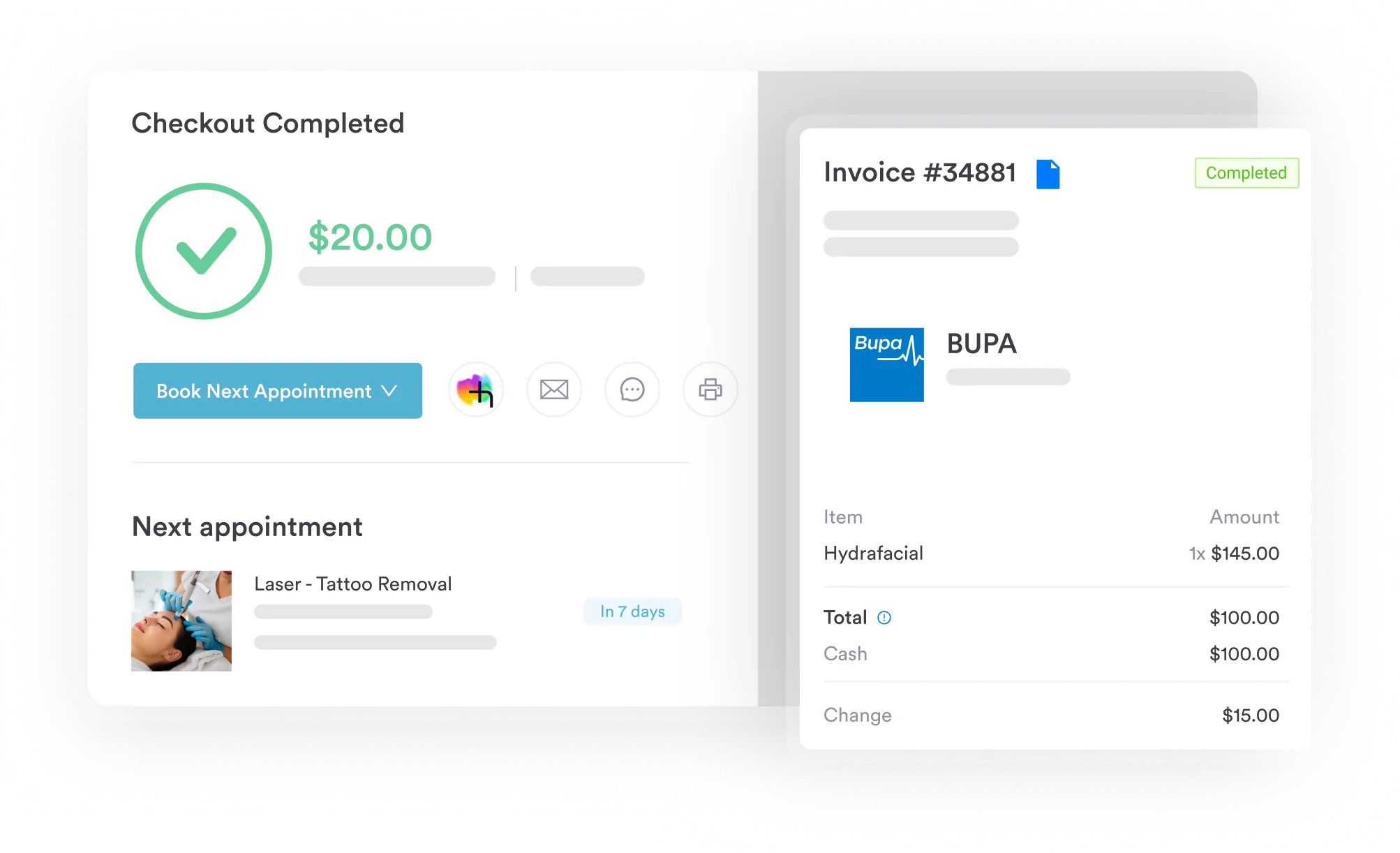

Pabau pre-fills claims from the patient record, checks required fields, and submits US claims through Claim.MD. Your team stops rekeying codes for every wound follow-up.

S91.151D rewards the coder who reads the note before the code book. When the side, the nail and the phase are all written down, the claim stands. When one is missing, query the provider before you bill, because a corrected claim costs more than a short delay.
The trade-off is a few extra words in every wound note. That habit is cheaper than an appeal, and it keeps the code from drifting to a less specific sibling.
Want claims that pre-fill from the record and check required fields first? Book a demo to see Pabau’s claims workflow for wound follow-ups.

Need to reduce claim denials across your billing workflow? Denial management in healthcare covers the most common denial patterns and how to build a prevention-first billing process.
Submitting claims electronically for the first time? How a medical claims clearinghouse works explains the role of clearinghouses like Claim.MD in validating and routing claims to payers.
Want a cleaner first-pass claim? What is a clean claim explains what a claim needs to pass payer edits on the first submission.
Billing debridement at a wound follow-up? CPT code 97597 explains how selective debridement is billed and documented.
Yes. S91.151D is billable for FY 2026 and FY 2027, and the code is unchanged in the FY 2027 files. Its parent, S91.151, isn’t billable without a 7th character.
A bite that doesn’t break the skin is excluded from S91.15-. Code it from S90.47-, other superficial bite of toe, instead. S90.46- covers nonvenomous insect bites.
There’s no national rule requiring one, but some states and payers ask for it. For a dog bite at a follow-up visit, W54.0XXD (bitten by dog, subsequent encounter) records the cause.
Category S91 says to code also any associated wound infection, such as L03.031 for cellulitis of the right toe. If the infection needs new active treatment, that visit takes the A character.
The note states the right side, names the wound as a bite, records an intact nail plate and bed, and shows healing-phase care.